애정결핍 (aejeong-gyeolpip) — The Name Korean Gives to a Hungry Heart
애정결핍
애정결핍 (aejeong-gyeolpip) means the state of a heart that stays hungry because it hasn’t been given enough love and attention. Skip your meals and your stomach goes hungry; go without affection and your heart does. Korean went ahead and put a name on that state.
Watch enough Korean dramas and this word shows up like a line from a character profile. The lead grew up apart from his parents, and now — even though he’s clearly loved — he keeps needing proof of it. The friend beside him tosses off one short line: 쟤, 애정결핍이야. (That guy? He’s starved for affection.) In those few words, the viewer understands about half of that character’s last twenty years. That’s why it’s one of the words subtitle-watchers of Korean dramas run into most often.
The nuance comes at three temperatures. First, the serious temperature. It’s used in a counseling room, or in a real conversation, to explain someone’s wound. Here the word is heavy, and not something to pull out carelessly. Second, the drama-critic temperature. Calling someone on screen an “애정결핍 character” isn’t an insult so much as an analysis. Third, the joking temperature. You say it with a laugh about the puppy that’s been attached to your leg all day, or the close friend who texts you every ten minutes. Same word — but depending on where it lands, it can be comfort or a weapon. Managing that temperature is the part learners actually need to learn.
Grammatically, it’s a noun. So you attach particles and endings to it: 애정결핍이야 (aejeong-gyeolpib-iya), 애정결핍인 것 같아요 (aejeong-gyeolpib-in geot gata-yo), 애정결핍이 왔나 봐 (aejeong-gyeolpib-i wanna bwa). It isn’t a verb, so 애정결핍하다 is not used.
A Real Conversation
Situation: Saturday afternoon, the living room of Emily’s place. The two of them are watching the final episode of a drama together. Emily’s cat has climbed onto Jun-kyung’s lap.
Jun-kyung: 아, 저 남자 진짜 왜 저래. 사랑받고 있으면서 계속 의심하잖아. Ugh, what’s wrong with that guy. He’s loved, and he still keeps doubting it.
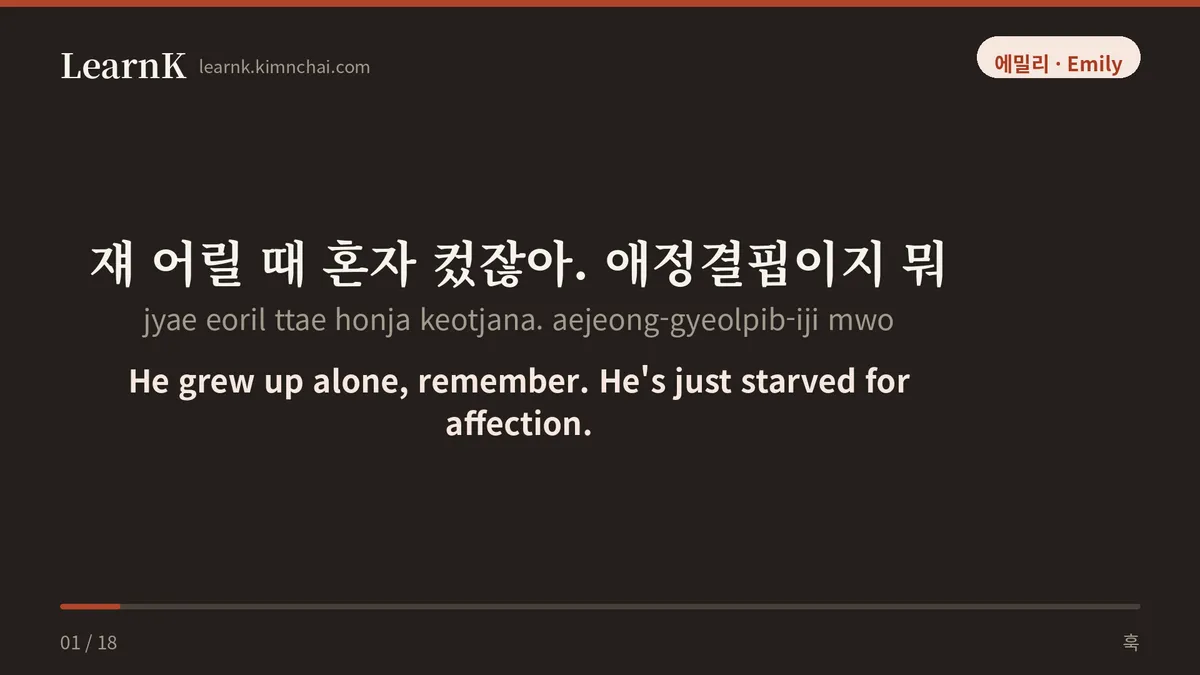
Emily: 쟤 어릴 때 혼자 컸잖아. 애정결핍이지 뭐. He grew up alone, remember. He’s just starved for affection.
Jun-kyung: 하긴. 그래서 자꾸 확인받고 싶은 거구나. True. That’s why he keeps needing reassurance.
Emily: 근데 네 무릎에 있는 애도 만만치 않아. 아침부터 사람 다리에 붙어 있어. By the way, the one on your lap is no better. He’s been glued to people’s legs since morning.
Jun-kyung: 얘야말로 애정결핍 아니야? 손만 떼면 울어. Isn’t he the one who’s starved for affection? He cries the second I stop petting him.
Emily: 야, 그건 애정결핍이 아니라 그냥 사랑이 더 필요한 거야. Hey, that’s not a deficiency, he just wants more love.
This Sounds Off
✗ (To your team leader at a company dinner) 부장님, 사모님께 자꾸 전화하시는 거 보니 애정결핍이신가 봐요. Sir, the way you keep calling your wife — I guess you’re starved for affection.
✓ (To a close friend) 너 오늘따라 연락 왜 이렇게 자주 해, 애정결핍이야? Why are you texting me so much today — starved for affection or something?
→ This word diagnoses someone’s emotional state, so aiming it at someone senior to you crosses a line. You can only use it as a joke with peers, or with people you’re genuinely close to.
✗ (To a friend who’s been crying for days after a breakup) 너 완전 애정결핍이네. You’re totally starved for affection.
✓ (To the same friend) 요즘 많이 외로웠구나. 나한테 좀 기대도 돼. You’ve been really lonely lately, haven’t you. You can lean on me a little.
→ Used in front of someone who is actually hurting, it amounts to sticking a label on the sore spot. You can only bring this word out lightly when the other person isn’t in pain right now.
Example Sentences by Situation
1) Talking about pets — the safest and most common place for it
우리 강아지는 애정결핍이라 화장실까지 따라와요. (uri gangaji-neun aejeong-gyeolpib-ira hwajangsil-kkaji ttara-wayo.) My dog is so starved for attention that he follows me even to the bathroom.
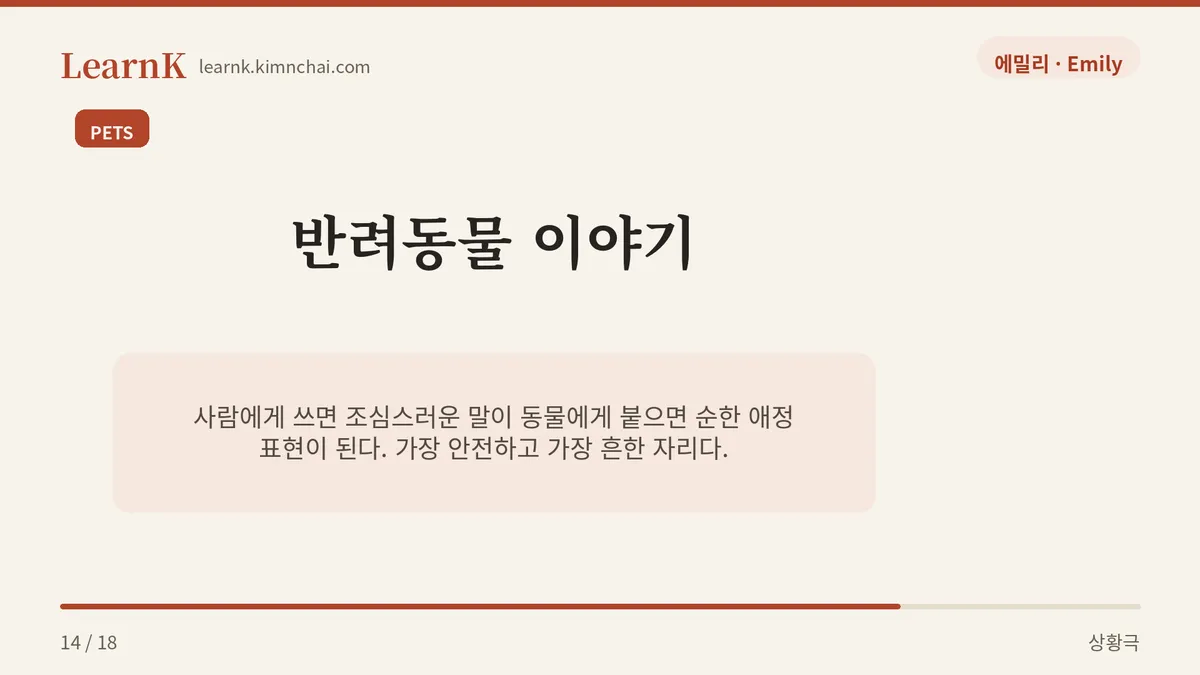
It’s a delicate word when applied to people, but applied to animals it turns into a mild term of endearment. Whenever pets come up in conversation in Korea, this sentence shows up almost like a set phrase.
2) Sharing thoughts after watching a drama together
그 인물은 애정결핍이 서사의 출발점이에요. (geu inmul-eun aejeong-gyeolpib-i seosa-ui chulbaljeom-ieyo.) For that character, the lack of affection is where the whole story starts.
This isn’t trash-talking the character; it’s pointing at the structure. Korean viewers really do write this way in drama reviews and community posts.
3) Joking about yourself — the gentlest use of all
나 요즘 애정결핍 왔나 봐, 자꾸 누구한테든 연락하고 싶어. (na yojeum aejeong-gyeolpip wanna bwa, jakku nugu-hante-deun yeollak-hago sipeo.) I think I’m starved for affection lately — I keep wanting to text somebody.
Pinned on someone else it’s a diagnosis; pinned on yourself it’s a confession. This is a form Koreans often reach for when they want to talk about loneliness without making it heavy.
Polite and Casual Forms, and Similar Expressions
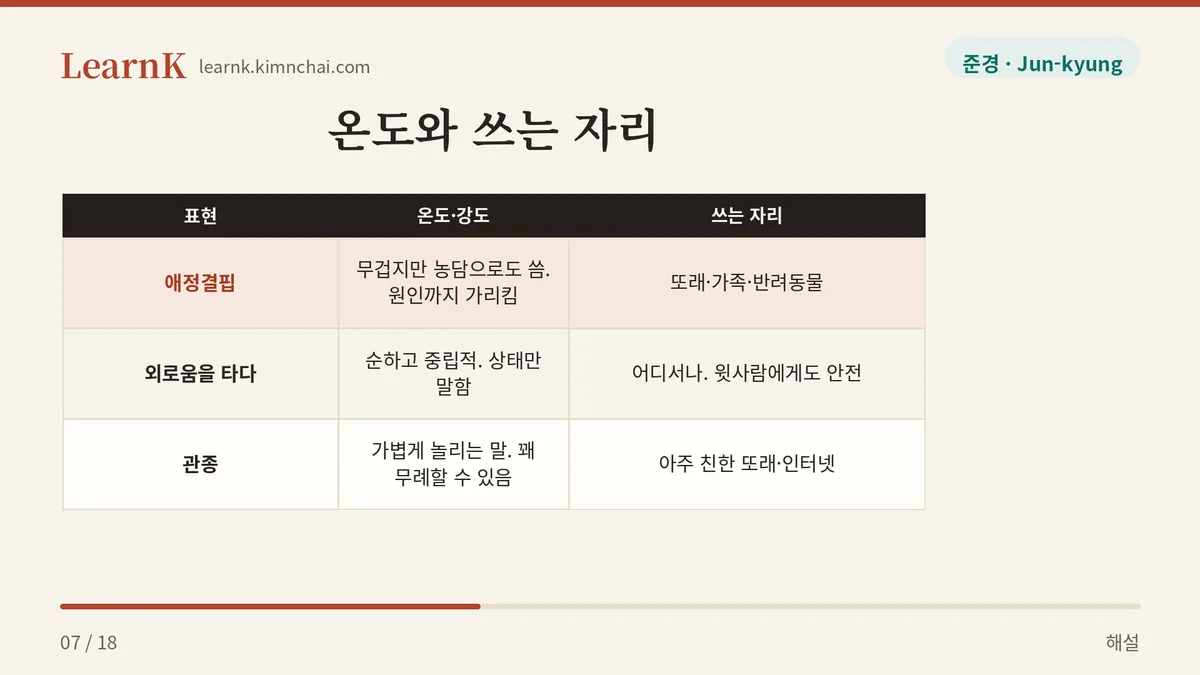
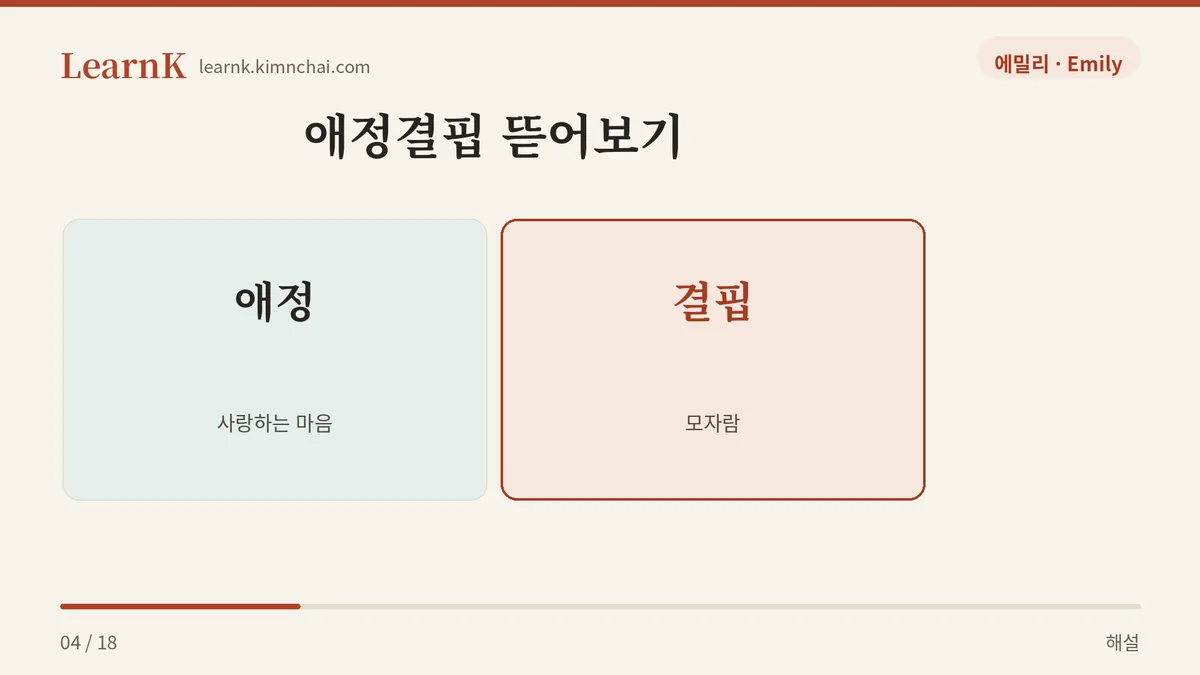
Since it’s a noun, the politeness level is decided by the predicate that follows. Casual is 애정결핍이야 (aejeong-gyeolpib-iya); polite is 애정결핍이에요 (aejeong-gyeolpib-ieyo). That said, this word turns rude the moment you state it as fact, so in real conversation people far more often soften it into a guess: 애정결핍인 것 같아요 (aejeong-gyeolpib-in geot gata-yo) or 애정결핍인가 봐 (aejeong-gyeolpib-in-ga bwa). Same word, different weight — 너 애정결핍이야 is a verdict, while 너 애정결핍인가 봐 sounds like concern.
| Expression | Temperature & strength | Where it’s used |
|---|---|---|
| 애정결핍 (aejeong-gyeolpip) | Heavy, but also used as a joke. Points at the cause, too | Peers, family, pets. Never with someone senior |
| 외로움을 타다 (oeroum-eul tada) | Mild and neutral. Describes only the state | Anywhere. Safe even with seniors |
| 관심종자 / 관종 (gwansim-jongja / gwanjong) | Light and teasing. Can be quite rude | Very close peers, or online. Off-limits otherwise |
| 정이 고프다 (jeong-i gopeuda) | Warm and literary | Serious conversation and writing. A favorite of older speakers |
Say 외로움을 타요 about someone and you’ve described how they are right now; say 애정결핍이에요 and you’ve reached back into their past. That difference is exactly where rudeness begins.
Cultural Background — How Dramas Explain Their Characters
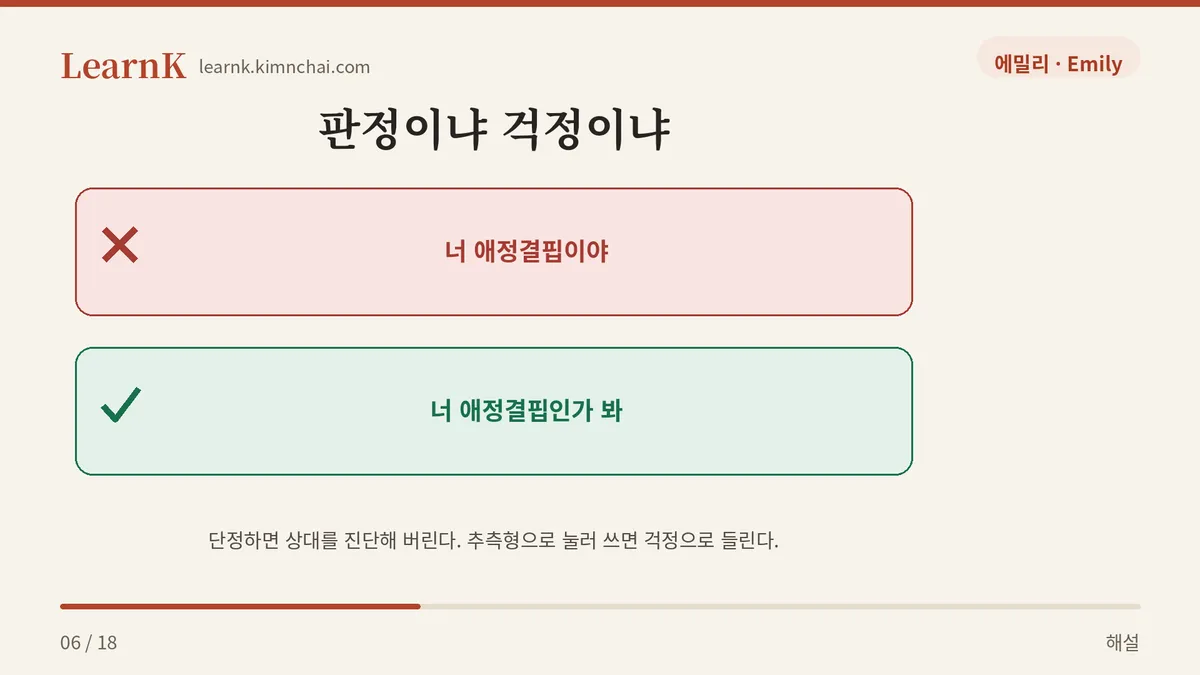
The word is built from two Sino-Korean roots. 애정 (愛情) is loving feeling; 결핍 (缺乏) is lack. A state in which love is lacking — the word means exactly what it’s made of. It started out as stiff vocabulary from psychology and medicine, but it has since come down into variety-show subtitles and internet comments and become everyday speech. That drift from technical term to daily word is fairly common in Korean.
The place you hear it most is, of course, drama. Korean dramas have long repeated a kind of storytelling that explains a character’s present behavior through childhood deprivation: the one who lost a parent early, the one who grew up being compared to a sibling, the one who was taken into a wealthy household but never quite became family. Once viewers know that background, they stop resenting the character’s clinginess and suspicion. 애정결핍 is the keyword that compresses all that understanding into a single term — which is why it shows up even more in viewers’ commentary than in the dialogue itself.
In everyday life it’s much lighter. When a friend sulks about a slow reply, you laugh it off with 너 애정결핍 왔네. Someone living alone might adopt a pet and say 내가 애정결핍이라. This habit of pressing a heavy word down into a joke is itself a Korean-language reflex — the harder a feeling is to say with a straight face, the more likely it comes out dressed as humor.
So when you learn this word, the thing to learn alongside it isn’t the meaning — it’s the distance. Use it freely on yourself, with a smile among close friends, and not at all beyond that. Keep to those three settings and you’ll never sound off.
Today’s Quiz
Your team leader at work mentions that he video-calls his family every weekend. What’s the most natural thing to say?
① 팀장님, 애정결핍이신가 봐요. Sir, I guess you’re starved for affection.
② 팀장님, 가족분들 많이 보고 싶으신가 봐요. Sir, you must miss your family a lot.
③ 팀장님, 완전 관종이시네요. Sir, you’re such an attention-seeker.
Answer: ②
① diagnoses the other person’s inner state, which sounds rude directed at someone senior, and ③ is a teasing word you’d have to be careful with even among peers. 애정결핍 is a word you don’t use when the setting is wrong, no matter how well the meaning fits — with someone senior, don’t name their state; turn it around and acknowledge the feeling instead.
Definitions and example sentences are from the National Institute of Korean Language’s Basic Korean Dictionary (krdict.korean.go.kr); that portion of this post, including our translations, is licensed under CC BY-SA 2.0 KR.