앨범깡 (aelbeomkkang) — Tearing Open Ten Albums for the Sake of One Photocard
앨범깡
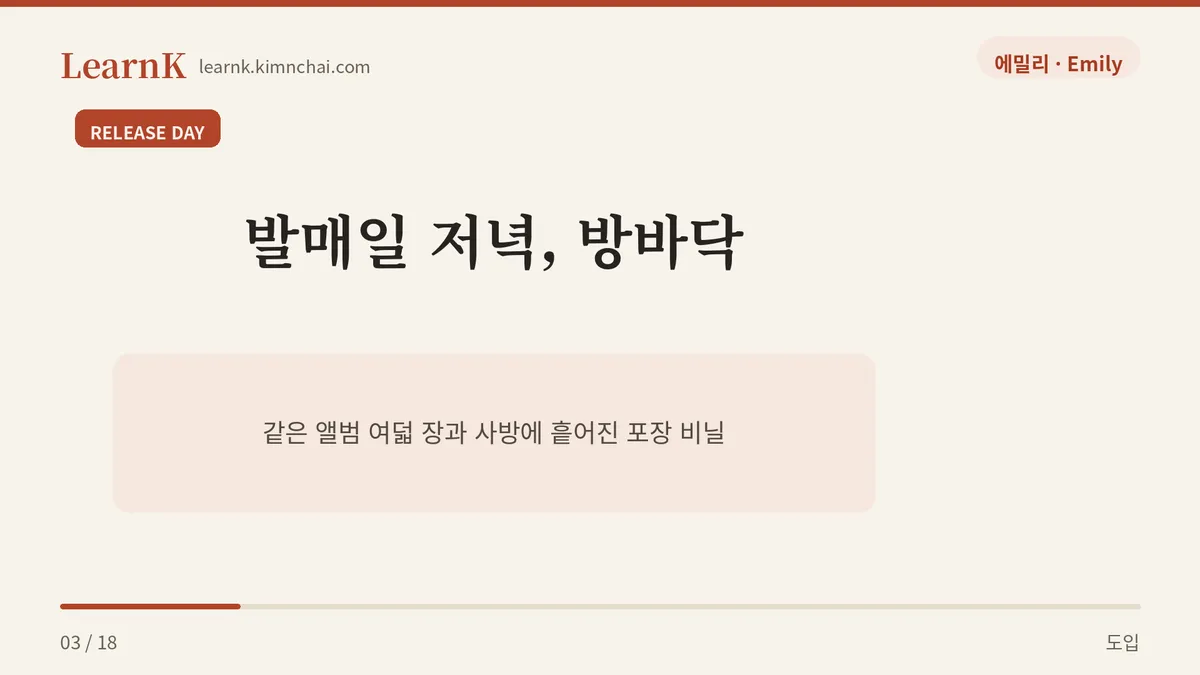
앨범깡 (aelbeomkkang) means buying several copies of the same album and ripping them open one after another in order to pull a photocard of the member you want. A K-pop album usually contains one or two random photocards, and you can’t tell which member you’ll get. So people end up buying, opening, and buying again until their 최애 (choeae, favorite member) finally shows up. The scene on the evening of a release day — five, ten copies of the same cover piled up on the bedroom floor, plastic wrap scattered everywhere — is what fans sum up in a single word: 앨범깡 (aelbeomkkang).
The heart of this word is “multiple copies” and “repetition.” Buying one album and carefully opening it is just unboxing. 앨범깡 is closer to a lottery pull. The sense of repeating the same action until you get what you want is baked into the word, which is why it always carries a touch of self-mockery. Someone who says “나 이번에 앨범깡 좀 했어” isn’t bragging — they’re laughing while confessing how much thinner their wallet got.
It’s a noun, and it pairs with 하다 (hada). You’ll see it used as 앨범깡 하다 (aelbeomkkang hada), 앨범깡 중 (aelbeomkkang jung), and 앨범깡 각 (aelbeomkkang gak, fandom slang meaning “this is a situation that calls for an album pull”). It’s a new coinage that hasn’t yet been entered as a headword in the National Institute of Korean Language’s Basic Korean Dictionary, so the definition in this post is drawn from observing how it’s actually used.
Seeing It in Real Conversation
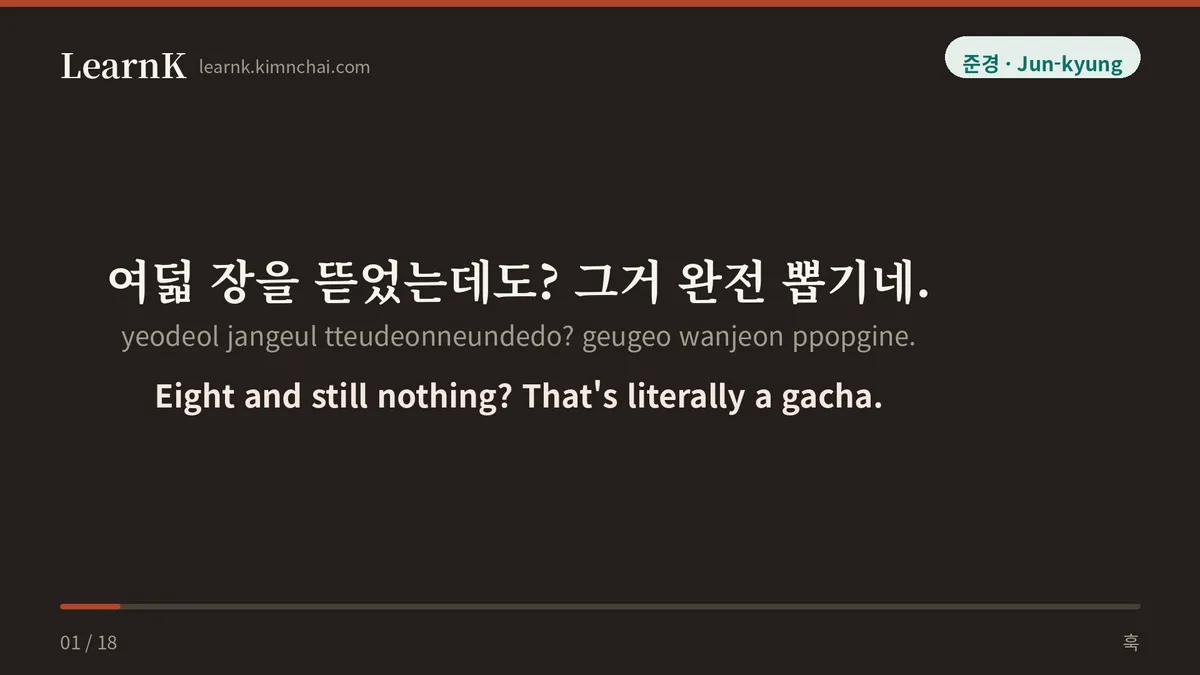
Setting: The evening of an album release day. Eight copies of the same album are stacked on Emily’s bedroom floor, and torn plastic wrap is scattered all around. Jun-kyung opens the door and walks in.
준경: 야, 이게 다 뭐야? 너 같은 앨범을 여덟 장 샀어? Hey, what is all this? You bought eight copies of the same album?
에밀리: 응, 앨범깡 하는 중이야. 아직 최애 포카가 안 나왔어. Yeah, I’m in the middle of an album pull. My bias’s photocard still hasn’t shown up.
준경: 여덟 장을 뜯었는데도? 그거 완전 뽑기네. Eight and still nothing? That’s literally a gacha.
에밀리: 그러니까 무서운 거야. 앨범깡은 진짜 적당히 해야 되는데. That’s exactly what’s scary about it. You really have to know when to stop.
준경: 남은 건 어떡하려고. 여덟 장을 다 듣진 않을 거 아냐. What are you doing with the rest? You’re not going to listen to all eight.
에밀리: 두 장은 친구 주고, 나머지는 포카만 빼서 교환할 거야. …한 장만 더 뜯어 볼까? Two go to friends, and I’ll trade the rest after pulling the cards. …Should I open just one more?
This Sounds Awkward
✗ (팀장님께) 팀장님, 주말에 앨범깡 하느라 한숨도 못 잤어요. (timjangnimkke) timjangnim, jumare aelbeomkkang haneura hansumdo mot jasseoyo. ✓ (또래 친구에게) 나 주말에 앨범깡 하느라 한숨도 못 잤어. (ttorae chinguege) na jumare aelbeomkkang haneura hansumdo mot jasseo. → This is fandom-only slang. Someone outside that context won’t understand it at all, and with a senior colleague it also leaves the impression that you’re casually tossing around a story about how much money you spent. In formal settings, it’s safer to spell it out as something like “앨범을 여러 장 샀어요 (aelbeomeul yeoreo jang sasseoyo, I bought several copies of the album).”
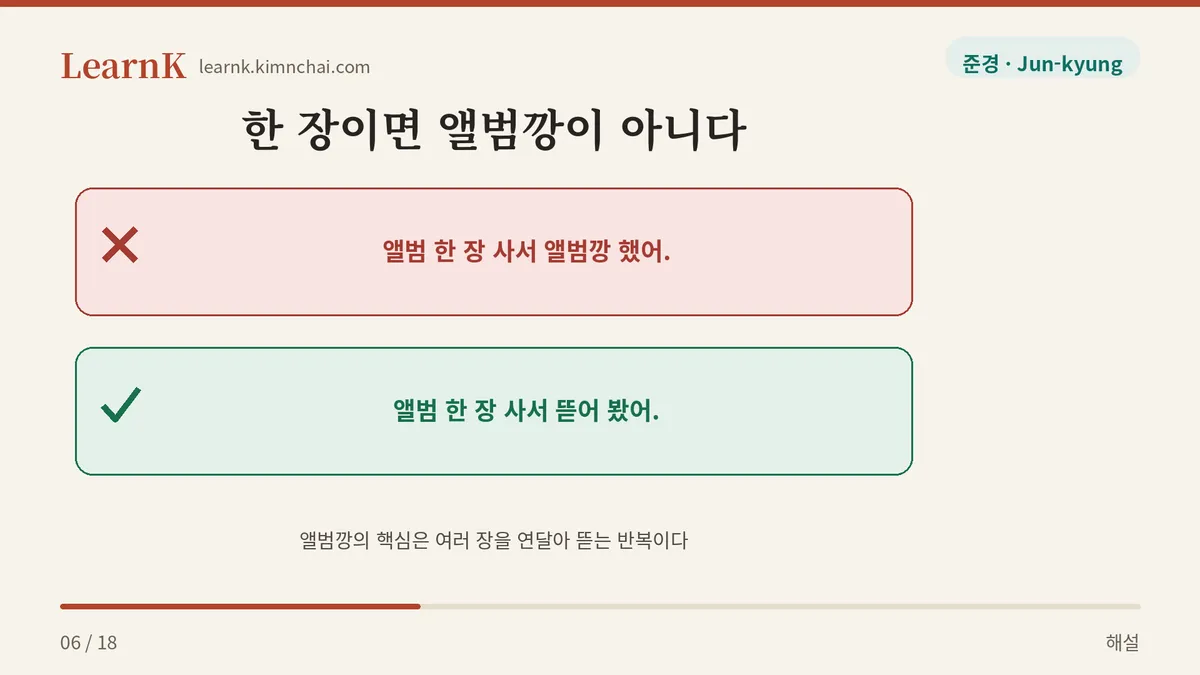
✗ 앨범 한 장 사서 앨범깡 했어. (aelbeom han jang saseo aelbeomkkang haesseo.) ✓ 앨범 한 장 사서 뜯어 봤어. (aelbeom han jang saseo tteudeo bwasseo.) → The core of 앨범깡 is “several copies, back to back.” One copy is just an unboxing, so if you attach this word to a single album, your listener will ask back, “몇 장 샀는데? (myeot jang sanneunde?, So how many did you buy?)”
Example Sentences by Situation
1. Confessing your spending to a friend during comeback week
이번 컴백은 앨범깡 안 하려고 했는데, 결국 열 장 뜯었어. (ibeon keombaegeun aelbeomkkang an haryeogo haenneunde, gyeolguk yeol jang tteudeosseo.) I wasn’t going to do an album pull this comeback, but I ended up opening ten.
앨범깡 stories usually start exactly like this — with “I wasn’t going to.” It signals that you know full well it’s a gambling mechanic, and the friend listening laughs and lets it slide.
2. Posting a listing on a secondhand marketplace app (polite style)
앨범깡 하고 남은 CD 팝니다. 포토카드는 없고 개봉만 했습니다. (aelbeomkkang hago nameun CD pamnida. potokadeuneun eopgo gaebongman haetseumnida.) Selling the CDs left over from my album pull. Photocards not included; opened only.
Here 앨범깡 is doing the work of describing the item’s condition. For a Korean fan, that one word conveys everything: the photocards are already out, and the CD itself is practically new.
3. Talking yourself down (to yourself, or on social media)
이번 달은 앨범깡 참는다. (ibeon dareun aelbeomkkang chamneunda.) This month I’m holding back on album pulls.
The simple fact that it pairs so often with 참는다 (chamneunda, hold back / resist) tells you a lot about the word’s character. It has the same texture as the way people talk about resisting a diet slip or an impulse buy.
Formal and Casual Forms, and Similar Expressions
앨범깡 itself carries no politeness marking. Politeness happens only in the verb that follows — casual is 앨범깡 했어 (aelbeomkkang haesseo), polite is 앨범깡 했어요 (aelbeomkkang haesseoyo). But as we saw above, switching to polite speech doesn’t make the word appropriate for a formal setting.
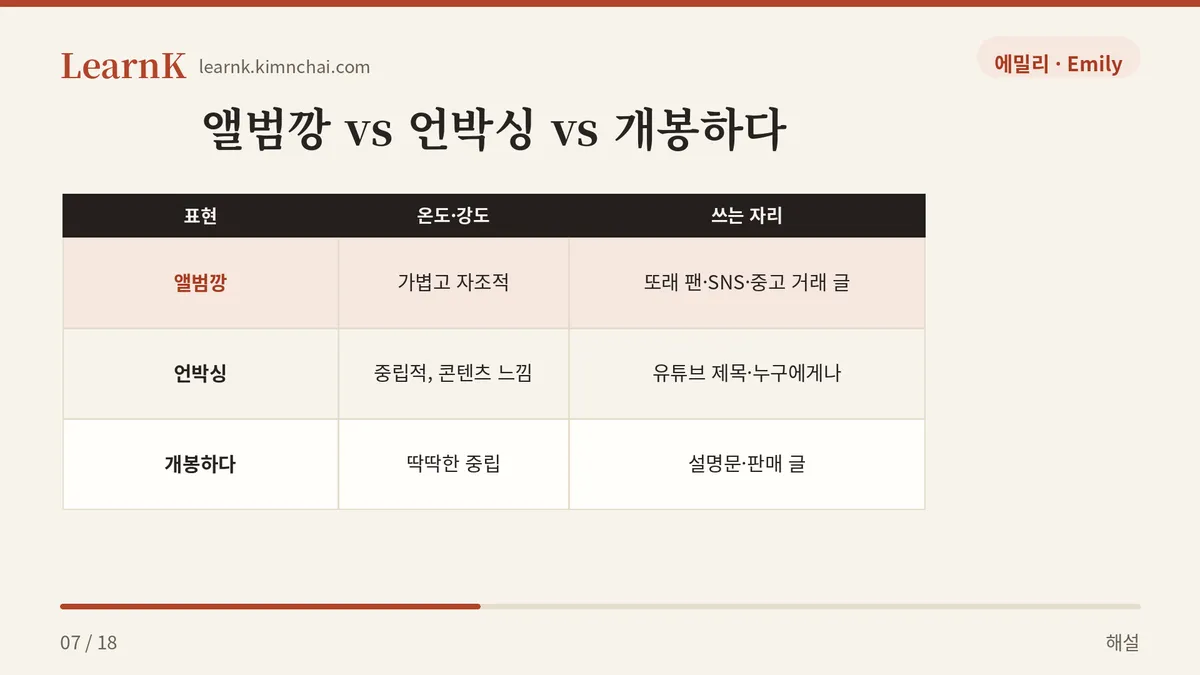
| Expression | Tone / intensity | Where it’s used |
|---|---|---|
| 앨범깡 (aelbeomkkang) | Light and self-deprecating; fandom slang | With fellow fans, on social media, in resale listings |
| 포카깡 (pokakkang) | Same tone, but the focus is on the cards themselves | Inside the fandom only |
| 언박싱 (eonbaksing) | Neutral; feels like content | YouTube titles; with anyone |
| 개봉하다 (gaebonghada) | Stiff and neutral | Explanatory writing, official notices, sales listings |
앨범깡 and 언박싱 seem to overlap, but they point in different directions. 언박싱 is an act of showing — you turn on the camera and open one thing carefully. 앨범깡 is an act of pulling — you rip through ten of them fast. That’s why the two words sometimes sit side by side in a single YouTube title.
Cultural Background — A Word Born from a Single Photocard
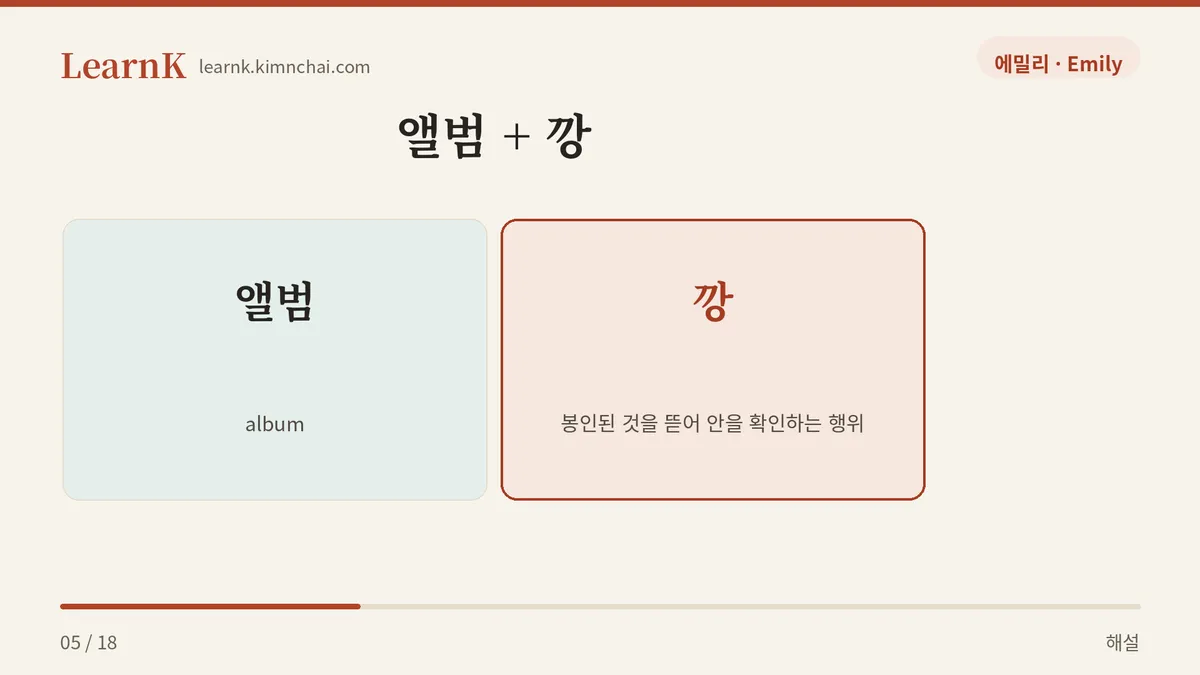
The word formation is simple: 앨범 (aelbeom, album) plus 깡 (kkang). This 깡 attaches wherever the meaning is tearing open something sealed to see what’s inside, as in 박스깡 (bakseukkang) and 포카깡 (pokakkang). Where exactly this 깡 came from is explained differently depending on who you ask, so I won’t declare one answer here. What is clear is the shape of its usage: “[something] + 깡” means tearing that something open and pulling out what’s inside.
Behind this word lies the way K-pop albums are sold. Each album contains a random photocard, each version has a different cover and contents, and entries for fan sign events are generally granted in proportion to how many copies you buy. That’s the structure that produces buying multiple copies of the same album for one card of the member you want, or for one more entry in the draw. 앨범깡 is the name fans gave to that structure.
So the word holds joy and exhaustion at the same time. The flutter in the moment of tearing one open is real, and so is the awkwardness of staring at eight leftover CDs afterward. In fact, Korean fandom has been talking for a long time about bulk album buying and the waste it creates, and a correspondingly dense culture has grown up around sharing leftover albums, passing them on secondhand, and trading just the photocards. That’s why words like 양도 (yangdo, transferring/passing on), 교환 (gyohwan, exchange), and 포카 교신 (poka gyosin, photocard trading) show up together in resale posts.
Here’s where this word becomes useful for Korean learners. Know 앨범깡, and half of what’s written in fan communities opens up to you. And once you also know that Korean fans put a self-deprecating tone on it rather than a boastful one, you can slide into that conversation naturally.
Today’s Quiz
Which of the following uses 앨범깡 most naturally?
① 앨범 한 장 사서 앨범깡 했어. (aelbeom han jang saseo aelbeomkkang haesseo.) ② 부장님, 저 어제 앨범깡 했습니다. (bujangnim, jeo eoje aelbeomkkang haetseumnida.) ③ 최애 포카 뽑으려고 앨범깡 하다가 열 장 뜯었어. (choeae poka ppobeuryeogo aelbeomkkang hadaga yeol jang tteudeosseo.)
Answer: ③
① is awkward because with only one copy, the core element of repetition is missing. ② has the meaning right but the setting wrong — with a senior colleague outside the fandom it won’t land, and it sounds flippant. ③ contains both the goal (your bias’s photocard) and the repetition (ten copies), so it’s the sentence where 앨범깡 sits most naturally in place.
The definitions, example sentences, and dialogue in this post are all original writing. ‘앨범깡 (aelbeomkkang)’ is a new coinage that has not yet been entered in the National Institute of Korean Language’s Basic Korean Dictionary (krdict.korean.go.kr), so this post contains no dictionary citations.