"아무거나 주세요 (amugeona juseyo)" — The All-Purpose Korean Phrase for When You Can't Decide What to Eat
아무거나
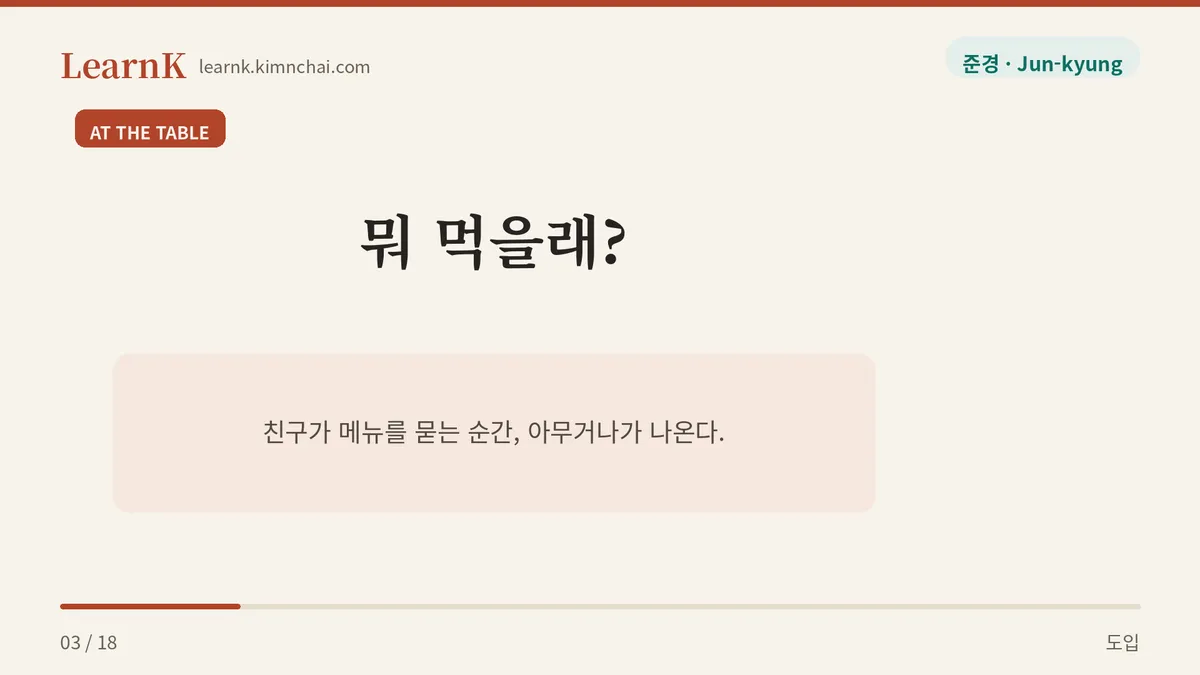
You’re sitting across from a friend at a Korean restaurant. The menu is full of letters you’ve never seen before, and there are barely any photos. Your friend asks, “What do you want to eat?” Just as your mind goes completely blank, one phrase can come to your rescue: 아무거나 (amugeona). “I’m fine with anything,” “Just give me anything” — it’s a real, everyday table expression that Koreans use several times a day.
Meaning and Nuance
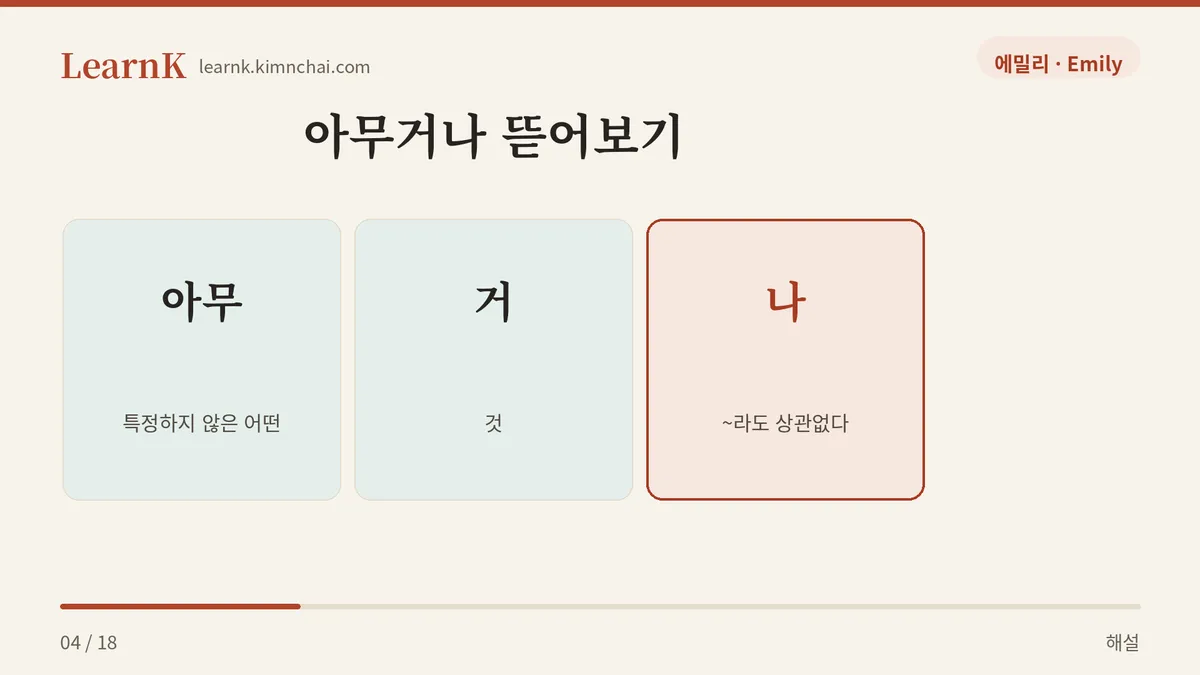
아무거나 (amugeona) is a shortened form of ‘아무 것이나 (amu geosina).’ ‘아무 (amu)’ means ‘some unspecified,’ ‘거 (geo)’ means ‘thing,’ and ‘나 (na)’ is a particle that adds the meaning of ’~ is fine too / it doesn’t matter which.’ So a literal translation of the whole thing is “any thing at all,” and more naturally it becomes “anything’s good.”
There are two key nuances.
First, it’s a gentle way of handing the choice over to the other person. It has the feeling of “I’m not picky, so you decide,” which is why it comes up so often when choosing what to eat together at a restaurant.
Second, depending on the situation, it can sound half-hearted. If you keep repeating “아무거나” in a moment when you really should be choosing, it can give the impression that you “don’t care.” That’s why it sounds much more natural when you add a little reason or condition afterward. For example, “매운 것만 빼고 아무거나 (maeun geotman ppaego amugeona)” — “anything except spicy.”
Example Sentences by Situation
Situation 1 — Picking a lunch menu with a friend
A: 오늘 점심 뭐 먹지? (What should we eat for lunch today?) B: 나는 아무거나 다 좋아 (amugeona da joa). 네가 골라! (I’m good with anything. You pick!)
This is the most typical use — leaving the decision to the other person while making it clear that “anything’s fine with me.”
Situation 2 — Ordering at a restaurant
사장님, 저희 아무거나 잘하는 걸로 주세요 (amugeona jalhaneun geollo juseyo). (Boss, just bring us whatever you do best.)
This means “Please pick for us whatever this place is most confident about.” When you use it at a regular spot or a home-style diner, trusting the owner to decide, it becomes a very Korean expression.
Situation 3 — Making a request with a condition attached
마실 거는 아무거나 시원한 거 (amugeona siwonhan geo) 로 부탁해. (For drinks, just get anything cold.)
By adding the condition ‘시원한 거 (something cold)’ after ‘아무거나,’ it becomes a thoughtful request that isn’t total indifference but rather “anything’s good within this range.”
Comparing Polite and Casual Speech, and Similar Expressions
Even with the same meaning, the ending changes depending on who you’re talking to.
- Casual: 아무거나 괜찮아 (amugeona gwaenchana) — friends, close relationships
- Polite: 아무거나 괜찮아요 (amugeona gwaenchanayo) — someone a bit older, a shop clerk
- More formal: 아무거나 괜찮습니다 (amugeona gwaenchanseumnida) — formal settings
Let’s also sort out some neighboring expressions that are easy to mix up.
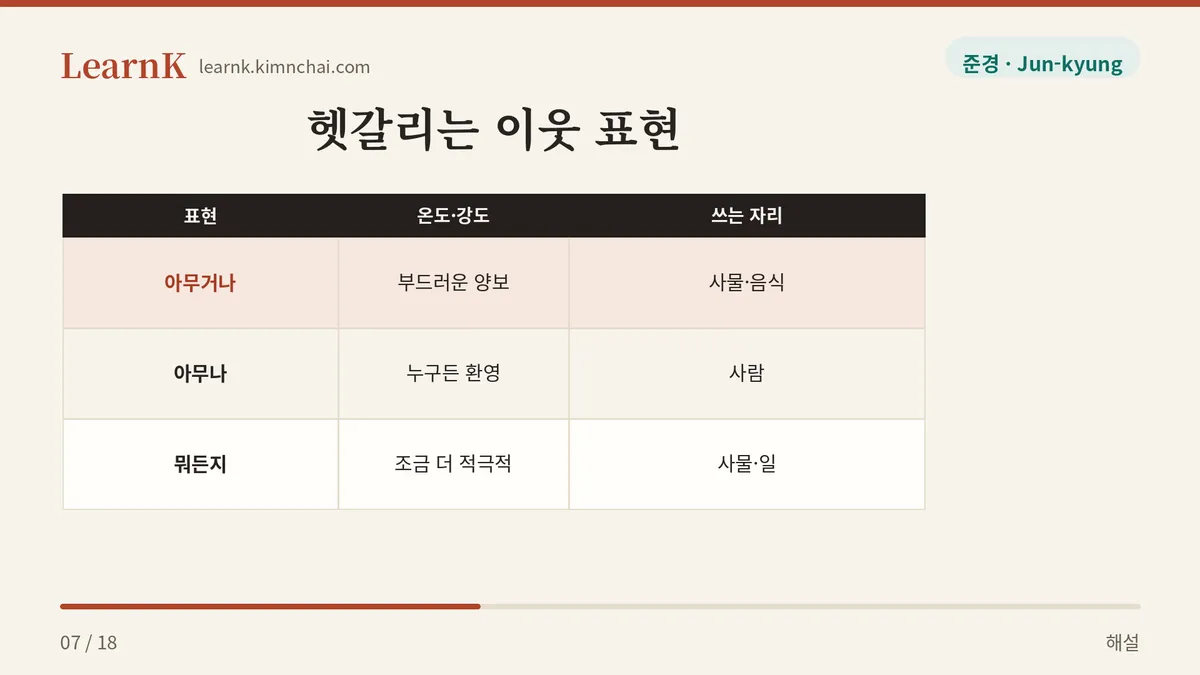
- 아무거나 (amugeona): ‘any thing at all’ — used for objects and food
- 아무나 (amuna): ‘any person at all’ — used for people (e.g., 아무나 와도 돼요 / anyone can come)
- 뭐든지 (mwodeunji): ‘whatever’ — a slightly more active and positive feeling than ‘아무거나’
Just remember to use 아무거나 for food and objects, and 아무나 for people, and your mistakes will drop dramatically.
Cultural Background — The Two Faces of “아무거나”
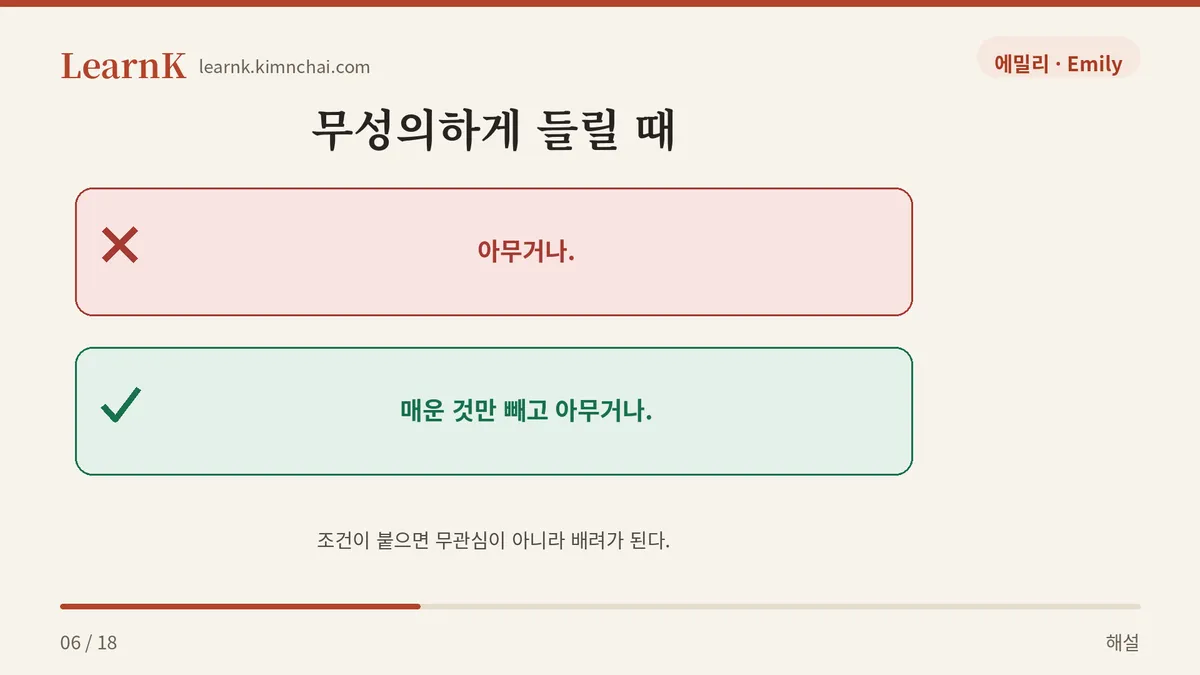
In restaurant scenes in Korean dramas, it’s very common to see a character casually toss out “아무거나 주세요 (just give me anything)” over a menu. Sometimes it’s a warm moment of yielding the choice out of consideration for the other person; other times it’s used as a directing device to reveal a tired, indifferent state of mind.
It’s the same in real life. If, during a date, you keep answering “아무거나” to the question “What do you want to eat?”, the other person might feel a little hurt. There’s even a joke in Korea that “the hardest menu item to make is ‘아무거나.’” So sometimes, instead of “아무거나,” adding one small preference like “오늘은 국물 있는 게 당겨 (gukmul inneun ge danggyeo)” — “today I’m craving something with broth” — makes for a much warmer conversation.
Closing Quiz
A friend asks, “이번 주말에 누구 초대할까? (Who should we invite this weekend?)” If you want to answer “Anyone at all is welcome,” what’s the right word for the blank?
”________ 데려와도 괜찮아! (You can bring ______!)”
① 아무거나 (amugeona) ② 아무나 (amuna)
See the answer
The answer is ② 아무나 (amuna). Since we’re talking about ‘people,’ you have to use ‘아무나,’ not ‘아무거나.’ If it were about food or objects, ‘아무거나’ would have been the correct answer!