안물안궁 (anmul-angung) — Cutting "I didn't ask and I'm not curious" down to four syllables
안물안궁
안물안궁 (anmul-angung) is a piece of slang that squeezes “안 물어봤고, 안 궁금하다 (an mureobwatgo, an gunggeumhada)” — “I didn’t ask, and I’m not curious” — into four syllables. It’s what you toss out to cut someone off when they’ve been going on and on about something you never asked about. When somebody keeps piling on the humblebrags or the life updates you don’t care about, Koreans don’t bother building a long sentence. They just drop four syllables. 안물안궁 (anmul-angung).
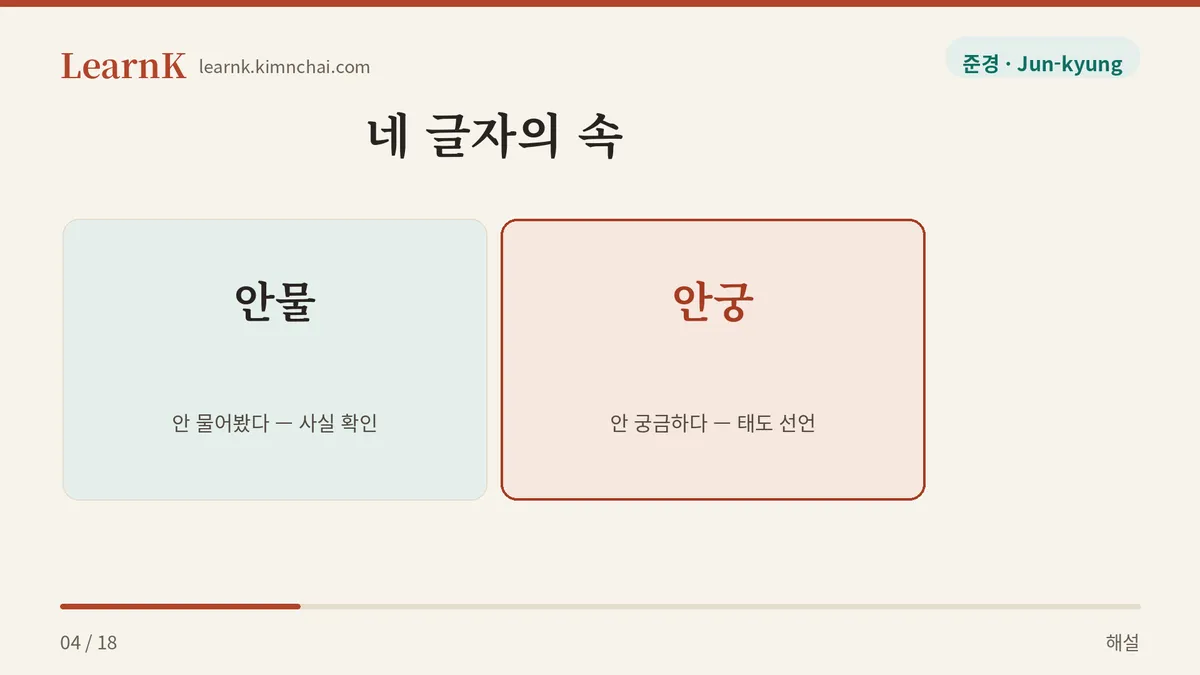
The power of this phrase is that it hammers the nail in twice. The first half, 안물 (anmul), is a statement of fact: “I never asked.” The second half, 안궁 (angung), is a declaration of attitude: “and I have no intention of becoming curious either.” Either half alone would get the meaning across, yet the two are deliberately stuck together. That’s why this isn’t really a phrase for turning down information — it’s closer to a phrase that folds up the entire direction of the conversation.
The temperature is high. And yet, strangely, the air in the room where this phrase actually gets thrown around is usually mixed with laughter. If someone genuinely wanted to push another person away, they’d use a far quieter, colder method. The instant you cut someone off with four crisp syllables, a second signal comes attached: “I can talk to you like this because of what we are to each other.” It sits right on the border between a straight-faced refusal and teasing between close friends. And it’s exactly that border that makes it dangerous for learners. Use it when you aren’t close enough, and the joke evaporates — only the rudeness is left.
A look at a real conversation
Scene: Saturday afternoon, at a parasol table in front of a convenience store. Two cup ramyeon are sitting there, and Jun-kyung has already been talking about the bike parts he just bought for fifteen minutes straight.
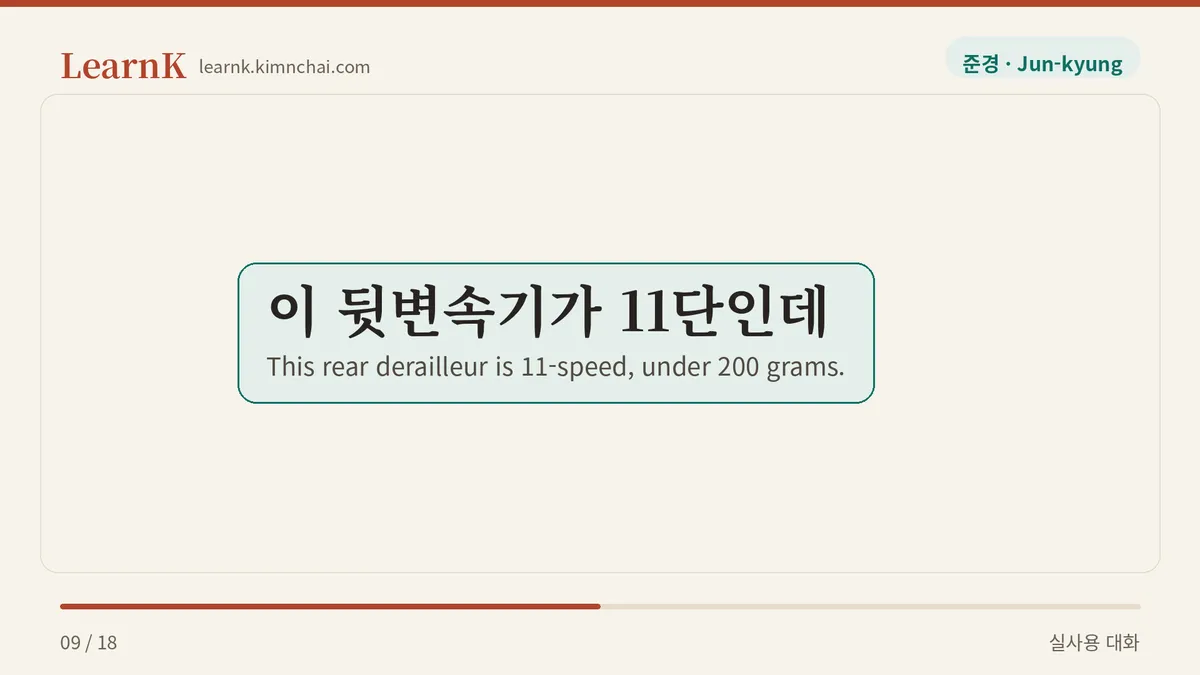
준경: 그러니까 이 뒷변속기가 11단인데, 무게가 200그램도 안 나가. So this rear derailleur is an 11-speed, and it weighs under 200 grams.
에밀리: 준경아, 미안한데 그건 좀 안물안궁. Jun-kyung, sorry, but I didn’t ask and I’m not curious.
준경: 어? 아까는 재밌다며. Huh? You said it was interesting earlier.
에밀리: 그건 십 분 전 얘기고. 지금은 라면 불어. That was ten minutes ago. Right now the ramyeon is getting soggy.
준경: 알았어, 알았어. 근데 이 체인은 진짜— Okay, okay. But this chain, seriously—
에밀리: 안. 물. 안. 궁. I. Did. Not. Ask.
Notice how, in that last line, Emily reads the four syllables out one at a time. This is something Koreans genuinely do all the time. Pulling the syllables apart slows the phrase down, and the slower it gets, the more playful it sounds. If she were actually angry, she wouldn’t stretch it out like that.
Using it like this sounds off
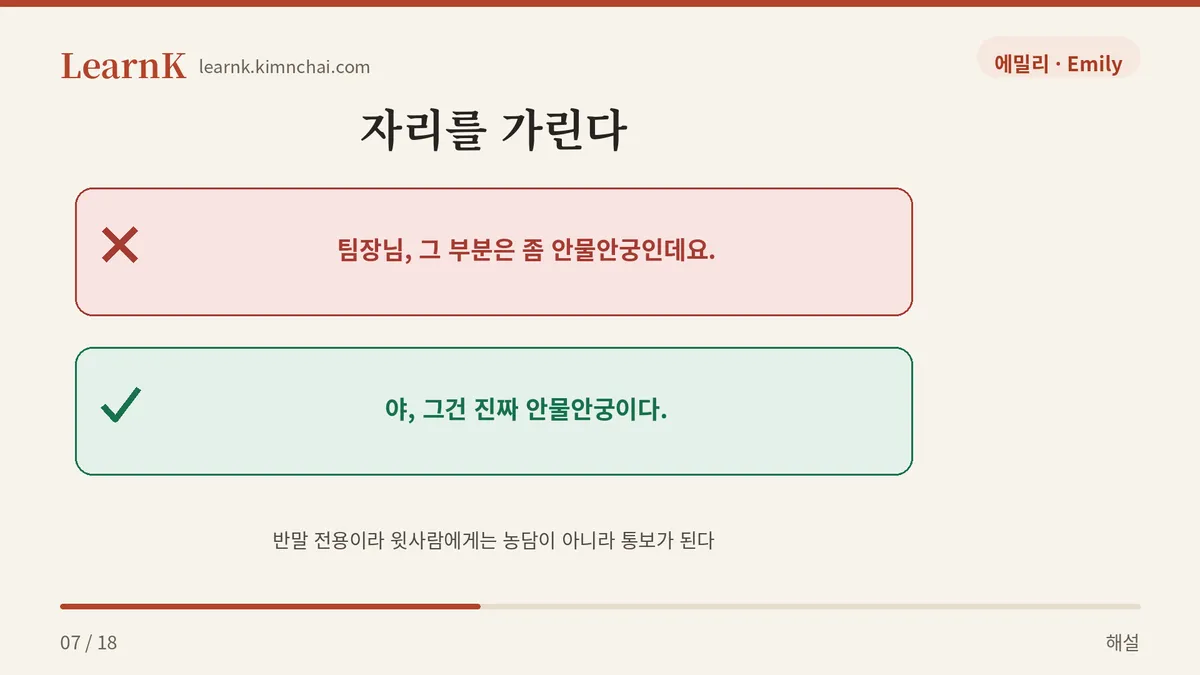
✗ (After your team lead finishes presenting in a meeting) 팀장님, 그 부분은 좀 안물안궁인데요. “Boss, that part is kind of a didn’t-ask-don’t-care for me.”
✓ (To a colleague your own age) 야, 그건 진짜 안물안궁이다. “Dude, that is seriously a didn’t-ask-don’t-care.”
→ This phrase is a declaration that shuts down what the other person is saying. Used with someone senior to you or in a public/professional setting, the problem goes beyond slang sounding too casual — it becomes a formal notice that “I will not be listening to you.” With someone above you, it’s safer to redirect with something like “그건 제가 잘 몰라서요 (geugeon jega jal mollaseoyo)” — “That’s not really something I know much about.”
✗ (To a friend who finally worked up the nerve to share what’s really on their mind) 아, 안물안궁. “Ugh, didn’t ask, don’t care.”
✓ (In the same moment) 힘들었겠다. 더 얘기해 봐. “That must have been hard. Tell me more.”
→ The grammar is perfectly fine, but the moment is wrong. When someone is showing off, this phrase is a joke; right after someone has opened up sincerely, it stops being a joke and becomes a knife. The same four syllables land with completely different weight depending on the situation.
Example sentences by situation
1. When the late-night relationship bragging starts in the group chat
야 지금 새벽 두 시야. 안물안궁이니까 얼른 자라. Ya jigeum saebyeok du siya. Anmul-angung-inikka eolleun jara. (Hey, it’s two in the morning. Nobody asked and nobody’s curious, so go to sleep already.)
This is the single most common place the phrase shows up: a group chat with friends. Here 안물안궁 (anmul-angung) isn’t a real rejection — it’s a signal that “we’re all reading this, and we’re all teasing you.” Tacking on something like “얼른 자라 (eolleun jara)” — “go to sleep already” — drops the temperature considerably.
2. When you cut yourself off (the safest way to use it)
아, 나만 신난 거지? 안물안궁인데 나 혼자 떠들었네. A, na-man sinnan geoji? Anmul-angung-inde na honja tteodeoreonne. (Oh — am I the only one having fun here? Nobody asked and nobody’s curious, and I’ve been talking away by myself.)
This is the usage I’d especially recommend to foreign learners. Aimed at someone else it’s risky; turned back on yourself, the risk disappears entirely. In fact, it makes you look like someone who’s aware they’ve been going on too long without reading the room. In Korean, a joke that lowers yourself just slightly almost always scores points.
3. When you acknowledge someone’s brag but still cut it off
대단한 건 알겠는데, 그 뒷얘기는 안궁. 밥부터 먹자. Daedanhan geon algenneunde, geu dwityaegineun angung. Bapbuteo meokja. (I get that it’s impressive, but I’m not curious about the rest of the story. Let’s eat first.)
If you drop the full four syllables and use only the back half, 안궁 (angung), the intensity weakens noticeably. Laying down an acknowledgment first — something like “대단한 건 알겠는데 (daedanhan geon algenneunde)”, “I get that it’s impressive, but…” — softens it even further. This is exactly how people dial the intensity up and down in real conversation.
Formal vs. casual speech, and similar expressions
First, something to be clear about: 안물안궁 (anmul-angung) has no polite (존댓말, jondaenmal) form. You can say “안물안궁입니다 (anmul-angung-imnida)”, but the moment you do, you’ve put casual-speech content inside a polite-speech shell, which only makes it more sarcastic. It’s best to think of this expression as casual-speech-only. If you need to convey the same meaning to someone senior to you, you have to pick an entirely different sentence.
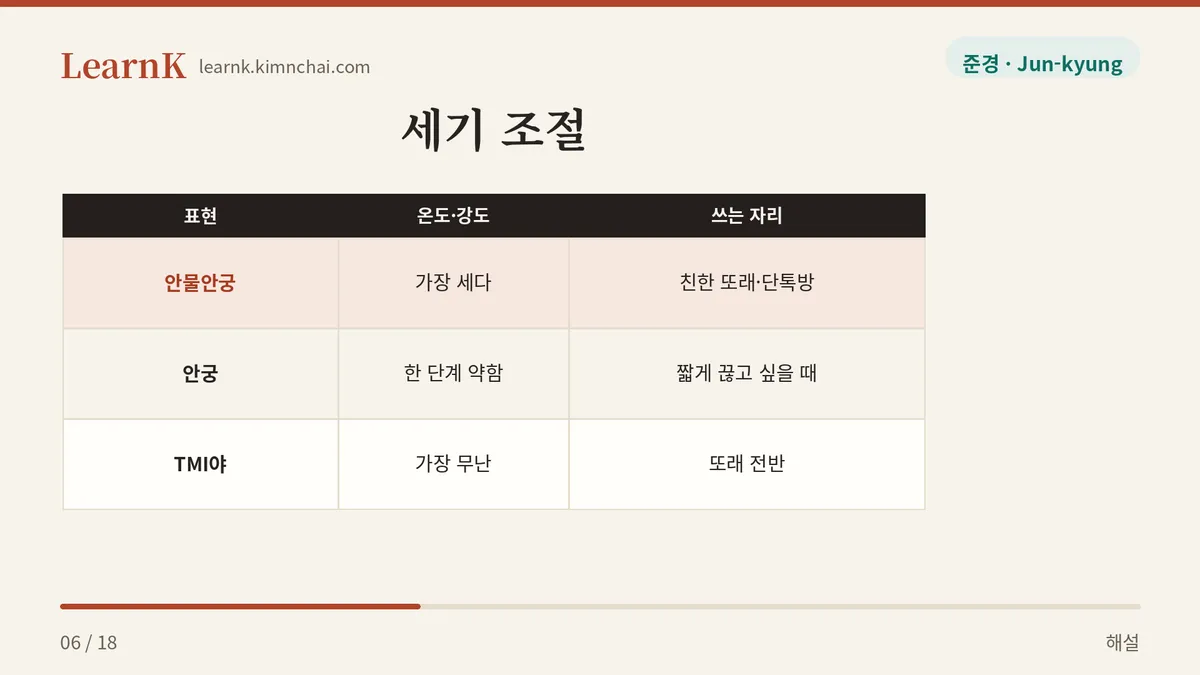
| Expression | Temperature & strength | Where it’s used |
|---|---|---|
| 안물안궁 (anmul-angung) | Strong and blunt, but mixed with playfulness | Close friends your own age, group chats. Never with someone senior |
| 안궁 (angung) | One notch weaker | Peers, messaging apps. When you want to cut it short |
| TMI야 (TMI-ya) | Soft, mixed with laughter | Peers in general. The safest of the three |
| 관심 없어요 (gwansim eopseoyo) | Cold and blunt | Polite in form, but the coldest of them all. Damages the relationship |
| 그건 제가 잘 몰라서요 (geugeon jega jal mollaseoyo) | Indirect and courteous | For steering the topic away with someone senior |
The rows worth studying in that table are the bottom two. 관심 없어요 (gwansim eopseoyo) is polite speech, and yet it damages a relationship more than 안물안궁 (anmul-angung) does. In Korean, how rude something is isn’t decided by polite speech versus casual speech alone. What matters more is whether you left room for a joke. 안물안궁 (anmul-angung) is casual speech, but it leaves the door to humor open; 관심 없어요 (gwansim eopseoyo) is polite speech that slams that door shut.
Cultural background — in a country that abbreviates absolutely everything
The word-formation is simple. Take 안물 (anmul) from “안 물어봤다 (an mureobwatda)” and 안궁 (angung) from “안 궁금하다 (an gunggeumhada)”, then stick them together. Keeping only the first syllable of each chunk is close to the basic grammar of Korean internet language. So many words like this have poured out that Koreans made an abbreviation for the phenomenon itself: 별다줄 (byeoldajul) — short for “별걸 다 줄인다 (byeolgeol da jurinda)”, “they abbreviate every last thing.” The fact that even the word mocking abbreviations is itself an abbreviation says everything about this linguistic habit.
It’s also no accident that it lands in four syllables. Korean neologisms have a striking fondness for a four-syllable rhythm. Broken into two chunks of two, it sticks to the mouth, and in a chat window it reads in a single breath. 안물안궁 (anmul-angung) survived and pushed aside the ten-syllable “안 물어봤고 안 궁금해 (an mureobwatgo an gunggeumhae)” not because it’s more precise, but because it has a better rhythm.
More interesting still is how head-on this phrase collides with an old Korean habit. Korea has a concept called 눈치 (nunchi) — the sense for reading even what the other person hasn’t said and acting accordingly. By the traditional rules, even when you were listening to something you had no interest in, the polite thing was to nod along appropriately and wait for the other person to notice on their own and wrap it up. 안물안궁 (anmul-angung) skips that waiting entirely. It takes what used to be handled by 눈치 (nunchi) and says it out loud.
But it doesn’t say it all the way out loud. When people throw this phrase out, they almost always laugh, or stretch the syllables apart, or tack on something like “밥이나 먹자 (babina meokja)” — “let’s just go eat.” They choose bluntness, then lay one thin film of humor over the top of it. Strip that film away and what’s left is simply rudeness. The real lesson a foreign learner should take from this expression isn’t the definition — it’s the existence of that film. Judge first whether you’re close enough to apply it, and if you aren’t sure, don’t use the phrase.
Today’s quiz
A Korean coworker has been telling you about the hike he went on over the weekend for twenty minutes now, at a company dinner. You aren’t that close with him yet, and he’s about ten years older than you. What’s the most appropriate thing to say?
- 부장님, 그건 좀 안물안궁이에요. — “Sir, that’s kind of a didn’t-ask-don’t-care.”
- 관심 없어요. — “I’m not interested.”
- 아, 저는 등산을 잘 몰라서요. 다음에 한번 데려가 주세요. — “Ah, I don’t really know much about hiking. Take me along sometime.”
Show the answer
Answer: 3
Option 1 is the single most typical mistake this post has been warning about. 안물안궁 (anmul-angung) is a declaration that cuts off what someone is saying, and it’s a casual-speech-only expression — so with an older coworker it won’t read as a joke, it’ll read as a formal notice. Option 2 is polite speech, but it’s the coldest of the lot and actually does the most damage to the relationship. Option 3 doesn’t cut the topic off; it moves it in a new direction. Remember this: in Korean, the safest way to wrap up a conversation isn’t refusal, it’s redirection.
Flip the situation, though — if this were a friend of ten years in front of a convenience store — and the answer is, without hesitation, the casual version of option 1. The same four syllables can be rudeness or a term of endearment, depending entirely on where you’re standing.
Definitions and example sentences are from the National Institute of Korean Language’s Basic Korean Dictionary (krdict.korean.go.kr); that portion of this post, including our translations, is licensed under CC BY-SA 2.0 KR.