반박불가 (banbakbulga) — Four Syllables for Throwing Up Your Hands When You've Got Nothing Left to Say
반박불가 (banbakbulga)
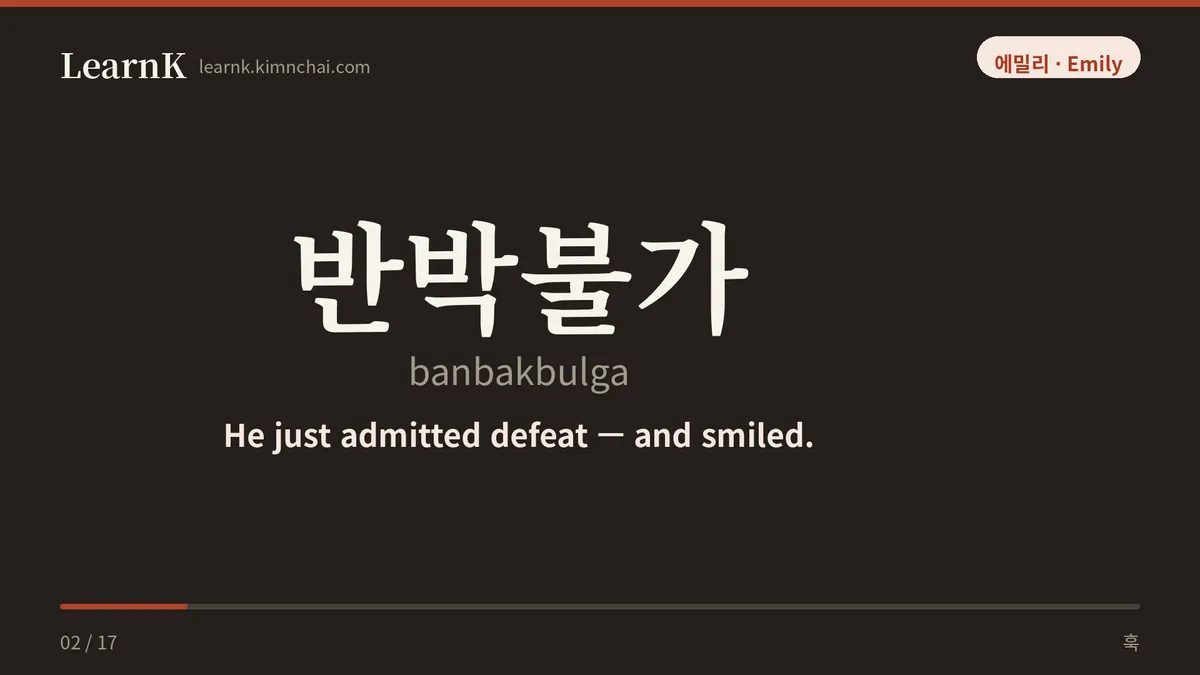
Scroll through an internet comment section or your friends’ group chat and you’ll keep hitting lines that contain nothing but four syllables. 반박불가 (banbakbulga) means the other person is so right that you have absolutely nothing to fire back with. Someone tosses out a remark, you go looking for a hole in it, and there isn’t one — this is what you say as you put the argument down, hands in the air.
The fun part is that it’s closer to surrender than to agreement. 네 말이 맞아 (ne mari maja), “you’re right,” is you weighing the point and granting it. 반박불가 (banbakbulga) is you stepping back because you’ve run out of things to say. That’s why it usually comes out of whoever just lost the argument — smiling, with a slightly sore look on their face.
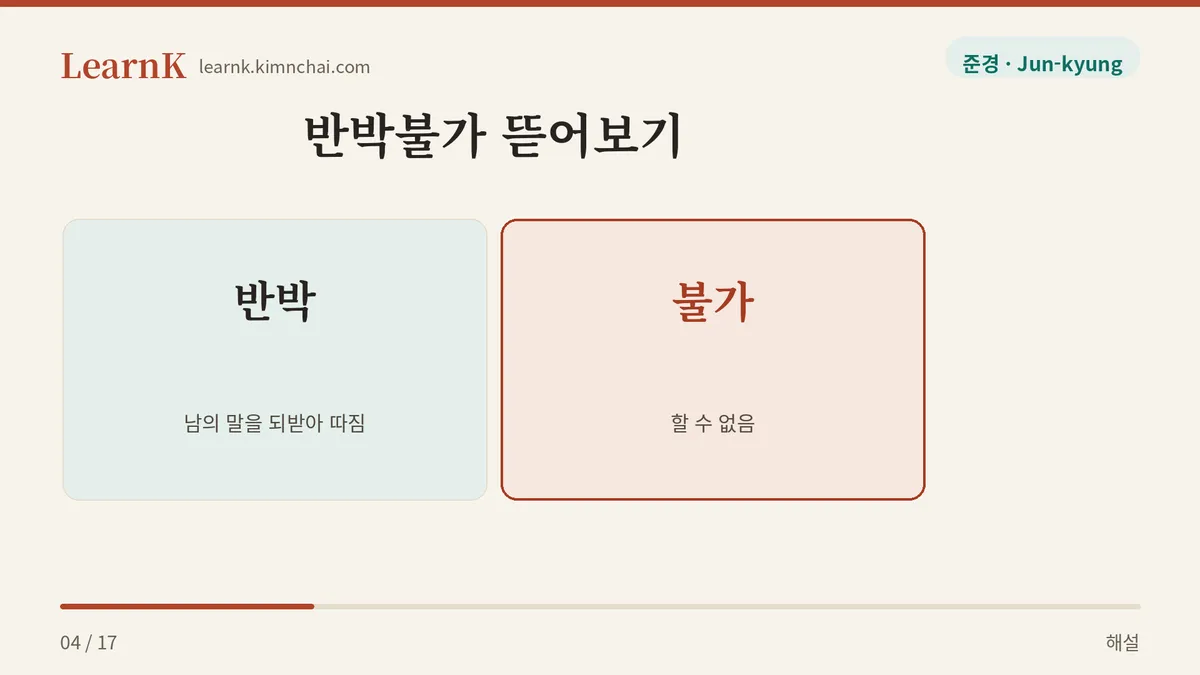
The structure is simple: a lump of Sino-Korean vocabulary made of 반박 (反駁, banbak, “rebutting, arguing back”) plus 불가 (不可, bulga, “not possible”). It started out spaced apart, as in 반박 불가능한 증거 (banbak bulganeunghan jeunggeo), “irrefutable evidence” — a stiff pairing at home in courtrooms, debates, and news headlines. Now people jam it into one block with no space and toss it out like an interjection. That particular playfulness — rolling a heavy Chinese-character word around lightly — is the flavor of this expression.
It’s flexible in use. Thrown out on its own: 반박불가 (banbakbulga). Rounded off into a full sentence: 반박불가다 (banbakbulgada). With a hint that you’ve realized it just this second: 반박불가네 (banbakbulgane). In slightly more formal writing it also shows up spaced out and stuck in front of a noun, as in 반박 불가 수준 (banbak bulga sujun), “on an undeniable level.”
Seeing It in Real Conversation
Scene: a Friday night during monsoon season, under the umbrella tables outside a neighborhood convenience store. They’ve just closed the delivery app.
Jun-kyung: 비 오는 날엔 무조건 파전에 막걸리지. 이건 국룰이야. On a rainy day it’s got to be pajeon and makgeolli. That’s the unwritten rule.
Emily: 근데 지금 비 와서 배달 다 한 시간 반 걸리는데? But it’s pouring right now, so every delivery is an hour and a half out.
Jun-kyung: …아, 반박불가. …Ah, can’t argue with that.
Emily: 그냥 여기서 컵라면 먹자. 비 소리 들으면서 먹으면 그것도 나름 운치 있어. Let’s just have cup ramyeon here. Eating while listening to the rain has its own charm.
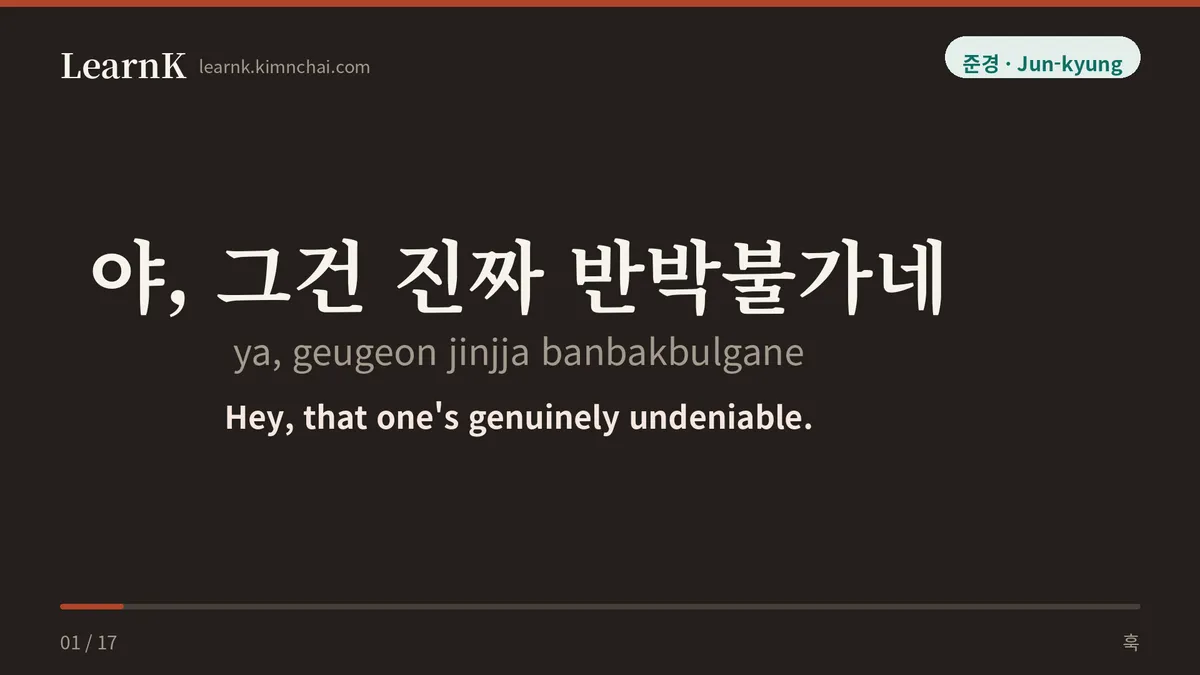
Jun-kyung: 야, 그건 진짜 반박불가네. 두 개 사 올게. Hey, that one’s genuinely undeniable. I’ll go grab two.
Emily: 우산은 하나뿐이야. 뛰어. There’s only one umbrella. Run.
When It Sounds Off
✗ (In the meeting room, right after your department head has finished presenting) 부장님, 방금 말씀 반박불가입니다. (bujangnim, banggeum malsseum banbakbulgaimnida.) — “Sir, what you just said is undeniable.” ✓ (To your department head) 말씀하신 부분, 저도 전적으로 동의합니다. (malsseumhasin bubun, jeodo jeonjeogeuro donguihamnida.) — “I completely agree with the point you made.” → 반박불가 (banbakbulga) is a verdict — you’re stamping a grade onto what someone said. Coming from a junior toward a senior, it lands less like agreement and more like scoring their performance. In formal settings, 이견의 여지가 없습니다 (igyeonui yeojiga eopseumnida) is the safe choice.
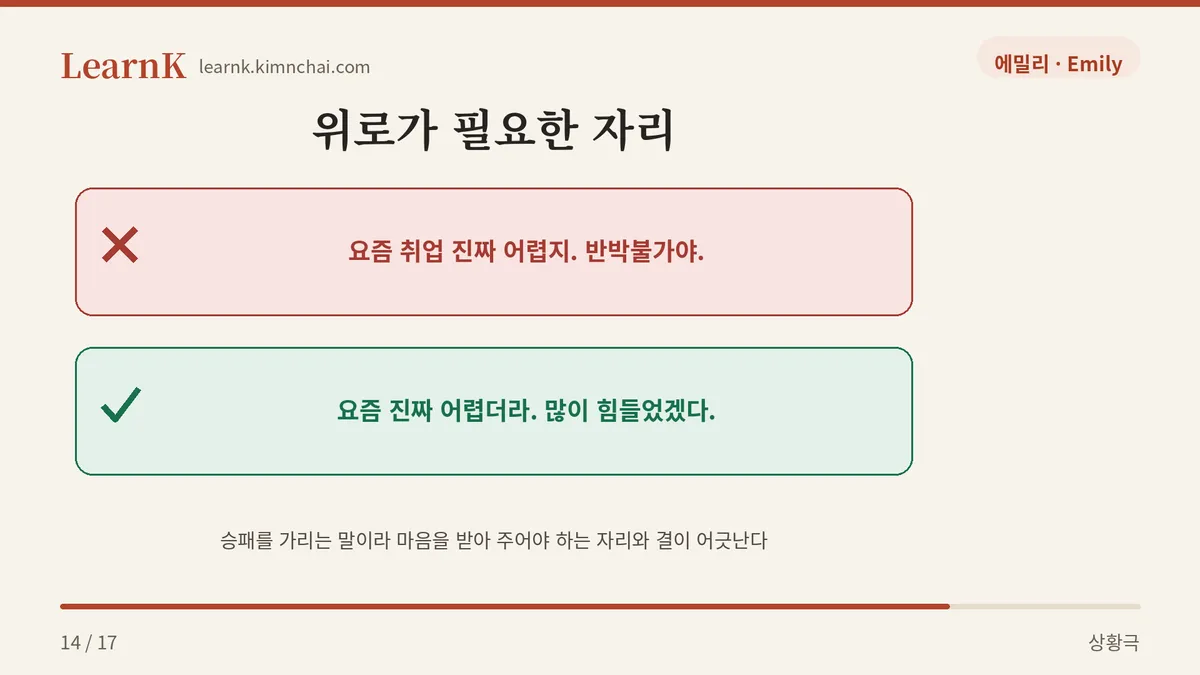
✗ (After a friend tells you they’ve quit their job) 요즘 취업 진짜 어렵지. 반박불가야. (yojeum chwieop jinjja eoryeopji. banbakbulgaya.) — “Job hunting really is brutal these days. Undeniable.” ✓ 요즘 진짜 어렵더라. 많이 힘들었겠다. (yojeum jinjja eoryeopdeora. mani himdeureotgetda.) — “It really has been rough lately. That must have been hard on you.” → Used where comfort is called for, it turns your friend’s situation into a debate topic. This phrase runs light in temperature and is built for deciding winners and losers, which cuts against the grain of a moment that asks you to receive someone’s feelings.
Example Sentences by Situation
Situation 1 — Monday morning, as a coworker gets dragged into the meeting room with a sigh.
월요일 아침 회의라니, 반박불가다. (woryoil achim hoeuirani, banbakbulgada.) “A Monday morning meeting — yeah, no argument there.” This is what you say back when your coworker grumbles 월요일 아침 회의는 인류의 적 (woryoil achim hoeuineun illyuui jeok), “Monday morning meetings are the enemy of mankind.” Less a serious endorsement than a laugh and a show of solidarity.
Situation 2 — Watching a soccer broadcast when the other team scores.
저건 그냥 잘 넣은 거야. 반박불가. (jeogeon geunyang jal neoeun geoya. banbakbulga.) “That was just a good goal. Can’t argue with it.” For when your own team has conceded and you still have to hand it to them. This phrase comes out most naturally in that spot where resentment and respect are mixed half and half.
Situation 3 — Writing a review on an online shopping site.
디자인은 아쉽지만 가격 대비 성능은 반박 불가 수준입니다. (dijaineun aswipjiman gagyeok daebi seongneungeun banbak bulga sujunimnida.) “The design is a letdown, but the performance for the price is on an undeniable level.” In reviews and headlines, this spaced-out form sitting in front of a noun is common. It’s one of the few formal-side uses where ending in -입니다 (-imnida) doesn’t sound strange at all.
Politeness Levels and Similar Expressions
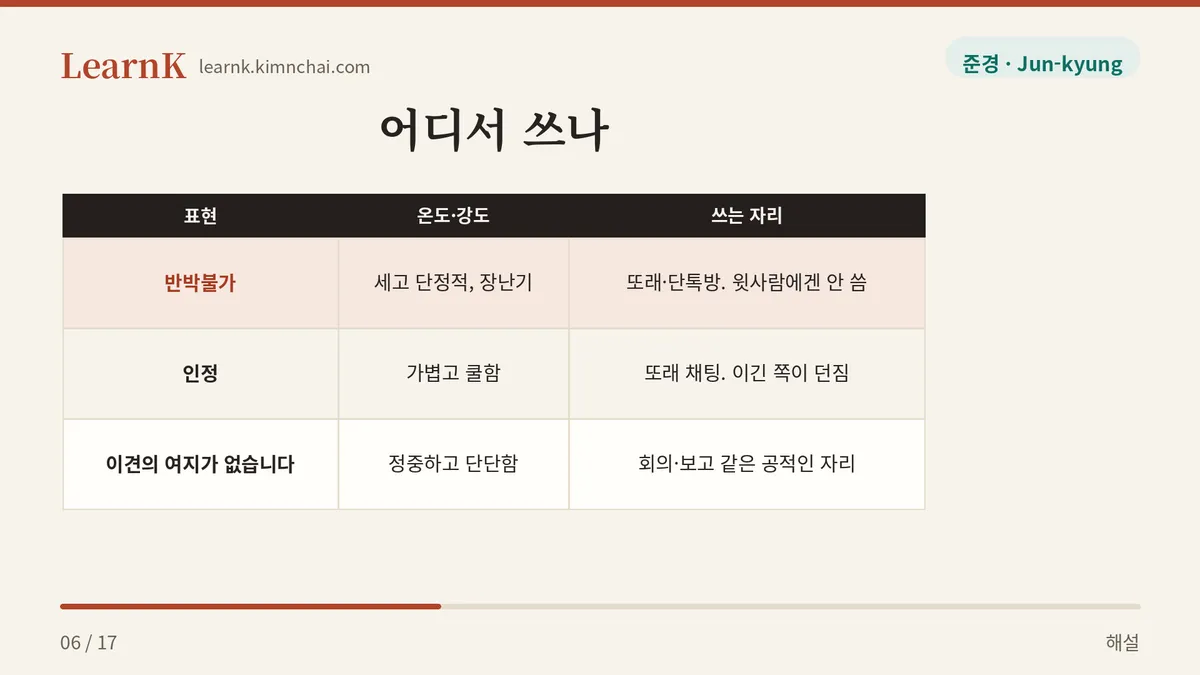
반박불가 (banbakbulga) is a noun phrase at heart, so it carries no honorific level of its own. You can attach a polite ending and say 반박불가입니다 (banbakbulgaimnida), but only when you’re evaluating a thing or a situation, as in example 3 above. Aimed at what a person said, it keeps its judging tone no matter how many -입니다 endings you pile on.
| Expression | Temperature / Force | Where It Belongs |
|---|---|---|
| 반박불가 (banbakbulga) | Strong and conclusive, with a streak of playfulness | Peers, group chats, comment sections. Not for seniors |
| 인정 (injeong) | Light and short, with a cool detachment | Peers, chatting. A one-word show of agreement |
| 맞는 말이야 (manneun mariya) | Neutral | Anywhere. The most unremarkable way to agree |
| 이견의 여지가 없습니다 (igyeonui yeojiga eopseumnida) | Polite and firm | Meetings, reports, other public settings |
People often mix it up with 인정 (injeong), but the two point in opposite directions. 인정 (injeong) is you stamping approval downward from above; 반박불가 (banbakbulga) is you reporting your own defeat. So at the moment an argument ends, the winner asks 인정? (injeong?) and the loser answers 반박불가 (banbakbulga).
Cultural Background — A Verdict Word Raised in the Comment Section
The place where this phrase hardened into its current shape is internet forums and comment sections. Online conversation has no face and no voice, only letters going back and forth, so expressions that stamp a quick verdict instead of explaining at length grow unusually well there. 국룰 (gungnul, an unspoken rule everybody follows), 인정 (injeong), and 반박불가 (banbakbulga) all belong to that same family — the rhythm of delivering a ruling in four syllables or two and moving on to the next line.
Variety show subtitles are another channel that spread it far and wide. When a cast member freezes with nothing to say and 반박불가 (banbakbulga) flashes across the screen in giant letters, viewers know that person has been completely defeated without a word of dialogue. Because it’s an expression Koreans learned as a subtitle before they learned it as speech, they naturally clip it short when they say it out loud.
One more thing. In Korean conversation, admitting you’ve lost often arrives together with laughter. Saying 내가 졌다 (naega jyeotda), “I lost,” with a straight face makes the mood heavy, but tossing out four stiff Sino-Korean syllables turns the defeat into a joke. That mismatch — using a heavy word lightly — is exactly the job 반박불가 (banbakbulga) does. If you’re learning Korean and you land this phrase once at the right moment, you can feel the temperature of the conversation noticeably ease.
Today’s Quiz
Which of the following is the best place to use 반박불가 (banbakbulga)?
- In the meeting room right after your department head has finished presenting, said straight to him
- When a friend says 비 오는 날엔 배달이 절대 제시간에 안 와 (bi oneun naren baedari jeoldae jesigane an wa), “deliveries never show up on time on rainy days,” and they’re completely right
- When a friend is upset about having quit their job
Answer: 2. Between friends, hearing something so right that you have nothing to fire back with — that’s this expression’s home turf. Option 1 turns into a junior handing down a verdict on a senior’s words, which sounds rude, and option 3 lays a win-or-lose phrase over a moment that calls for comfort. If a friend nails it in the group chat today, don’t write a paragraph — just send the four syllables. 반박불가 (banbakbulga).