반전 (banjeon) — The One Twist That Flips a K-Drama's Final Episode Upside Down
When you binge-watch Korean dramas, there comes a moment when a story you thought was all wrapped up gets completely flipped in the last five minutes. The character you were sure was good turns out to be the real culprit, or the person you were certain had died comes strolling back, perfectly alive. In exactly that moment, the word Korean viewers are the first to pour into live chats and comment sections is today’s expression.
반전
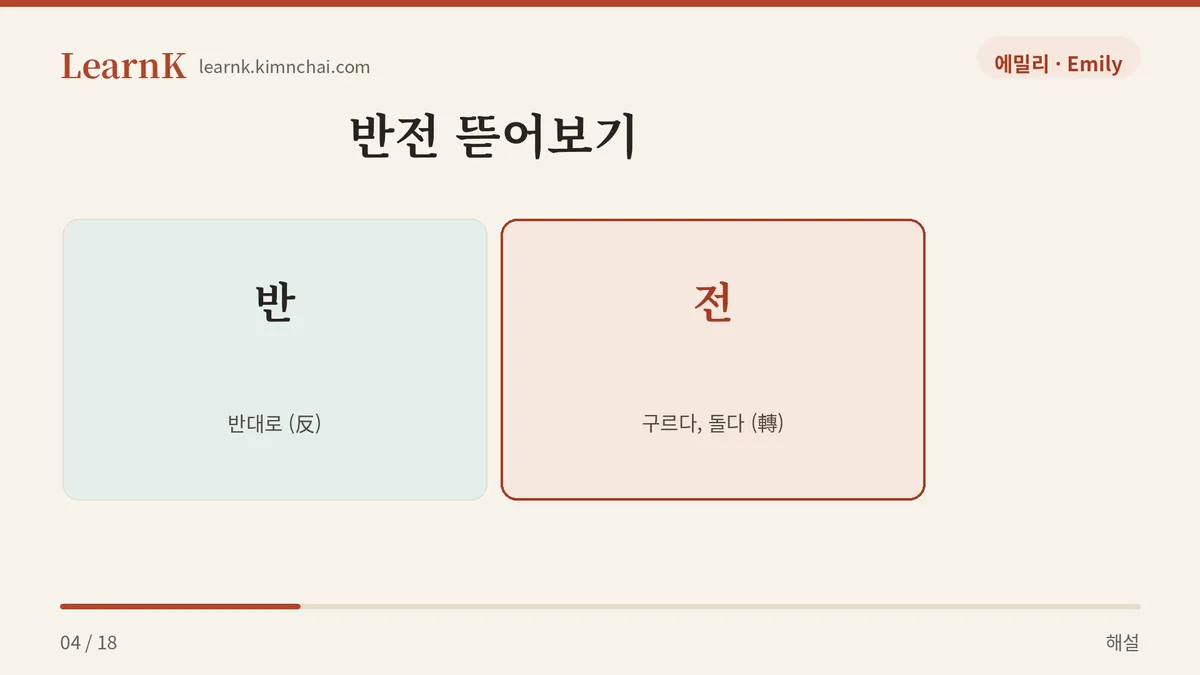
반전 (banjeon) means a flow or situation suddenly flipping to the complete opposite of what you expected. It originally comes from the Chinese characters for ‘turning (轉) in reverse (反),’ so it’s used broadly — from a machine spinning backward to the direction of a story taking a sharp turn. But for K-drama and film fans, 반전 basically has one meaning — the ‘plot twist,’ that one blow that catches the audience off guard.
The nuance matters. 반전 isn’t simply ‘surprising’; it carries the sense that the premise you’ve believed all along collapses. That’s why saying a 반전 was good is the highest praise, while calling something “a 반전 for the sake of a 반전” is a criticism that it felt forced.
Checking with the National Institute of Korean Language Dictionary
The National Institute of Korean Language’s Basic Korean Dictionary explains 반전 in three branches.
반전 「noun」
- A machine or the like turning or rolling in the opposite direction. (reverse)
- A position, order, direction, etc. changing to the opposite. (reversal)
- The flow or state of an event or affair being turned around. (twist) — National Institute of Korean Language, Basic Korean Dictionary (krdict.korean.go.kr)
The 반전 we meet in dramas is the third one — the ‘twist.’ Shall we check with an example sentence the dictionary itself provides?
그 영화는 결말에 반전이 있어 끝까지 집중해서 봐야 한다. — National Institute of Korean Language, Basic Korean Dictionary (krdict.korean.go.kr)
It means there’s a 반전 hidden in the 결말 (結末), the ending of the story. The power to keep you from looking away until the very end — that’s the charm of a 반전.
우와, 이 영화 구성도 정말 탄탄하고 반전도 기가 막히다. — National Institute of Korean Language, Basic Korean Dictionary (krdict.korean.go.kr)
Here ‘기가 막히다’ is an exclamation of awe — praise that the 반전 is so wonderful it leaves you speechless.
우리는 전반전에 다섯 골을 넣어 후반전도 되기 전에 승패가 가름이 났다. — National Institute of Korean Language, Basic Korean Dictionary (krdict.korean.go.kr)
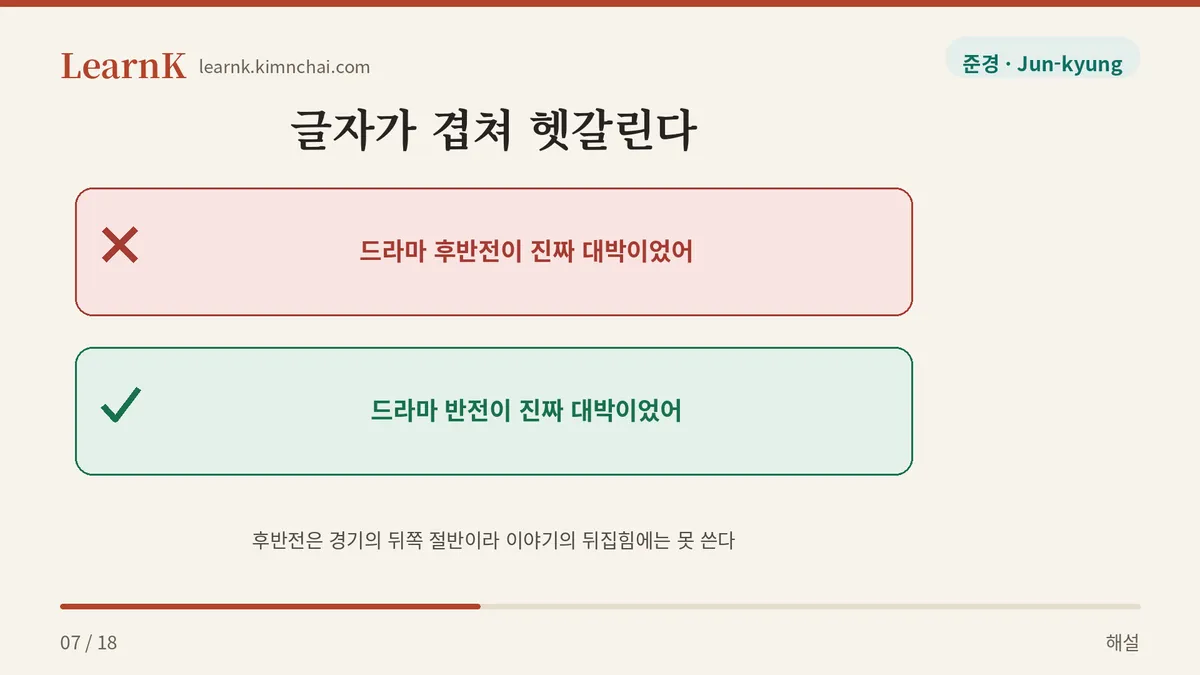
Hold on a second — be careful here! ‘후반전 (後半戰)’ means the ‘second half’ of a match, a completely different word. Its letters overlap with today’s ‘반전 (反轉),’ so it’s easy to mix them up. Always use context to tell whether it’s a sports story or a story being flipped on its head.
Seeing It in a Real Conversation
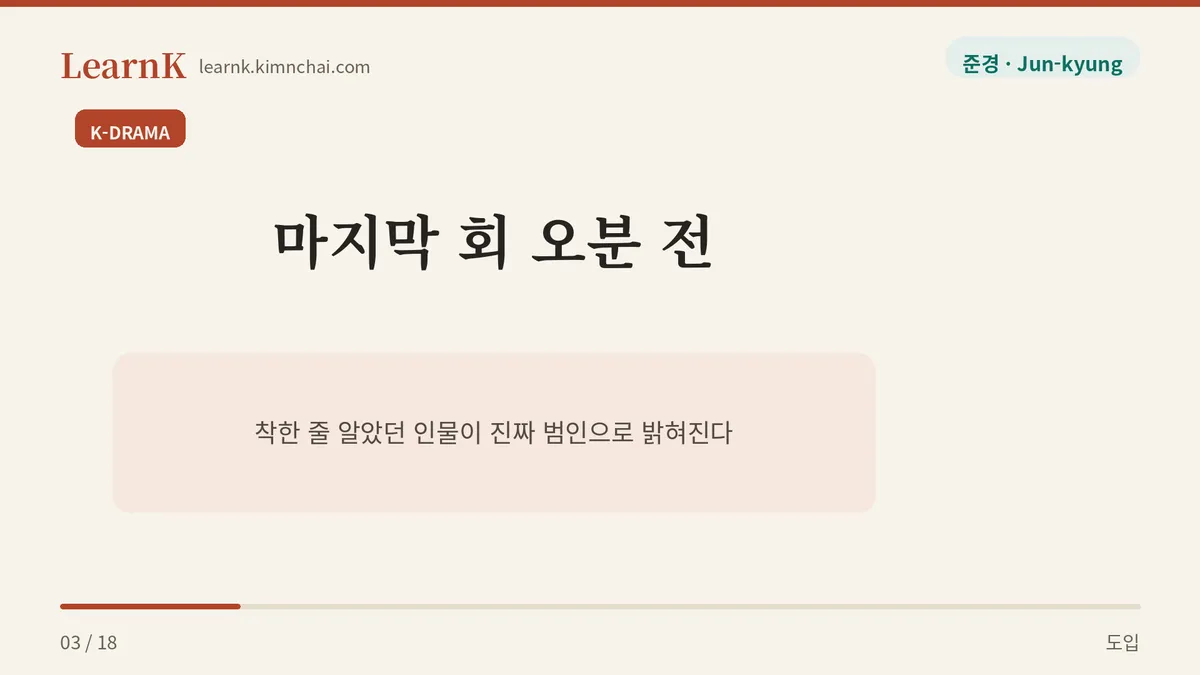
Scene: Sunday night, in Jun-kyung’s living room. The final episode of a 12-part drama the two have been binging together just ended.
Jun-kyung: 야, 봤어? 그 실장이 진짜 범인이었다니. Hey, did you see that? The manager was actually the culprit!
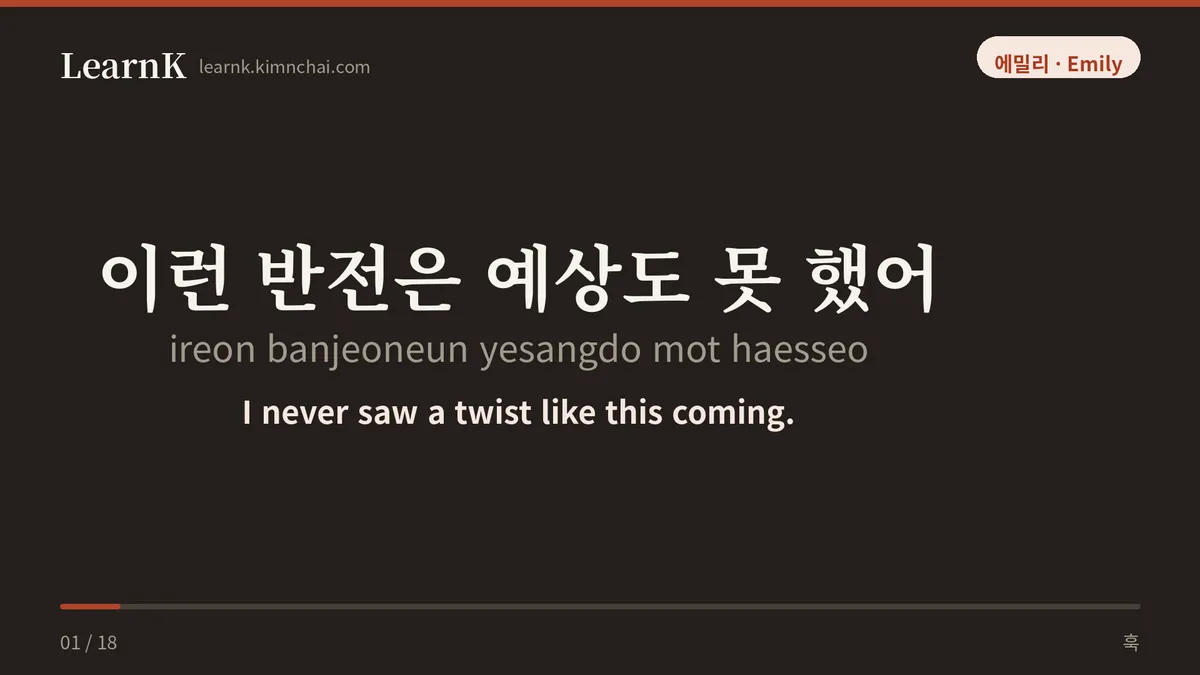
Emily: 헐, 나 진짜 소름 돋았어. 이런 반전은 예상도 못 했어. Whoa, I got total goosebumps. I never saw a twist like this coming.
Jun-kyung: 그치? 8회까지만 해도 완전 착한 사람인 척했잖아. Right? Up until episode 8 he totally played the nice guy.
Emily: 근데 나 솔직히 좀 아쉬워. 반전을 위한 반전 같았달까. But honestly I’m a little let down. It felt like a twist just for the sake of a twist.
Jun-kyung: 오, 눈치 빠른데? 나도 마지막엔 좀 억지스럽다 싶었어. Oh, sharp eye. I thought the ending was a bit forced too.
Emily: 그래도 끝까지 못 끄고 봤으니 성공한 거지 뭐. Still, we couldn’t turn it off till the very end, so I guess it worked.
Example Sentences by Situation
- When recommending a drama to a friend: “마지막 회에서 엄청난 반전이 있었어 (majimak hoeeseo eomcheongnan banjeoni isseosseo).” — A way to strongly push ‘you have to watch this’ without giving away spoilers.
- When talking about an unexpected turnaround in life: “면접 떨어진 줄 알았는데 합격 문자가 왔어 — 완전 인생 반전이야 (wanjeon insaeng banjeoniya).” — That moment when you’ve braced for the worst and get the exact opposite result.
- When talking about someone’s unexpected charm: “무서운 역만 하던 배우가 이번엔 코믹 연기라니, 완전 반전 매력이야 (banjeon maeryeogiya).” — A trendy expression used when you discover a side of someone that’s the opposite of how they appear.
Polite and Casual Speech, and Similar Expressions
Since 반전 is a noun, it doesn’t change based on levels of politeness on its own. You just change the end of the sentence — among friends, “반전이야 (banjeoniya),” and when being polite, “반전이에요 (banjeonieyo)” or “반전이었습니다 (banjeonieotseumnida).”
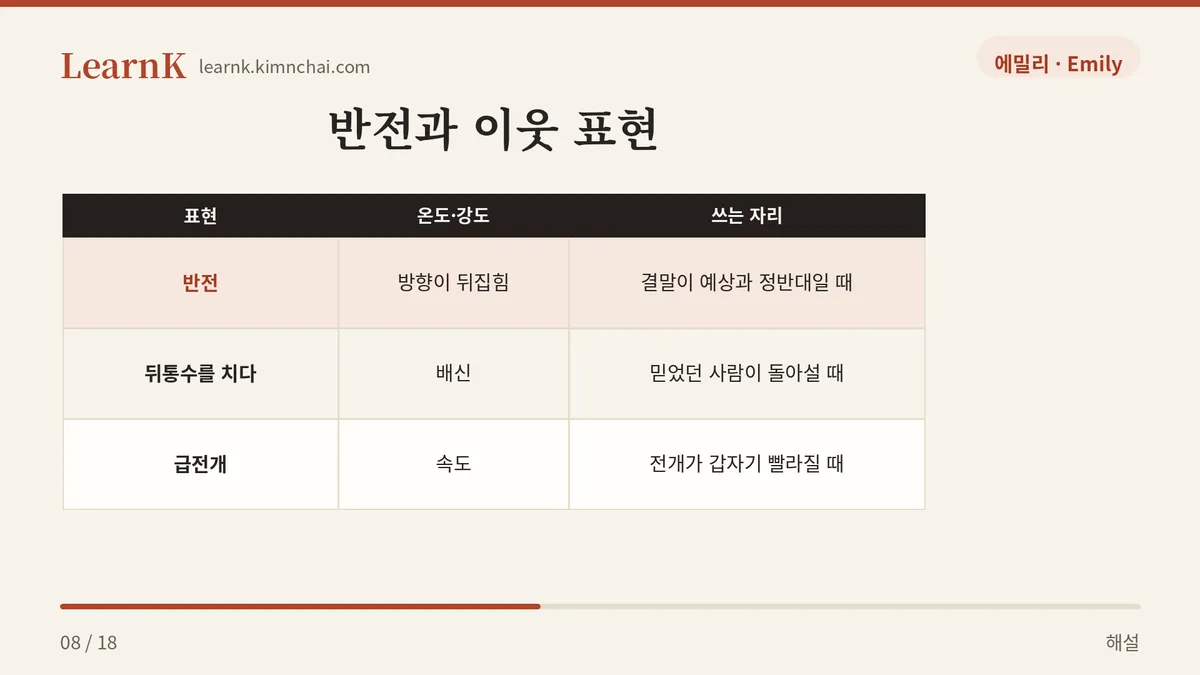
It’s good to know some similar expressions too. 뒤통수(를) 치다 (dwitongsureul chida) physically expresses the ‘twist’ of a trusted person betraying you, while 급전개 (geupjeongae) means a story suddenly veering fast. The difference is that 반전 emphasizes the result of ‘the direction being flipped,’ while 급전개 emphasizes the development of ‘the speed picking up.‘
Cultural Background
In Korean dramas, the 반전 is a grammar of its own. Producers place a decisive 반전 in the final episode to boost ratings, and fans start theorizing over “what’s this week’s 반전?” even before it airs. In the idol world too, the gap between on-stage charisma and off-stage goofiness is called 반전 매력 (banjeon maeryeok) with great affection. In other words, 반전 is a very living word that attaches not just to stories but to ‘people’ as well.
Today’s Quiz
A character you thought was a good supporting role turns out to be the mastermind in the final episode. How would you express this situation in one word? (Answer: 반전!)
Definitions and example sentences are from the National Institute of Korean Language’s Basic Korean Dictionary (krdict.korean.go.kr); that portion of this post, including our translations, is licensed under CC BY-SA 2.0 KR.