밥심 (bapsim) — the Korean word for the strength that comes from eating
밥심 (bapsim)
밥심 (bapsim) means the strength that appears in you after you’ve eaten. In Korea, when someone is drooping with exhaustion, the first thing out of your mouth isn’t 좀 쉬어 (jom swieo), “get some rest” — it’s 밥은 먹었어? (babeun meogeosseo?), “have you eaten?” The word 밥심 stands right inside that order of priorities: offer a tired person food before you offer them rest. Stopping halfway through hauling boxes on moving day to spread newspaper on the bare floor and order 짜장면 (jjajangmyeon); buying a convenience-store 김밥 (gimbap) before walking into the library during exam season — both come out of one and the same idea: you have to eat first, then do the thing.
밥심 is an invisible strength. It isn’t the same as 체력 (chelyeok), the strength of muscle, and it’s a little different from 기운 (giun), the liveliness of the spirit. Packed whole into the word is a cause and effect: this is strength that exists because you ate. That’s why it shows up overwhelmingly often with the particle 으로 (-euro), used like a means or an instrument — 밥심으로 일하다 (bapsim-euro ilhada), 밥심으로 버티다 (bapsim-euro beotida), 밥심으로 살다 (bapsim-euro salda). Its temperature is warm and a little homespun. It’s everyday speech with a faint streak of humor in it, so it travels across the dinner table far more often than across a report. One note: it’s written 밥심, but it’s pronounced [밥씸] (bapssim), with a tensed consonant.
Checking it in the National Institute of Korean Language dictionary
밥심 「noun」 밥을 먹은 후에 생긴 힘. [en] The strength gained after eating. [ja] ごはんのパワー【ご飯のパワー】 — ご飯を食べた後にできる力。 [es] fuerza de arroz — Fuerza que se produce después de comer. [zh] 米粮之力,饭劲 — 吃饭后获得的能量或力量。 — National Institute of Korean Language, Basic Korean Dictionary (krdict.korean.go.kr)
The Portuguese gloss isn’t listed in the dictionary. What follows is not a dictionary quotation but our own translation — força que se ganha depois de comer (the strength you gain after eating).
Below are the dictionary’s actual usage examples, quoted exactly as they appear, each with a note on the kind of situation it would come out of.
그래. 밥심도 없이 일을 계속할 수는 없지. — National Institute of Korean Language, Basic Korean Dictionary (krdict.korean.go.kr)
This is the scene where you can’t stand by any longer and stop someone who intends to keep working through skipped meals. The 도 in 밥심도 없이 is the important part. It’s the particle that frames 밥심 as the bare-minimum condition, so the sentence reads as worry: “how are you going to manage without even that much?” The 그래 at the front is the kind of reply that accepts what the other person said while taking a step back.
지수는 힘들 때마다 맛있는 음식을 먹으며 밥심으로 버틴다. — National Institute of Korean Language, Basic Korean Dictionary (krdict.korean.go.kr)
The most typical use of 밥심. It’s drawn not as the strength of one meal but as a way of living that repeats 힘들 때마다, “every time things get hard.” Here 밥심 is a story about physical stamina and, at the same time, a way of pulling your mind back together.
민준이는 밥심으로 일하고 있다. — National Institute of Korean Language, Basic Korean Dictionary (krdict.korean.go.kr)
A sentence describing a person who can only get things done if he eats well. In Korean, 밥심 travels alongside labor like this. The more physical the work, the more natural the word sounds.
밥심으로 살다. — National Institute of Korean Language, Basic Korean Dictionary (krdict.korean.go.kr)
This is 일하다 grown up into 살다. It says that not a day but a whole life is being pushed along by the strength of food, so older people often reach for it when looking back on hard years.
밥심이 좋다. — National Institute of Korean Language, Basic Korean Dictionary (krdict.korean.go.kr)
A rare form that puts 밥심 in the subject slot without 으로. It’s close to a compliment — said about someone who perks right up the moment they eat well, someone who bounces back fast.
Seeing it in a real conversation
Situation: Emily’s moving day. They’ve been carrying boxes all morning and noon has just passed. Newspaper is spread out on the empty living room floor, and the jjajangmyeon has arrived.
Jun-kyung: 자, 일단 앉아. 짜장면 왔어. Alright, sit down for a sec. The jjajangmyeon is here.
Emily: 나 배 별로 안 고픈데. 저 상자만 먼저 옮기고— I’m not that hungry though. Let me just move that box first—
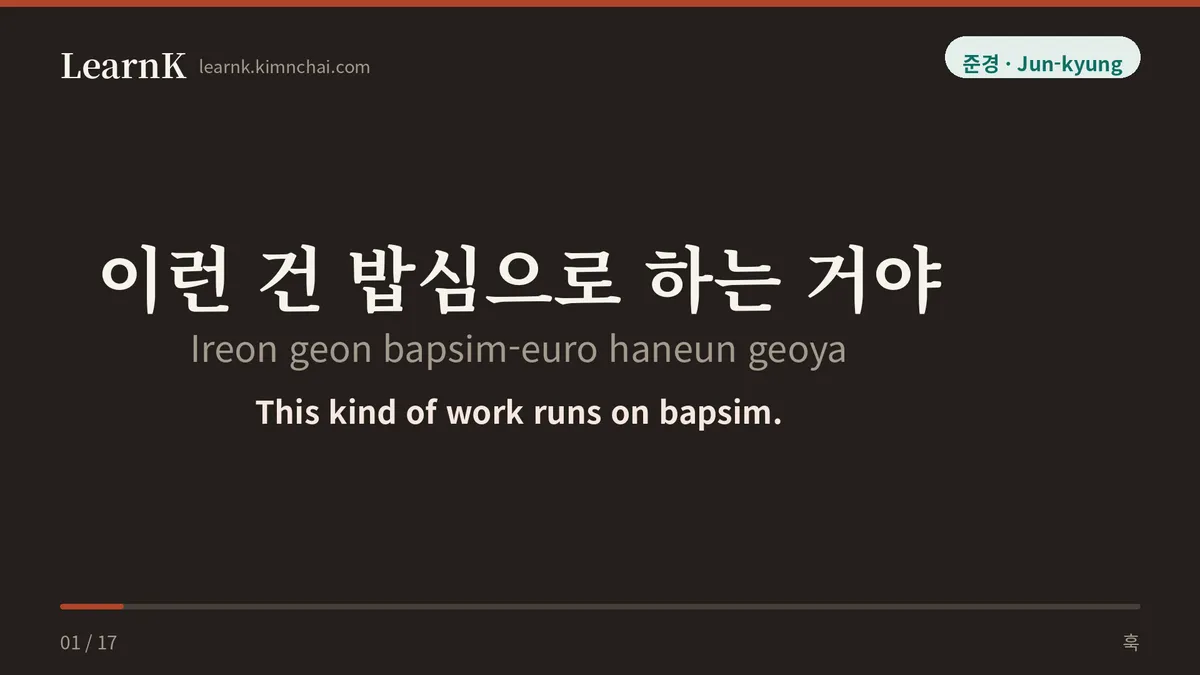
Jun-kyung: 야, 이런 건 밥심으로 하는 거야. 먹고 하면 두 배로 빨라. Hey, this kind of work runs on bapsim. Eat first and you’ll go twice as fast.
Emily: 하긴, 아까부터 손에 힘이 하나도 없더라. True, my hands have had no strength in them for a while now.
Jun-kyung: 그러니까. 한 그릇 비우고 나면 저 상자쯤은 그냥 들려. Exactly. Once you finish a bowl, a box like that will lift itself.
Emily: 알았어, 먹을게. 밥심 좀 채우고 나머지 끝내자. Okay, I’ll eat. Let me fill up on some bapsim and then let’s finish the rest.
Used this way, it sounds off
✗ (Reporting to the executives) 이번 프로젝트는 팀원들의 밥심으로 마무리했습니다. (Ibeon peurojekteuneun timwondeurui bapsim-euro maburihaetseumnida.) We wrapped up this project on the team’s bapsim.
✓ (At the after-party, to your teammates) 이거 진짜 우리 밥심으로 끝낸 거다. (Igeo jinjja uri bapsim-euro kkeutnaen geoda.) We seriously finished this on pure bapsim.
→ 밥심 is affectionate, homespun, everyday speech, so in an official report it lands as a joke rather than as sincerity. In a formal setting, 팀원들의 헌신으로 (timwondeurui heonsin-euro), “through the team’s dedication,” is the right choice. The word isn’t wrong — the room is.
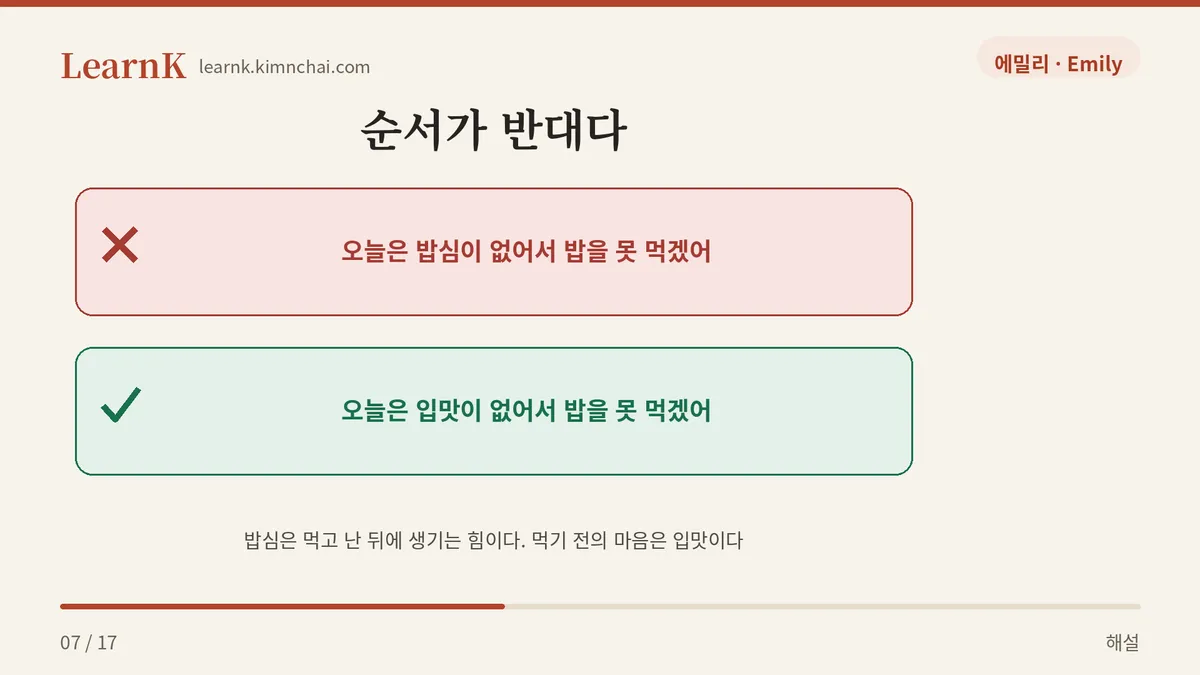
✗ 오늘은 밥심이 없어서 밥을 못 먹겠어. (Oneureun bapsimi eopseoseo babeul mot meokgesseo.)
✓ 오늘은 입맛이 없어서 밥을 못 먹겠어. (Oneureun immasi eopseoseo babeul mot meokgesseo.) I have no appetite today, so I can’t eat.
→ This is the misunderstanding learners run into most. 밥심 is the strength that appears after you’ve eaten; it is not the desire to eat. The order is backwards. The feeling you have before eating is called 입맛 (immat) or 식욕 (sigyok), appetite.
Example sentences by situation
Situation 1 — Exam season, outside the library A friend who skipped breakfast has been stuck on the same page all morning. 아침 굶었더니 글자가 안 읽혀. 나가서 뭐라도 먹고 오자, 밥심으로 하는 거지. (Achim gumeotdeoni geuljaga an ilkyeo. Nagaseo mworado meokgo oja, bapsim-euro haneun geoji.) I skipped breakfast and now the words won’t go in. Let’s go eat something — this all runs on bapsim.
Situation 2 — On the phone with your parents They call their grown child living alone and ask how they’re doing before anything else. A Korean parent’s phone call almost always opens with this line. 밥은 챙겨 먹고 다니지? 사람이 다 밥심으로 사는 거야. (Babeun chaenggyeo meokgo daniji? Sarami da bapsim-euro saneun geoya.) You’re eating properly, right? People live on bapsim, all of them.
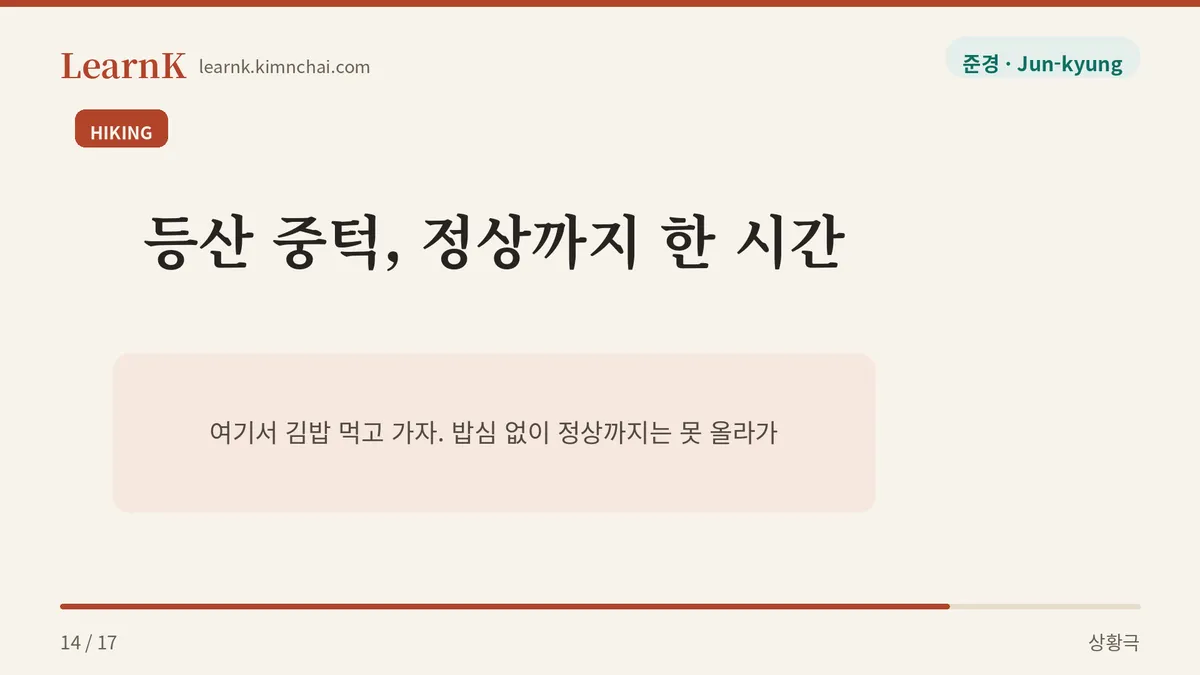
Situation 3 — Halfway up the mountain There’s about an hour left to the summit, and the group’s pace has slowed noticeably. 여기서 김밥 먹고 가자. 밥심 없이 정상까지는 못 올라가. (Yeogiseo gimbap meokgo gaja. Bapsim eopsi jeongsangkkajineun mot ollaga.) Let’s eat our gimbap here. You can’t make it to the top without bapsim.
Politeness levels and similar expressions
밥심 is a noun, so the word itself carries no honorific level. You adjust the height at the end of the sentence — 밥심으로 버텨 (bapsim-euro beotyeo) / 밥심으로 버텨요 (bapsim-euro beotyeoyo) / 밥심으로 버팁니다 (bapsim-euro beotimnida). Just keep in mind that in a truly formal setting, no matter how far you raise the ending, the temperature of the word still won’t match the room.
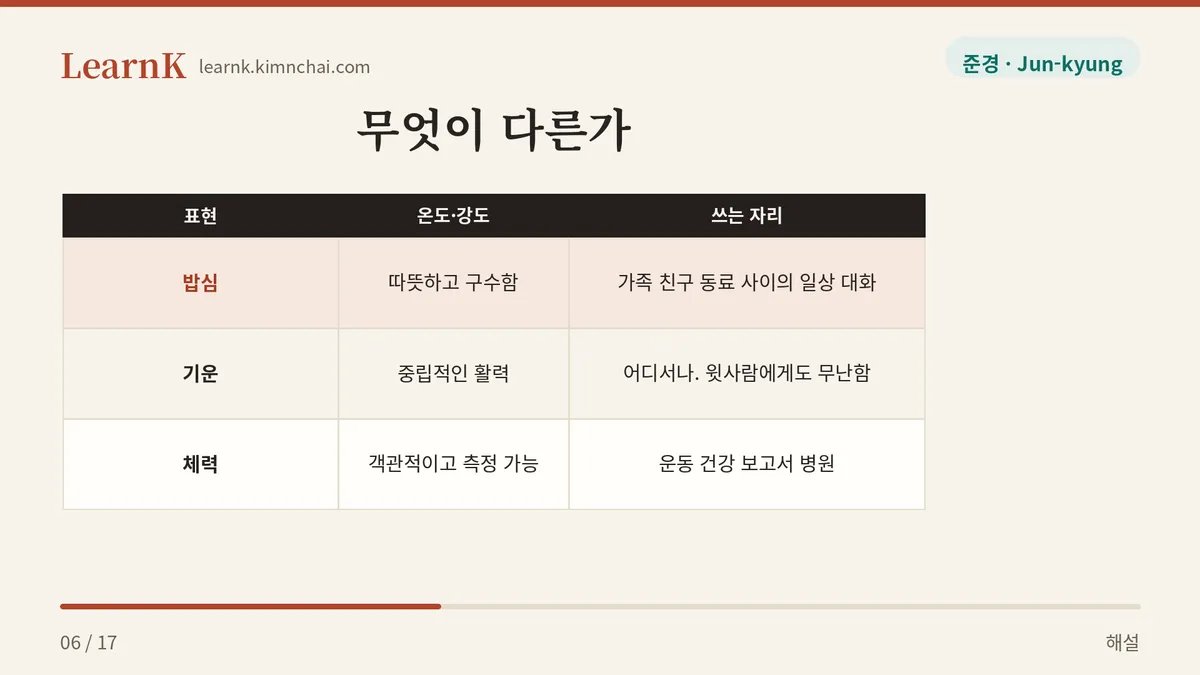
| Expression | Temperature & strength | Where it’s used |
|---|---|---|
| 밥심 (bapsim) | Warm and homespun, with a faint streak of humor | Everyday talk among family, friends, and coworkers. Not used in official documents |
| 기운 (giun) | Neutral. Overall vitality of body and mind | Anywhere. Perfectly fine with people senior to you |
| 체력 (chelyeok) | Neutral and objective; feels measurable | Exercise, health, reports, hospitals |
| 든든하다 (deundeunhada) | Warm fullness and reassurance | Describing how you feel right after finishing a meal |
The difference between 밥심 and 기운 matters most of all. 기운 doesn’t ask where it came from, but with 밥심 the cause is necessarily 밥, food. You don’t call the alertness that comes from a cup of coffee 밥심.
Cultural background — a country where food is the greeting
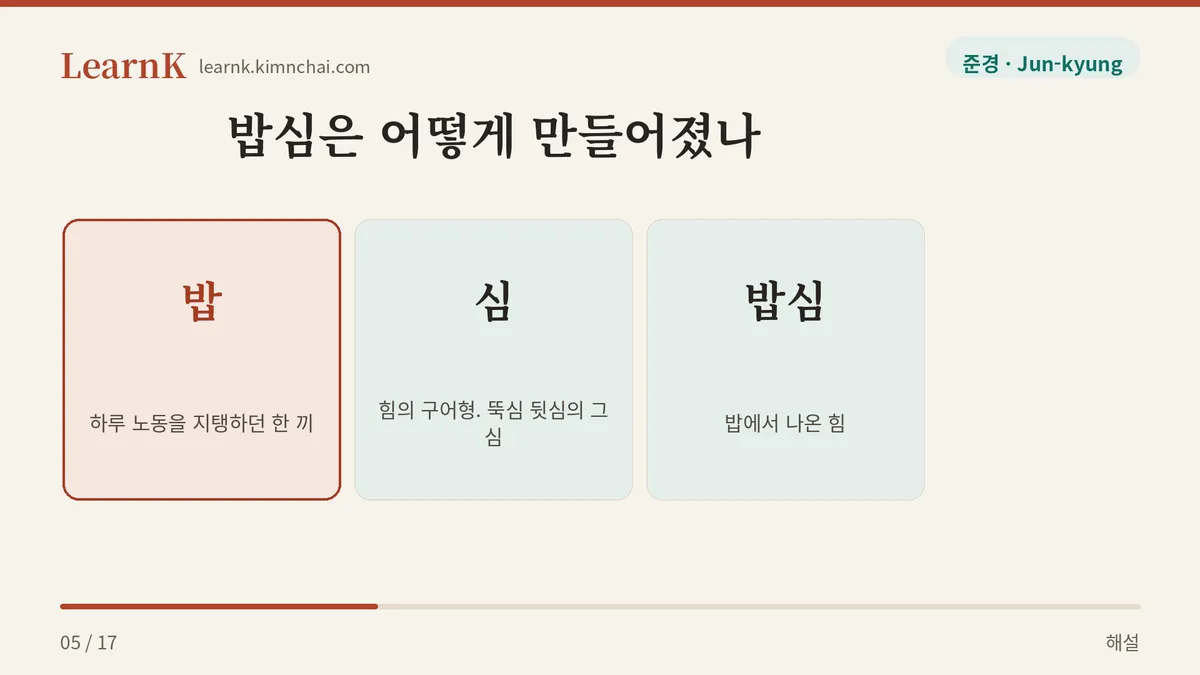
밥심 is 밥 (bap), a meal of rice, joined to 심 (sim), the colloquial form of 힘 (him), strength. Other words built with the same 심 include 뚝심 (ttukssim), the strength that won’t bend, and 뒷심 (dwitssim), the strength to hold out to the very end. 밥심 sets 밥 on top of that family, pressing the strength that comes out of a meal into two syllables.
In Korean, 밥 carries far more than one sitting’s worth of meaning. Making a living is 밥벌이 (bapbeori); what a thing is worth is 밥값 (bapgap); the invitation to get closer is 밥 한번 먹자 (bap hanbeon meokja), “let’s eat sometime”; and the standard how-are-you is 밥은 먹었어? (babeun meogeosseo?), “have you eaten?” The feel of an era when a bowl of rice was literally what carried a day of labor stayed on in the language. That’s why telling someone to make sure they eat doesn’t read as nutritional advice — it reads as worry.
Watch Korean dramas and you can see this sense on screen. Remarkably often, the scene right after characters have a huge fight or lose someone is a scene at a table full of food. Instead of a comforting line, a hand pushing a rice bowl over comes first, and the audience reads the heart of it without a word of dialogue. It’s out of this soil that a show like 《식샤를 합시다》 (Let’s Eat, tvN, 2013), which puts the act of eating at the center of the story, could grow. Think of 밥심 as the spot where that whole culture hardened into a single word.
Today’s quiz
Which word belongs in the blank?
A: 오늘따라 왜 이렇게 힘이 없어? Why are you so out of energy today of all days?
B: 아침을 굶었더니 그래. 나 ( ) 없이는 오후 못 버텨. It’s because I skipped breakfast. I can’t get through the afternoon without ( ).
① 입맛 (immat) ② 밥심 (bapsim) ③ 식욕 (sigyok) ④ 밥맛 (bammat)
The answer is ② 밥심 (bapsim). ①, ③, and ④ all point to a feeling you have before eating — the state of wanting to eat. The only word for the strength that appears after eating is 밥심. B is missing exactly that strength because he couldn’t eat breakfast, so 밥심 is what makes the sentence hold together.
Definitions and example sentences are from the National Institute of Korean Language’s Basic Korean Dictionary (krdict.korean.go.kr); that portion of this post, including our translations, is licensed under CC BY-SA 2.0 KR.