발이 넓다 (bari neolda) — Why Korean Says “Knows a Lot of People” with Feet
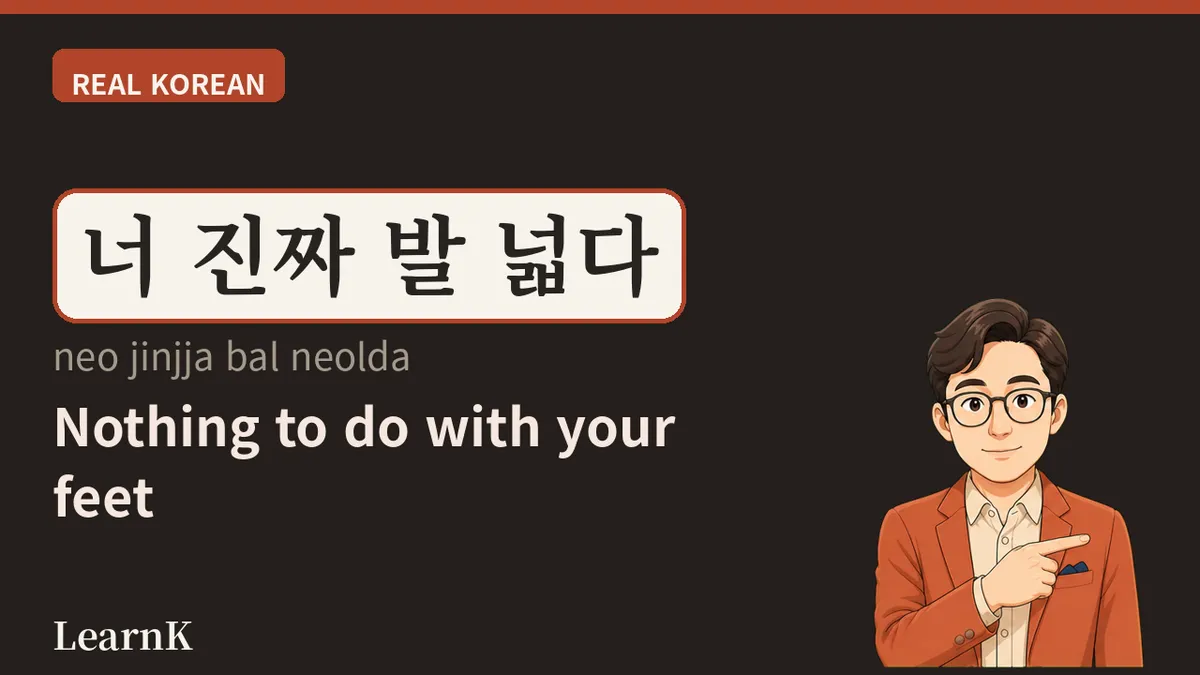
발이 넓다 (bari neolda) describes someone who knows so many people that their connections reach into all sorts of circles and all sorts of fields. When you’re shopping around for a moving company, urgently asking after a decent dentist, or picking the spot for the team dinner — in Korea this phrase comes out before anyone opens a search app. “야, 혹시 아는 사람 없어? (ya, hoksi aneun saram eopseo?)” — Hey, do you happen to know anyone? And in every group there’s always one of them: whatever you’re looking for, they answer, “아, 그거 내가 아는 사람 있는데 (a, geugeo naega aneun saram inneunde)” — Oh, I know someone for that. That’s the person Koreans describe as 발이 넓다 (bari neolda).
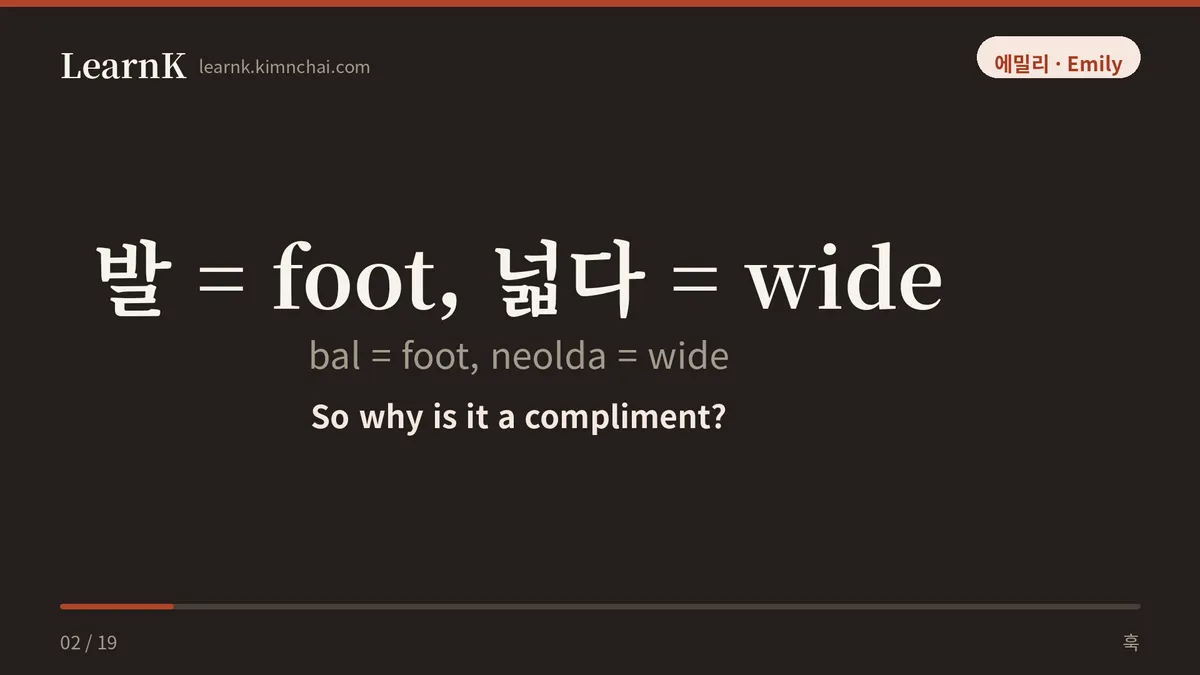
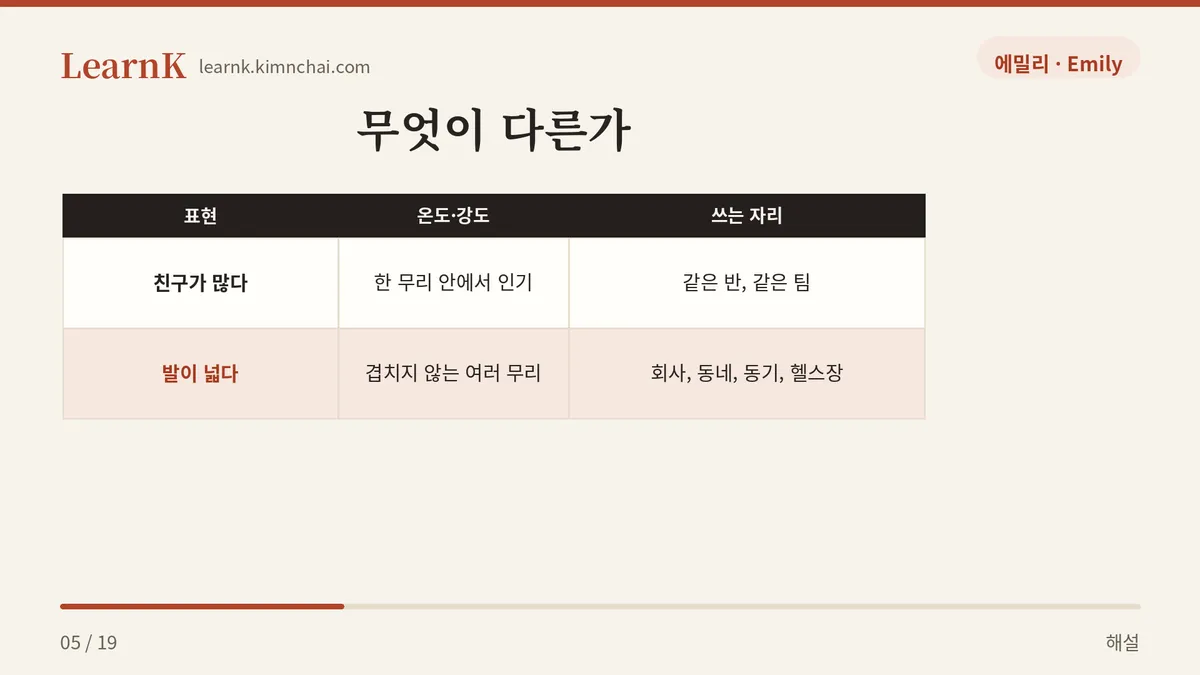
Translated word for word it’s “발 (foot) is 넓다 (wide),” which sounds like you’re talking about the width of someone’s feet — but what it actually points to isn’t the body, it’s relationships. The ground your feet have covered is wide → you’ve been in and out of many places → you know that many people. That’s why it has a different flavor from 친구가 많다 (chinguga manta), “to have a lot of friends.” Having a lot of friends is closer to being well liked inside one group, while 발이 넓다 (bari neolda) means having a foot planted in several circles that don’t overlap with each other. You know people from work, people from the neighborhood, classmates from university, and someone you met at the gym.
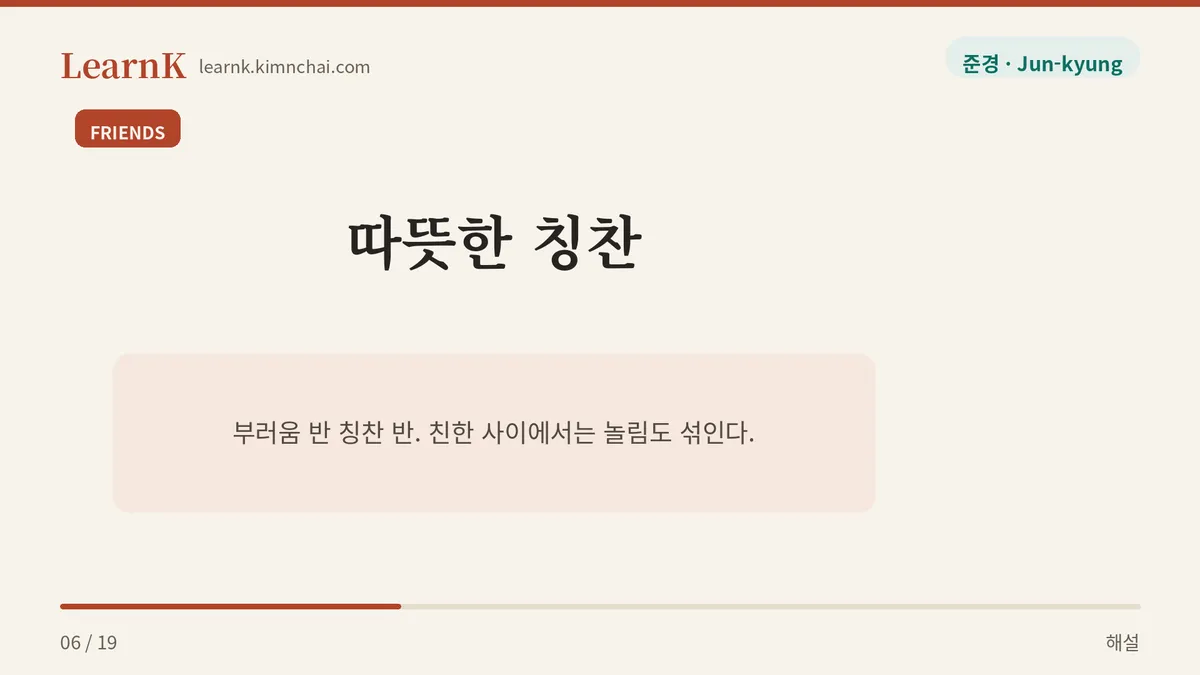
The temperature is generally warm. It’s half envy and half compliment, and between close friends it can come with a bit of light teasing, as in “넌 진짜 발이 넓어 (neon jinjja bari neolbeo)” — You really do know everyone. What matters, though, is that it’s fundamentally something you say about other people. Remembering just this one thing will let you avoid half of the awkward uses below.
A Real Conversation
Scene: the evening of moving day. The boxes are all in, and they’re sitting on the floor of a living room where nothing has been unpacked yet, eating jjajangmyeon.
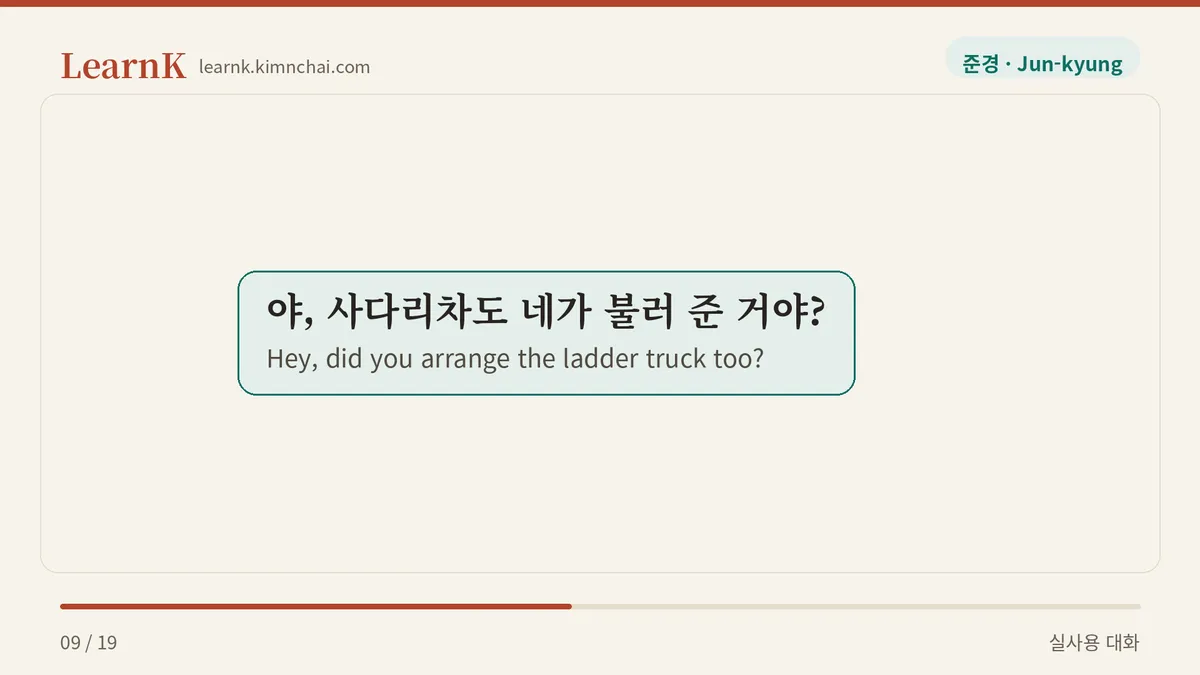
Jun-kyung: 야, 사다리차도 네가 불러 준 거야? 도배까지? Hey, did you arrange the ladder truck too? And the wallpapering?
Emily: 응. 도배는 아랫집 아주머니 조카분이고, 인터넷 기사님은 우리 헬스장에서 만난 분이야. Yeah. The wallpaper guy is the downstairs lady’s nephew, and the internet installer is someone from my gym.
Jun-kyung: 와… 너 진짜 발 넓다. 나 이 동네 3년 살았는데 아는 사람이 편의점 사장님뿐이야. Wow… you really do know everyone. I’ve lived here three years and the only person I know is the convenience store owner.
Emily: 넓긴 뭐가 넓어. 오래 살다 보니까 그냥 얽힌 거지. Wide, my foot. I’ve just been here long enough that it all got tangled together.
Jun-kyung: 아니야, 이건 재능이야. 다음 주 팀 회식 장소도 네가 좀 골라 줘. No, it’s a talent. Pick the spot for our team dinner next week, too.
Emily: 그건 발이 넓은 거랑 아무 상관 없거든? 그냥 지도 앱 켜면 되잖아. That has nothing to do with knowing a lot of people. Just open a map app.
In speech, particles get dropped all the time. Written out the phrase is 발이 넓다, but out loud, “발 넓다” — the way Jun-kyung says it — is far more common.
Where It Sounds Off
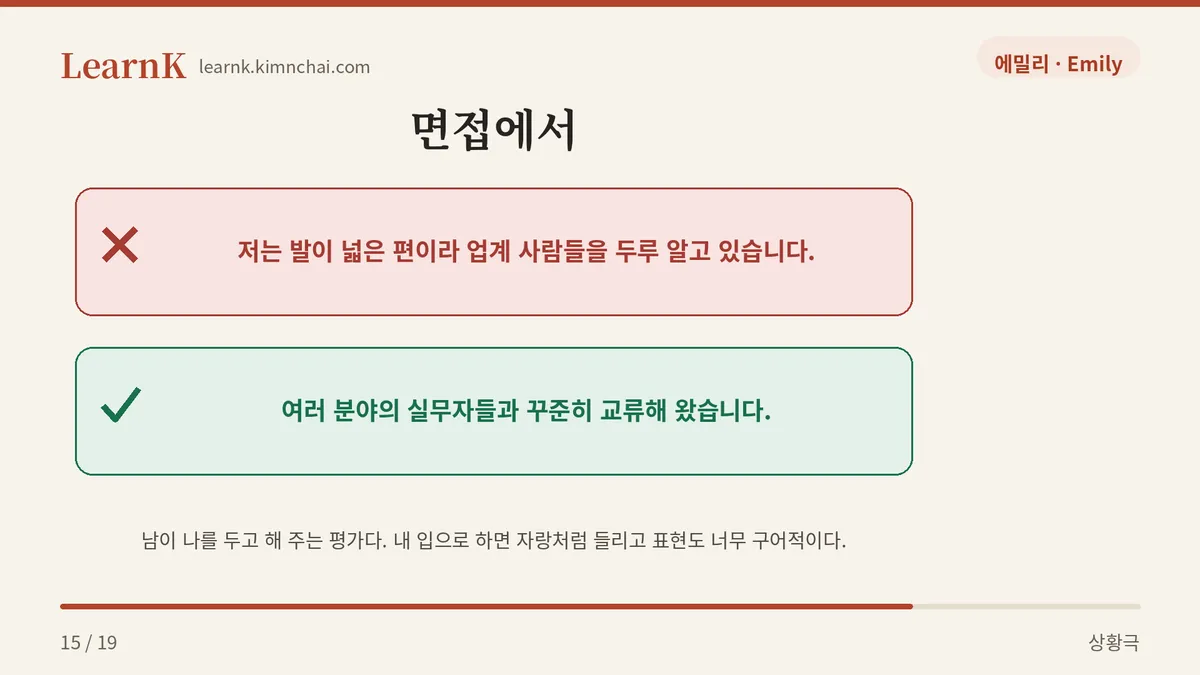
✗ (in a job interview) 저는 발이 넓은 편이라 업계 사람들을 두루 알고 있습니다. (jeoneun bari neolbeun pyeonira eopgye saramdeureul duru algo itseumnida.) I’m the type who knows a lot of people, so I’m acquainted with folks all across the industry.
✓ (in a job interview) 여러 분야의 실무자들과 꾸준히 교류해 왔습니다. (yeoreo bunya-ui silmujadeulgwa kkujunhi gyoryuhae watseumnida.) I’ve maintained steady contact with practitioners across a range of fields.
→ 발이 넓다 (bari neolda) is an assessment other people make about you. Coming out of your own mouth it stops sounding like a statement of fact and starts sounding like bragging — and in a formal setting the expression itself is far too colloquial.
✗ (looking at your seven-year-old nephew) 우리 지호는 발이 넓네. (uri Jiho-neun bari neomne.) Our Jiho sure knows a lot of people.
✓ (looking at your seven-year-old nephew) 우리 지호는 친구가 참 많네. (uri Jiho-neun chinguga cham manne.) Our Jiho sure has a lot of friends.
→ This expression assumes a person out in the world, moving between different social circles. Used on a small child, it lands like a joke about a kid playing grown-up.
Example Sentences by Situation
1) When you have to ask a favor at work You need to find a contact at a new client company and you have no connection whatsoever. In a Korean office, this is the moment you go looking for “that person” inside your own department first.
- 그건 김 대리한테 물어봐. 걔가 발이 넓어서 업계 사람을 다 알아.
- (geugeon Gim daeri-hante mureobwa. gyaega bari neolbeoseo eopgye sarameul da ara.)
- Ask Kim about that. She knows everyone in the industry.
2) At a wedding The back of a wedding hall where the guests just keep pouring in. It’s a place where the bride’s and groom’s relationships become visible as a headcount, which makes it one of the spots where this expression gets used most.
- 신랑이 발이 넓은가 봐. 하객이 끝도 없이 들어와.
- (sillang-i bari neolbeun-ga bwa. hagaeg-i kkeutto eopsi deureowa.)
- The groom must know a lot of people. The guests just keep coming.
3) When you’re talking about the neighborhood Connections don’t only exist at work. The phrase works exactly the same way in the small worlds of a market, a school parents’ group, or an apartment complex. In polite speech, you add ‘-으시- (-eusi-)’.
- 우리 엄마가 이 동네에서 발이 넓으셔서, 이사 오자마자 반찬이 세 집에서 왔어.
- (uri eommaga i dongne-eseo bari neolbeusyeoseo, isa ojamaja banchani se jibeseo wasseo.)
- My mom knows everybody around here — the day we moved in, side dishes arrived from three different households.
Polite and Casual Forms, and Similar Expressions
In casual speech you drop the particle and toss it out short, like “너 발 넓다 (neo bal neolda)” or “발 진짜 넓네 (bal jinjja neomne).” In polite speech the subject is someone senior to you, so “발이 넓으시네요 (bari neolbeusineyo)” and “발이 참 넓으신가 봐요 (bari cham neolbeusin-ga bwayo)” are the natural forms. You can use it as a compliment to someone’s face, but it fits casual conversation better than official occasions.
| Expression | Tone & intensity | Where it’s used |
|---|---|---|
| 발이 넓다 (bari neolda) | Warm compliment, mixed with envy | Anywhere in everyday conversation. Said about others |
| 마당발 (madangbal) | Stronger and more colloquial; refers to the person themselves | Among peers and close friends. “그 사람 완전 마당발이야 (geu saram wanjeon madangbarija)” |
| 인맥이 넓다 (inmaegi neolda) | Neutral and dry, with a hint of self-interest | Work conversations, formal settings, documents |
| 오지랖이 넓다 (ojirabi neolda) | Negative, a rebuke | For someone butting into other people’s business. Not a compliment |
Watch out for that last row in particular. Both end in 넓다 (neolda), so learners mix them up constantly — but 발이 넓다 (bari neolda) is a compliment about knowing a lot of people, while 오지랖이 넓다 (ojirabi neolda) is a criticism about barging into other people’s affairs. “선배님, 오지랖이 참 넓으세요 (seonbaenim, ojirabi cham neolbeuseyo)” isn’t praise — it’s picking a fight.
Cultural Background — Relationships Drawn with the Body
Korean has an unusual number of idioms that sketch a person’s character or circumstances using body parts. 손이 크다 (soni keuda, generous with what you spend), 귀가 얇다 (gwiga yalda, easily swayed by what others say), 입이 무겁다 (ibi mugeopda, good at keeping secrets) — and 발이 넓다 (bari neolda). What they share is that they turn an abstract quality into a single visible picture. 발이 넓다 works the same way. The foot stands for the places a person has actually been, and those places being wide means the range their steps have reached is large. Relationships, imagined as surface area.
There’s a reason this expression gets so much use. In Korea, information and opportunity flow through people as much as through search bars. A good hospital, a trustworthy interior contractor, even a new job — these often arrive by way of “someone who knows someone.” So a person with 발이 넓다 isn’t simply sociable; they’re seen as practically useful. The number of guests at a wedding, or the speed at which news of a death spreads by text message, makes that web of relationships visible in the same way.
This person is a familiar figure in dramas, too. When the protagonist is backed into a corner, a supporting character shows up saying “내가 아는 사람이 하나 있는데 (naega aneun sarami hana inneunde)” — I know someone — and hands over the thread that unravels everything. A story structure where the key isn’t information but connections is extremely common in Korean dramas. When a character like that appears, viewers naturally think, “쟤 발 넓네 (jyae bal neomne)” — That one knows everybody.
One more thing worth adding: 발이 넓다 doesn’t mean that person’s relationships are all deep. It’s a statement about breadth, not depth, which is why Koreans often flip the expression around and say something like “발은 넓은데 진짜 친한 사람은 없어 (bareun neolbeunde jinjja chinhan sarameun eopseo)” — Knows tons of people, but no one they’re really close to.
Today’s Quiz
Which of the following uses 발이 넓다 (bari neolda) awkwardly?
- 우리 팀장님은 발이 넓으셔서 업계에 모르는 사람이 없어. (uri timjangnimeun bari neolbeusyeoseo eopgye-e moreuneun sarami eopseo.) Our team leader knows so many people there’s no one in the industry she doesn’t know.
- (면접에서) 저는 발이 넓은 편이라 아는 분들이 많습니다. (jeoneun bari neolbeun pyeonira aneun bundeuri mansseumnida.) (in a job interview) I’m the type who knows a lot of people, so I have many acquaintances.
- 형이 발이 넓으니까 형한테 한번 물어보자. (hyeongi bari neolbeunikka hyeonghante hanbeon mureoboja.) My older brother knows a lot of people, so let’s ask him.
See the answer
Answer: 2
발이 넓다 (bari neolda) is closer to an assessment other people make about you. Using it about yourself — and in a formal setting like a job interview, no less — sounds like bragging, and the expression is far too colloquial for the occasion. Here, “여러 분야의 실무자들과 꾸준히 교류해 왔습니다 (yeoreo bunya-ui silmujadeulgwa kkujunhi gyoryuhae watseumnida)” is the safer choice. Sentences 1 and 3 show this expression where it belongs: about someone else, in a relaxed conversation.