발연기 (baryeon-gi): Acting With Your Feet? — The One Word That Shatters Your Immersion
Have you ever been totally absorbed in a drama, only to have your immersion shattered the moment a certain actor appears on screen? It’s clearly a sad scene, but you don’t feel sad at all, and the lines sound like someone reading a textbook out loud. When this happens, Korean viewers leave exactly one word in the comments — 발연기 (baryeon-gi). Today, let’s dig deep into this slang term that every K-drama fan absolutely needs to know.
발연기
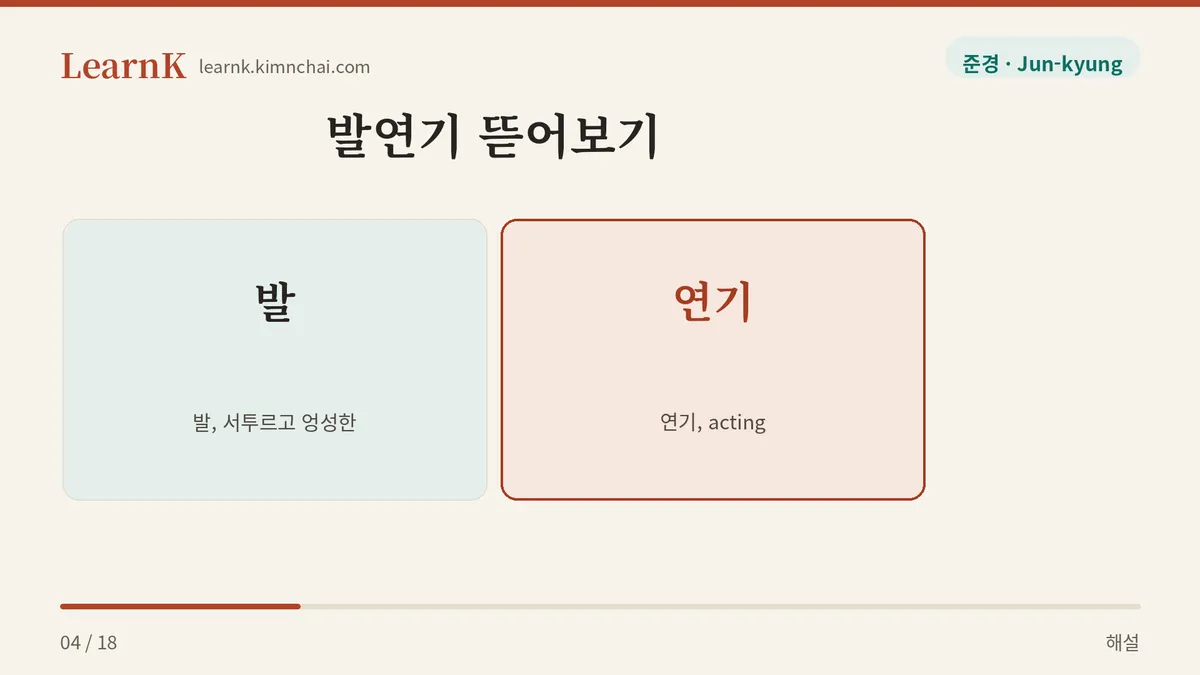
발연기 (baryeon-gi) is a coined word that combines ‘발 (bal, foot)’ and ‘연기 (yeon-gi, 演技, acting)’. Taken literally, it means ‘acting done with your feet’ — in other words, acting that is hopelessly clumsy and terrible. It’s a sarcastic way of saying that acting, which should be done carefully with your hands and your whole body, looks like it was thrown together with someone’s feet.
The key here is the prefix ‘발-’ (bal-). In Korean, attaching ‘발-’ to the front of a noun adds the meaning ‘clumsy and sloppy.’
- 발번역 (bal-beonyeok) — a botched translation
- 발그림 (bal-geurim) — a clumsy drawing
- 발연기 (baryeon-gi) — terrible acting
Once you learn this one pattern, you can understand a whole set of words at once. On the flip side, wonderful acting poured out with all one’s heart isn’t called ‘손 연기 (son yeon-gi, hand acting)’ — instead it’s called 열연 (yeoryeon, passionate acting) or 명연기 (myeong-yeongi, brilliant acting).
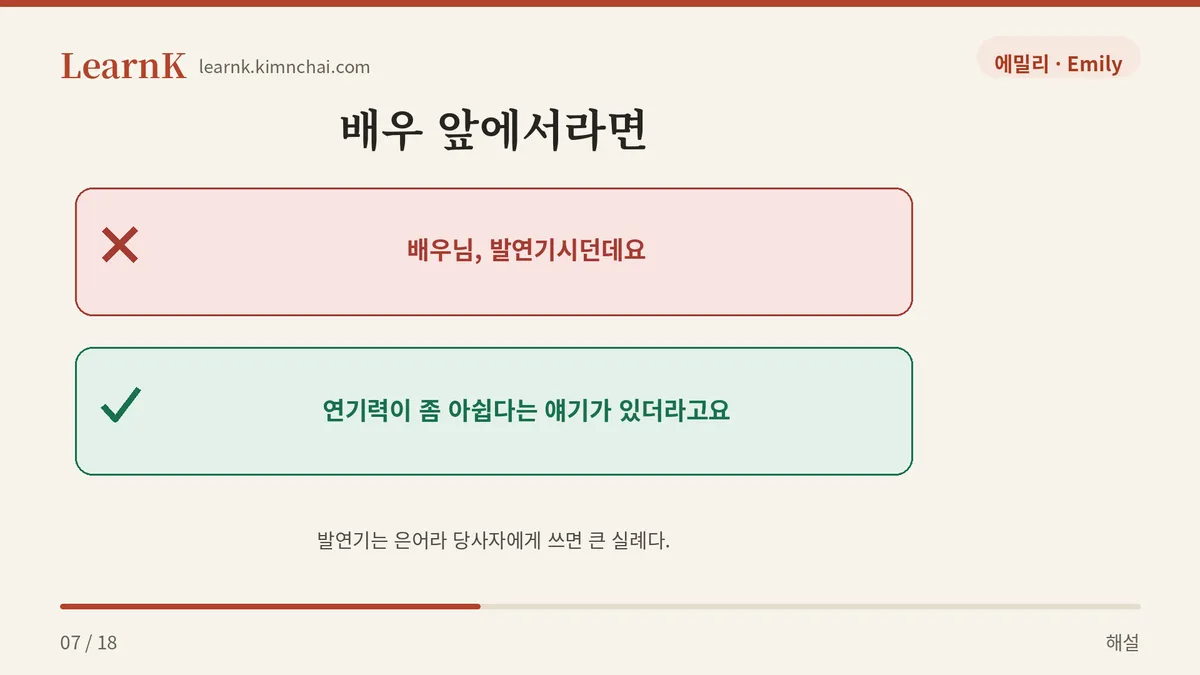
Be careful with the nuance. 발연기 is informal slang, so it’s something friends toss back and forth casually. Using it openly right in front of the actor would be extremely rude.
Seeing It in a Real Conversation
Scene: Saturday night, on the living room couch. Jun-kyung and Emily are watching episode 1 of a drama that just premiered.
준경: 어? 쟤 왜 저래. 우는 장면인데 하나도 안 슬프네. Huh? What’s up with that guy. It’s a crying scene but it’s not sad at all.
에밀리: 그러게. 대사를 그냥 읽는 것 같아. 완전 발연기다. Right? It’s like he’s just reading the lines off a page. Total bad acting.
준경: ㅋㅋ 너 이제 이런 말도 쓰네. 근데 진짜 발로 하는 것 같긴 하다. Haha, you’re even using words like that now. But yeah, it really does look half-baked.
에밀리: 나 여기 산 지 15년이야. 이 정도는 알지. 근데 주인공은 잘하지 않아? I’ve lived here 15 years. I know at least this much. But the lead’s good, right?
준경: 어, 주인공은 괜찮아. 조연 한 명이 자꾸 발연기해서 몰입이 깨져. Yeah, the lead’s fine. One supporting actor keeps acting so badly that it breaks the immersion.
에밀리: 맞아. 저 배우 예능에선 웃긴데 연기는 좀 아쉽다. True. That actor’s funny on variety shows, but the acting’s a bit of a letdown.
Example Sentences by Situation
Example 1 — Walking out of the movie theater (to a friend, casual speech)
Korean: 기대했는데 남자 주인공 발연기 때문에 영화 다 망쳤어.
Romanization: gidaehaenneunde namja jugong baryeon-gi ttaemune yeonghwa da mangchyeosseo.
I had high hopes, but the male lead’s terrible acting ruined the whole movie.
Example 2 — Cutting a rookie actor some slack (casual speech)
Korean: 아직 신인이라 좀 발연기여도 봐줄 만해.
Romanization: ajik sinin-ira jom baryeon-gi-yeodo bwajul manhae.
They’re still a rookie, so even the clumsy acting is somewhat forgivable.
Comparing Formal vs. Casual Speech and Similar Expressions
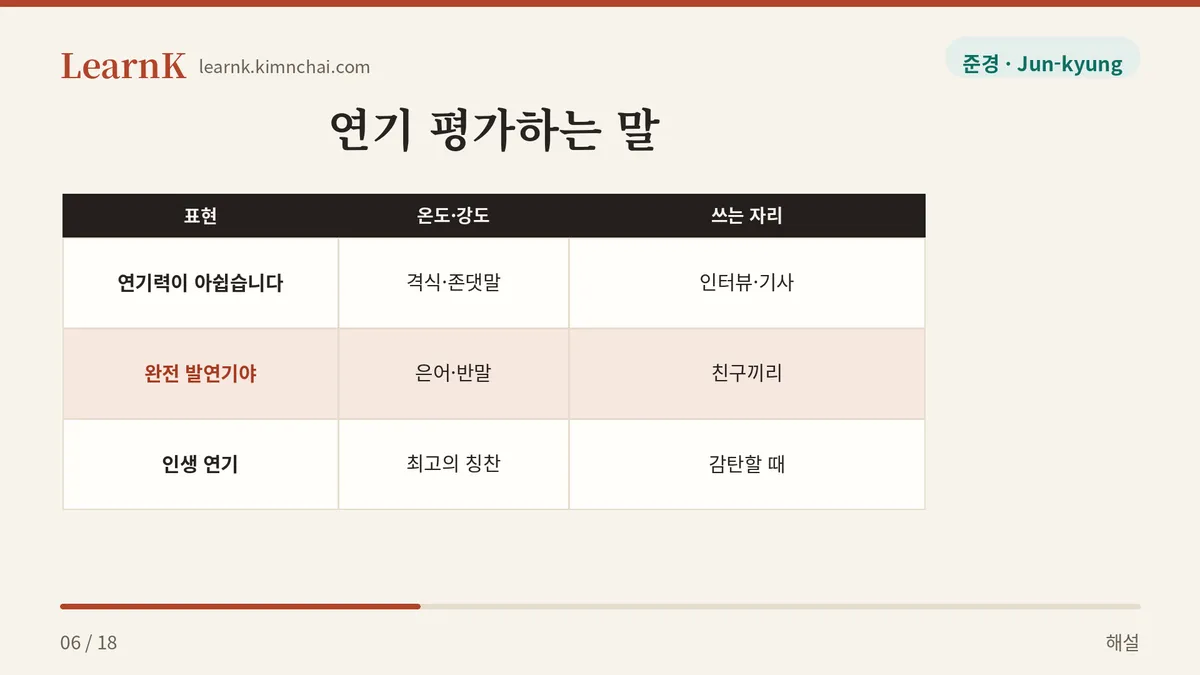
발연기 is slang by nature, so it’s used in casual, informal settings. That’s why, in formal contexts like reporters, critics, or broadcast interviews, people don’t use this word as-is but soften it instead.
- Formal style: 연기력이 아쉽습니다 (yeongiryeogi aswipseumnida) — the acting leaves something to be desired
- Slang (casual): 완전 발연기야 (wanjeon baryeon-giya) — they’re totally terrible at acting
Get to know some related expressions, too. 국어책 읽기 (gugeochaek ilgi) means ‘reading lines with no emotion, as if reading aloud from a Korean-language textbook,’ and it’s a classic symptom of 발연기. 연기력 논란 (yeongiryeok nollan) refers to a situation where an actor’s acting has come under scrutiny. The opposite is 인생 연기 (insaeng yeongi) — literally ‘the best acting of one’s life.‘
Cultural Background
Korea has an unusually strong culture of watching dramas in real time and reacting together in the comments. As a result, people are extremely sensitive to acting ability, and all eyes turn to the broadcasters’ annual Acting Awards each year. In particular, when a singer or idol debuts as an actor, a ‘발연기 논란 (baryeon-gi controversy)’ often follows. When the verdict is that someone sings and does variety shows well but is awkward at emotional acting, viewers immediately turn that scene into a ‘국어책 읽기’ meme and tease it endlessly. So if you learn 발연기, you’ll find it much easier to jump into conversations in K-drama fan communities.
Closing Quiz
What word goes in the blank?
A friend says: 「저 배우 표정이 너무 어색해. 대사도 그냥 읽어. 완전 ___네!」 (‘That actor’s expressions are so awkward. And they just read the lines. Total ___!’)
(Hint: ‘발 (bal)’ + ‘연기 (yeon-gi)’)
Answer: 발연기 (baryeon-gi) — now you can use it with confidence while watching your dramas, right? Just please hold back when you’re right in front of the actor!