복세편살 (bokse-pyeonsal) — "Live Easy in a Complicated World": Four Syllables That Hold a Korean Survival Strategy
복세편살 (bokse-pyeonsal)
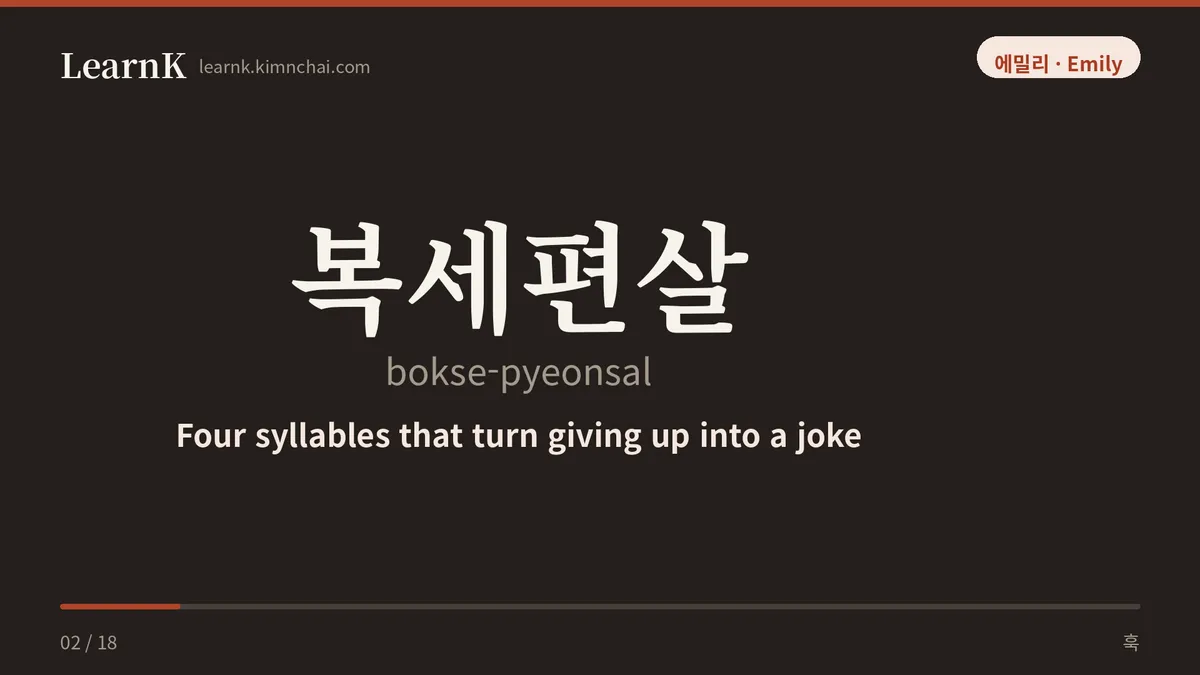
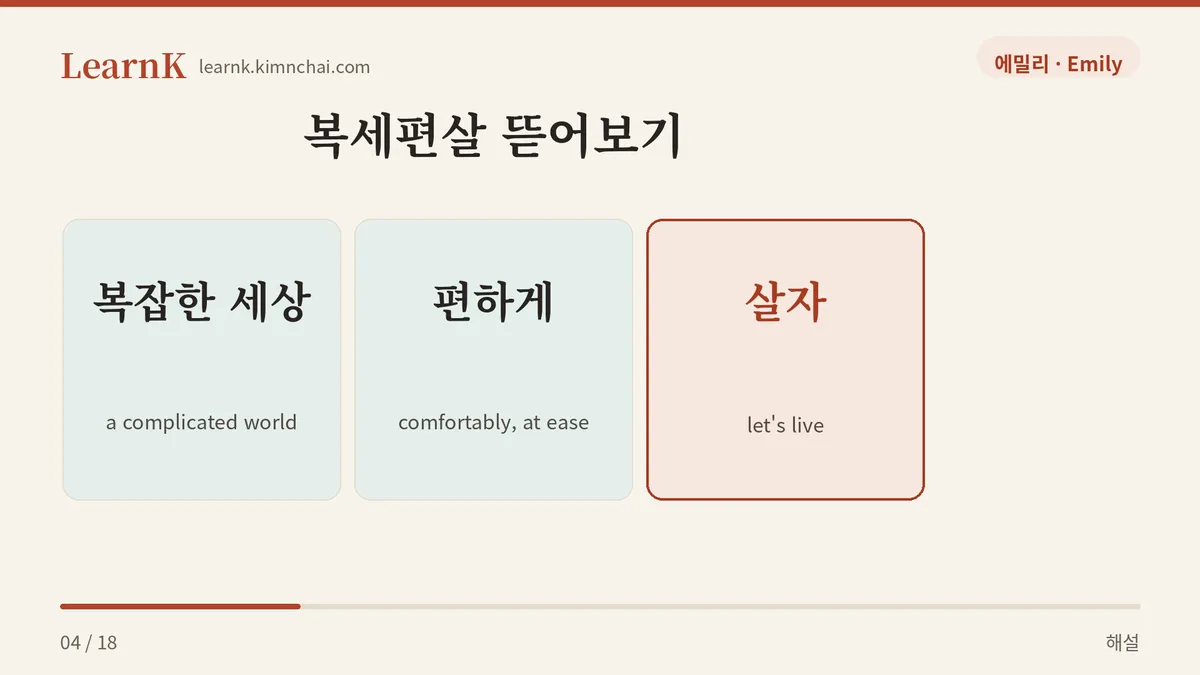
복세편살 (bokse-pyeonsal) is a four-syllable compression of 복잡한 세상 편하게 살자 (bokjaphan sesang pyeonhage salja), “let’s live easy in a complicated world.” It means that instead of straining and scrutinizing every detail, you pick whichever option leaves your mind at ease. Friday evening at the supermarket, after staring at the japchae ingredients for a long while, someone finally reaches for the meal kit in the next section — and as they drop it into the cart, Koreans say this: “복세편살이지 뭐.” (Bokse-pyeonsal-iji mwo. “Eh, live easy in a complicated world.”)
The situations that produce this phrase are mostly alike. It’s the moment you decide not to do something you’re perfectly capable of doing better. Running the robot vacuum instead of mopping by hand. Buying the thing you’ve been comparing for over thirty minutes without another thought. Picking up holiday pancakes at the market instead of frying them yourself. So these four syllables aren’t a confession that you lack the ability — they’re closer to a declaration that you could, but you’ve chosen not to.
The tone is half self-mockery, half good humor. It has the lightness of a single shrug, so the listener usually laughs and goes along with it. There’s a quiet bit of self-defense mixed in too: It’s not that I’m lazy — the world is just too complicated, and this is how I live in it. That’s why 복세편살 (bokse-pyeonsal) isn’t a declaration of surrender but a declaration of re-prioritizing. You didn’t give up on japchae; you placed your mood that evening above the japchae.
It behaves like a noun. You can tack it onto the end of a sentence as a closer, or speak of it as a whole way of living.
- 복세편살이지 (bokse-pyeonsal-iji) — “뭐 어때, 복세편살이지.” (“So what — live easy in a complicated world.”) The period you toss out after making a decision.
- 복세편살로 살다 (bokse-pyeonsallo salda) — “나 요즘 복세편살로 살아.” (“I’ve been living by bokse-pyeonsal lately.”) For pointing to an entire lifestyle.
- 복세편살 하자 (bokse-pyeonsal haja) — “복세편살 하자, 우리.” (“Let’s live easy, you and I.”) For sitting a worn-out friend back down.
Seeing It in a Real Conversation
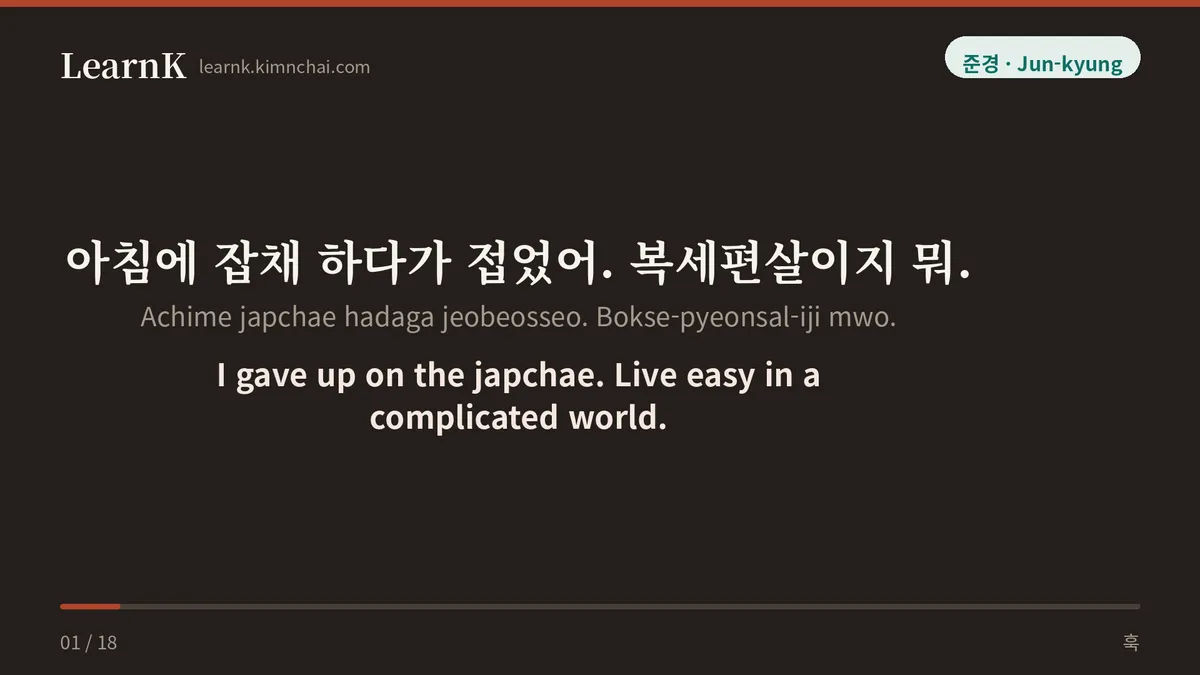
The scene: housewarming day at Jun-kyung’s place. Emily has arrived thirty minutes early, and the dining table is lined with delivery containers.
에밀리: 어? 오빠 오늘 직접 요리한다더니? 이거 다 시킨 거야? Huh? Didn’t you say you’d cook today? Did you order all of this?
준경: 어… 아침에 잡채 하다가 접었어. 복세편살이지 뭐. Yeah… I started making japchae this morning and gave up. Live easy in a complicated world, right?
에밀리: 야, 근데 솔직히 이게 더 맛있겠는데? 잘했어. Hey, honestly this looks better. Good call.
준경: 그치? 세 시간 볶아 놓고 짜다는 소리 듣느니 낫지. Right? Better than stir-frying for three hours and hearing it’s too salty.
에밀리: 인정. 나도 요즘 복세편살로 살아. 나 밥솥 팔았잖아. Agreed. I’m living by bokse-pyeonsal these days too. I sold my rice cooker, you know.
준경: 밥솥을 팔아? 야, 그건 좀 너무 편한 거 아니야? You sold your rice cooker? Hey, isn’t that taking it a bit too far?
When It Sounds Off
✗ (To the chief mourner at a funeral) 너무 상심하지 마세요. 복세편살이잖아요. (“Don’t grieve too much. It’s bokse-pyeonsal, after all.”) ✓ (To the chief mourner at a funeral) 얼마나 힘드세요. 뭐라 드릴 말씀이 없습니다. (“This must be so hard. I don’t know what to say.”) → 복세편살 (bokse-pyeonsal) is a light piece of slang with a shrug built into it. Set down in a place heavy with grief, it doesn’t sound like comfort — it sounds like you couldn’t be bothered.
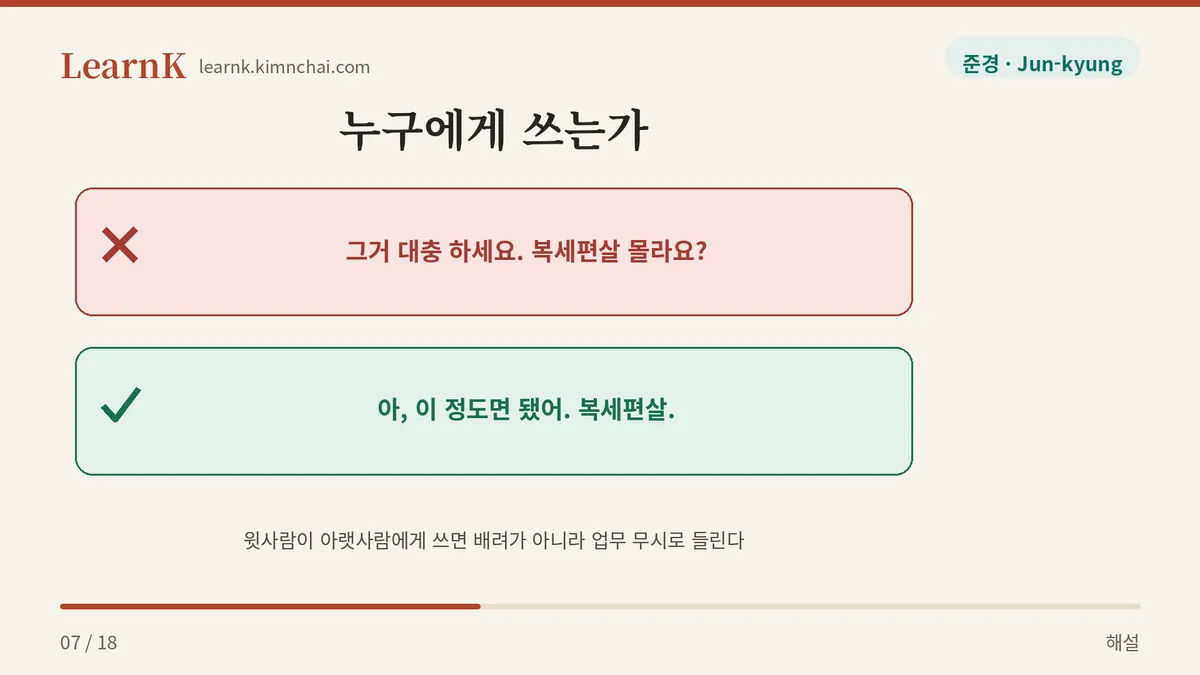
✗ (A team lead to a team member facing a deadline) 그거 대충 하세요. 복세편살 몰라요? (“Just do that one roughly. Haven’t you heard of bokse-pyeonsal?”) ✓ (A team member, to themselves) 아, 이 정도면 됐어. 복세편살. (“Ah, this is good enough. Bokse-pyeonsal.”) → This phrase is fundamentally something you say to yourself. When someone senior says it to someone junior, it doesn’t land as consideration — it lands as dodging responsibility or dismissing the work. It isn’t used to lower someone else’s standards on their behalf.
Example Sentences by Situation
① When you’ve been agonizing over your cart for thirty minutes
No matter how many reviews you read, you can’t tell the difference between the ₩30,000 one and the ₩35,000 one. This is when you hit the payment button and say:
고민할 시간에 그냥 사자. 복세편살. (Gominhal sigane geunyang saja. Bokse-pyeonsal.) Rather than spend the time agonizing, just buy it. Live easy in a complicated world.
② When a friend is worn out by their relationships
To a friend who has been chewing over one line from a group chat for three days now. Instead of solving the problem, this takes some of the weight off.
야, 그 사람 생각 그만하고 우리 복세편살 하자. (Ya, geu saram saenggak geumanhago uri bokse-pyeonsal haja.) Hey, stop thinking about that person — let’s just live easy.
③ At the holiday table
This year you bought the pancakes at the market instead of frying them. The moment someone looks like they’re about to comment, you smile and get there first.
올해는 사 왔어요. 복세편살이 요즘 유행이라잖아요. (Olhaeneun sa wasseoyo. Bokse-pyeonsari yojeum yuhaengiraljanayo.) I bought them this year. They say living easy is the trend these days.
As in that third example, 복세편살 (bokse-pyeonsal) is often used as a device for turning an excuse into a joke. Saying seriously, “I didn’t have time to fry the pancakes,” makes the mood heavy; toss out the four syllables and it passes with a laugh.
Polite Form, Casual Form, and Similar Expressions
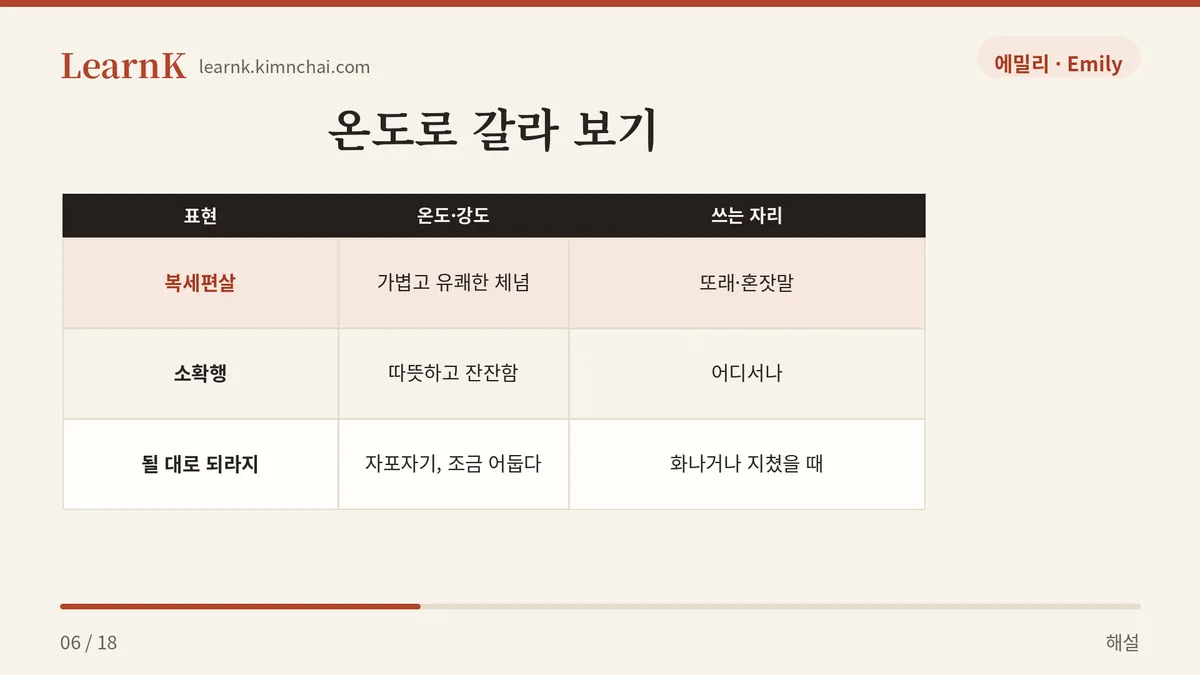
The polite form “복세편살입니다 (bokse-pyeonsal-imnida)” is grammatically possible, but it’s almost never used in a meeting or a report. If it shows up anywhere, it’s somewhere light and smiling — a social media bio, a self-introduction. Lining it up against similar expressions makes its place clearer.
| Expression | Tone & Intensity | Where It’s Used |
|---|---|---|
| 복세편살 (bokse-pyeonsal) | Light, cheerful resignation | Among peers, on social media, to yourself. Not in formal settings |
| 소확행 (sohwakhaeng) | Warm and gentle | Anywhere, including ad copy |
| 마음을 비우다 (maeumeul biuda) | Calm and neutral | Safe even with people senior to you |
| 될 대로 되라지 (doel daero doeraji) | Throwing in the towel; a bit dark | When you’re angry or exhausted |
| 대충 살자 (daechung salja) | Blunter and more self-deprecating | Only with very close friends |
소확행 (sohwakhaeng) is especially easy to confuse with it. 소확행 is about seeking out “small but certain happiness,” while 복세편살 (bokse-pyeonsal) is about taking away what’s hard. Buying freshly baked bread and feeling happy is 소확행; deciding not to bake the bread at all is 복세편살.
Cultural Background — When Four Syllables Become a Life Philosophy
복세편살 (bokse-pyeonsal) takes the first syllable of each word in 복잡한 세상 편하게 살자. Korean has a long habit of compressing a whole sentence into four syllables like this, and in the late 2010s the practice was especially lively. 소확행 (sohwakhaeng) (small but certain happiness), 워라밸 (worabael) (work-life balance), and 얼죽아 (eoljuga) (iced americano even if I freeze to death) all spread around the same period. What’s interesting is that most of these four-syllable coinages point not to objects but to attitudes toward life. What Korean society was wrestling with in that era is stamped directly into its vocabulary.
Behind it lies the fatigue of a long competition. As the single correct answer — good school, good company, good home — grew harder and harder to reach, people stopped chasing that answer and began switching over to standards of their own. 복세편살 is a slogan that compresses that switch into one sentence. That’s why there’s always a trace of defiance mixed into it. Instead of telling the voice that says try harder “I’d rather not,” you smile and toss out four syllables.
This feeling is easy to find in Korean dramas, too. The scene of a worn-out office worker finishing a day in Seoul and boarding a long commute home; stories about characters searching for “room to breathe” rather than success — that was one of the major throughlines of Korean drama in the 2020s. Even when the word 복세편살 never appears in the dialogue, the emotion those scenes draw is exactly what these four syllables carry.
One thing is worth remembering, though. 복세편살 is not the phrase of someone who has genuinely let go of everything. A person truly exhausted to the point of collapse can’t toss this out like a joke. Being able to use these four syllables with a smile is a sign that some slack is still left in them. So when a friend says it, you usually don’t need to worry. It’s when even this phrase stops coming out that you should look closer.
Today’s Quiz
Which of the following uses 복세편살 (bokse-pyeonsal) most naturally?
- (Reporting to your department head) 이번 분기 전략은 복세편살입니다. (“Our strategy this quarter is bokse-pyeonsal.”)
- (Moving day, muttering to yourself as you look at your stuff) 이거 다 버리고 새로 사자. 복세편살. (“Let’s throw all of this out and buy new. Bokse-pyeonsal.”)
- (On hearing that a friend is seriously ill) 복세편살 해, 너무 걱정하지 말고. (“Do the bokse-pyeonsal thing — don’t worry too much.”)
- (In a job interview) 제 좌우명은 복세편살입니다. (“My motto is bokse-pyeonsal.”)
Show the answer
Answer: 2
복세편살 (bokse-pyeonsal) fits best in the moment you decide, for yourself, “not to try so hard.” Number 2 — muttered to yourself in front of a pile of moving boxes — is the classic case.
Numbers 1 and 4 are formal settings. Putting light slang into a report or an interview gives the impression that you’re underprepared. Number 3 makes someone else’s pain lighter on their behalf, so it sounds rude — this phrase is only ever used for your own load.