복선 (bokseon) — Why Koreans Restart Episode One the Moment the Finale Ends
복선 (bokseon)
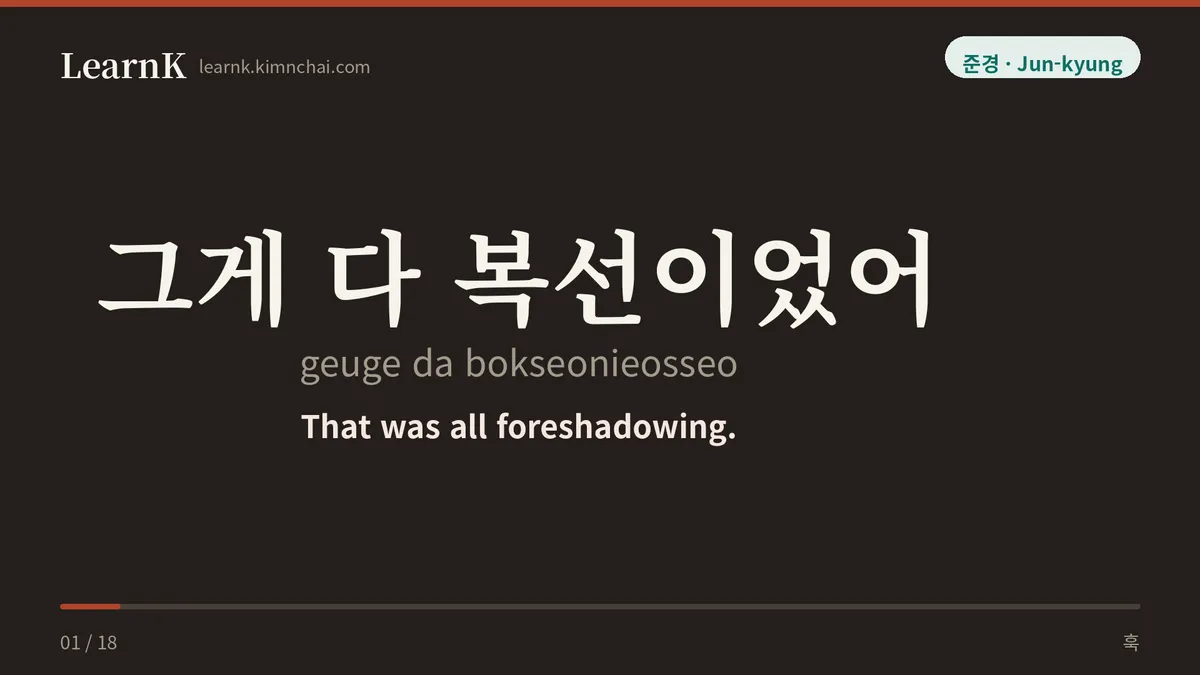
복선 (bokseon) is a device in a novel or a drama that quietly tips the reader off, ahead of time, about an event still to come. There is that moment in the small hours, right after you’ve finished the last episode, when you go “Wait… then that umbrella back in episode one was—” and goosebumps crawl up your back. The very first word Korean viewers type into the chat at that exact moment is 복선 (bokseon).
If you watch Korean dramas with subtitles, chances are you met this word in the comments long before you ever heard it in the dialogue. Posts like 이거 복선 아니냐 (igeo bokseon aninya) — “Isn’t this foreshadowing?” — and 작가님 복선 미쳤다 (jakganim bokseon michyeotda) — “The writer’s foreshadowing is insane” — go up every single week on the message boards of a currently airing drama. This isn’t a word you can just memorize the meaning of and move on. The whole way Koreans enjoy a story is packed inside it.
The fun part is that this word has two faces. Used outside of a story, it means “a plan secretly prepared in advance, just in case.” In a spy thriller or a political drama, 그는 이미 복선을 깔아 두었다 (geuneun imi bokseoneul kkara dueotda) — “he had already laid his 복선” — refers to a contingency the character had quietly set up. That said, in everyday conversation today, the second sense — the storytelling device — is overwhelmingly the more common one.
The one nuance you really need to hold onto is that 복선 is always something you lay down. The mental picture is of something spread flat on the floor in advance, so that you step on it later — which is why the verb that goes with it is almost fixed: 복선을 깔다 (bokseoneul kkalda), “to lay foreshadowing.” And picking that laid-down thread back up at the ending is 복선을 회수하다 (bokseoneul hoesuhada), “to collect the foreshadowing.” When you want to praise it, you say 치밀한 복선 (chimilhan bokseon), “meticulous foreshadowing”; when it’s so obvious that all the air goes out of the room, it’s 진부한 복선 (jinbuhan bokseon), “trite foreshadowing.” So the heart of 복선 is “hidden at first, revealed later.” Something shown openly from the very beginning is not 복선.
Checking it in the National Institute of Korean Language dictionary
복선 (bokseon) (noun)
- A plan secretly prepared in advance in case of an unexpected turn of events. [en] plot; plan — A secret contingency plan that a person makes without others knowing about it. [ja] ふくせん【伏線】 — 万が一の場合に備え、密かに前もって立てておいた計画。 [es] plan secreto — Plan preparado con antelación sin que lo sepa el otro para preparase ante una coyuntura imprevista. [zh] 备用策略 — 为以防万一而在暗地里提前准备的计划。
- In a novel, a play, and so on, the act of hinting to the reader in advance at an event that will happen later. [en] foreshadowing; subplot — A thing used as a hint for readers about an event that will happen in a novel or play, etc. [ja] ふくせん【伏線】 — 小説や戯曲などで、後に起こる事件を前もって読者にほのめかすこと。 [es] insinuación del desarrollo de la trama — Entrega de una pista anticipada al lector sobre un caso que va a ocurrir en una novela u obra. [zh] 伏线,伏笔 — 小说或戏剧等中提前暗示读者未来将发生的事件。 — National Institute of Korean Language, Basic Korean Dictionary (krdict.korean.go.kr)
The dictionary carries no Portuguese gloss, so there was nothing for us to translate. For reference only, it would come out to something like “pista antecipada / presságio na narrativa” — but that line is ours, not the dictionary’s.
Now let’s look at the real usage examples the dictionary provides, exactly as they appear.
그 드라마에서 여주인공이 자꾸 현기증을 느끼는 것은 뒤에 여주인공이 불치병에 걸릴 것의 복선인 것 같다. (geu deuramaeseo yeojuingongi jakku hyeongijeungeul neukkineun geoseun dwie yeojuingongi bulchibyeonge geollil geosui bokseonin geot gatda) “In that drama, the way the heroine keeps getting dizzy seems to be foreshadowing that she’ll be diagnosed with an incurable illness later on.” — National Institute of Korean Language, Basic Korean Dictionary (krdict.korean.go.kr)
Anyone who has watched Korean dramas for a while will laugh at this sentence. The second a lead character gets dizzy for no reason or has a nosebleed, viewers already know where this is going. That state — where nothing has actually happened yet, but you can already say “this is 복선” — is exactly where the word lives.
소설 ‘운수 좋은 날’에서는 시종일관 음울하고 어두운 소설의 배경이 비극적 결말에 대한 복선 구실을 하는 셈이다. (soseol ‘unsu joeun nal’eseoneun sijongilgwan eumulhago eoduun soseorui baegyeongi bigeukjeok gyeolmare daehan bokseon gusireul haneun semida) “In the short story A Lucky Day, the consistently gloomy, dark setting effectively serves as foreshadowing of the tragic ending.” — National Institute of Korean Language, Basic Korean Dictionary (krdict.korean.go.kr)
This example shows that 복선 doesn’t have to be an object or a line of dialogue. Rain falling all day long, weather that just stays dark — the atmosphere itself can be the foreshadowing. This is the usage that comes up most often in Korean literature class at school.
이번 영화는 이야기 자체가 매우 흥미진진합니다. 독자들에게 추리하는 즐거움을 주기 위해 복선도 치밀하게 깔아 두었지요. (ibeon yeonghwaneun iyagi jache-ga mae-u heungmijinjinhamnida. dokjadeurege churihaneun jeulgeoumeul jugi wihae bokseondo chimilhage kkara dueotjiyo) “The story of this film is fascinating in itself. And to give the audience the pleasure of figuring things out, we laid the foreshadowing very meticulously.” — National Institute of Korean Language, Basic Korean Dictionary (krdict.korean.go.kr)
This is how a creator talks about their own work. Directors and writers really do say this in interviews and at press screenings. 복선도 치밀하게 깔아 두었다 (bokseondo chimilhage kkara dueotda) is a chunk worth memorizing whole.
복선을 깔다. (bokseoneul kkalda) “To lay foreshadowing.” — National Institute of Korean Language, Basic Korean Dictionary (krdict.korean.go.kr)
The dictionary lists this separately as a short collocation — a pairing that habitually travels together. In other words, the dictionary itself is telling you that 복선 attaches to 깔다 (kkalda, “to lay/spread”) rather than to 놓다 (nota, “to put”) or 만들다 (mandeulda, “to make”).
A real conversation
Situation: Sunday night, the living room of Jun-kyung’s apartment. The drama’s finale has just ended, and Jun-kyung has immediately started episode one again.
준경: 야, 잠깐만. 나 지금 1화 다시 볼래. 진짜 미치겠다. Hey, hold on. I’m rewatching episode one right now. This is driving me crazy.
에밀리: 왜, 뭐 놓친 거 있어? Why, did you miss something?
준경: 1화에서 걔가 우산 두 개 들고 나왔잖아. 그게 다 복선이었어. In episode one, he came out holding two umbrellas, remember? That was all foreshadowing.
에밀리: 헐. 그럼 아까 그 편지도…? 작가님 복선 진짜 치밀하게 깔았네. Whoa. Then that letter earlier too…? The writer really laid the foreshadowing out meticulously.
준경: 그러니까. 나만 몰랐지. 눈치 빠른 사람들은 3화에서 이미 다 알았대. Right? I was the only one who didn’t get it. Apparently the sharp viewers had it figured out back in episode three.
에밀리: 됐어, 그냥 처음부터 같이 다시 보자. 2회차부턴 다 보인다니까. Forget it, let’s just rewatch it together from the start. On a second watch you see everything.
This sounds off
✗ (after a friend says, “I haven’t been feeling well lately, so I got some tests done”) 아, 지난달에 계속 피곤하다더니 그게 복선이었네. (a, jinandare gyesok pigonhadadeoni geuge bokseonieonne) — “Ah, you kept saying you were tired last month — that was the foreshadowing.” ✓ (to your friend) 그때 많이 힘들었겠다. 결과는 언제 나와? (geuttae mani himdeureotgetda. gyeolgwaneun eonje nawa?) — “That must have been really rough. When do the results come in?” → 복선 is a device belonging to made-up stories. Pinning it onto a real person’s illness turns their life into a spectacle. For real events, something like 그때 징조였나 봐 (geuttae jingjoyeonna bwa), “I guess that was a sign,” is at least better — and most of the time, saying nothing at all is better still.
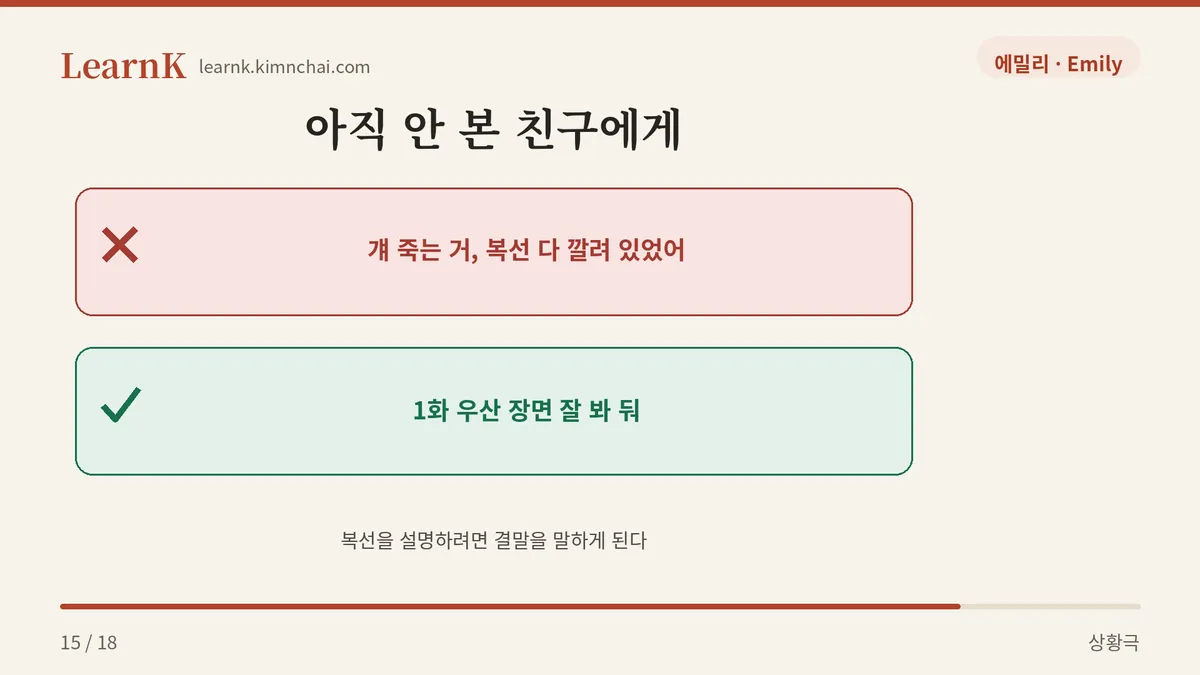
✗ (to a friend who hasn’t watched the drama yet) 너 마지막에 걔 죽는 거, 복선 다 깔려 있었어. 1화 우산 장면 보면 알아. (neo majimage gyae jungneun geo, bokseon da kkallyeo isseosseo. ilhwa usan jangmyeon bomyeon ara) — “The fact that he dies at the end — the foreshadowing was all there. Watch the umbrella scene in episode one and you’ll see.” ✓ (to a friend who hasn’t watched the drama yet) 1화 우산 장면 잘 봐 둬. 나중에 다시 생각날 거야. (ilhwa usan jangmyeon jal bwa dwo. najunge dasi saenggangnal geoya) — “Pay close attention to the umbrella scene in episode one. It’ll come back to you later.” → To explain foreshadowing, you have no choice but to give away the ending. Spoilers are a fairly sensitive matter in Korea, so this is a word you bring out only after checking that everyone in the room has already finished the show.
Example sentences by situation
Situation 1 — In the group chat where you’re all watching the same drama. The show is still airing, so nobody knows the ending yet; when a suspicious scene comes up, you toss this out.
- 이 장면 복선 같지 않아? (i jangmyeon bokseon gatji anha?) — “Doesn’t this scene feel like foreshadowing?”
Situation 2 — Chewing over something your boss said at work. Here it’s the first meaning — “a plan quietly prepared in advance.” It’s often used half-jokingly.
- 부장님 그 말씀에 복선이 깔려 있었던 것 같아요. (bujangnim geu malsseume bokseoni kkallyeo itdeon geot gatayo) — “I think there was something laid underneath what the manager said.”
Situation 3 — In a writing class or a workshop critique. In a teaching or advice-giving register, it comes out like this.
- 결말을 살리려면 복선을 미리 깔아 두세요. (gyeolmareul sallyeoryeomyeon bokseoneul miri kkara duseyo) — “If you want the ending to land, lay your foreshadowing in advance.”
Formal vs. casual speech, and similar words
복선 is a noun, so the word itself carries no politeness level. The only thing that changes is the predicate you attach to it — casually, 이거 복선이야 (igeo bokseoniya); politely, 이건 복선인 것 같아요 (igeon bokseonin geot gatayo). So the word itself is perfectly safe to use in front of someone older or senior to you. The real differences lie among its near-synonyms.
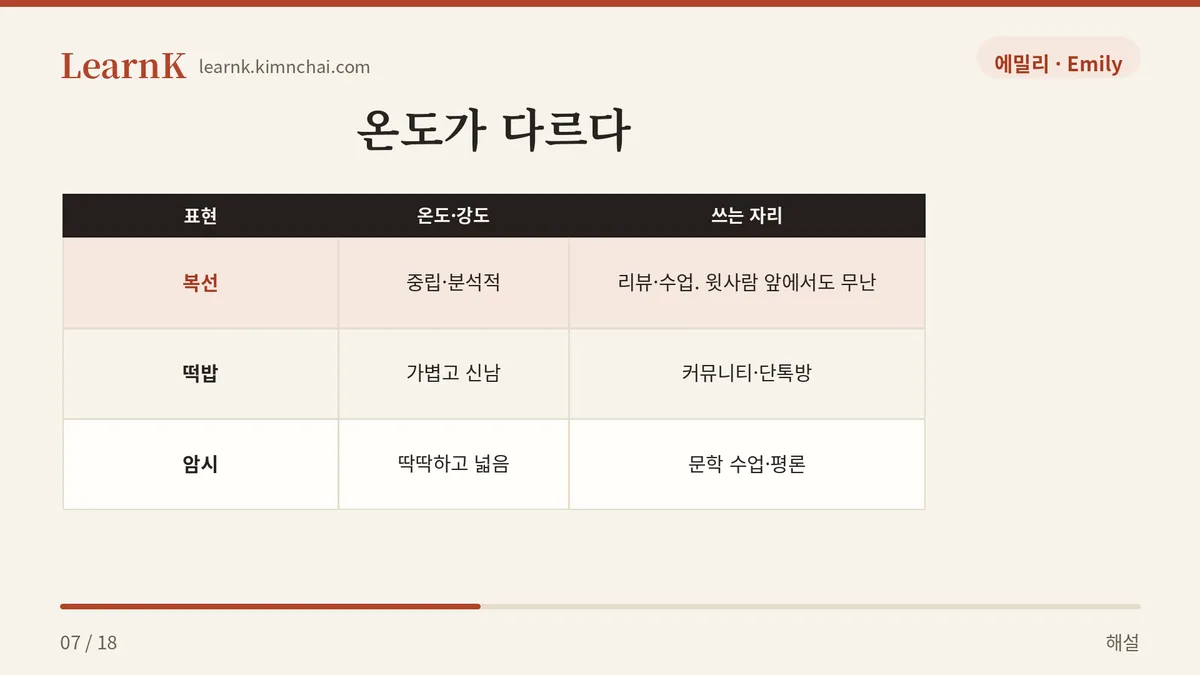
| Expression | Temperature & intensity | Where it belongs |
|---|---|---|
| 복선 (bokseon) | Neutral, analytical | Reviews, commentary, the classroom. Safe in front of seniors |
| 떡밥 (tteokbap) | Light and excited | Online communities, group chats. Not for reports or class presentations |
| 암시 (amsi) | Stiff, and broader in scope | Literature classes, criticism. Used even outside storytelling devices |
| 반전 (banjeon) | The instant the surprise detonates | Refers to the twist itself. A twist only lands if 복선 was laid first |
떡밥 (tteokbap) is worth a closer look: it originally means fishing bait, and it hardened in online communities into “the device that hooks the viewer.” Its meaning overlaps almost entirely with 복선, but the temperature is different. Telling your professor 이 소설은 떡밥이 좋습니다 (i soseoreun tteokbabi jossseumnida), “this novel’s bait is great,” comes off as flippant; telling a friend 이 드라마 복선 구조가 정교하다 (i deurama bokseon gujoga jeonggyohada), “this drama’s foreshadowing structure is intricate,” makes you sound like you’re writing a thesis by yourself. Just read the room and pick.
Cultural background — the night you restart episode one
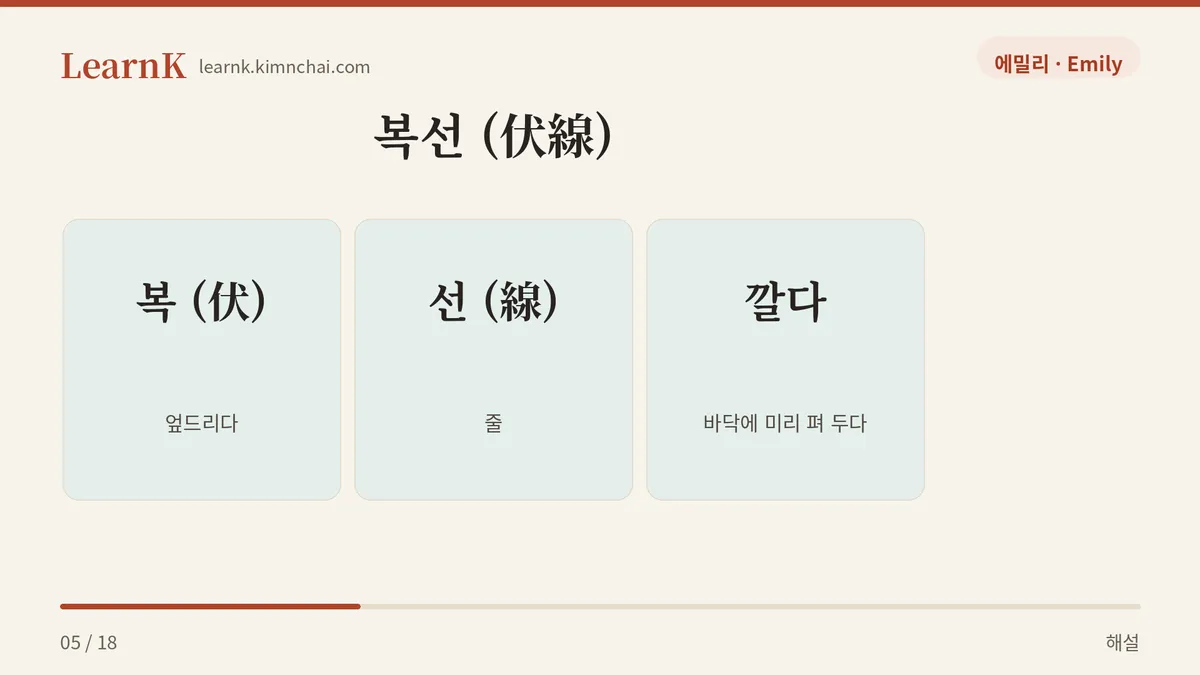
The hanja behind 복선 are 엎드릴 복 (伏), “to lie face down,” and 줄 선 (線), “line.” Literally, “a line lying hidden, face down.” It’s pressed flat against the floor, so you don’t see it the first time you walk past — you only see it on the way back. Hold that image and you’ll understand on your own why the pairing 복선을 깔다 (bokseoneul kkalda) became so fixed. For the record, there’s a homophone 복선 (複線) as well, but that one means a double-track railway — a completely different word.
There’s a reason this word gets used so heavily in Korea. For a long time, Korean dramas aired twice a week over the course of several weeks. That leaves three or four empty days until the next episode, and viewers have nothing to do in between. So they gathered on message boards and picked the last episode apart frame by frame, playing detective. Why did that guy look at his watch right there? Why was that line delivered twice? A culture grew up naturally in which whoever guessed the ending before the finale aired became a hero — and the shared language of that game was 복선.
That’s why Korean has a separate phrase, 정주행 2회차 (jeongjuhaeng ihoecha), “second full run-through”: watching a show from the very beginning again after you already know the ending. The pleasure of that second viewing depends entirely on 복선. A well-made work becomes a completely different story the second time around. Take Signal (tvN, 2016), where past and present are connected by a single old walkie-talkie — Korean viewers especially love that structure, where one object you glanced past early on turns out to mean something entirely different by the end. When people say 복선 회수 완벽했다 (bokseon hoesu wanbyeokhaetda), “the foreshadowing payoff was perfect,” after an ending airs, that’s one of the highest compliments a work can receive.
Today’s quiz
Which of the following uses 복선 most naturally?
- 어제 내가 지갑을 잃어버린 게 복선이었어. (eoje naega jigabeul irheobeorin ge bokseonieosseo) — “Me losing my wallet yesterday was foreshadowing.”
- 이 드라마, 1화에 나온 그 편지가 복선이었네. (i deurama, ilhwae naon geu pyeonjiga bokseonieonne) — “This drama — that letter back in episode one was the foreshadowing.”
- 비 온다길래 우산을 복선했어. (bi ondagillae usaneul bokseonhaesseo) — “They said it’d rain, so I foreshadowed an umbrella.”
The answer is number 2. 복선 is a device inside a story that hints in advance at what’s coming, so number 2 — looking back after seeing the ending and going “ah, so that was the foreshadowing” — is the accurate use. Number 1 is something that actually happened to you in real life, so you don’t call it 복선; and number 3 doesn’t work at all, because 복선 is not a verb. Remember: 복선 always travels together with 깔다 (kkalda).
Definitions and example sentences are from the National Institute of Korean Language’s Basic Korean Dictionary (krdict.korean.go.kr); that portion of this post, including our translations, is licensed under CC BY-SA 2.0 KR.