불금 (bulgeum) — The Two Syllables That Only Light Up on Friday Night
불금 (bulgeum)
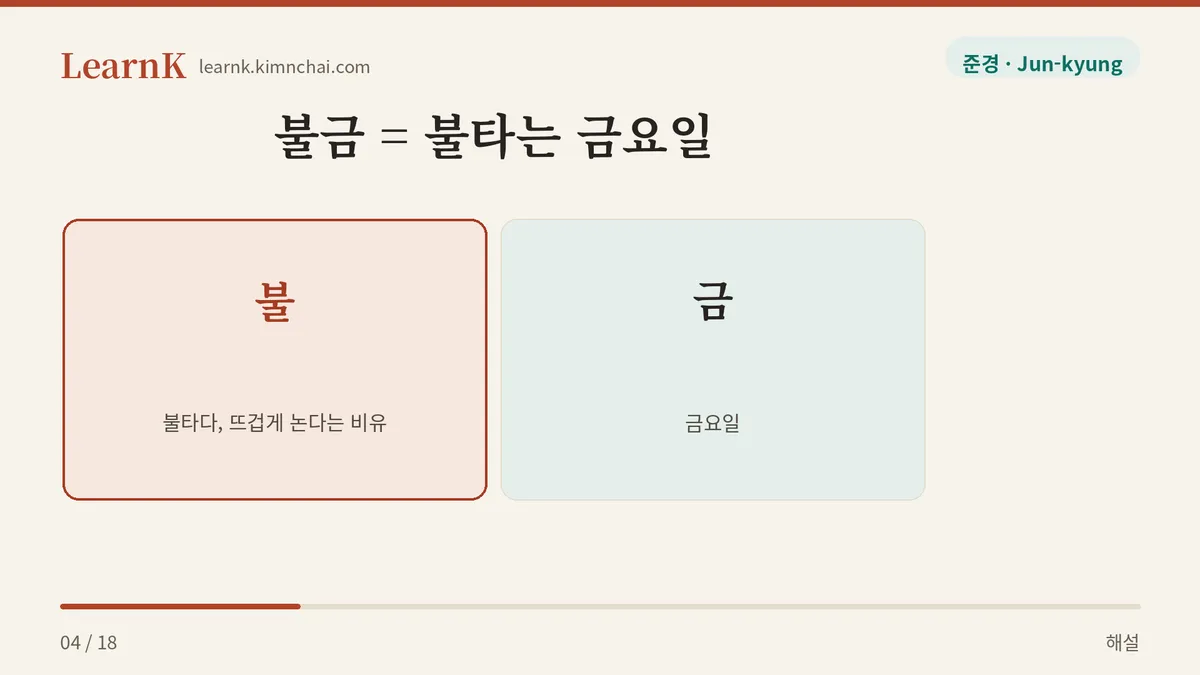
Once it’s past five o’clock on a Friday afternoon, the air in a Korean office changes. Nobody starts anything new, and “저녁에 뭐 해? (jeonyeoge mwo hae?)” — “what are you doing tonight?” — starts making the rounds in the group chat. This is exactly the moment people reach for the word 불금 (bulgeum). 불금 (bulgeum) is a shortened form of 불타는 금요일 (bultaneun geumyoil), “burning Friday,” and it means throwing yourself into Friday night now that the week’s work is finished. It’s the one night you don’t have to get up for work the next morning, and these two syllables hold the resolve not to let that night just slip away.
So 불금 (bulgeum) is less the name of a weekday than the name of a feeling. Friday comes around on the calendar every week, but if you’ve been scheduled for overtime or an exam is right around the corner, that Friday isn’t 불금 (bulgeum). Flip it around: on an uneventful Friday evening, sitting outside a convenience store and cracking open a single can of beer counts as an excellent 불금 (bulgeum). It isn’t a word that requires glamorous plans — it only requires that feeling of release, of “tonight is mine to spend however I like.”
Inside a sentence, it usually shows up like this: 불금이다 (bulgeumida), 불금인데 (bulgeuminde), 불금을 보내다 (bulgeumeul bonaeda), 불금을 즐기다 (bulgeumeul jeulgida). As a parting greeting, people say things like 불금 잘 보내세요 (bulgeum jal bonaeseyo) — “have a good 불금.” Online, it gets shortened even further into 즐불금 (jeulbulgeum, from 즐거운 불금 / jeulgeoun bulgeum, “a fun 불금”).
The temperature of the word is light and giddy. It’s spread far enough to turn up in ad copy and on shop signs, but because its roots are in slang and abbreviation, it still sounds casual in formal settings. This is the exact spot where learners trip up most often.
See It in a Real Conversation
Scene: Friday evening, seven o’clock, at a parasol table outside a neighborhood convenience store. Jun-kyung is walking out with a can of beer when he runs into Emily on her way home from work.
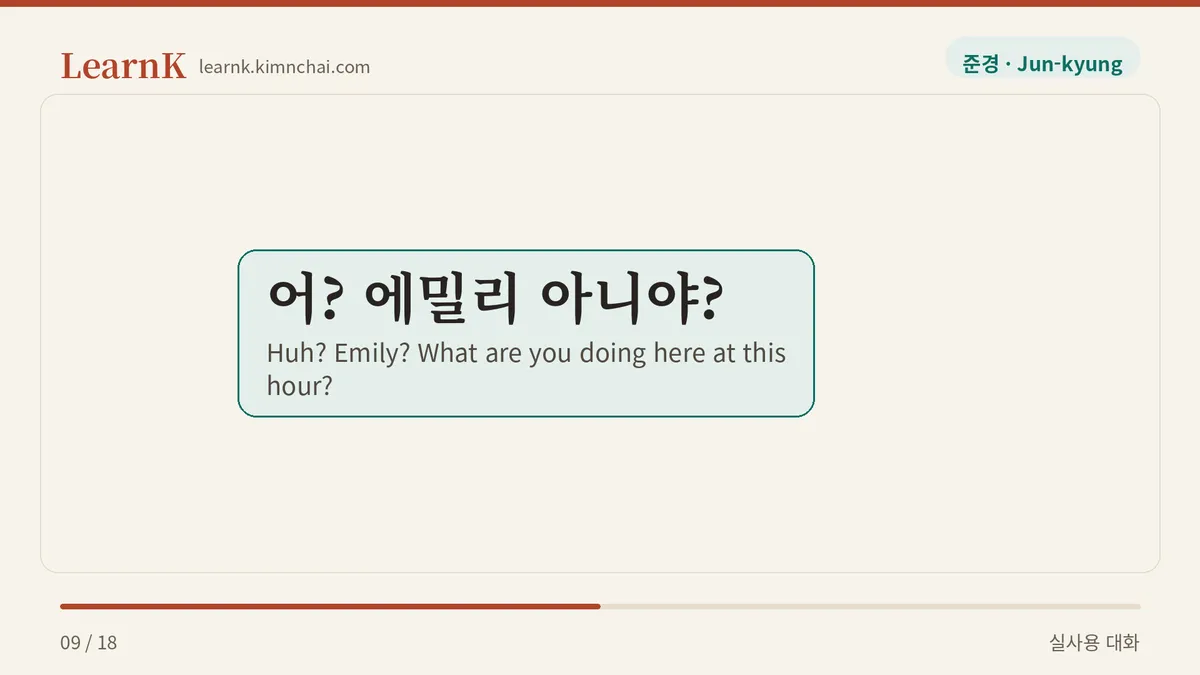
Jun-kyung: 어? 에밀리 아니야? 이 시간에 여기 웬일이야. Huh? Emily? What are you doing here at this hour?
Emily: 방금 퇴근했지. 근데 너 손에 든 거 뭐야, 벌써 시작했네? I just got off work. What’s that in your hand — you started already?
Jun-kyung: 불금인데 이 정도는 해야지. 너도 하나 사 와, 여기 앉아. It’s bulgeum, I’ve earned at least this much. Go grab one, sit here.
Emily: 나 오늘은 그냥 집 가서 눕고 싶어. 이번 주에 야근을 세 번 했어. I just want to go home and lie down today. I worked late three times this week.
Jun-kyung: 야, 누워 있는 것도 불금이야. 꼭 나가서 놀아야 불금이냐? Hey, lying down is bulgeum too. Who says you have to go out for it to count?
Emily: 그건 맞는 말이네. 그럼 나도 딱 한 캔만 사 올게. Fair enough. Okay, I’ll grab just one can then.
This Sounds Unnatural
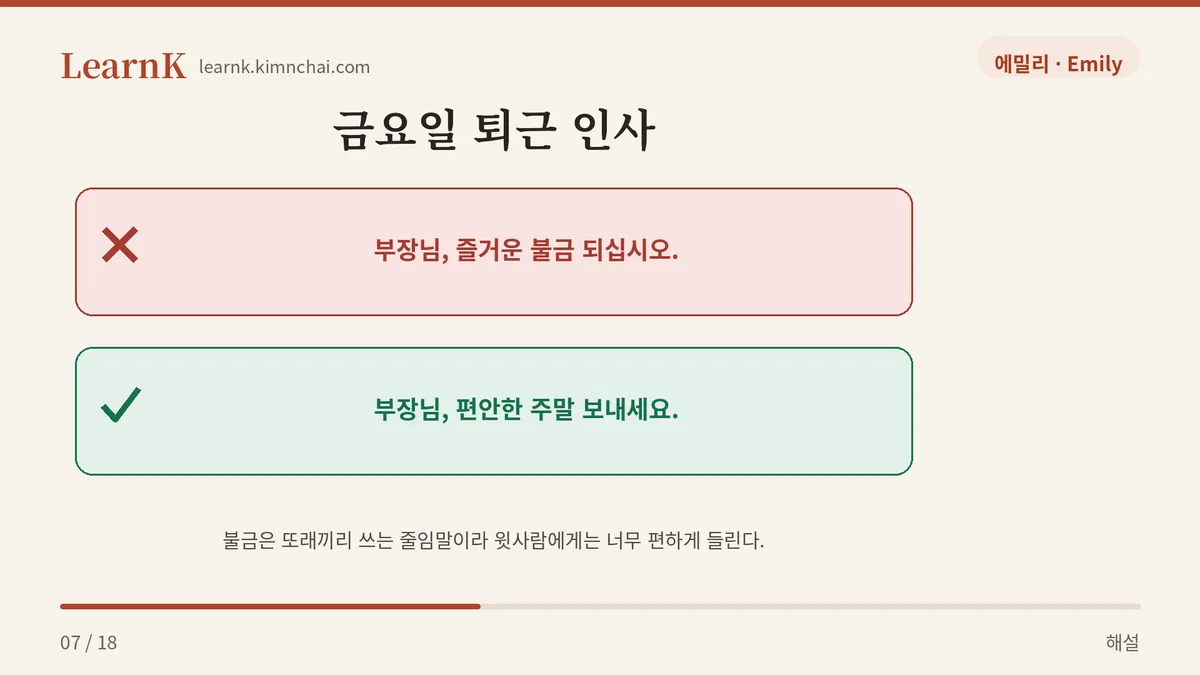
✗ (as a Friday sign-off to your department head) 부장님, 즐거운 불금 되십시오. (bujangnim, jeulgeoun bulgeum doesipsio.) ✓ (to your department head) 부장님, 편안한 주말 보내세요. (bujangnim, pyeonanhan jumal bonaeseyo. — “Have a restful weekend, sir.”) → 불금 (bulgeum) is clipped slang that peers use with each other. Using it with someone senior to you or with a client doesn’t come across as rude, exactly — it comes across as being too familiar. A close 선배 (seonbae, senior colleague) is fine, but for official greetings, emails, and documents, “주말 잘 보내세요 (jumal jal bonaeseyo)” is the safe choice.
✗ (out having fun on a Saturday night) 오늘 진짜 불금이다! (oneul jinjja bulgeumida!) ✓ (out having fun on a Saturday night) 오늘 진짜 **불토 (bulto)**다! (oneul jinjja bultoda!) → The 금 (geum) in 불금 (bulgeum) is 금요일 (geumyoil, Friday). It doesn’t mean “an exciting night” that you can stick onto any night at all — the day of the week is baked in. Saturday night gets its own word: 불토 (bulto).
Example Sentences by Situation
1) Thursday evening, making plans with a coworker for the next day
People often float the idea a day early rather than on Friday itself. Here, 불금 (bulgeum) works as a roundabout way of asking, “Are you free tomorrow evening?”
내일 불금인데 뭐 할 거야? 아무 계획 없으면 같이 저녁 먹자. (naeil bulgeuminde mwo hal geoya? amu gyehoek eopseumyeon gachi jeonyeok meokja.) Tomorrow’s bulgeum — what are you up to? If you’ve got no plans, let’s grab dinner together.
2) Friday morning in the group chat
Bringing up the evening the moment the day begins — a very typical use. Adding 기념으로 (ginyeomeuro, “in honor of”) makes even an ordinary menu sound like an occasion.
오늘 불금 기념으로 저녁에 치킨 어때요? (oneul bulgeum ginyeomeuro jeonyeoge chikin eottaeyo?) In honor of bulgeum, how about chicken tonight?
3) Friday night, working late alone and laughing at yourself
불금 (bulgeum) also shows up plenty in the negative. “불금은 무슨 (bulgeumeun museun)” is a colloquial expression meaning “바로 that’s the opposite of 불금” — a way of letting your grievance out as a joke.
불금은 무슨, 나는 지금 사무실에서 혼자 불타는 중이야. (bulgeumeun museun, naneun jigeum samusireseo honja bultaneun jungiya.) Bulgeum, my foot — I’m the one burning here in the office, all by myself.
Polite and Casual Forms, and Related Expressions
불금 (bulgeum) is itself a noun, so the politeness level is decided by whatever follows it. Casual: “불금인데 뭐 해? (bulgeuminde mwo hae?)” Polite: “불금인데 약속 있으세요? (bulgeuminde yaksok isseuseyo?)” That said, switching to polite endings doesn’t mean you can use it with just anyone. The speech level may be raised, but the word itself is casual — so if the other person is your senior, you’re better off swapping in a different expression entirely.
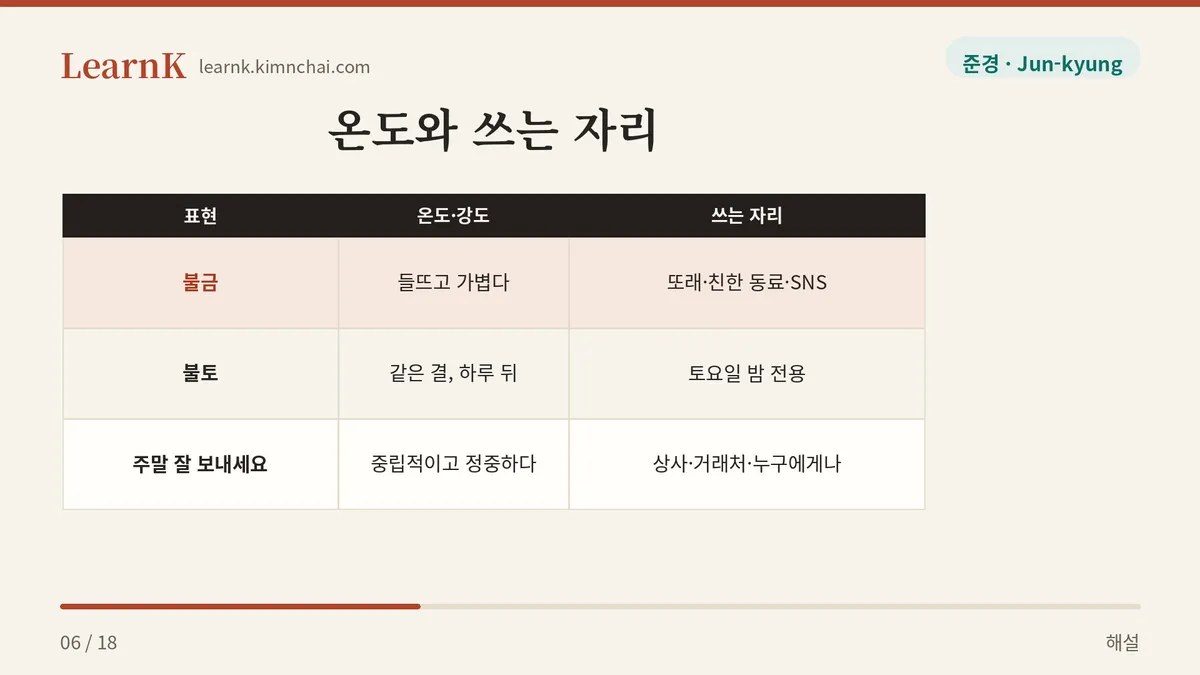
| Expression | Temperature / Intensity | Where to use it |
|---|---|---|
| 불금 (bulgeum) | Giddy and light | Peers, close coworkers, social media. Not for formal settings |
| 불토 (bulto) | Same flavor as 불금, one day later | Saturday nights only. Sounds off on a Friday |
| 주말 잘 보내세요 (jumal jal bonaeseyo) | Neutral and polite | Anyone at all — your boss, clients, people you’ve just met |
| 금요일 밤 (geumyoil bam) | A plain statement of fact, no emotion | When you’re pointing at a time. Sentences that pin down when to meet |
Cultural Background — A Word Born After Saturday Workdays Disappeared
The word-formation is simple and transparent. 불금 (bulgeum) takes the first syllable of each half of 불타는 금요일 (bultaneun geumyoil). The 불타다 (bultada) here doesn’t mean anything is literally on fire — it’s a metaphor for having a blazing good time. Korean is full of expressions that liken heat to fire, so people also say “오늘 제대로 불태웠다 (oneul jedaero bultaewotda)” — “I really burned it up today” — after a hard day’s work. That’s exactly why the overtime example above is funny. It’s the same 불타다 (bultada): one fire is the fire of playing, the other is the fire of working.
Behind this word taking root is the five-day workweek. Back when working Saturday mornings was standard, Friday night couldn’t be the start of the weekend. Only once Saturday shifts disappeared did Friday night become “the weekend’s first night” — and that night got a name. By the 2010s it had spread into broadcasting, advertising, bar signs, and convenience-store promo copy, and at this point it’s less slang than everyday vocabulary.
The interesting part is that the contents of the word keep changing. 불금 (bulgeum) used to conjure up company dinners, second rounds, and late-night 노래방 (noraebang, karaoke), but these days a night of ordering delivery at home and binge-watching a drama gets called 불금 (bulgeum) with total confidence. That version even has its own label: 집콕 불금 (jipkok bulgeum) — from 집콕 (jipkok), “holing up at home.” When Jun-kyung says “누워 있는 것도 불금이야” in the conversation above, he isn’t joking; he’s stating the current mood exactly as it is.
On the opposite end sits 월요병 (woryobyeong, the listlessness you feel on Mondays). A Korean week starts with 월요병 (woryobyeong), peaks at 불금 (bulgeum), and comes back down into Sunday-evening gloom. That’s why Friday-night scenes in Korean dramas and variety shows are unusually bright and loud. Conversely, people who are busiest on Friday nights — shift workers, small-business owners — will say, half-jokingly, “나는 불금이 없다 (naneun bulgeumi eopda)”: “I don’t get a 불금.” If you can hear the small ache tucked inside that line, you’ve understood the word 불금 (bulgeum) properly.
Today’s Quiz
Which of these three sentences uses 불금 (bulgeum) unnaturally?
- 오늘 불금인데 맥주 한잔할까? (oneul bulgeuminde maekju hanjanhalkka?)
- 부장님, 즐거운 불금 되십시오. (bujangnim, jeulgeoun bulgeum doesipsio.)
- 이번 주 불금은 그냥 집에서 영화나 보려고. (ibeon ju bulgeumeun geunyang jibeseo yeonghwana boryeogo.)
Answer: number 2. The grammar isn’t wrong — the setting is. 불금 (bulgeum) is clipped slang that peers use with each other, so even with honorific endings attached, it sounds too casual when aimed at your boss. Here you’d say “부장님, 편안한 주말 보내세요 (bujangnim, pyeonanhan jumal bonaeseyo).” And for the record, calling a night of resting at home 불금 (bulgeum), as in number 3, is a completely natural use these days.