불멍 (bulmeong) — Time You Spend in Front of a Wood Fire, Thinking About Nothing
불멍 (bulmeong)
At a campsite, once dinner is done and even the dishes are washed, people drift over one by one and settle in front of the fire. And then the talking just stops. Nobody said ‘let’s be quiet,’ but everyone is watching the fire. 불멍 (bulmeong) means spending time staring blankly at a burning fire — a campfire, a wood stove — with nothing in particular going through your head. It’s a word that settled into Korean camping culture only over the last few years, so it hasn’t made it into the dictionary as a headword yet, but it’s hard to get through a Korean weekend conversation these days without hearing it.
The heart of this word is that doing nothing is the point. Chatting while you watch the fire, grilling meat, taking photos — none of that is 불멍. Putting your phone down, wiping the to-do list out of your head, and just watching the flames move: that state is 불멍. That’s why the word carries no hint of scolding you for being lazy. If anything, when someone says 나 이번 주말에 불멍하고 왔어 (na ibeon jumare bulmeonghago wasseo) — ‘I went and did some bulmeong this weekend’ — it sounds like they rested well. Among Korean words for rest, not many carry a temperature this warm and this drowsy.
It’s a noun. So you use it as 불멍을 하다 (bulmeong-eul hada) or 불멍하다 (bulmeonghada), and more colloquially as 불멍 때리다 (bulmeong ttaerida). When you’re stating a purpose, 불멍하러 가다 (bulmeonghareo gada), ‘to go do bulmeong,’ is the natural form. You can do it alone or with a group, and here’s the interesting part: in group 불멍, saying nothing isn’t awkward. Silence in Korean conversation is usually a bit of a burden, but in front of a fire, silence gets a pass.
See It in a Real Conversation
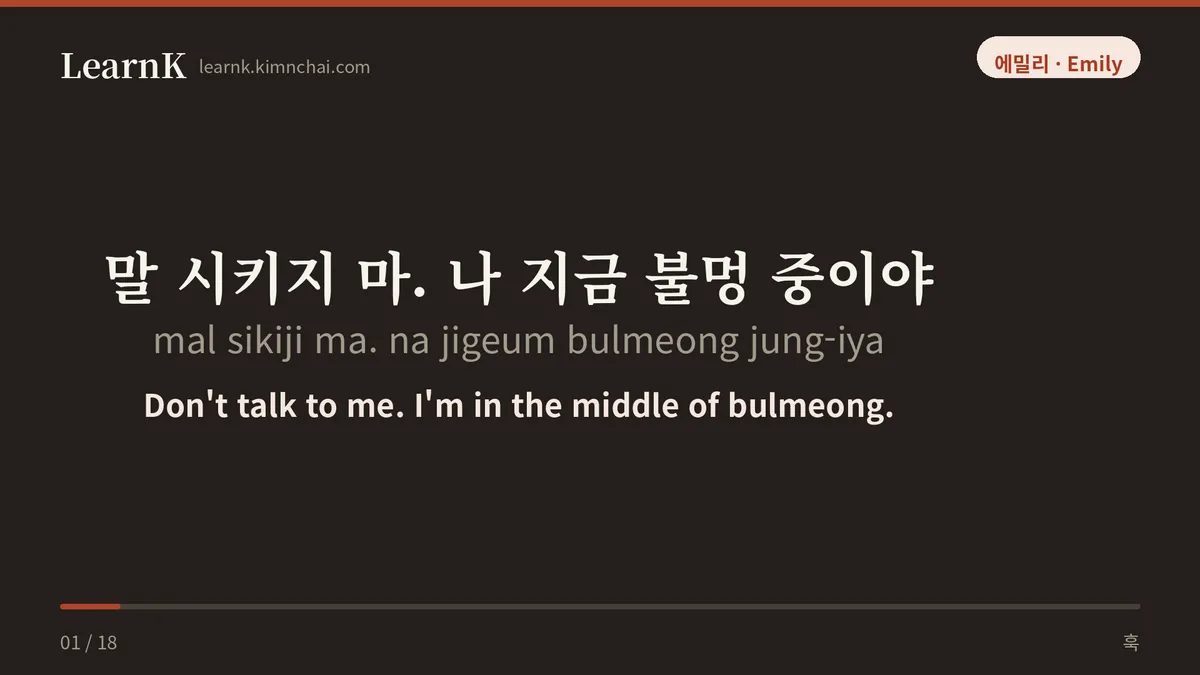
The scene: a campsite in late autumn. Dinner is finished, and Jun-kyung has picked up the last log.
Jun-kyung: 야, 장작 이게 마지막인데 지금 넣을까? Hey, this is the last log. Should I put it in now?
Emily: 넣어. 이제부터가 진짜지. Put it in. This is where it actually starts.
Jun-kyung: 뭐가 진짜야? What starts?
Emily: 불멍. 나 이거 하려고 세 시간 운전했어. Bulmeong. I drove three hours for this.
Jun-kyung: 하긴, 불 보고 있으면 진짜 아무 생각도 안 나더라. True, when you stare at a fire your head just goes empty.
Emily: 그러니까 핸드폰 좀 내려놔. 아까부터 계속 보잖아. Right? So put your phone down. You’ve been on it this whole time.
Jun-kyung: 알았어, 알았어. 나도 불멍 좀 하자. Okay, okay. Let me do some bulmeong too.
Emily: 응, 말 시키지 마. 나 지금 불멍 중이야. Yeah, don’t talk to me. I’m in the middle of bulmeong.
Where It Sounds Off
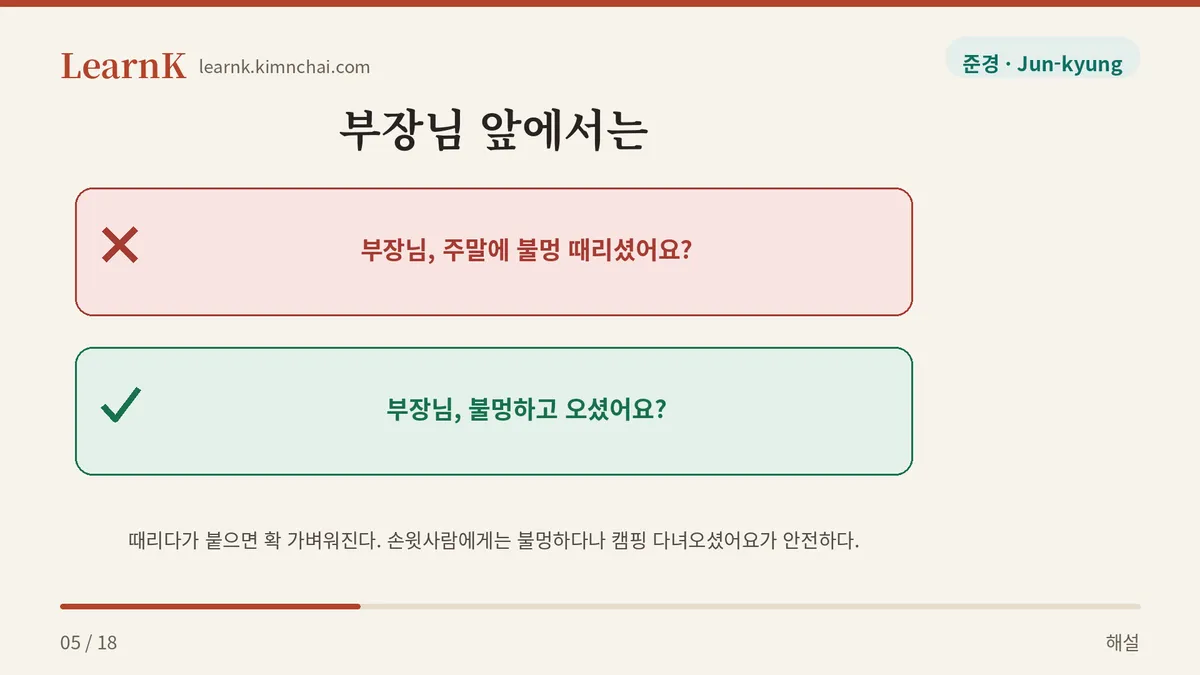
✗ (To your department head) 부장님, 주말에 불멍 때리셨어요? Sir, did you go bang out some bulmeong this weekend? ✓ (To a coworker your age) 야, 주말에 불멍 좀 때렸어? Hey, did you get some bulmeong in over the weekend? → The word 불멍 itself gets used freely across age groups these days, but the moment 때리다 (ttaerida) attaches to it, the whole thing turns casual. With someone senior to you, 주말에 캠핑 다녀오셨어요? (jumare kaemping danyeowasseoyo?, ‘Did you go camping over the weekend?’) or 불멍하고 오셨어요? (bulmeonghago osyeosseoyo?) is the safe range.
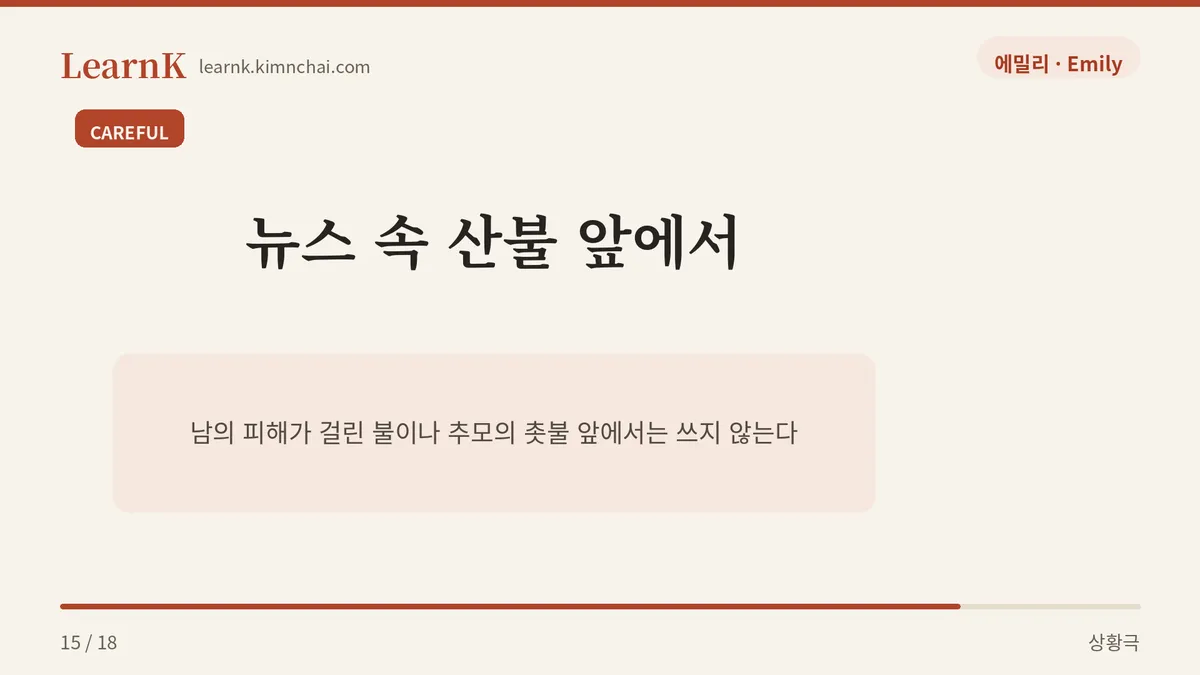
✗ (Watching wildfire footage on the news) 와, 저거 완전 불멍이다. Wow, that’s total bulmeong. ✓ (Watching the campfire at a campsite) 와, 이거 완전 불멍이다. Wow, this is total bulmeong. → 불멍 is only for a managed fire that you’re safely warming yourself beside. Use it for a fire where someone is losing something, or in front of memorial candles, and it turns another person’s loss into a spectacle. The meaning still comes across — but you come across differently.
Example Sentences by Situation
1. Friday evening on the way home, when a friend asks about your weekend plans
이번 주말엔 아무것도 안 하고 불멍만 하다 오려고. ibeon jumareneun amugeotdo an hago bulmeongman hada oryeogo ‘This weekend I’m going to do absolutely nothing but 불멍 and come back.’ (Fuller form: 이번 주말엔 아무것도 안 하고 불멍만 하다 올 생각이야.)
This is the classic line from someone who’s been run ragged all week. Attaching ~만 하다 오려고 (‘going to go do only ~ and come back’) adds the sense of a deliberate choice: I am purposely not doing anything else.
2. To a friend who says they can’t fall asleep at night
나 요즘 잠 안 올 때 유튜브로 불멍 영상 틀어놓고 자. na yojeum jam an ol ttae yutyubeuro bulmeong yeongsang teureonoko ja ‘These days when I can’t sleep, I put on a bulmeong video on YouTube and fall asleep to it.’
In Korea, people do 불멍 without lighting an actual fire. YouTube has countless videos that are nothing but hours of crackling logs, and people just call them 불멍 영상 (bulmeong yeongsang, ‘bulmeong videos’). It’s a landscape created by the fact that most people live in apartments.
3. Handing out roles to a friend on their first camping trip
고기는 내가 구울 테니까 너는 불멍이나 하고 있어. gogineun naega guul tenikka neoneun bulmeongina hago isseo ‘I’ll grill the meat, so you just sit there and do some bulmeong.’
~이나 하고 있어 (‘just go do ~, I guess’) is normally a mild jab, but here it turns into an affectionate joke meaning ‘you don’t have to do a thing.’ That flip is only possible because of the warmth built into the word 불멍.
Polite and Casual Forms, and Similar Expressions
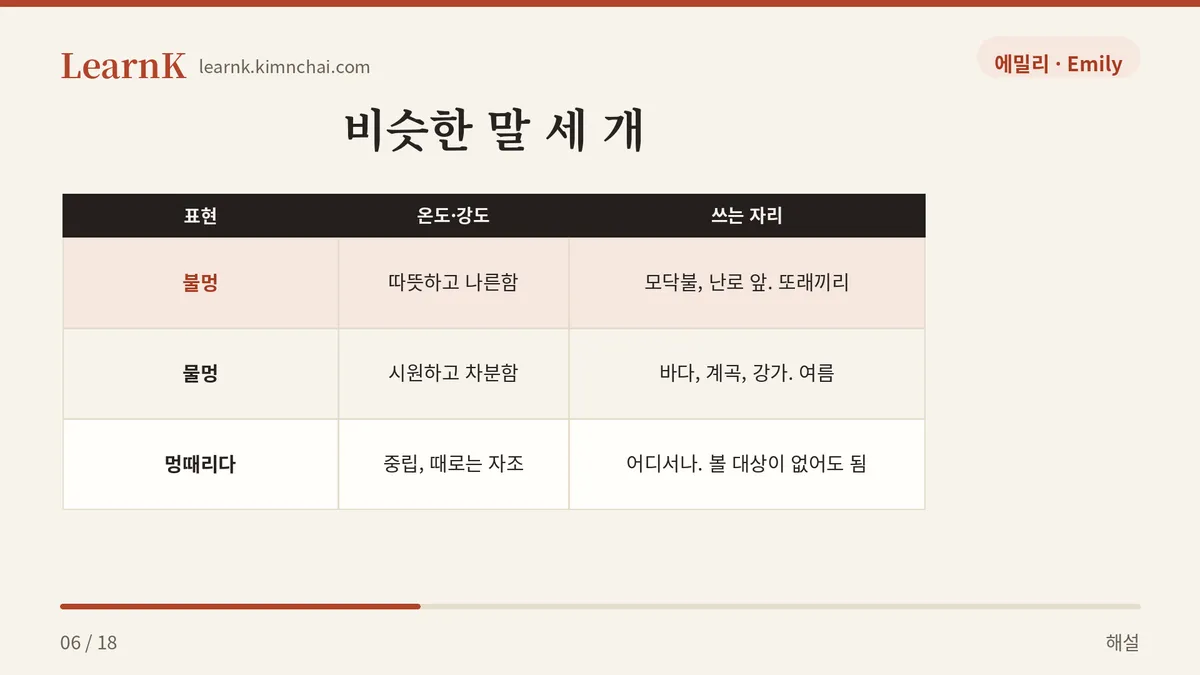
In casual speech you’d say 불멍하자 (bulmeonghaja) or 불멍 때리자 (bulmeong ttaerija). In polite speech, 불멍하고 왔어요 (bulmeonghago wasseoyo) and 불멍하러 다녀왔습니다 (bulmeonghareo danyeowatseumnida) sound natural. That said, in high-formality settings like a work report or an official presentation, the fact that it’s a new coinage makes it a poor fit. For those moments, 푹 쉬고 왔습니다 (puk swigo watseumnida, ‘I got a good rest’) is the safer choice.
| Expression | Temperature / Intensity | Where it fits |
|---|---|---|
| 불멍 (bulmeong) | Warm and drowsy, camping mood | With peers and on social media; in front of a campfire or stove |
| 물멍 (mulmeong) | Same feel, but cooler and calmer | At the sea, a valley stream, a riverbank; common in summer |
| 멍때리다 (meongttaerida) | Neutral, sometimes self-deprecating | Anywhere; doesn’t need anything to look at |
| 힐링하다 (hillinghada) | Soft and inoffensive | Safe even in front of someone senior |
멍때리다 is the object-less version — you do it on the subway, you do it in the middle of a meeting. 불멍 and 물멍, on the other hand, have a fixed thing you’re looking at, which gives them the feel of something you deliberately make time for. 멍때렸다 leans toward time that slipped away; 불멍했다 leans toward time well spent.
Cultural Background — Fire for People Who Live in Apartments
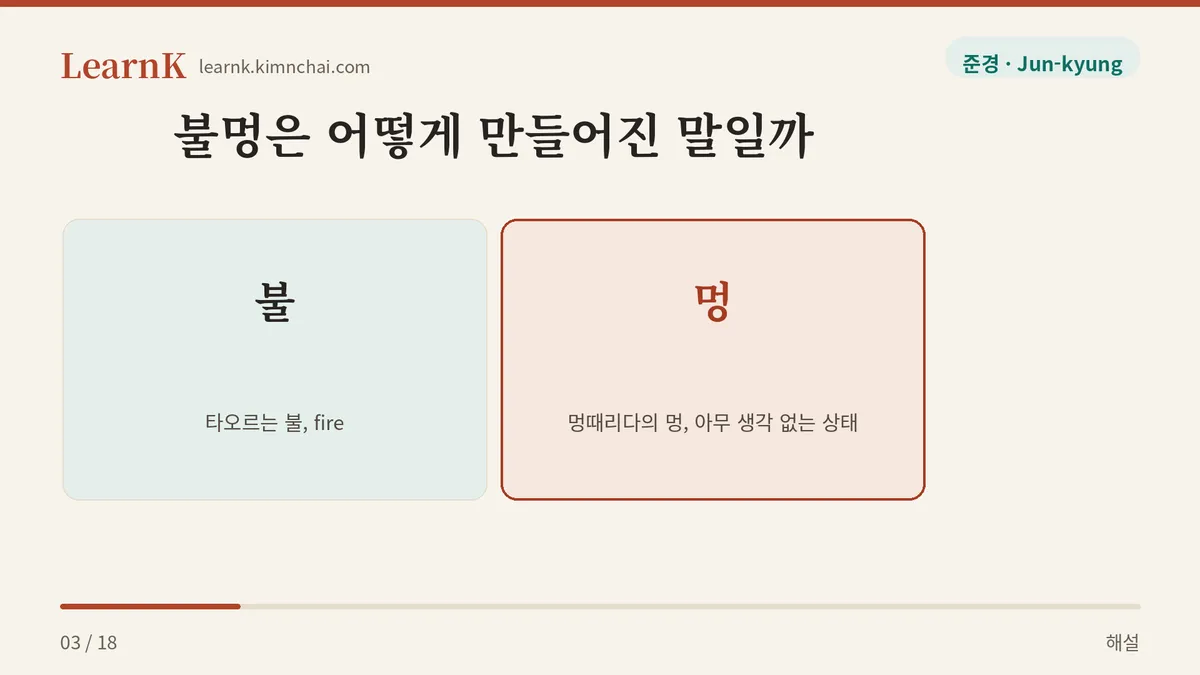
불멍 is built from 불 (bul, ‘fire’) plus 멍 (meong). That 멍 comes from 멍하다 (meonghada) and 멍때리다 (meongttaerida), pointing to a state of sitting there blank, with your mind checked out. This word-building pattern is so easy that a whole family of siblings followed. Watch water and it’s 물멍 (mulmeong); watch a forest, 숲멍 (supmeong); watch rain out the window, 비멍 (bimeong); watch snow falling, 눈멍 (nunmeong). It’s a great illustration of how Korean neologisms reproduce.
Two things overlapped to spread this word. One is the camping boom that’s been running since the late 2010s. When camping variety shows aired scenes of cast members sitting for minutes at a time saying nothing, just watching the fire, that scene needed a name. The other is a mood that recognizes ‘doing nothing’ as an activity in its own right. Since the mid-2010s, Korea has held 멍때리기 대회 (meongttaerigi daehoe, ‘space-out competitions’), where people compete at sitting still and doing nothing, and they’ve made real headlines. In a society where being busy was the virtue, it turned out that rest needed a name of its own before people could relax with a clear conscience.
And there’s one more practical reason. Most Koreans live in apartments. For generations raised in homes with no fireplace and no 아궁이 (agung-i, traditional kitchen furnace), real fire is something you almost never encounter in daily life. That’s what makes a campfire at a campsite special — and when even that isn’t possible, people keep a fire burning through a YouTube video instead. The faintly wistful note clinging to the word 불멍 comes from exactly here.
Today’s Quiz
Which of the following uses 불멍 most naturally?
① 어젯밤 옆 건물에 불이 났는데 사람들이 다 나와서 불멍했다. Last night the building next door caught fire, and everyone came out and did bulmeong. ② 캠핑장에서 장작 넣어 놓고 두 시간 동안 불멍만 했다. At the campsite I put the logs on and did nothing but bulmeong for two hours. ③ (In a job interview) 저는 주말마다 불멍 때리는 사람입니다. I’m the kind of person who bangs out some bulmeong every weekend.
Answer: ②
① uses it for an actual fire emergency. 불멍 is only for a fire you’re safely warming yourself beside, so using it in the face of someone else’s loss sounds seriously rude. ③ gets the meaning across but lands in the wrong setting. Using a slang coinage with 때리다 attached in a formal situation like an interview makes you look unprepared. ② — at a campsite, taking your time, doing nothing else but watching the fire — is exactly where this word belongs.