챌린지 (chaellinji) — the word you'll hear far more often than "도전" in Korea these days
챌린지 (chaellinji)
챌린지 (chaellinji) originally comes from the English word “challenge,” the same idea as 도전 (dojeon). But today in Korea, when someone says 챌린지 (chaellinji), they almost always mean a participatory trend: you film yourself copying the same dance or gesture, post it to social media, and pass it on to the next person.
On the day an idol group drops a new single, the first thing fans watch isn’t the music video — it’s a 15-second vertical clip. Only the most eye-catching move from the chorus is cut out (in Korea this bit is called 포인트 안무 (pointeu anmu), the “point choreography”), and two members stand side by side and dance it. Then, within days, tens of thousands of videos copying that exact move pile up underneath. Filmed from the back of a university lecture hall, in front of the mirror in an apartment elevator, on the night shift at a convenience store. The one word for this whole phenomenon is 챌린지 (chaellinji).
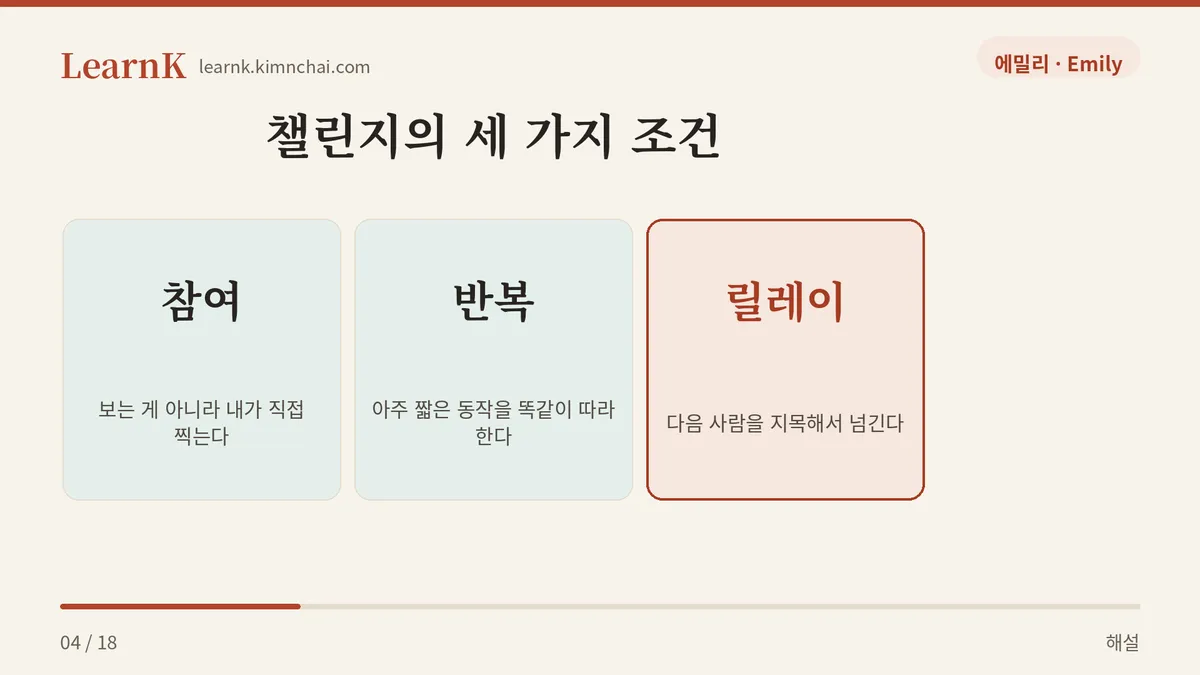
So the first thing a Korean learner has to adjust about this word isn’t its meaning — it’s its temperature. English “challenge” carries the weight of enduring something hard; Korean 챌린지 (chaellinji) has almost none of that weight left. What it carries instead is three sensations. First, 참여 (chamyeo), participation — you don’t watch it, you film it yourself. Second, 반복 (banbok), repetition — everyone copies the same very short move exactly. Third, 릴레이 (rille-i), the relay — you tag the next person and hand it off. If even one of these three is missing, Koreans generally won’t call it a 챌린지 (chaellinji).
The forms it shows up in are fixed, too. 챌린지 찍다 (chaellinji jjikda), 챌린지 하다 (chaellinji hada), 챌린지 뜨다 (chaellinji tteuda) — that’s very nearly all of them. 뜨다 (tteuda) in particular means “the video has gone up / it’s started catching on,” so 챌린지 떴어? (chaellinji tteosseo?) is closer to “Is that video up already?” These days the word gets attached to things that aren’t dances at all: 필사 챌린지 (pilsa chaellinji), the copy-out-a-passage-by-hand challenge; 물 마시기 챌린지 (mul masigi chaellinji), the drink-more-water challenge; 하루 만 보 걷기 챌린지 (haru man bo geotgi chaellinji), the 10,000-steps-a-day challenge. It now stretches to cover “setting yourself a small goal and keeping it going while posting proof shots.” The common thread is still just one thing — you don’t do it quietly on your own, you do it where other people can see.
Seeing It in a Real Conversation
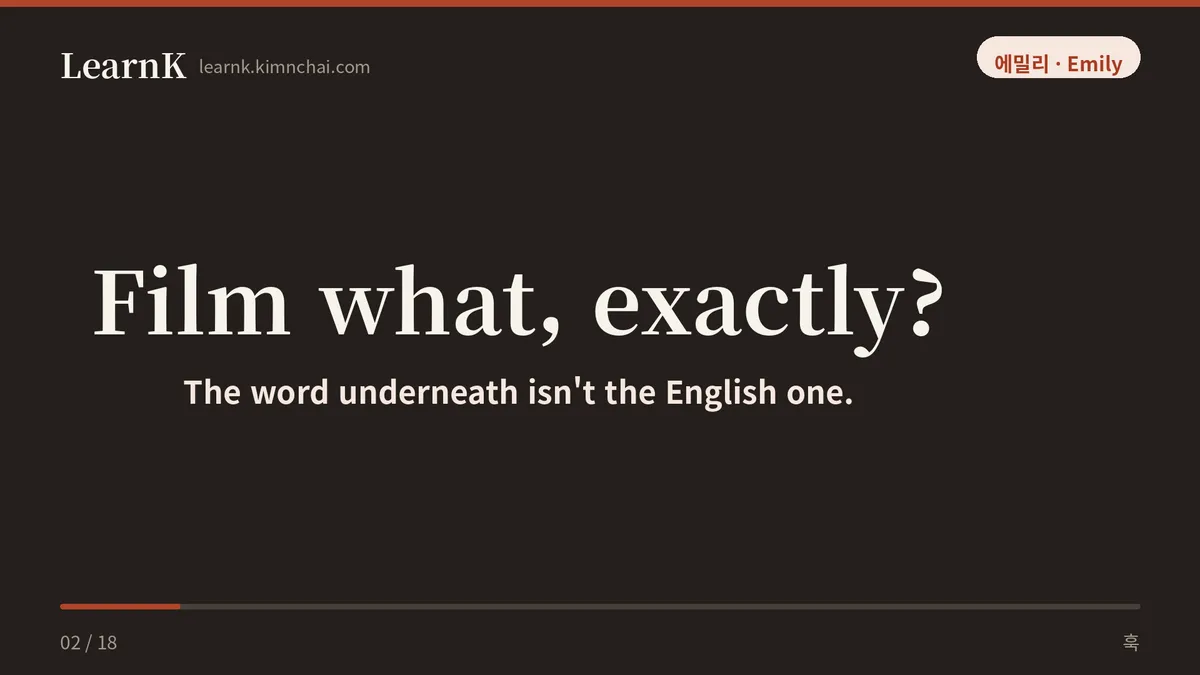
Scene: Saturday afternoon, beside the playground of an apartment complex. Emily has propped her phone up on a bench and is watching the screen, working through some hand movements on her own. Jun-kyung, on his way back from grocery shopping, catches her at it.
Jun-kyung: …너 지금 뭐 해? …What are you doing right now?
Emily: 아 깜짝이야. 조카가 자꾸 같이 챌린지 찍자고 해서, 미리 좀 연습하는 중이야. Oh, you scared me. My niece keeps asking me to film a challenge with her, so I’m getting some practice in beforehand.
Jun-kyung: 야, 그거 그렇게 각 잡고 하는 거 아니야. 다들 그냥 대충 찍어. Hey, that’s not something you rehearse like that. Everybody just films it casually.
Emily: 대충 찍으면 나만 박자 놓쳐. 지난번에 그래서 조회수 열두 개 나왔어. If I film it casually, I’m the only one off the beat. That’s how I ended up with twelve views last time.
Jun-kyung: 열두 개면 많이 나온 거지. …근데 그 챌린지 나도 알아. 회사 단톡방에 돌아다니더라. Twelve is a lot, honestly. …Actually, I know that challenge. It’s been going around our work group chat.
Emily: 그럼 잘됐다. 너도 옆에 서. 둘이 찍는 거야. Perfect, then. Stand next to me. It’s meant for two people.
Where It Sounds Off
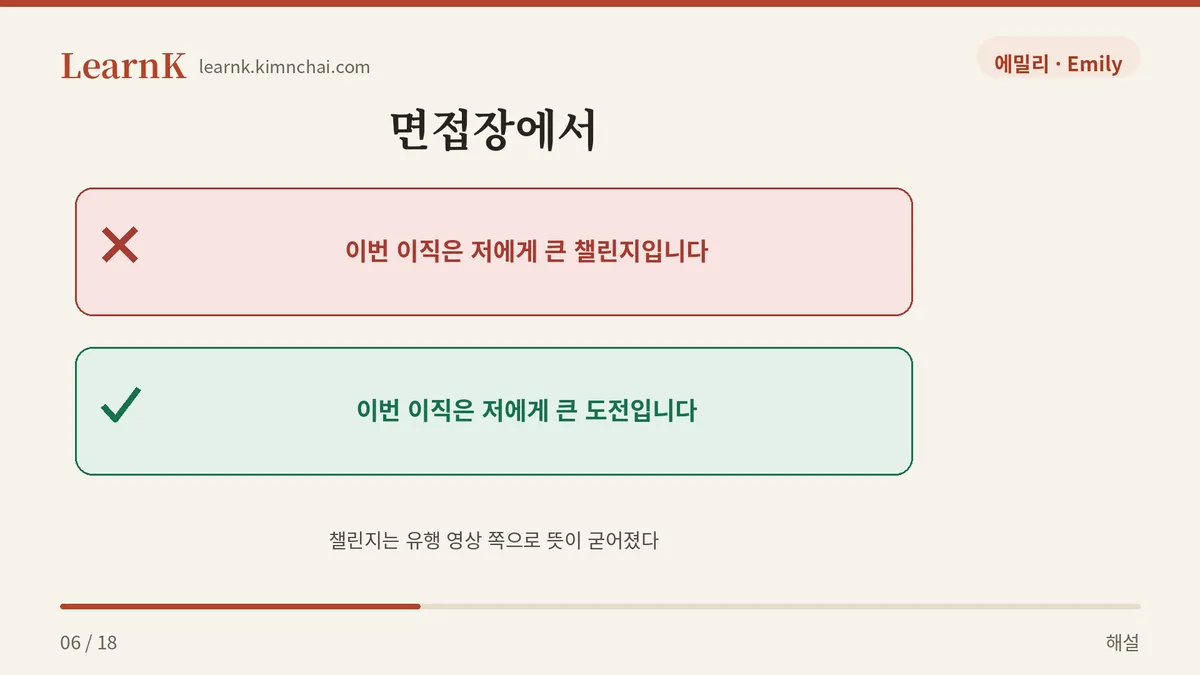
✗ (In a job interview) 이번 이직은 저에게 큰 챌린지입니다. (ibeon ijigeun jeoege keun chaellinji-imnida.) ✓ (In a job interview) 이번 이직은 저에게 큰 도전입니다. (ibeon ijigeun jeoege keun dojeon-imnida.) → In Korean, 챌린지 (chaellinji) has hardened into the social-media-trend meaning. Used in a serious setting to mean “a difficult undertaking,” it makes your words sound flippant, and for a split second your listener will stall out wondering, “Wait, is he saying he’s going to film a video?” In formal settings, 도전 (dojeon) is the safe choice.
✗ 그 회사가 새로운 시장에 챌린지했습니다. (geu hoesaga saeroun sijange chaellinjihaetseumnida.) ✓ 그 회사가 새로운 시장에 도전했습니다. (geu hoesaga saeroun sijange dojeonhaetseumnida.) → The verb 챌린지하다 (chaellinjihada) has survived in Korean only in the sense of “film a copy of a trending video.” The structure ~에 챌린지하다 (~e chaellinjihada) doesn’t exist in Korean at all, so the sentence lands like English transcribed word for word.
Example Sentences by Situation
1. On the day your favorite group makes a comeback, to a friend (casual speech)
이번 신곡 챌린지 벌써 떴어? 나 아직 못 봤는데. (ibeon singok chaellinji beolsseo tteosseo? na ajik mot bwanneunde.) Is the challenge for the new song already up? I haven’t seen it yet.
This is the single most-traded sentence among fans on comeback day. Here 떴어? (tteosseo?) doesn’t mean “is it trending?” so much as “has the official video been posted?”
2. Pitching a promotion idea at work (polite speech)
저희 팀도 홍보용으로 챌린지 하나 찍어 볼까요? (jeohui timdo hongboyongeuro chaellinji hana jjigeo bolkkayo?) Shall our team film a challenge for promotion too?
Even in a formal setting, you can use the word this way as long as it means “trend video.” The difference from the ✗ example above isn’t the word — it’s the meaning. Here it points at an actual video someone is going to film, not at a serious undertaking, so it sounds perfectly natural.
3. When you’ve been tagged in the relay
선배가 저를 다음 챌린지 주자로 지목했어요. 안 하면 안 될까요? (seonbaega jeoreul da-eum chaellinji jujaro jimokhaesseoyo. an hamyeon an doelkkayo?) My senior tagged me as the next person for the challenge. Do I really have to do it?
지목하다 (jimokhada), “to single someone out / tag them,” is the core verb of challenge culture. Because the whole thing runs as a relay, being tagged comes with a quiet social pressure attached. The awkwardness in the second half of this sentence is exactly that pressure.
Politeness Levels and Related Expressions
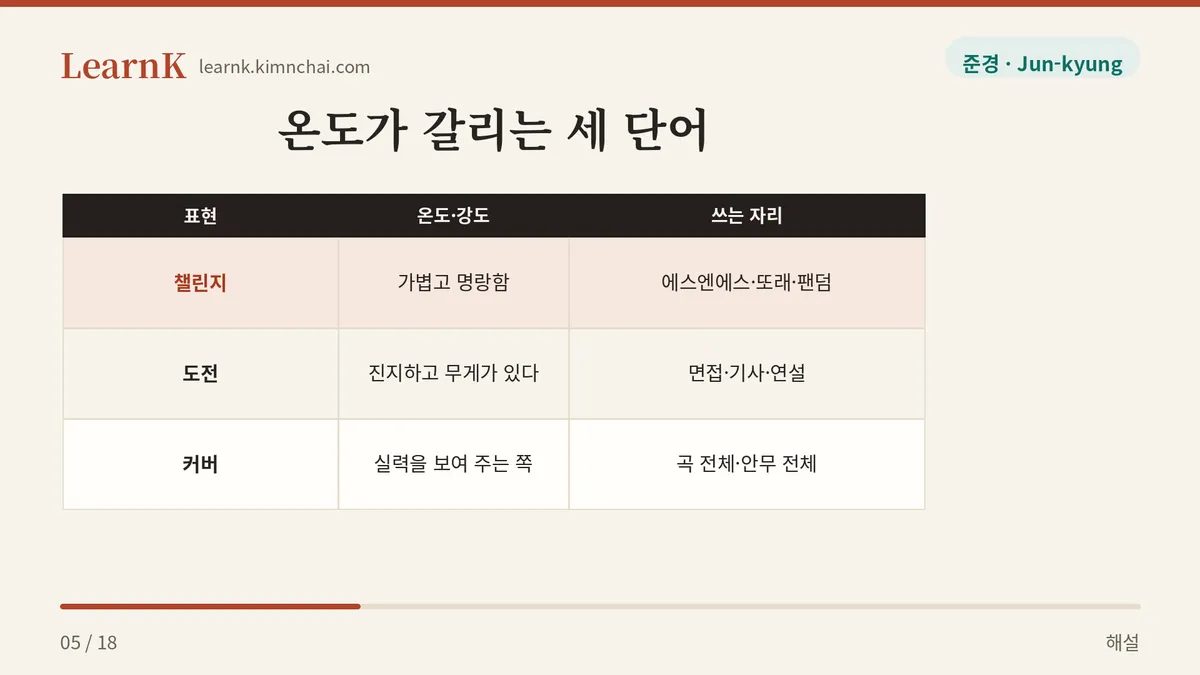
챌린지 (chaellinji) is a noun, so it carries no honorific level of its own. The politeness is decided by the verb that follows it — to a friend, 챌린지 찍었어? (chaellinji jjigeosseo?); to someone older, 챌린지 찍으셨어요? (chaellinji jjigeusyeosseoyo?). That said, because the temperature of the word itself is so light, there are situations formal enough that adding honorifics still won’t make it fit.
| Expression | Temperature & weight | Where it’s used |
|---|---|---|
| 챌린지 (chaellinji) | Light and cheerful, closer to play | Social media, peers, fandom. Not in interviews or written reports |
| 도전 (dojeon) | Serious, carries real weight | Anywhere. Suits interviews, news articles, speeches |
| 커버 (keobeo) | Neutral, tilted toward showing skill | When you take on a whole song or a whole routine, not just 15 seconds |
| 유행 (yuhaeng) | Neutral, an observer’s step-back view | When describing the phenomenon itself (“요즘 유행이래 (yojeum yuhaeng-irae)” — “apparently it’s the thing right now”) |
The line between 챌린지 (chaellinji) and 커버 (keobeo) in particular is policed pretty strictly inside fandoms. Copy 15 seconds of the chorus and it’s a 챌린지 (chaellinji); dance a three-minute routine start to finish and it’s a 커버 (keobeo). 커버 (keobeo) is where people compete on skill — with 챌린지 (chaellinji), being bad at it is practically the premise.
Cultural Background — the Game You Have to Play Once You’re Tagged
The decisive moment that planted the sense of 챌린지 (chaellinji) in Korea was the Ice Bucket Challenge of 2014. It was a fundraising campaign to help people with ALS, and its structure — post a video of yourself getting doused in ice water, then tag a few people to take it up next — spread widely in Korea too. That’s when the relay frame of “tagged → do it → tag the next person” settled into people’s heads, and the word 챌린지 (chaellinji) stopped meaning “a challenge to overcome” and became the name of this relay game.
When that frame met short vertical-video platforms, it became the K-pop 챌린지 (chaellinji) we know today. Agencies now deliberately design an “easy-to-copy eight seconds” into a song from the writing stage: a move you can do with just your arms, that works sitting down, that films fine in a cramped room. It’s been a long time since “does the challenge catch on?” became one of the metrics that decides whether a song succeeds in Korea.
But there’s a deeper reason this word is useful to Korean learners. 챌린지 (chaellinji) is a window that shows, in compressed form, how Korean internet culture actually moves — people choose doing something together, visibly, over enjoying it alone; when you’re tagged, you generally say yes; and someone participating clumsily is found more endearing than someone doing it well. So when a Korean friend says 너도 찍어 (neodo jjigeo), “you film one too,” it isn’t a test of your skill. It’s closer to an invitation into the group.
Today’s Quiz
Which of the following uses 챌린지 (chaellinji) unnaturally?
- 이번 신곡 챌린지 봤어? 안무가 너무 귀엽더라. (ibeon singok chaellinji bwasseo? anmuga neomu gwiyeopdeora.)
- 요즘 그 챌린지 안 찍은 사람이 없대. (yojeum geu chaellinji an jjigeun sarami eopdae.)
- 이번 승진 시험은 저에게 아주 큰 챌린지입니다. (ibeon seungjin siheomeun jeoege aju keun chaellinji-imnida.)
Answer: 3
For something as serious and weighty as a promotion exam, you use 도전 (dojeon). The natural version is 이번 승진 시험은 저에게 아주 큰 도전입니다 (ibeon seungjin siheomeun jeoege aju keun dojeon-imnida.). Unlike English “challenge,” Korean 챌린지 (chaellinji) has narrowed to mean “a trending video you film a copy of” — so phrase it like sentence 3 and your listener will stall out for a beat.