초동 (chodong): An Album’s First-Week Sales — and the First Five Minutes at the Scene
초동 (chodong)
The Monday after comeback week, fandom timelines get buried under a single number. 초동 (chodong) means the very first action you take when you set out to do something. The dictionary definition is that plain — but step inside K-pop fandom and the word points at something far sharper: the number of albums sold in the first week after release. So in fandom, 「초동 떴어?」 (chodong tteosseo?) is the same as “Are the first-week numbers out?”, and 「초동 깼다」 (chodong kkaetda) means “They broke the last album’s first-week record.”
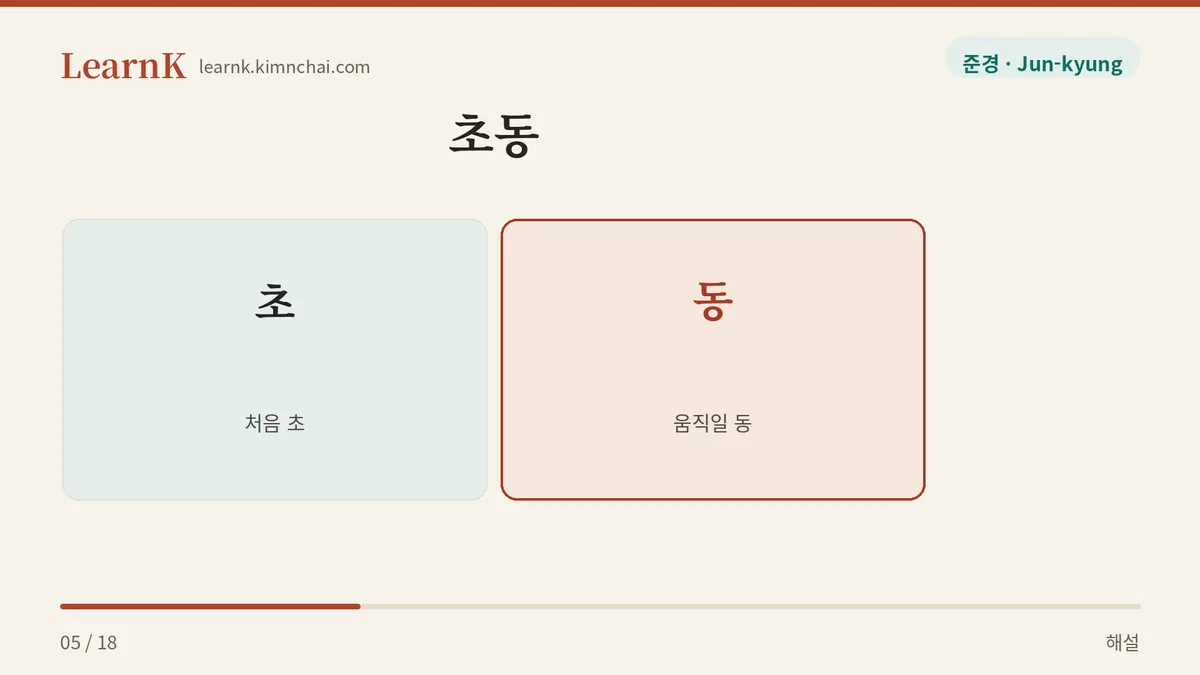
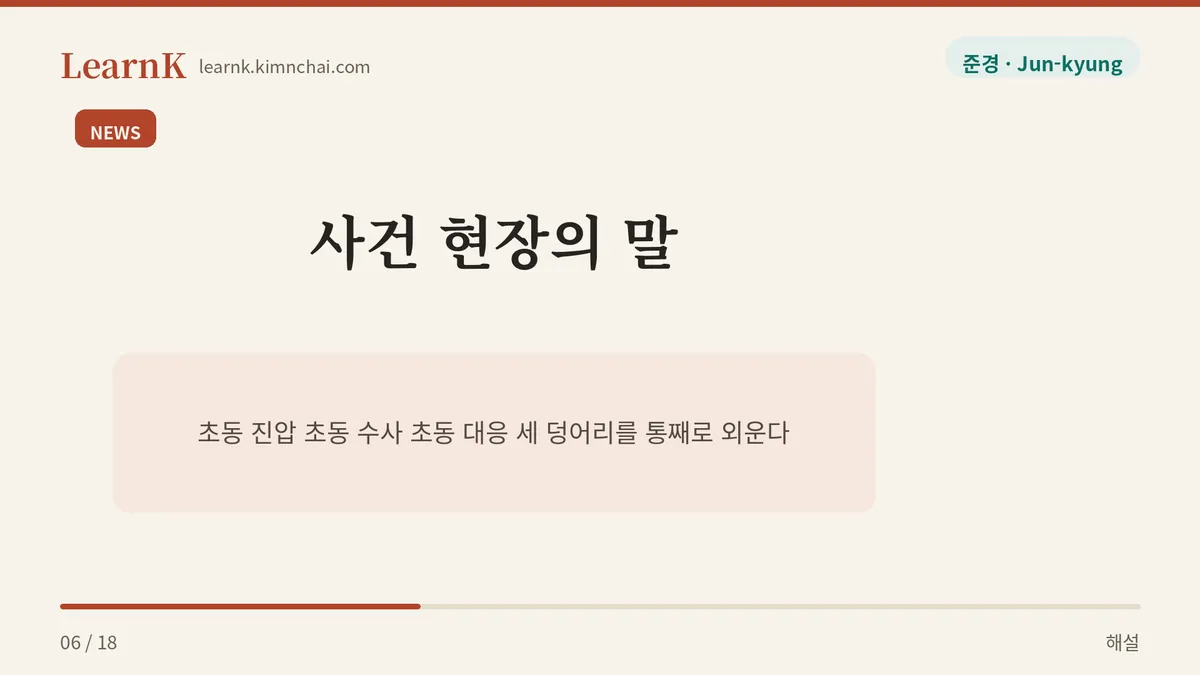
The hanja lay the structure bare: 初 (처음 초, cheoeum cho, “first”) + 動 (움직일 동, umjigil dong, “to move”) — literally the first movement. And this word’s original home wasn’t fandom at all; it was the scene of an emergency. The few minutes after firefighters arrive and put the first water on the flames, the first hours after a case is reported and police secure the site — that is where you find 초동 진압 (chodong jinap), 초동 수사 (chodong susa), and 초동 대응 (chodong daeeung).
One instinct runs through both worlds: the first few days decide the whole outcome. A fire not caught in the first five minutes takes the building; an album that falls behind in week one gets pushed down the charts. So 초동 (chodong) always carries a temperature of urgency and competition. 「초동이 좋다」 (chodongi jota) is praise; 「초동이 늦었다」 (chodongi neujeotda) is nearly a rebuke. That is exactly where it splits from 초반 (choban), which merely marks a stretch of time near the beginning.
Checking It in the National Institute of Korean Language Dictionary
초동 (chodong) 「noun」 The first action one takes when doing something. [en] first action — The initial action one performs when doing something. [ja] しょどう【初動】 — 何かをする時、最初に取る行動。 [es] primera acción — Primera acción al realizar un trabajo. [zh] 初次行动,初期 — 在做某事时,最初做的行动。 — National Institute of Korean Language, Basic Korean Dictionary (krdict.korean.go.kr)
The dictionary carries no Portuguese gloss. For reference, it would come out roughly as primeira ação — a primeira ação que se toma ao começar algo, but that one line is our own translation, not a quotation from the dictionary.
Now look at the short set phrases the dictionary lists alongside the entry, exactly as they appear.
초동 단계 (chodong dangye). / 초동 수사 (chodong susa). / 초동 대응 (chodong daeeung). / 초동 조치 (chodong jochi). / 초동 진압 (chodong jinap). — National Institute of Korean Language, Basic Korean Dictionary (krdict.korean.go.kr)
In order: initial stage / initial investigation / initial response / initial measures / initial suppression.
What matters is that all five are fixed pairings welded to a following noun. 초동 (chodong) rarely stands on its own — it travels with the noun behind it. Memorize these five chunks whole and you are halfway to reading the news.
정부는 불법 선거 운동을 초동 단계에서 철저히 차단할 계획이다. The government plans to block illegal campaigning thoroughly at the initial stage. — National Institute of Korean Language, Basic Korean Dictionary (krdict.korean.go.kr)
This is a sentence about reaching in while the problem is still small, before it grows. 「초동 단계에서」 (chodong dangye-eseo, “at the initial stage”) is used to mean “before it spreads.”
네, 다행히 소방관들의 재빠른 초동 진화로 큰 피해는 없었습니다. Yes, fortunately, thanks to the firefighters’ quick initial knockdown of the blaze, there was no major damage. — National Institute of Korean Language, Basic Korean Dictionary (krdict.korean.go.kr)
You can still hear the cadence of a reporter live from a fire scene. It is no accident that 재빠른 (jaeppareun, “quick”) sits out front. 초동 (chodong) is always judged on fast or late, so its modifiers usually point to speed.
경찰은 강력한 초동 진압으로 시위가 더 크게 번지는 것을 막았다. Police kept the protest from spreading further through a forceful initial suppression. — National Institute of Korean Language, Basic Korean Dictionary (krdict.korean.go.kr)
Here the modifier is 강력한 (gangnyeokhan, “forceful”). It shows that after speed, the next most common yardstick is strength.
That is as far as the dictionary takes us. The fandom sense — “first-week sales” — hasn’t made it into a dictionary headword yet. The word hardened in the field first, and the dictionary is still catching up.
Seeing It in Real Conversation
Situation: Night three of comeback week. Album boxes lie stacked and half-torn-open on Jun-kyung’s floor, and the two of them are sorting photocards into piles.
Jun-kyung: 야, 이거 미개봉으로 남길 거야? 아니면 다 뜯어? Hey, are you keeping these sealed? Or should we open them all?
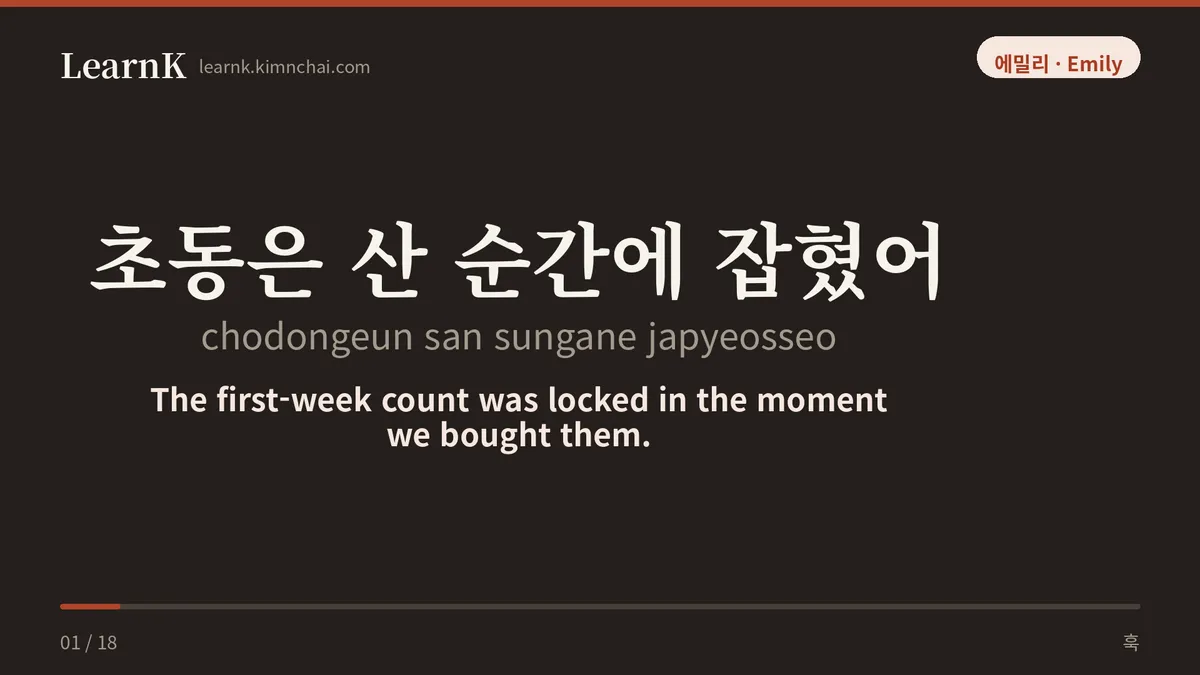
Emily: 다 뜯어야지. 어차피 초동은 산 순간에 잡혔어. Open them all. The first-week count was locked in the moment we bought them.
Jun-kyung: 아 맞다. 근데 이번 주 집계 몇 장 나왔대? Oh right. So how many did it move this week?
Emily: 방금 떴어. 초동 사십일만. Just came out. 410,000 for the first week.
Jun-kyung: 헐, 지난 앨범보다 훨씬 늘었네. 나 소름 돋았어. Whoa, way up from the last album. I’ve got goosebumps.
Emily: 그러니까. 초동 잘 나오면 음방 점수도 같이 올라가거든. Right? When the first week lands well, the music-show scores go up with it.
Used This Way, It Sounds Off
✗ (two months after release) 이 앨범 초동 대박이야, 지금까지 백만 장 넘게 팔렸대. This album’s 초동 is huge — apparently it’s sold over a million copies so far. ✓ (two months after release) 이 앨범 누적 백만 장 넘었대. 초동도 사십만이었어. This album has passed a million cumulative. Its 초동 was 400,000, too. → 초동 (chodong) points only at the tally for the first week after release. Stick it onto cumulative sales piled up over four months and fandom people will hear it instantly as “oh, that person doesn’t really know.”
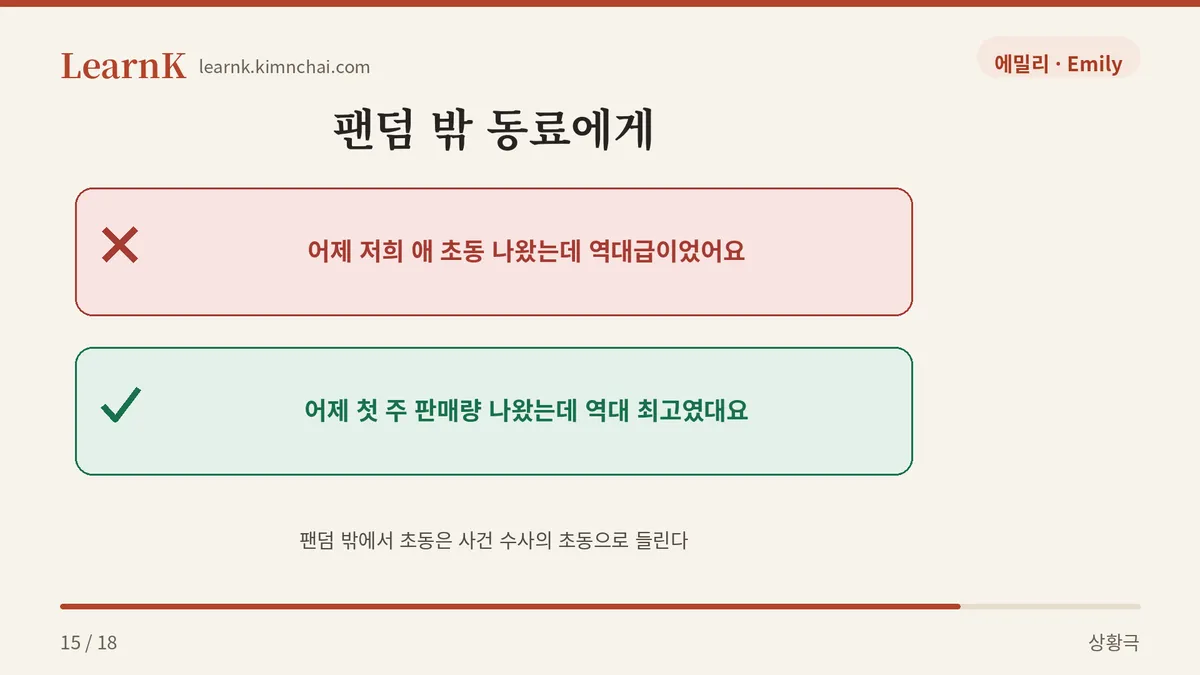
✗ (to a coworker outside the fandom) 어제 저희 애 초동 나왔는데 역대급이었어요. Our kid’s 초동 came out yesterday and it was all-time level. ✓ (to a coworker outside the fandom) 어제 첫 주 판매량 나왔는데 역대 최고였대요. The first-week sales came out yesterday, and apparently it was an all-time high. → Outside fandom, 초동 is still the 초동 of 초동 수사 (chodong susa) and 초동 대응 (chodong daeeung). Someone who isn’t in on it will ask what incident happened. Keep fandom shorthand inside the fandom, and spell it out when you step outside — that’s the safe move.
Examples by Situation
① The night before the comeback, an announcement in the fan group chat
내일 0시 발매입니다. 초동 집계는 발매일부터 잡히니까, 예약 구매분 배송 완료 인증 꼭 올려 주세요. Release is at midnight tonight. The 초동 tally starts counting from release day, so please post proof that your pre-orders were delivered.
This one line contains the entire reason fandoms cram their buying into release week. The same ten copies count toward 초동 if bought in week one, and count for nothing toward it if bought next month.
② A company meeting, the day after a service outage
어제 장애는 초동 대응이 삼십 분 늦었던 게 컸습니다. 알림이 새벽에 울렸는데 확인이 안 됐어요. Yesterday’s outage came down largely to the 초동 대응 being thirty minutes late. The alert fired in the early hours and nobody saw it.
In an office, this phrase usually shows up as the opening line of an apology. It’s the expression you reach for when the point isn’t the incident itself but the fact that the first response was slow.
③ A Friday evening when a cold is coming on
목이 좀 칼칼한데. 이런 건 초동 진압이지. 나 오늘 일찍 자고 약 먹을래. My throat’s a bit scratchy. This calls for 초동 진압. I’m taking medicine and going to bed early tonight.
Here the fire-and-police term 「초동 진압」 (chodong jinap) is pulled over onto the body as a joke. Koreans say this all the time, and it doesn’t land heavily at all — it’s closer to a fun way of announcing “I’m not pushing myself today.”
Formal and Casual Speech, and Similar Expressions
초동 (chodong) is a noun, so it carries no politeness of its own. The level is set by whatever predicate you attach — to a friend, 「초동 나왔어?」 (chodong nawasseo?); in a meeting, 「초동 집계 확인되었습니까?」 (chodong jipgye hwagin-doeeotseumnikka?). You just swap out the ending. What actually confuses learners isn’t politeness, though — it’s the neighboring words that look alike.
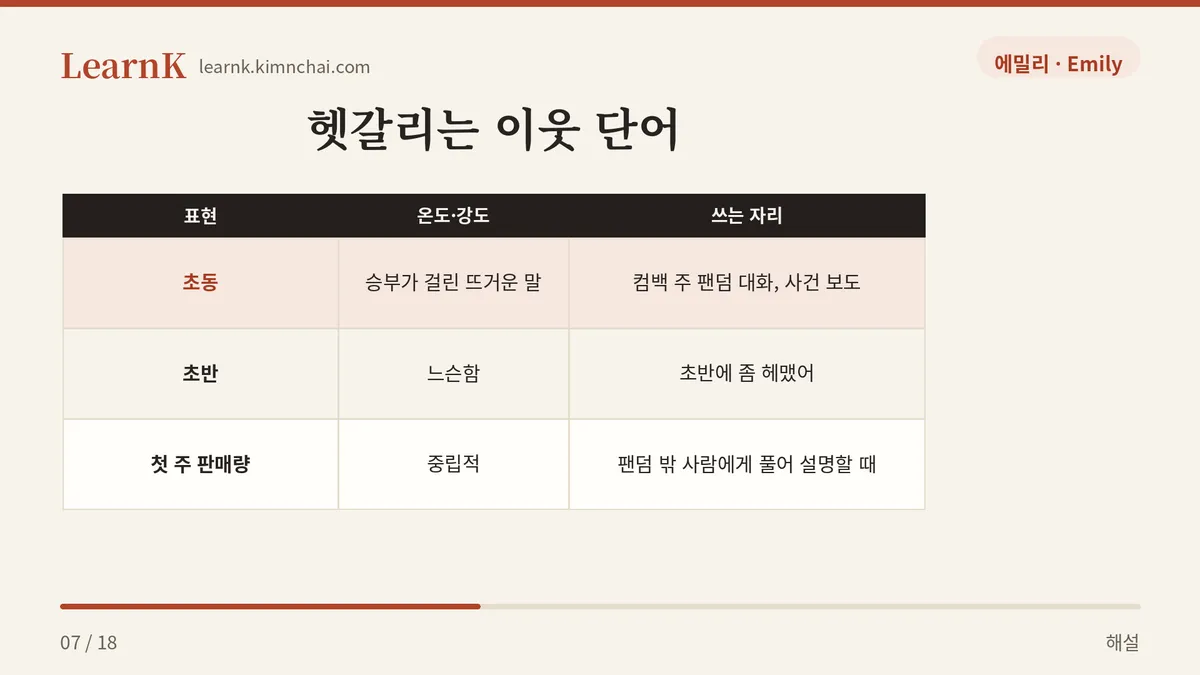
| Expression | Temperature / intensity | Where it’s used |
|---|---|---|
| 초동 (chodong) | Hot, with something at stake. Judged on fast vs. late | Fandom talk and headlines during comeback week; incident and disaster coverage |
| 첫 주 판매량 (cheot ju panmaeryang) | Neutral, descriptive | When spelling things out for someone outside the fandom |
| 초반 (choban) | Loose. Just means the early part | Anywhere in daily life. 「초반에 좀 헤맸어」 (choban-e jom hemaesseo, “I floundered a bit early on”) |
| 초동 대응 (chodong daeeung) | Official and heavy. Responsibility comes attached | Incident reports, news, company meetings |
The contrast with 초반 (choban) is especially worth holding onto. 초반 is simply the early stretch, while 초동 asks what you did in that stretch. 「초반에 힘들었어」 (choban-e himdeureosseo, “it was rough early on”) is natural; 「초동에 힘들었어」 (chodong-e himdeureosseo) is not.
Cultural Background — Why Everything Gets Piled Into the First Week
Watch Korean crime dramas and you’ll hear this word constantly. The detective who arrives late to the scene and stiffens at the sight of footprints already wiped away; the superior who throws down a file saying the 초동 수사 (chodong susa) was botched — these scenes repeat so often that you can picture them without quoting a single line. In that genre 초동 carries almost moral weight, and one sentence — 「초동이 늦었다」 (chodongi neujeotda, “the initial response was late”) — sums up a character’s failure whole.
That weight crossed straight over into K-pop fandom. First-week album performance is announced by several tallying bodies (Hanteo Chart, Circle Chart, and others), each with its own criteria, and the number ripples outward into music-show scores, press headlines, and even year-end awards nominations. On top of that, fan-signing event entries are usually proportional to how many copies you buy, so from a fan’s point of view there’s no reason to put off an album purchase. That’s how the culture of pouring all firepower into release week took hold — and fandoms call that week outright 총공 (chonggong), short for 총공격 (chonggonggyeok, “all-out attack”).
In the end, the firefighter’s first five minutes and the fandom’s first seven days stand on the same logic: once time passes there’s no taking it back, and whatever you poured in at the start is what stays to the end. Learn this one word and Korean news and fandom tweets start reading at the same time.
Today’s Quiz
Which of the following uses 초동 (chodong) naturally?
① 이 드라마 초동에는 좀 지루했는데 후반부가 재밌어졌어. This drama was a bit boring in the 초동, but it got fun in the second half.
② 발매 첫 주 초동이 삼십만 장을 넘었대. Apparently the release-week 초동 passed 300,000 copies.
③ 어제 산 앨범, 오늘 개봉해서 초동했어. The album I bought yesterday — I opened it today, so I 초동-ed.
Show the answer
Answer: ②
① simply means the early part of something, so it needs 초반 (choban). ③ uses 초동 as a verb, but 초동 doesn’t conjugate as 「초동하다」 (chodonghada). Pairing it with a first-week tally figure, the way ② does, is the most common form in fandom.
Definitions and example sentences are from the National Institute of Korean Language’s Basic Korean Dictionary (krdict.korean.go.kr); that portion of this post, including our translations, is licensed under CC BY-SA 2.0 KR.