취저 (chwijeo): The Moment Something Hits Your Taste Dead-On
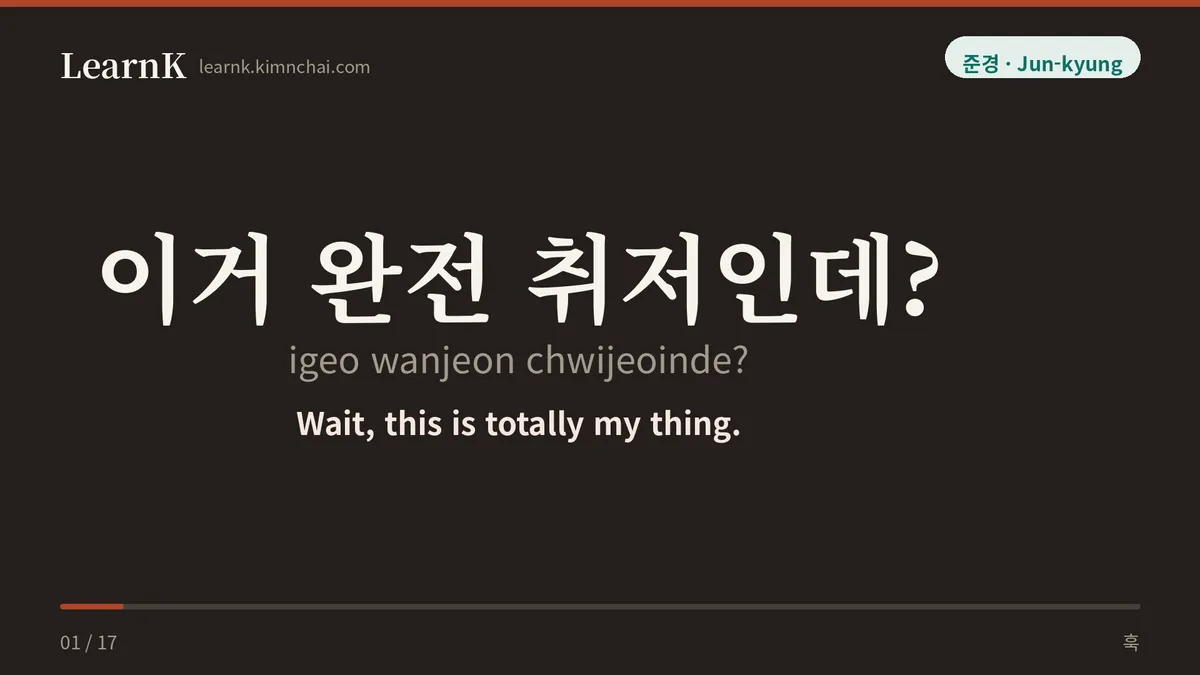
Have you ever had a friend recommend a café, and the second you opened the door, the lighting, the music, and the smell of coffee were all exactly to your liking? These days, Koreans sum up that feeling in one short word. “여기 완전 취저야! (yeogi wanjeon chwijeoya!)” — “This place is totally my thing!” Today, let’s dig deep into a piece of slang that pops up several times a day in social media and YouTube comments and in conversations with friends: 취저 (chwijeo).
취저
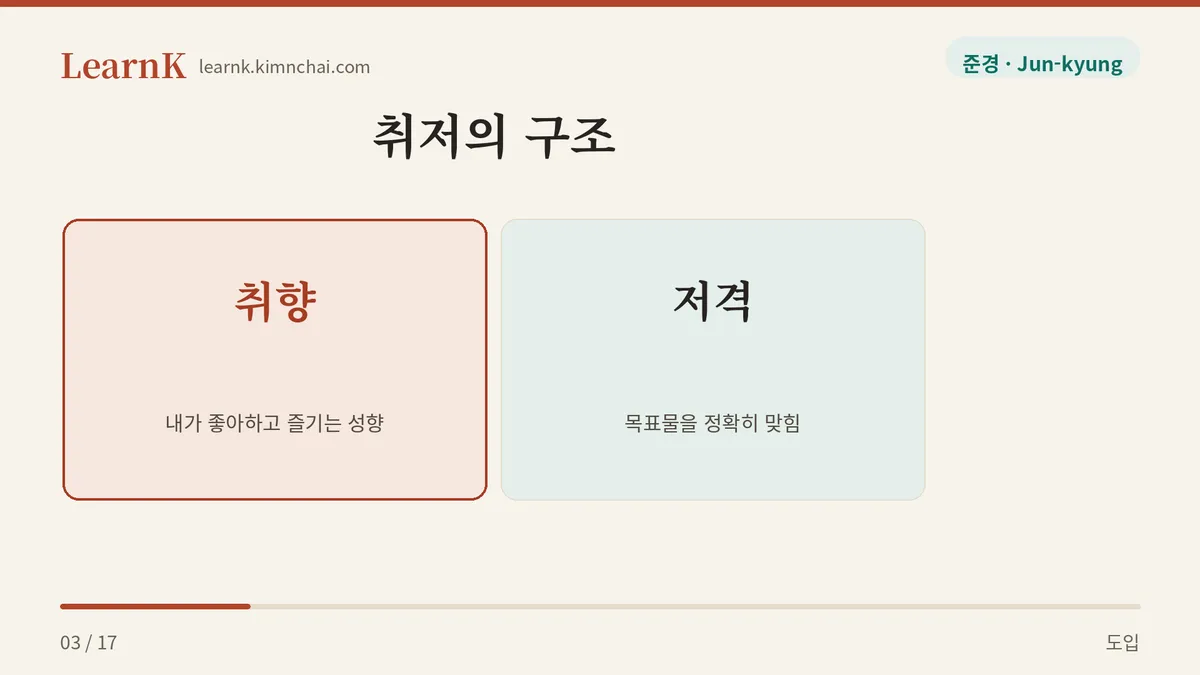
취저 (chwijeo) is a shortened form of 취향 저격 (chwihyang jeogyeok). 취향 (chwihyang) means “the tendency of what you like and enjoy” — in other words, it corresponds to the English word taste — and 저격 (jeogyeok) is originally a military term meaning “to shoot and hit a target precisely.” Put the two together, and you get a picture of “aiming right at my taste and hitting the bullseye.”
In other words, 취저 refers to something that fits your heart perfectly, as if someone had taken deliberate aim at it. It’s not just “I like it” — it carries a mix of admiration and surprise, a “How did they know my taste this well?” feeling. That’s why the emotional punch is much stronger than an ordinary “I like it.”
The pronunciation is [chwijeo], just two syllables — very simple. It’s used like a noun, and also as a predicate, as in 취저다 (chwijeoda) and 취저야 (chwijeoya).
Meaning and Nuance at a Glance
- Literally: 취향 (taste) + 저격 (hitting precisely)
- Actual meaning: something that fits your taste perfectly
- Emotion: the thrilling joy of discovery — beyond simple satisfaction, a “How did they know?” feeling
- Grammatical feel: used as a noun, and almost like an exclamation too
Example Sentences by Situation
Situation 1 — When your taste in music clicks. A friend listening to your playlist is impressed.
이 밴드 처음 듣는데 완전 취저다. 어디서 찾았어? (i baendeu cheoeum deutneunde wanjeon chwijeoda. eodiseo chajass-eo?) “I’ve never heard this band before, but they’re totally my thing. Where’d you find them?”
It’s an exciting moment of discovery — a band you’re hearing for the first time steals your heart from the very first song.
Situation 2 — When a gift is exactly to your liking. Someone who has just received a birthday present says:
내 취향 어떻게 알았어? 이거 진짜 취저야, 고마워! (nae chwihyang eotteohge arass-eo? igeo jinjja chwijeoya, gomawo!) “How did you know my taste? This is really my thing — thank you!”
It’s an expression full of both gratitude and admiration, saying that the gift-giver hit your heart dead-on.
Situation 3 — When recommending a drama or movie. A review like this goes up on an online community:
잔잔한 감성 드라마 좋아하는 사람한테는 이거 100% 취저임. (janjanhan gamseong deurama joahaneun saramhantenun igeo baekpeosenteu chwijeoim.) “For anyone who loves calm, emotional dramas, this is 100% your thing.”
It’s a confident recommendation, saying that people with a certain taste are sure to love it.
Comparing Polite/Casual Speech and Similar Expressions
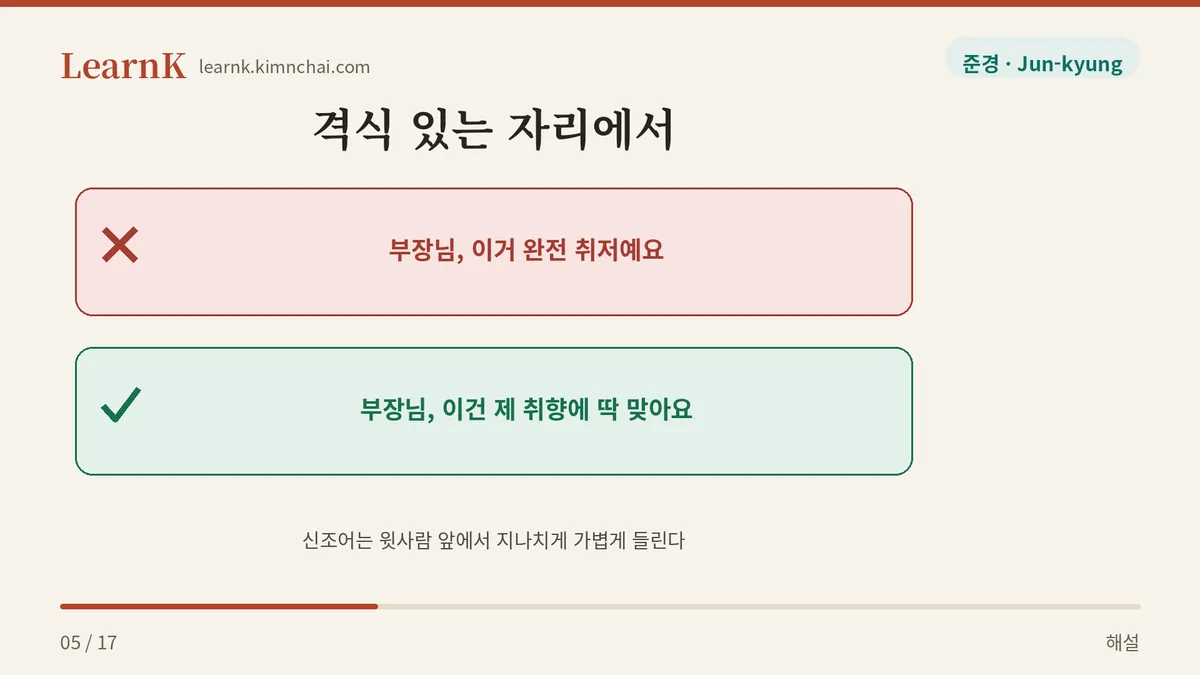
Because 취저 is slang by nature, it feels most natural in casual speech (반말) between friends. You wouldn’t often use it in formal settings or with someone older than you, but if you want to raise the register a bit more gently, it’s safer to spell it out in polite form as 취향 저격이에요 (chwihyang jeogyeog-ieyo). For meetings or official documents, I’d recommend switching entirely to 제 취향에 딱 맞아요 (je chwihyang-e ttak majayo) — “It fits my taste perfectly.”
It helps to learn some similar expressions too.
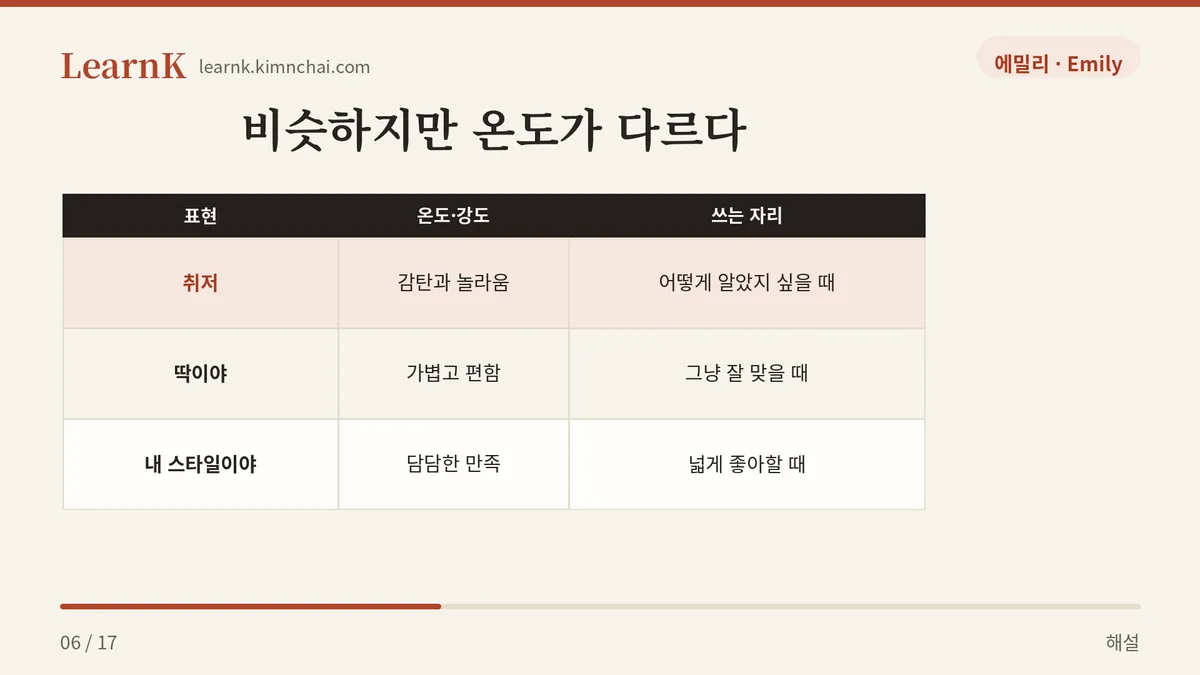
- 딱이야 (ttagiya): Means “it’s a perfect fit” — the friend-to-friend expression closest to 취저.
- 내 스타일이야 (nae seutail-iya): Borrowed from the English word style, with a slightly broader range.
- 취향 저격 (chwihyang jeogyeok): The full original form of 취저. Often seen in writing and ad copy.
There’s a subtle difference: while 취저 puts the emphasis on the surprise of “they pinpointed my taste exactly,” 내 스타일이야 (nae seutail-iya) is closer to a more understated kind of satisfaction.
Cultural Background — An Age of Abbreviations and Personal Taste
취저 was born where two currents of the Korean language meet. One is the abbreviation culture that enjoys compressing things into two or three syllables, and the other is the taste-driven consumer culture that prizes having your own distinct color. Today’s young generation in Korea responds strongly to “something that knows me exactly” rather than “something inoffensive,” and 취저 has taken root as the word to express that feeling.
That’s why 취저 is beloved in advertising and marketing too. In phrases like “curation that snipes your taste,” this word appears whenever a brand whispers to consumers, “We understand you.” In dramas, scenes where a character is moved by the other person’s gift or date plan — feeling their taste hit dead-on — are a staple. Inside these two seemingly trivial syllables lies a rather warm emotion: the joy of being truly seen and understood.
Today’s Quiz
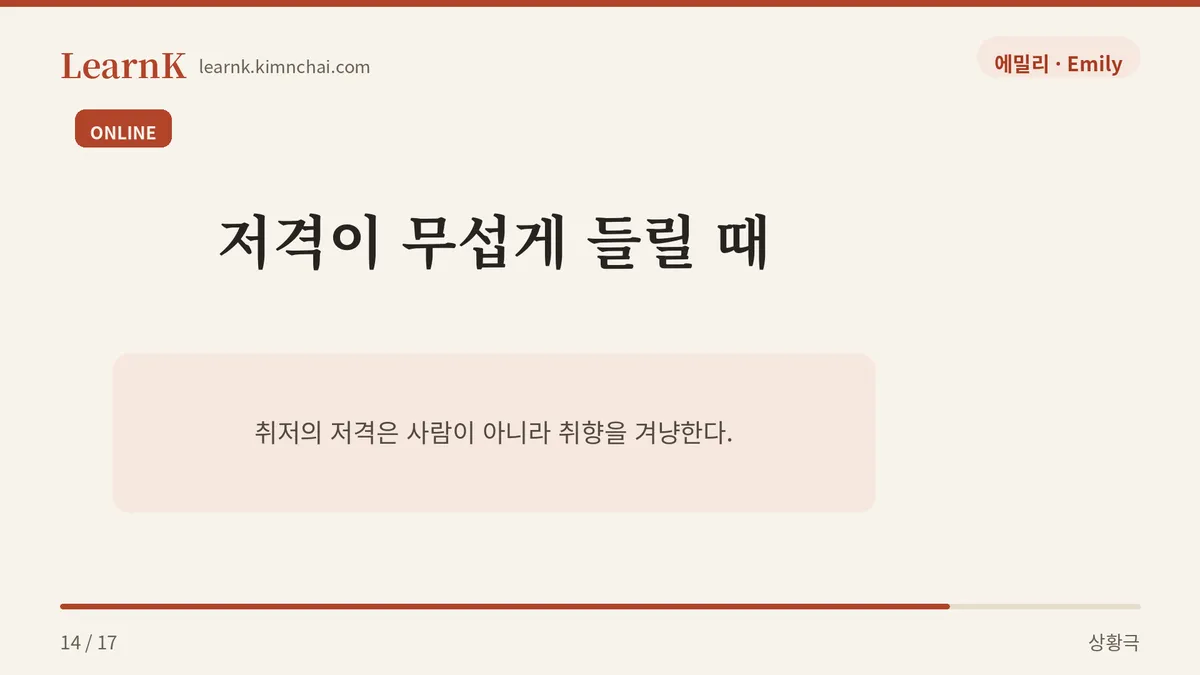
A café your friend picked out fit your heart perfectly — the lighting, the music, even the coffee. Try expressing this delight in one sentence of casual speech (반말) using 취저.
Sample answer: “여기 완전 취저다! 어떻게 알고 골랐어? (yeogi wanjeon chwijeoda! eotteohge algo golass-eo?)” — “This place is totally my thing! How did you know to pick it?”