사이버 렉카 (saibeo rekka) — The Name for Whoever Reaches the Crash Site First
사이버 렉카 (saibeo rekka)
When something blows up on the Korean internet, the first thing to arrive at the scene isn’t a reporter or the police. It’s a video. Within hours of a story breaking, a thumbnail plastered with red arrows and question marks pops up in your recommendations. 사이버 렉카 (saibeo rekka) means a person or channel that races to the scene the moment an incident or controversy breaks, turns someone else’s misfortune into sensational video, and cashes in on the views.
There’s a particular reason this word matters if you’re learning Korean. It shows up everywhere — news comment sections, community boards, KakaoTalk chats with friends — but look it up in a dictionary and you won’t find it. If you don’t know what it means, you miss the entire temperature of the conversation. If someone says of a channel, “저거 사이버 렉카야,” that’s not “that channel is kind of lame.” It’s a heavy accusation: “that person makes a living selling other people’s disasters.”
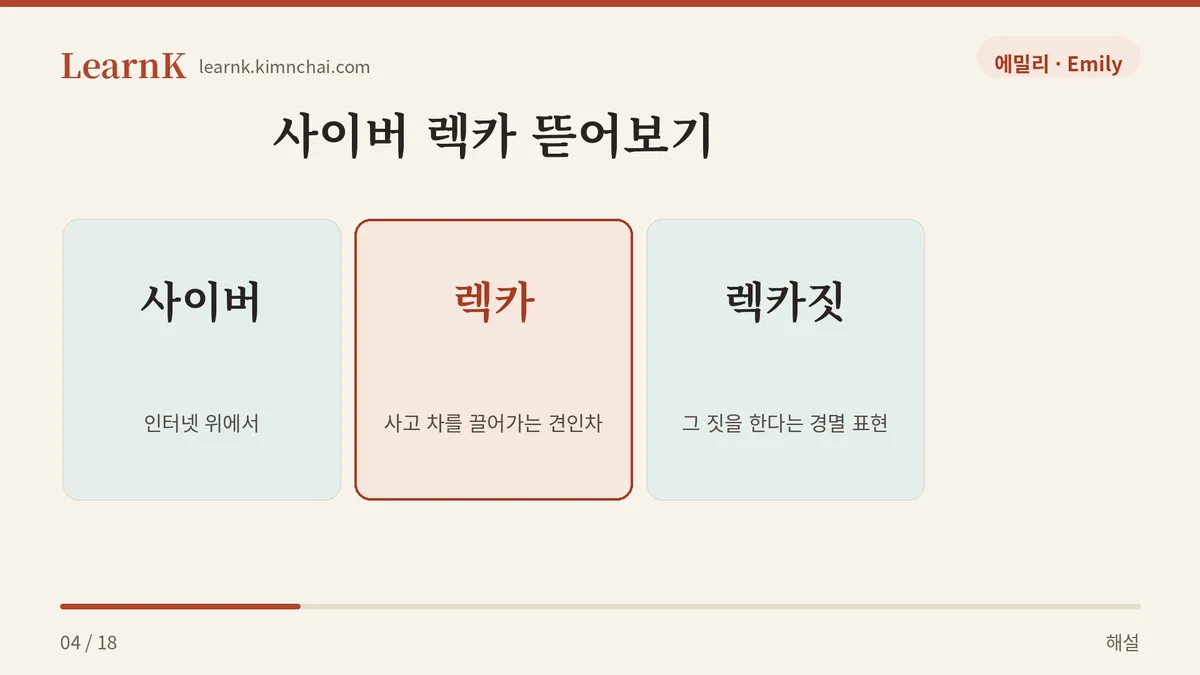
Grammatically it’s a noun. So it attaches directly, as in 사이버 렉카다 (saibeo rekka-da), 사이버 렉카 같다 (saibeo rekka gatda), or 사이버 렉카 채널 (saibeo rekka chaeneol). Online, people also drop the first half and use just 렉카 (rekka), and they call that kind of behavior 렉카짓 (rekka-jit). The moment -짓 (-jit) gets attached, the contempt climbs another notch.
The heart of the nuance is that two things overlap. One is speed — running to the scene faster than anyone else. The other is money — that speed is aimed at attention and profit. With only one of the two, it isn’t 사이버 렉카 (saibeo rekka). A friend who always hears the news first is just quick on the draw, and a YouTuber who earns money is just a YouTuber. The word only holds when the whole picture comes together: racing to someone else’s crash site and making a living off it.
A Real Conversation
Situation: The subway home on a Friday evening. Sitting side by side, each on their own phone, Jun-kyung tilts his screen toward Emily.
Jun-kyung: 야, 이거 봤어? 그 배우 사건 벌써 영상 올라왔는데. Hey, did you see this? There’s already a video up about that actor’s scandal.
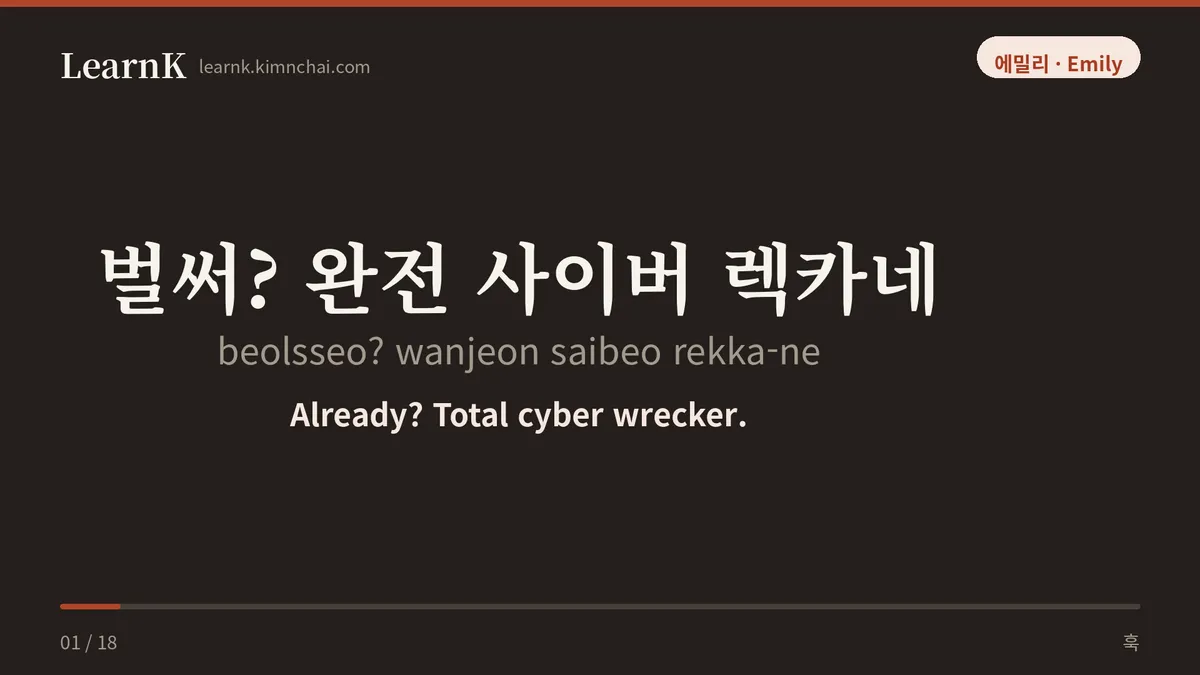
Emily: 어제 밤에 터진 거잖아. 벌써? 완전 사이버 렉카네. That broke last night. Already? Total cyber wrecker.
Jun-kyung: 썸네일 봐 봐. 빨간 화살표에 물음표. 근데 내용은 그냥 기사 읽어 주는 게 다야. Look at the thumbnail. Red arrow, question mark. But the content is just reading out a news article.
Emily: 근데 나도 모르게 누르게 되더라고. 그게 무서운 거야. But I end up clicking it without realizing. That’s the scary part.
Jun-kyung: 그러니까 사이버 렉카가 안 없어지지. 우리가 눌러 주잖아. That’s exactly why cyber wreckers don’t go away. We’re the ones clicking.
Emily: 아 진짜. 나 오늘부터 그냥 관심 없음 누를래. Ugh, seriously. From today I’m just hitting ‘not interested.‘
These Uses Sound Off
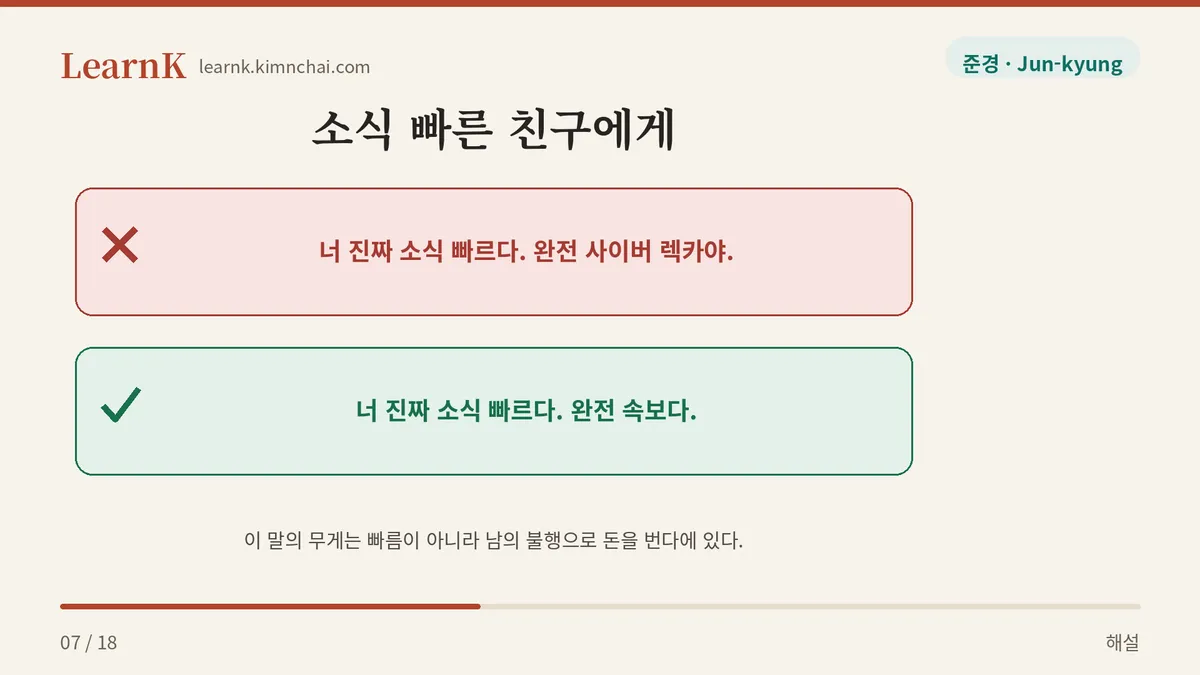
✗ (to a friend who just passed on some news) 너 진짜 소식 빠르다. 완전 사이버 렉카야. ✓ (to a friend who just passed on some news) 너 진짜 소식 빠르다. 완전 속보다. (“You really hear things fast. You’re a walking news flash.”) → The weight of this word isn’t in “fast,” it’s in “makes money off other people’s misfortune.” Aimed at someone who’s simply quick, it lands as a serious insult rather than a compliment, and the person hearing it will stop smiling.
✗ (in a meeting, naming a specific channel) 그 채널은 사이버 렉카입니다. 상대할 가치 없습니다. ✓ (in a meeting) 그 채널은 이슈 위주로 자극적으로 편집하는 곳입니다. (“That channel edits sensationally, focusing on whatever’s controversial.”) → Pointing at a specific channel or person with this word in a public setting is a strong attack on their character, and it plants the seed of a dispute. In formal settings it’s safer to swap in neutral language that simply describes the behavior.
Example Sentences by Situation
1) When a friend watches only a summary video and takes it as fact
Most internet incidents in Korea spread first as “summary videos,” because video moves faster than the original article. When a friend states something as settled fact on the strength of one of those videos, this is the line that makes them take a step back.
그거 사이버 렉카 영상 보고 말하는 거지? 원문 기사부터 찾아봐. geugeo saibeo rekka yeongsang bogo malhaneun geoji? wonmun gisabuteo chajabwa. (You’re saying that based on a cyber-wrecker video, right? Go find the original article first.)
2) Cleaning up your subscription list
Because the algorithm keeps pushing these channels at you, Korean YouTube users periodically “clean out” their subscriptions and recommendations. The word comes up naturally when describing that cleanup.
주말에 구독 목록 정리했어. 사이버 렉카만 골라서 다 끊었더니 피드가 조용하다. jumare gudok mongnok jeongnihaesseo. saibeo rekkaman golraseo da kkeunneonni pideuga joyonghada. (I cleaned up my subscriptions over the weekend. I unsubscribed from all the cyber wreckers and my feed got quiet.)
3) In a news article
Here’s the interesting part: the word started as internet slang, but today it appears as-is in newspaper articles and broadcast subtitles. It doesn’t feel out of place even in formal written Korean.
소속사는 허위 사실을 유포한 사이버 렉카 채널들에 법적 대응을 예고했다. sosokssaneun heowi sasireul yuposan saibeo rekka chaeneuldeure beopjjeok daeeungeul yegohaetda. (The agency announced legal action against cyber-wrecker channels that spread false information.)
Formal and Casual Speech, and Similar Expressions
Because it’s a noun, the word itself has no honorific or humble form. You can make the sentence polite — 사이버 렉카예요 (saibeo rekka-yeyo), 사이버 렉카입니다 (saibeo rekka-imnida) — and the form becomes courteous. But a polite form doesn’t make the content polite. The instant this word is pointed at someone it is already an accusation, so even wrapped in honorifics it lands with roughly the force of “저분은 사기꾼입니다 (jeobuneun sagikkun-imnida)” — “that person is a fraud.” If you want to be polite, you have to change the word itself, not the sentence ending.
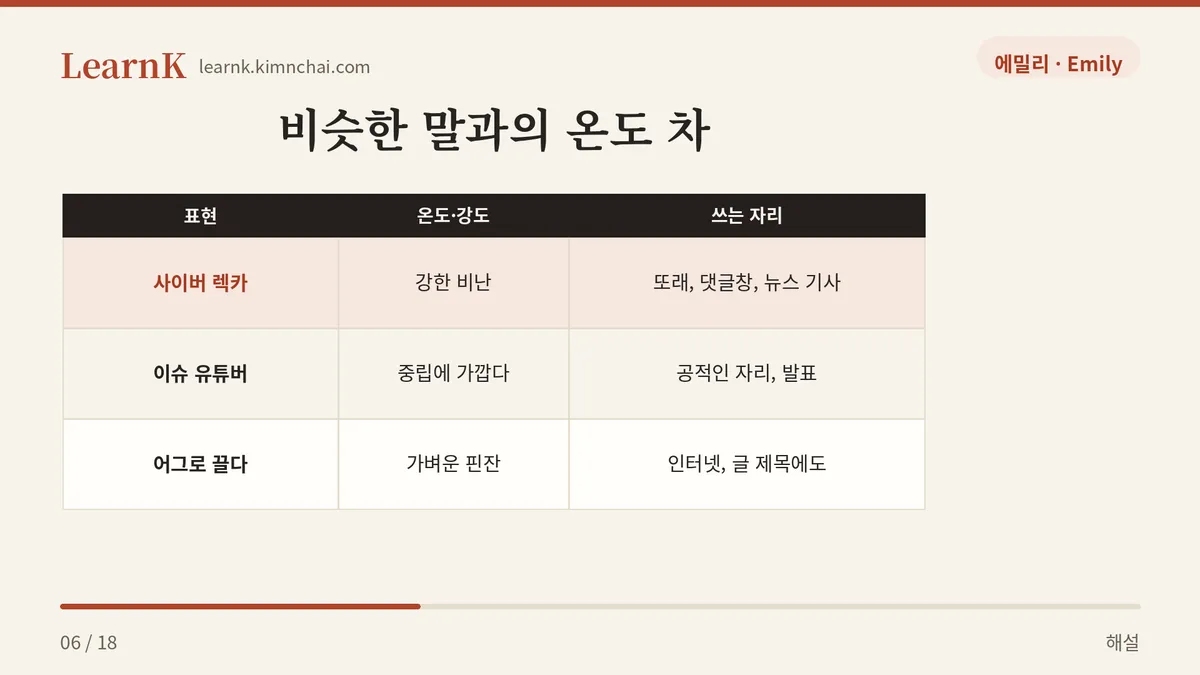
| Expression | Temperature / Strength | Where it’s used |
|---|---|---|
| 사이버 렉카 (saibeo rekka) | Strong condemnation. Cuts at the profit motive too | Among peers, on social media, in comment sections. Also appears in news articles |
| 이슈 유튜버 (isyu yutyubeo) | Neutral to mildly negative | Public settings, presentations, conversations with people you’ve just met |
| 어그로 끌다 (eogeuro kkeulda) | Light criticism. Points at the attention-seeking itself | Among peers, online. Used for posts and headlines, not just people |
| 기레기 (giregi) | Strong condemnation. Limited to reporters and the press | Internet comments. Say it to someone’s face and a fight starts immediately |
About the same situation, saying “저 채널 어그로 끄네” is a light jab — roughly “they’re just doing that for attention.” But saying “저 채널 사이버 렉카야” condemns the way that person makes a living. The difference in force is unmistakable.
Cultural Background — Where the Tow Trucks Used to Race
렉카 (rekka) is the English word wrecker rendered in Korean pronunciation; in Korea it refers to the tow truck that hauls away crashed vehicles. For a long time, whenever there was an accident on the road, tow trucks would come racing in as if competing to arrive first — and that image is the skeleton of this word. Add 사이버 (saibeo, “cyber”) to the front and you get the same scene playing out on the internet instead of the highway. Something comes running the moment there’s a crash; the bigger the crash, the more of them swarm; and that running isn’t goodwill, it’s a livelihood — all three carried over intact. Once you know how the word was built, you understand why it sounds so cold.
The term settled into internet usage around 2020. As the structure where YouTube views translate directly into income took hold, and the algorithm began pushing sensational titles further and further, it became common for a single incident to trigger dozens of summary videos within hours. People needed a name for that speed, so they borrowed a scene they already knew from the road.
The Korean internet consumes issues at an extraordinary pace. Something that starts in the morning fills the real-time search rankings by lunch, and a summary video is up by evening. That’s why this word functions less as a plain insult and more as a kind of self-policing device. The moment a comment saying “이건 좀 사이버 렉카 아니냐” appears under a video, the people watching it pause for a second. If you learn this word as a Korean learner, you also get a look at how the Korean internet keeps watch over itself.
Today’s Quiz
Which of the following is the most natural situation for using 사이버 렉카 (saibeo rekka)?
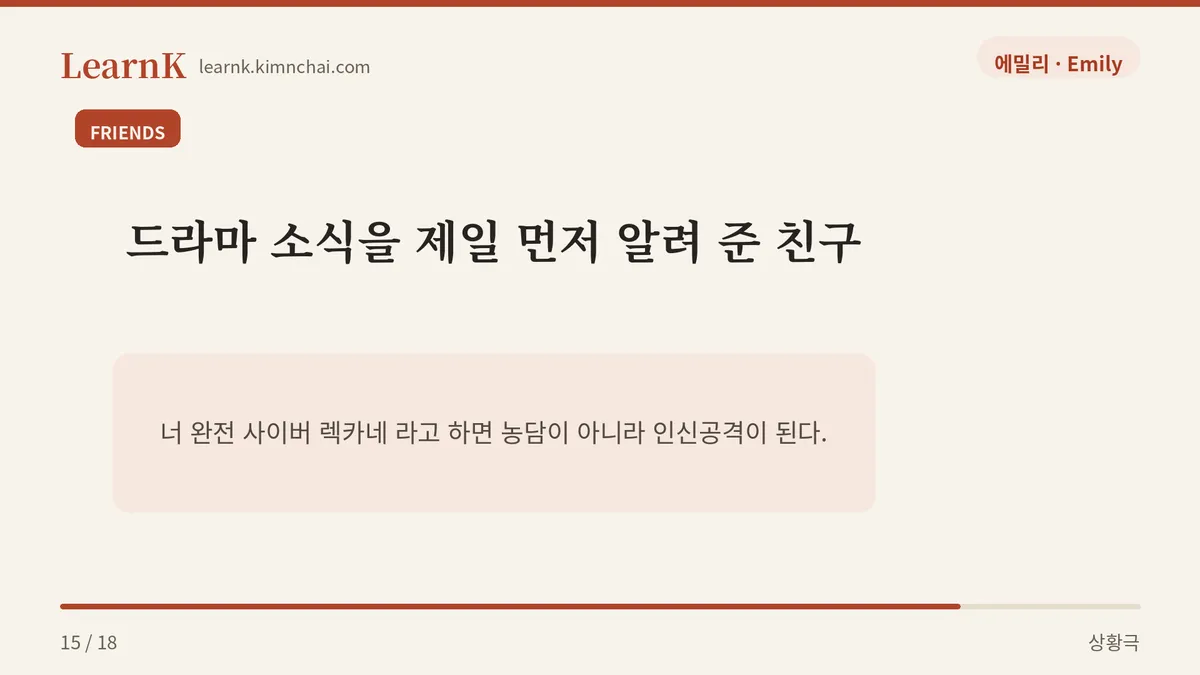
- When a friend tells you about a new drama before anyone else does
- When you see a channel that stitched together yesterday’s controversy, posted a video this morning, and slapped ads on it
- When a coworker puts together the meeting materials in a single day
See the answer
Answer: 2
Numbers 1 and 3 are just “fast.” The weight of this word isn’t speed — it’s taking someone else’s misfortune as raw material and harvesting attention and money from it. It only sounds natural when all three conditions line up as in number 2: ① someone else’s controversy, ② turned around quickly, ③ into content that pays. For number 1, “소식 진짜 빠르다 (sosik jinjja ppareuda)” is the right line; for number 3, “일 처리 진짜 빠르시네요 (il cheori jinjja ppareusineyo).”
Definitions and example sentences are from the National Institute of Korean Language’s Basic Korean Dictionary (krdict.korean.go.kr); that portion of this post, including our translations, is licensed under CC BY-SA 2.0 KR.