닭갈비 (dakgalbi) — Why a Dish Named "Ribs" Has No Bones in It

닭갈비
닭갈비 (dakgalbi) means “food made from a chicken’s ribs or meat.” In Korea, when someone says 우리 닭갈비 먹을까? (uri dakgalbi meogeulkka?) — “Should we get dakgalbi?” — it’s less like picking one item off a menu and more like a proposal about the shape of the whole evening. A wide iron griddle comes out, you wait ten minutes or so while the meat, cabbage, and rice cakes cook, and once the meat is gone you fry rice in the sauce left behind. It isn’t a meal you wolf down and leave; it’s a meal you settle in for. That’s why the word tends to attach itself to sentences like “who should I go with?” rather than “what should I eat on my own?”
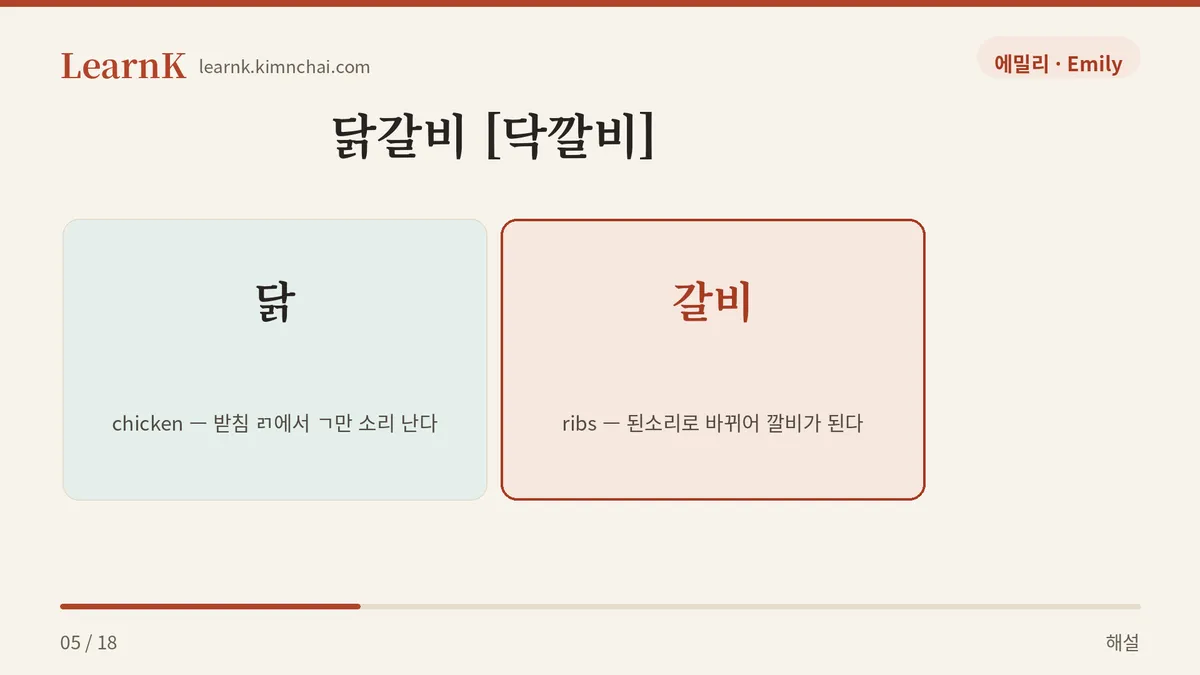
The name says 갈비 (galbi, “ribs”), but you’ll rarely be holding a bone and tearing meat off it. 닭갈비 is a compound of 닭 (dak, “chicken”) + 갈비 (galbi, “ribs”), and it’s pronounced [닥깔비] (dakkalbi) — in the final cluster ㄺ only the ㄱ is sounded, and the following syllable turns into a tense consonant. If a learner reads it as [달갈비] (dalgalbi), it gives them away on the spot, so pin the sound down first. As for nuance, it has nothing to do with formality. It’s the name of an object, so the word itself is neither honorific nor humble; the difference between 존댓말 (jondaenmal, polite speech) and 반말 (banmal, casual speech) shows up in the verbs around 닭갈비.
Checking It in the National Institute of Korean Language Dictionary

닭갈비 「noun」 Food made from chicken ribs or flesh. — National Institute of Korean Language, Basic Korean Dictionary (krdict.korean.go.kr)
The definition is short, but the answer is already sitting in that one line. It lists two things side by side — 갈비나 살 (galbina sal), “ribs or flesh” — which means it’s dakgalbi if there are bones in it, and it’s dakgalbi if it’s nothing but boneless meat. Having 갈비 in the name doesn’t make bones a requirement.
[en] dakgalbi; spicy stir-fried chicken — Food made from chicken ribs or flesh. [ja] タッカルビ — 鶏のカルビや肉で作った食べ物。 [es] costillas de pollo — Comida elaborada con costillas o carne de pollo. [zh] 辣炒鸡排 — 用鸡肋部或鸡肉烹制的食品。 — National Institute of Korean Language, Basic Korean Dictionary (krdict.korean.go.kr)
The Portuguese definition isn’t carried in the dictionary, so we’ve added our own translation for reference (not dictionary content): costelinha de frango; frango salteado e picante — comida feita com costelas ou carne de frango.
Here are the dictionary’s own usage examples, exactly as they appear.
닭갈비 전문점. (dakgalbi jeonmunjeom.) — A dakgalbi specialty restaurant. 닭갈비 골목. (dakgalbi golmok.) — Dakgalbi alley. 뼈 없는 닭갈비. (ppyeo eomneun dakgalbi.) — Boneless dakgalbi. — National Institute of Korean Language, Basic Korean Dictionary (krdict.korean.go.kr)
닭갈비 전문점 (dakgalbi jeonmunjeom) refers to a restaurant that serves only dakgalbi. In Korea, the foods that get 전문점 (jeonmunjeom, “specialty shop”) attached to them are usually the ones with a long prep process or a dedicated piece of cooking equipment — and dakgalbi, which needs a big iron griddle set into every table, is exactly that kind of food.
닭갈비 골목 (dakgalbi golmok) is a street lined with dakgalbi restaurants one after another. Korea has several places where a single dish takes over an entire alley, and for a traveler this one word doubles as the name of a destination.
뼈 없는 닭갈비 (ppyeo eomneun dakgalbi) — the fact that the dictionary bothers to list a phrase with 뼈 없는 (“boneless”) attached tells you that bone-in dakgalbi still exists. That said, what you’ll meet at a griddle-style dakgalbi place in the city is usually the boneless kind.
이 지역은 닭갈비로 유명하다. (i jiyeogeun dakgalbiro yumyeonghada.) — This area is famous for dakgalbi. 일반적인 닭갈비도 맛있지만 숯불에 구워 먹는 닭갈비가 아주 별미이다. (ilbanjeogin dakgalbido masitjiman sutbure guwo meongneun dakgalbiga aju byeolmiida.) — Ordinary dakgalbi is delicious too, but dakgalbi grilled over charcoal is a real delicacy. — National Institute of Korean Language, Basic Korean Dictionary (krdict.korean.go.kr)
The first sentence is a pattern you can lift straight into travel writing or an introduction. 이 지역은 닭갈비로 유명하다 (i jiyeogeun dakgalbiro yumyeonghada) — the frame ‘~로 유명하다 (~ro yumyeonghada)’, “famous for ~,” is the most basic way to link a place to a food. The second sentence tells you there are two cooking methods. The stir-fried-on-a-griddle version is the one we usually picture, and 숯불에 구워 먹는 닭갈비 (sutbure guwo meongneun dakgalbi), charcoal-grilled dakgalbi, is the one the dictionary singles out with the word 별미 (byeolmi), “a delicacy.”
Seeing It in a Real Conversation
Scene: Dakgalbi alley in Chuncheon. The griddle heats up the moment they sit down, and the sauce-coated meat is just starting to cook.
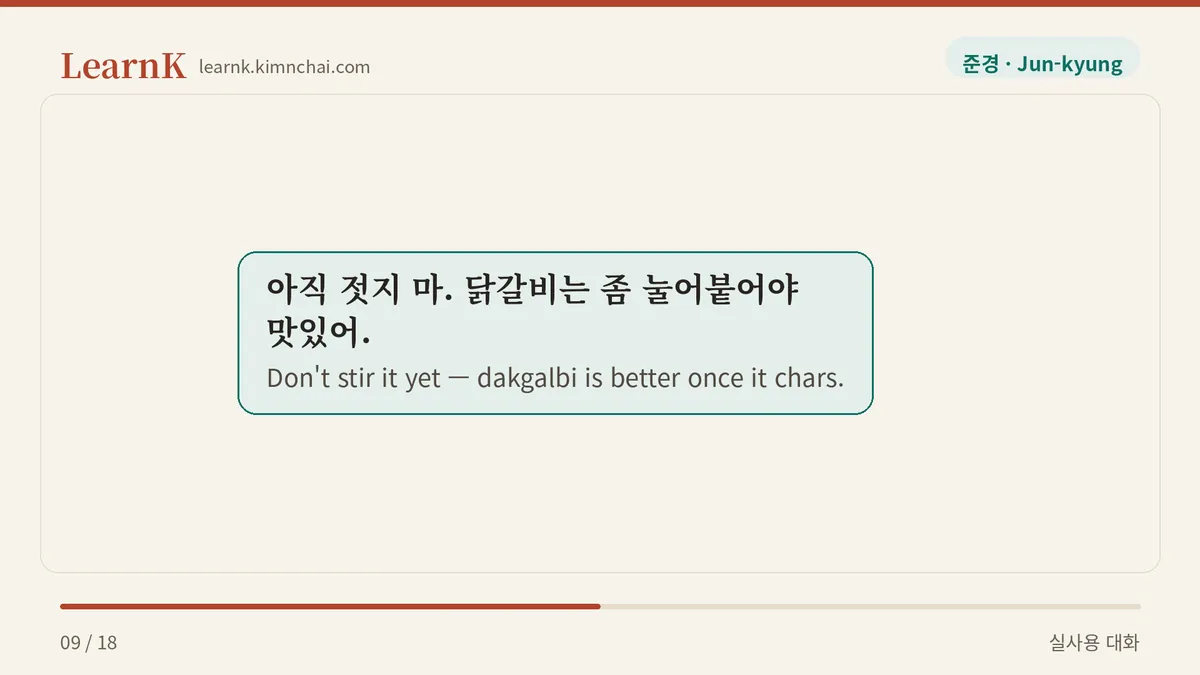
Jun-kyung: 아직 젓지 마. 닭갈비는 좀 눌어붙어야 맛있어. Don’t stir it yet. Dakgalbi tastes better once it sticks and chars a bit.
Emily: 알았어. 근데 나 닭갈비가 이렇게 큰 철판에 나오는 건 처음 봐. Okay. But this is my first time seeing dakgalbi come out on such a huge iron plate.
Jun-kyung: 여기가 원래 닭갈비 골목이잖아. 이 동네는 다 이래. This is dakgalbi alley, remember. Every place around here is like this.
Emily: 아, 그래서 아까부터 골목 전체에서 냄새가 났구나. Ah, so that’s why the whole alley smelled like this on the way in.
Jun-kyung: 다 먹고 볶음밥 시킬 거지? 그거 안 하면 여기까지 온 의미가 없어. We’re getting the fried rice at the end, right? Otherwise there was no point coming all the way here.
Emily: 당연하지. 나 아까부터 그거 기다렸어. Obviously. I’ve been waiting for that since we sat down.
This Sounds Off
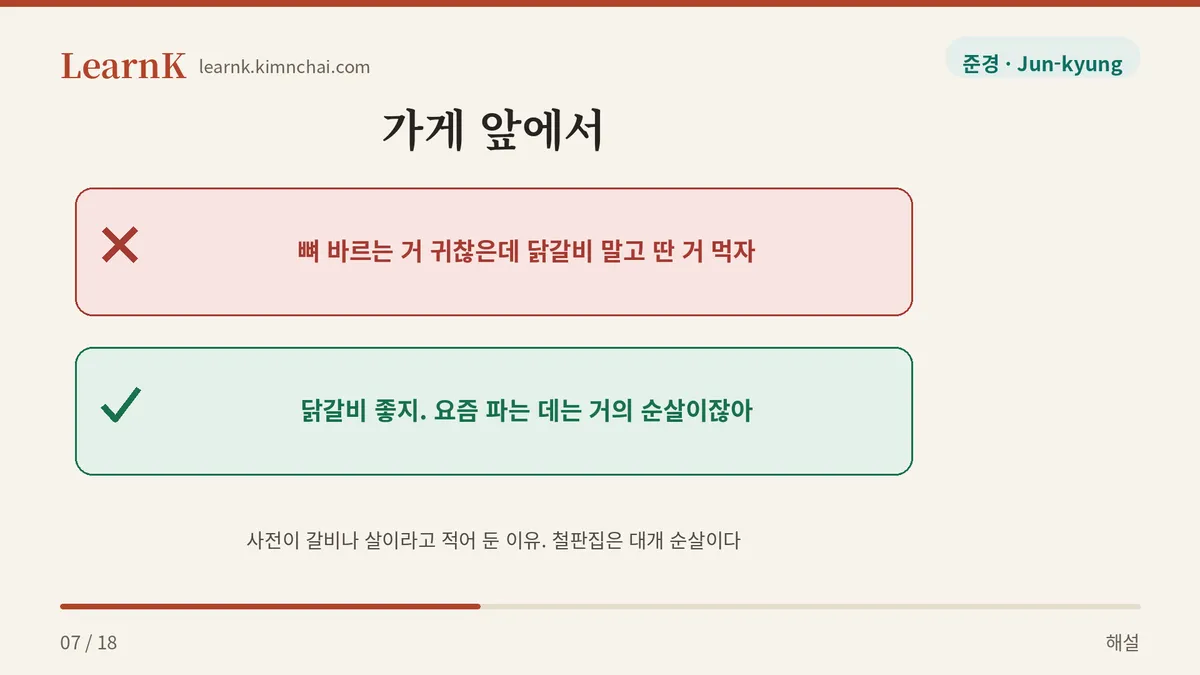
✗ (in front of the restaurant) 나 뼈 바르는 거 귀찮은데… 닭갈비 말고 딴 거 먹자. Picking meat off bones is such a hassle… let’s eat something other than dakgalbi. ✓ (in front of the restaurant) 닭갈비 좋지. 요즘 파는 데는 거의 순살이잖아. Dakgalbi sounds good. Most places serve it boneless these days anyway. → This is the mistake of assuming, from the name alone, that it’s a dish where you gnaw on ribs. That’s exactly why the dictionary definition lists two options side by side, ‘갈비나 살 (galbina sal)’. What comes out at a griddle-style dakgalbi restaurant is usually deboned meat.
✗ 이 프로젝트 진짜 닭갈비야. 버리자니 아깝고 하자니 싫고. This project is such a dakgalbi. Too good to throw away, too annoying to do. ✓ 이 프로젝트 진짜 **계륵 (gyeruk)**이야. 버리자니 아깝고 하자니 싫고. This project is such a gyeruk. Too good to throw away, too annoying to do. → If you translate “chicken’s ribs” literally, 닭갈비 looks right — but the Korean word used for this metaphor is the Sino-Korean 계륵 (gyeruk). 닭갈비 has hardened into the name of a dish on a griddle and nothing else, so using it figuratively will just leave the other person confused. Learners who know the Chinese characters 鷄肋 trip on this one especially often.
Example Sentences by Situation
1. Suggesting a place for a team dinner — everyone in the department has different tastes and you’re looking for a safe bet. Dakgalbi is a regular candidate here: easy to share and gentle on the budget.
오늘 회식은 닭갈비 어떠세요? 다 같이 나눠 먹기 편하잖아요. (oneul hoesigeun dakgalbi eotteoseyo? da gachi nanwo meokgi pyeonhajanayo.) How about dakgalbi for tonight’s team dinner? It’s easy for everyone to share.
2. Planning a trip — here’s what the dictionary example “이 지역은 닭갈비로 유명하다” looks like once you put it into a real conversation.
춘천 가면 닭갈비 골목부터 들러야 돼. 거기가 제일 유명하거든. (Chuncheon gamyeon dakgalbi golmokbuteo deulleoya dwae. geogiga jeil yumyeonghageodeun.) If you go to Chuncheon, you have to hit dakgalbi alley first. That’s the most famous spot.
3. Ordering at the restaurant — you don’t order the fried rice up front; you ask for it separately once the meat is nearly gone. Just knowing that order of operations makes you look like a local.
닭갈비 이 인분 주시고요, 볶음밥은 이따가 말씀드릴게요. (dakgalbi i inbun jusigoyo, bokkeumbabeun ittaga malsseumdeurilgeyo.) Two servings of dakgalbi, please — I’ll let you know about the fried rice later.
Polite vs. Casual Speech, and Similar Expressions
닭갈비 itself never changes form. The politeness is carried by the verbs you use with it.
- Casual: 우리 닭갈비 먹으러 갈까? (uri dakgalbi meogeureo galkka?) — “Should we go get dakgalbi?”
- Polite: 저녁에 닭갈비 드시러 가실래요? (jeonyeoge dakgalbi deusireo gasillaeyo?) — “Would you like to go for dakgalbi this evening?”
All that changed is 먹다 (meokda) → 드시다 (deusida) and 가다 (gada) → 가시다 (gasida); the noun stays exactly as it is. Nobody honorifies a food’s name by making something like ‘닭갈비님 (dakgalbi-nim)’.
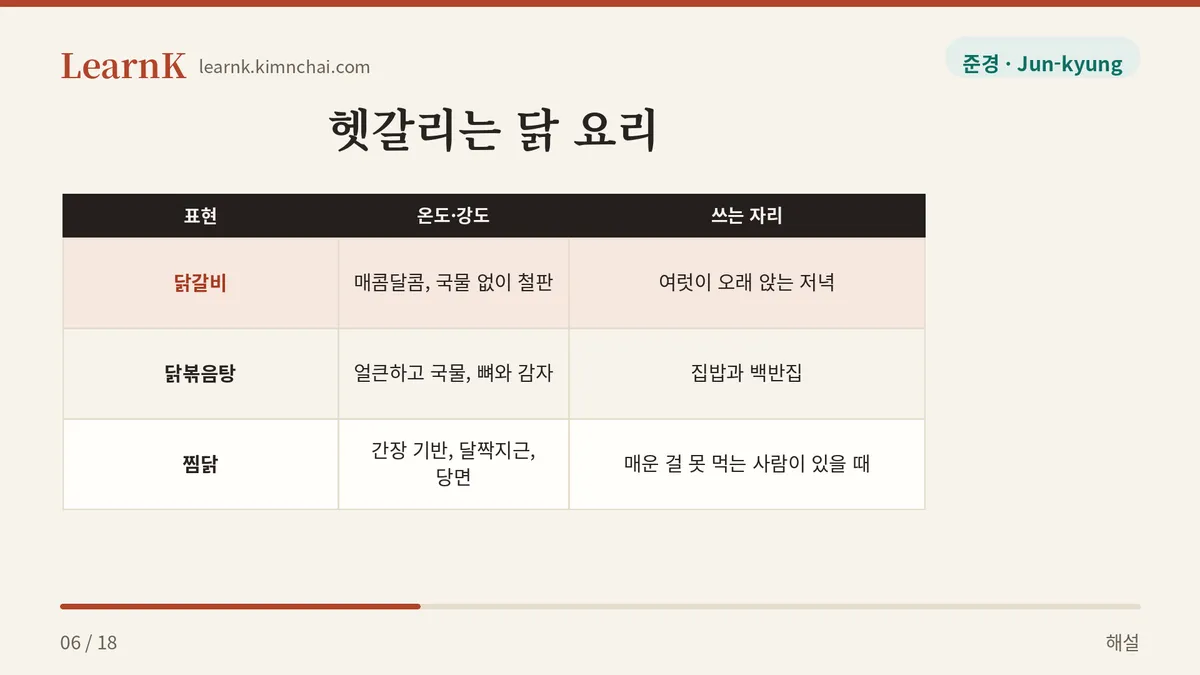
The differences between the chicken dishes that look similar are quickest to see in a table.
| Expression | Flavor & character | Where it fits |
|---|---|---|
| 닭갈비 (dakgalbi) | Sweet-and-spicy sauce, stir-fried on a griddle with no broth | A long evening with a group. Ends with fried rice |
| 닭볶음탕 (dakbokkeumtang) | Hot and hearty, with broth. Made with bone-in chicken and potatoes | Home cooking and set-menu diners. The kind of meal where you spoon broth over rice |
| 찜닭 (jjimdak) | Soy-sauce based, so on the sweet side, with glass noodles | When someone in the group can’t handle spicy food |
| 숯불 닭갈비 (sutbul dakgalbi) | Same sauce, but a strong smoky flavor | The version the dictionary calls a 별미 (byeolmi), “delicacy.” Takes longer to grill |
Cultural Background — The Time That Passes in Front of the Griddle
Dakgalbi is said to have started in Chuncheon, Gangwon Province, and the story that comes with it is that it was cheap, so students loved it. Even now, say “Chuncheon” and dakgalbi follows right behind, and the very phrases the dictionary lists as examples — 닭갈비 골목 and 닭갈비 전문점 — show that relationship plainly. The name of a city and the name of a dish ended up calling to each other.
The real defining feature of this food isn’t the flavor; it’s the time. Nobody can pick up their chopsticks until the meat is cooked, so for those few minutes you have no choice but to talk. That’s also why Korean dramas so often show characters sitting across a griddle from each other, waiting for it to cook — the waiting is what generates the dialogue. And the meal doesn’t count as finished until you’ve completed the last step, frying rice in the sauce that’s left. Get up without the fried rice and your Korean companions will look genuinely disappointed.
One more thing. Most restaurants take orders starting from two servings. That means it’s a hard dish to eat alone, and it’s part of why this word is always spoken alongside a head count. A dictionary example like “닭갈비를 거의 다 먹었는데 아직도 배가 부르지 않아 (dakgalbireul geoui da meogeonneunde ajikdo baega bureuji ana)” — “I’ve eaten almost all the dakgalbi and I’m still not full” — comes out naturally precisely because it’s a generous dish to begin with.
Today’s Quiz
Which of the following uses ‘닭갈비’ most naturally?
① 이 프로젝트는 완전 닭갈비야. 버리기도 아깝고 하기도 싫어. This project is total dakgalbi. Too good to throw away, too annoying to do. ② 춘천에 가면 닭갈비 골목부터 가 보자. When we get to Chuncheon, let’s go to dakgalbi alley first. ③ 닭갈비는 뼈를 하나씩 발라 가며 먹는 게 제일 중요해. With dakgalbi, the most important thing is picking the meat off the bones one by one.
Answer: ②
① puts 닭갈비 where the Sino-Korean word 계륵 (gyeruk) belongs — “something too good to discard but not much use” — so it doesn’t work in Korean. ③ is the case of guessing from the name that it’s a bone dish; dakgalbi these days is usually boneless meat stir-fried on a griddle. ② is a sentence in which the dictionary examples “닭갈비 골목” and “이 지역은 닭갈비로 유명하다” are alive and intact.
Definitions and example sentences are from the National Institute of Korean Language’s Basic Korean Dictionary (krdict.korean.go.kr); that portion of this post, including our translations, is licensed under CC BY-SA 2.0 KR.