닭강정 (dakgangjeong) — the Korean fried chicken that's actually better cold
닭강정 (dakgangjeong)
Today’s expression is 닭강정 (dakgangjeong). It means bite-sized pieces of chicken that are fried twice and then tossed in a sticky sauce made from corn syrup and gochujang. If you’ve ever walked through the alleys of a Korean market and spotted one shop with a line far longer than the rest, odds are it’s a dakgangjeong shop. On a huge iron griddle, the fried chicken gets rolled around with a paddle until every piece is coated, then heaped into a paper tub and capped with a lid. Customers carry that tub onto a bus, onto a train, and don’t lift the lid until they get home two or three hours later. And it’s still good — that’s the whole identity of this dish.
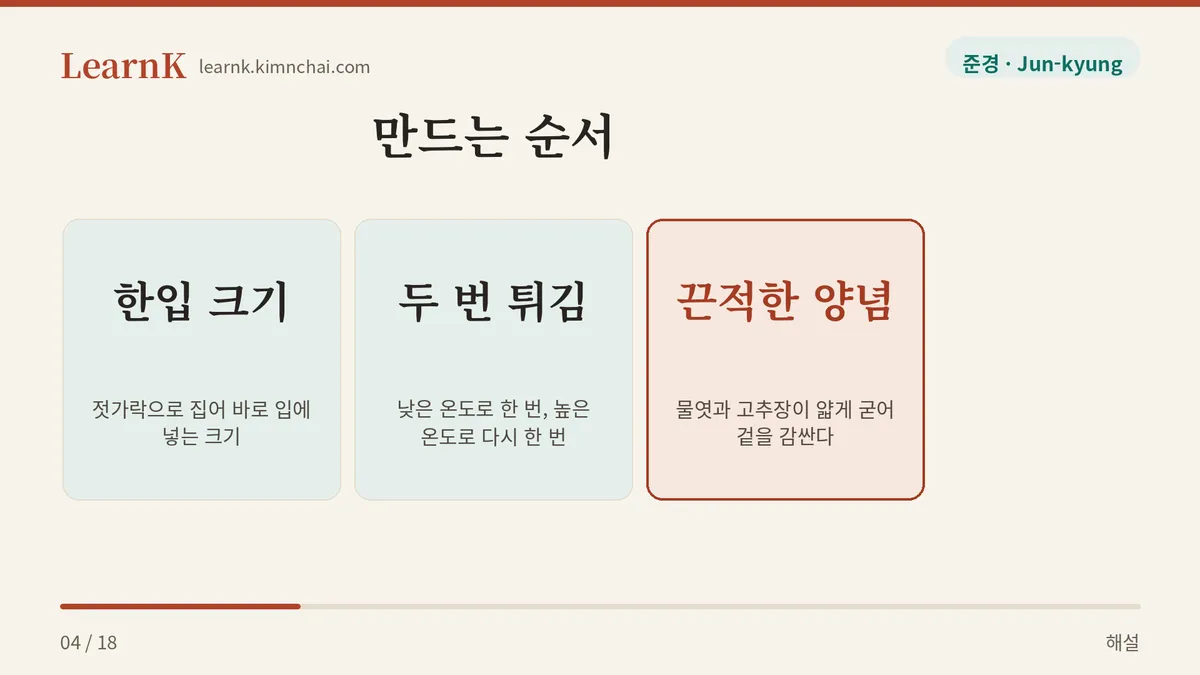
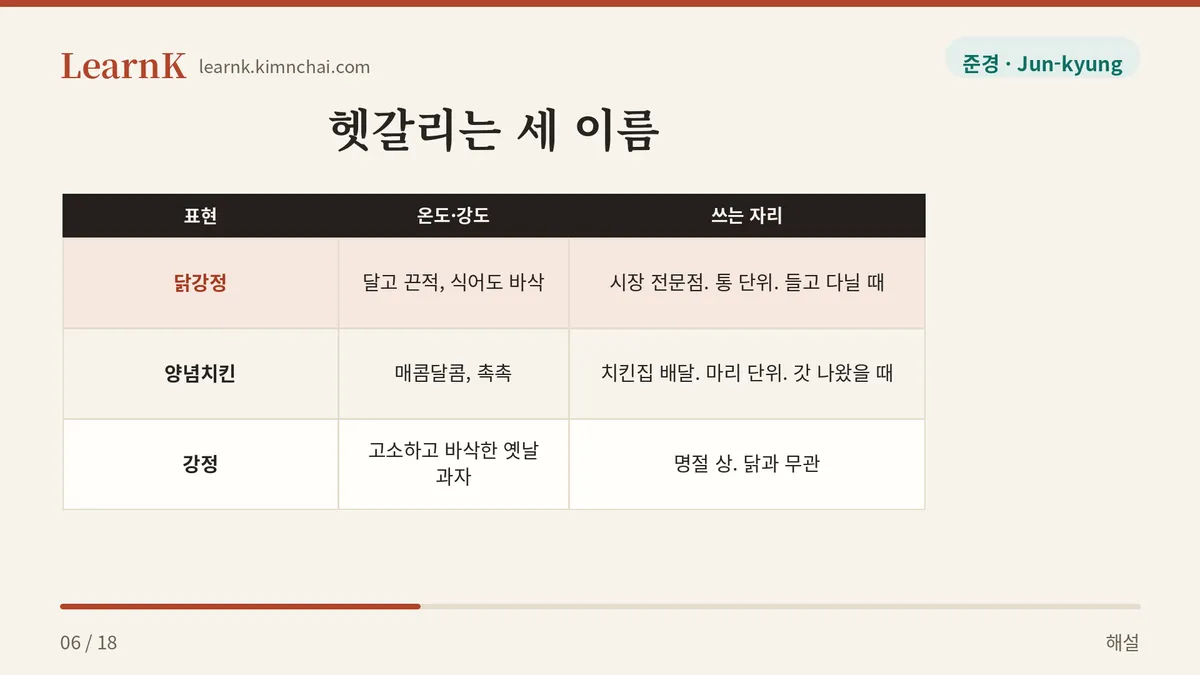
There’s a question foreign learners living in Korea ask all the time: what’s the difference between 닭강정 (dakgangjeong) and 양념치킨 (yangnyeom-chikin)? On the surface they’re both red and sweet, but Koreans treat them as completely different foods. First, the size is different. Yangnyeom-chikin is a whole chicken cut into big pieces by part, while dakgangjeong comes in small pieces you can pick up with chopsticks and pop straight into your mouth. Second, the frying method is different. Dakgangjeong is fried twice — once at a low temperature, then again at a high one — which makes the outside firm. Third, the thickness of the sauce is different. The sauce on yangnyeom-chikin soaks in and stays moist, while dakgangjeong’s sauce sets into a sticky glaze thanks to the corn syrup, coating the batter in a thin shell.
Those three things together create dakgangjeong’s particular character. It doesn’t go soggy as it cools. If anything, the surface hardens over time and the crunch comes alive. That’s why dakgangjeong is close to a food designed from the start to be carried around. Unlike chicken you have to eat piping hot, dakgangjeong can ride in your travel bag for a few hours and still hold its own when you take it out. Even the unit it’s sold in is different. Chicken is counted by the bird; dakgangjeong is counted by the tub (한 통, han tong) or the cup. When you order, you choose between 순살 (sunsal) — boneless — and bone-in, and between 매운맛 (maeunmat) — spicy — and mild, and you can also ask for half and half. The peanuts or sesame seeds sprinkled on at the end add a nutty note, and they’re also the root of the name 강정 (gangjeong) — but more on that later.
See It in a Real Conversation

Scene: the last day of a trip to Sokcho. There isn’t much time left before the bus to Seoul, but the line in front of the dakgangjeong shop in Jungang Market stretches on and on.
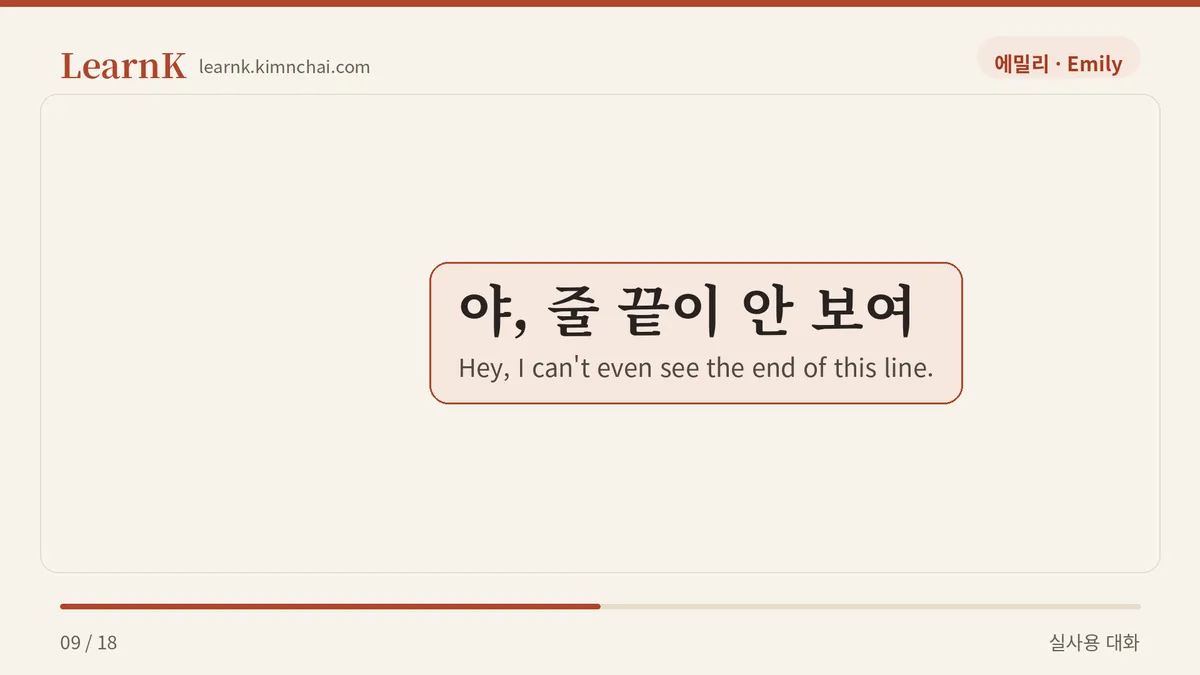
Emily: 야, 줄 끝이 안 보여. 우리 버스 놓치는 거 아니야? Hey, I can’t even see the end of this line. Aren’t we going to miss our bus?
Jun-kyung: 괜찮아, 이 정도면 이십 분이면 빠져. 여기까지 와서 닭강정 안 사 가면 진짜 후회해. It’s fine, a line like this clears in twenty minutes. If we come all the way here and don’t buy dakgangjeong, we’ll seriously regret it.
Emily: 근데 버스에서 두 시간이잖아. 도착하면 다 식을 텐데? But it’s two hours on the bus. It’ll be completely cold by the time we get there.
Jun-kyung: 그러니까 닭강정이지. 얘는 식어야 진짜야. 겉이 딱딱해지면서 더 바삭해져. That’s exactly why it’s dakgangjeong. It’s at its best cold — the outside firms up and gets even crunchier.
Emily: 아 맞다. 저번에 네가 가져온 것도 다음 날 아침에 먹었는데 하나도 안 눅눅했어. Oh, right. The one you brought last time — I ate it the next morning and it wasn’t soggy at all.
Jun-kyung: 봤지? 매운맛 반, 순한맛 반으로 하자. 어머니 갖다드릴 거 한 통 더 사고. See? Let’s do half spicy, half mild. And one more box to take to my mom.
This Sounds Off
닭강정 (dakgangjeong) isn’t a word that carries emotion or attitude — it’s the name of a food — so it can’t be rude depending on who you’re talking to. Instead, here are two misunderstandings learners really do run into.
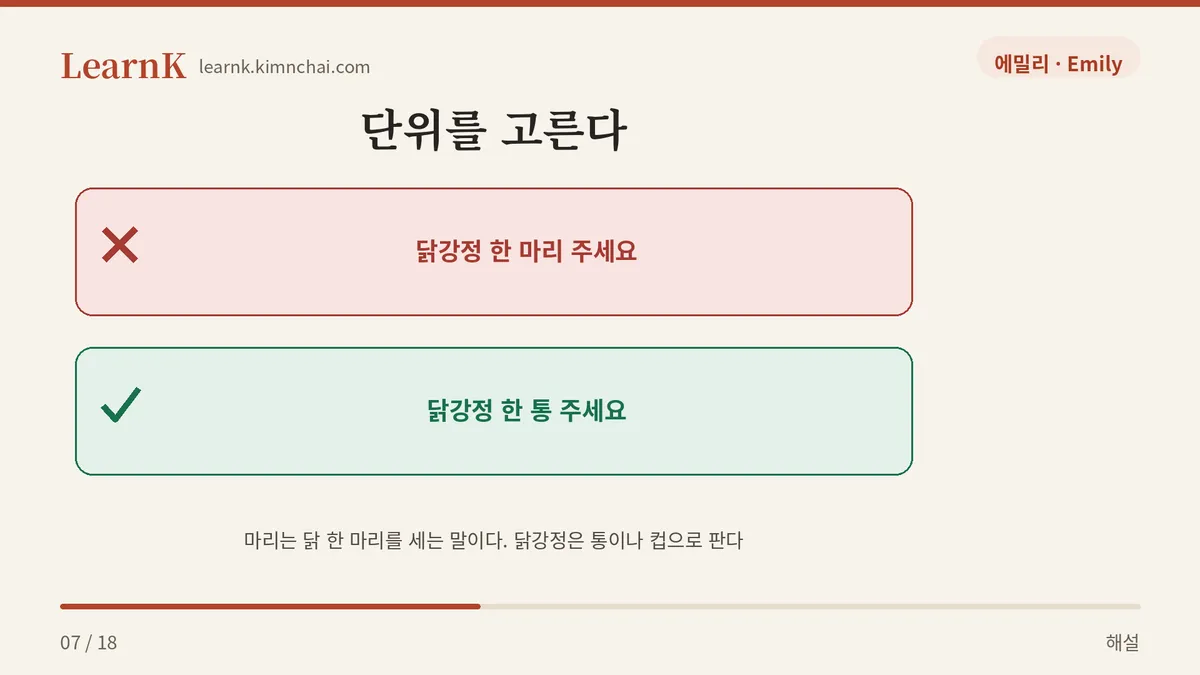
✗ (walking into a fried chicken restaurant) 여기 닭강정 한 마리 주세요. (yeogi dakgangjeong han mari juseyo.) ✓ (at a chicken restaurant) 여기 양념치킨 한 마리 주세요. (yeogi yangnyeom-chikin han mari juseyo.) / (at a dakgangjeong shop in a market) 닭강정 한 통 주세요. (dakgangjeong han tong juseyo.) → Dakgangjeong isn’t counted with 마리 (mari), the counter for whole birds. It’s sold by the tub, the cup, or the box. On top of that, your neighborhood chicken place usually doesn’t have dakgangjeong on the menu at all. There’s a separate sense that dakgangjeong is something you buy at a specialty shop inside a market or a takeout-only place.
✗ 나 어제 시장에서 강정 사 먹었어. (na eoje sijang-eseo gangjeong sa meogeosseo.) ✓ 나 어제 시장에서 닭강정 사 먹었어. (na eoje sijang-eseo dakgangjeong sa meogeosseo.) → Drop the 닭 (dak) in front and say just 강정 (gangjeong), and your listener will picture the old-fashioned confection served at holiday tables. It isn’t a word you can shorten.
Example Sentences by Situation
Situation ① At a dakgangjeong shop in the market — it’s finally your turn.
순살로 한 통 주세요. 반은 매운맛으로 해 주세요. (sunsallo han tong juseyo. baneun maeunmaseuro hae juseyo.) One box of boneless, please. Make half of it spicy.
This is the sentence you’ll hear most often at a dakgangjeong shop. Most places let you choose between boneless and bone-in, and between spicy and mild, and many will mix two flavors in a single tub. The “half A, half B” pattern works exactly the same way when you’re ordering chicken.
Situation ② Someone back from a business trip, setting down a box.
이거 속초 갔다가 사 온 닭강정이야. 식었지만 원래 식은 게 더 맛있어. (igeo Sokcho gatdaga sa on dakgangjeong-iya. sigeotjiman wonrae sigeun ge deo masisseo.) This is dakgangjeong I picked up in Sokcho. It’s cold, but honestly it tastes better that way.
In Korea, dakgangjeong occupies the same slot as a souvenir you bring back from a trip. It’s one of the few foods you don’t have to apologize for serving cold, so tacking on a line like this feels completely natural.
Situation ③ Deciding what to eat for dinner with a friend.
치킨 시킬까? 밖에서 먹을 거면 닭강정 포장해 가는 게 낫지 않아? (chikin sikilkka? bakkeseo meogeul geomyeon dakgangjeong pojanghae ganeun ge natji anha?) Should we order chicken? If we’re eating outside, wouldn’t it be better to get dakgangjeong to go?
This is the calculation Koreans actually make when they’ll be eating somewhere else — a Han River park, a campsite. Delivery chicken has to stay hot until it arrives; with dakgangjeong, that worry doesn’t exist.
Formal vs. Casual, and Similar Expressions
닭강정 (dakgangjeong) is a noun, so the word itself doesn’t change shape between formal and casual speech. What changes is the sentence around it. Ordering at a shop, you’d say 닭강정 한 통 주세요 (dakgangjeong han tong juseyo); among friends, 닭강정 하나 시키자 (dakgangjeong hana sikija) — only the predicate that follows shifts. With strangers, going with the -주세요 (-juseyo) form is always safe.
Lining up the names that look similar makes the differences obvious.
| Expression | Flavor & texture | Where it belongs |
|---|---|---|
| 닭강정 (dakgangjeong) | Sweet and sticky; still crunchy when cold | Markets and takeout specialty shops. Sold by the tub. For carrying around |
| 양념치킨 (yangnyeom-chikin) | Sweet and spicy, moist | Chicken restaurants and delivery. Sold by the bird. Best fresh out of the fryer |
| 후라이드치킨 (huraideu-chikin) | Plain, seasoned with salt only | Chicken restaurants and delivery. With beer |
| 강정 (gangjeong) | A nutty, crisp old-fashioned confection | Holiday tables and tea trays. Nothing to do with chicken |
Cultural Background — The Old-Fashioned Sweet Hidden in the Name
The name 닭강정 (dakgangjeong) is 닭 (dak, chicken) joined to 강정 (gangjeong). Gangjeong was originally a type of 한과 (hangwa), traditional Korean confectionery: glutinous rice dough that’s dried, fried, coated in grain syrup, and then rolled in puffed rice, sesame seeds, or soybean powder. Fry it, glaze it with sticky syrup, and coat the outside with nutty little bits — those three steps are exactly the same as dakgangjeong. Chicken made the way gangjeong is made; hence, dakgangjeong. The peanuts sprinkled on at the end aren’t decoration, then — they’re the justification for the name.
The regional story matters too. Jungang Market in Sokcho, Gangwon Province, and Sinpo Market in Incheon are both famous for dakgangjeong, so people who visit either city pick up a tub for the trip home. The sight — and smell — of a Seoul-bound bus or train filled with it is pretty familiar to Koreans. Bring a tub into the office and the afternoon naturally turns into a sharing session, with everyone who didn’t get to travel asking where you’ve been. And the reason it makes such a good gift comes down to the same thing: the taste doesn’t fall apart with time.
Dakgangjeong shows up on screen, too. The 2024 Netflix series Chicken Nugget (Korean title 《닭강정》) is a comedy built on the absurd premise that a man’s daughter turns into dakgangjeong — director Lee Byung-hun’s adaptation of the webtoon of the same name. The fact that the title alone gets a laugh, before a single line of dialogue, already says a lot. In Korea this word needs no explanation: everyone shares a mental image of the tub it comes in and the smell that comes with it.
Today’s Quiz
Jun-kyung has a two-hour bus ride to Seoul ahead of him. He still went out of his way to stand in line for dakgangjeong. Which of the following is the best reason?
① Because it only tastes right if you eat it hot, right away ② Because as it cools, the outside actually firms up and gets crunchier ③ Because it’s only sold by the whole bird, which makes it good for sharing
The answer is ②. Dakgangjeong is fried twice and coated in a corn-syrup-based sauce, so it doesn’t go soggy over time. ① is a description that fits yangnyeom-chikin, and ③ has the counter wrong — dakgangjeong is counted by the tub, not by the bird.
Definitions and example sentences are from the National Institute of Korean Language’s Basic Korean Dictionary (krdict.korean.go.kr); that portion of this post, including our translations, is licensed under CC BY-SA 2.0 KR.