닭살 돋다 (daksal dotda) — Saying "Cringe" With Your Skin, in Korean
닭살 돋다 (daksal dotda) describes that uncomfortable, prickly feeling — as if tiny bumps were rising all over your skin — that hits you when you run into words or behavior that are just too sweet, too syrupy to sit through. When the couple at the next table in a café call each other 우리 애기 (uri aegi), “our baby.” When a friend reads the text they’re about to send their partner out loud. When a 선배 (seonbae, an older friend or senior) you haven’t seen in ages suddenly turns serious and says 너는 나에게 참 특별한 사람이야 (neoneun naege cham teukbyeolhan saramiya), “you’re a really special person to me.” At moments like these, Koreans rub their forearms and say: 닭살 돋아 (daksal doda).
닭살 돋다
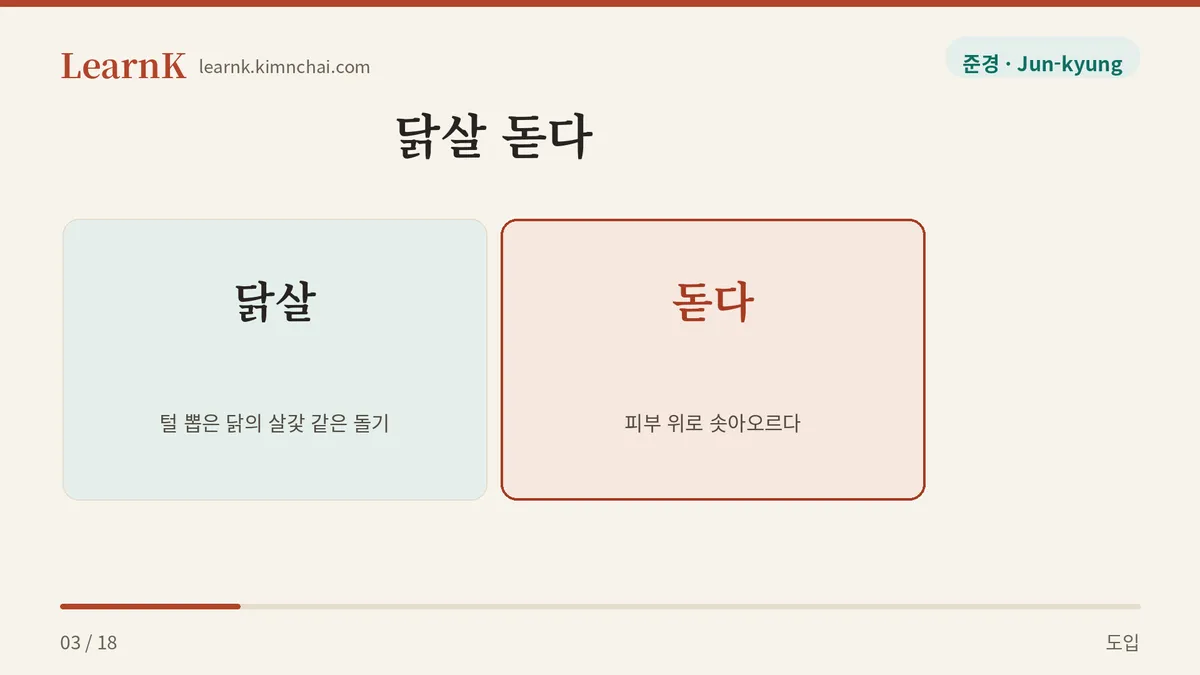
There are two branches to this expression. The first is when your body genuinely reacts. When you dip your feet into cold water, when the air conditioning hits the back of your neck — the bumps that rise on your skin are themselves called 닭살 (daksal). The second is when it isn’t the body reacting but the heart. You use it when someone’s words are so sweet, so earnest, so staged-sounding that the person listening can barely take it.
In everyday conversation, the second use wins by a landslide. When someone says 닭살 돋다 in Korean today, nine times out of ten they mean 오글거린다 (ogeulgeorinda), “cringey”; 느끼하다 (neukkihada), “cheesy”; or 보기 민망하다 (bogi minmanghada), “awkward to watch.”
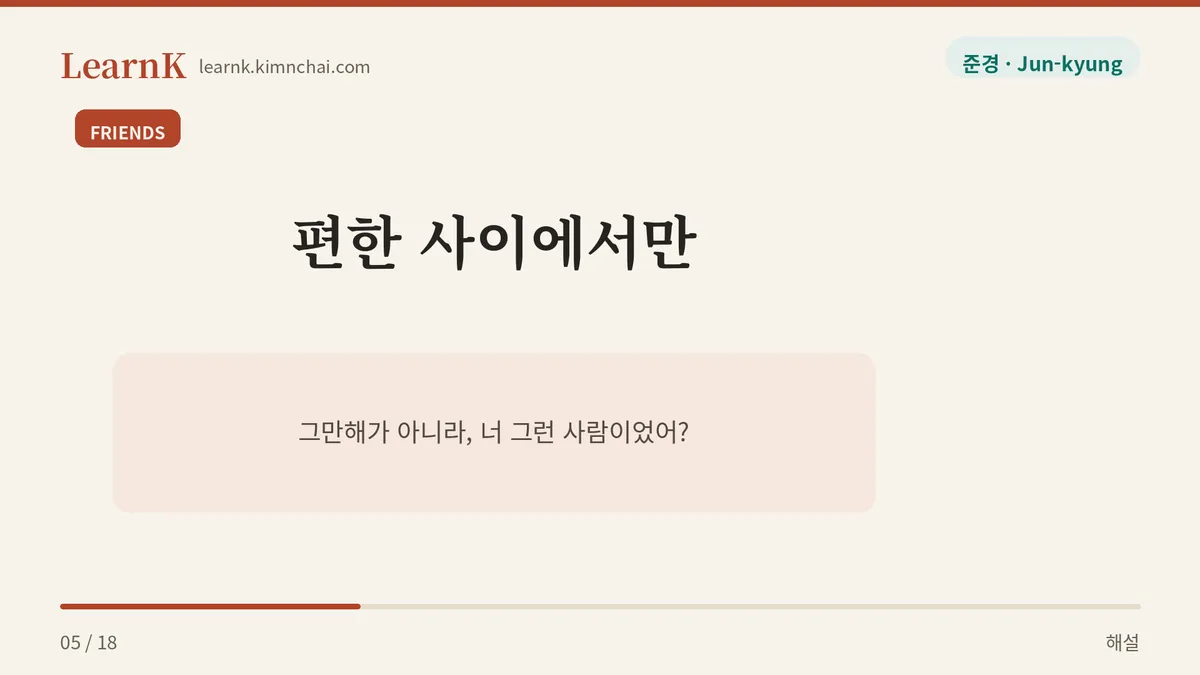
What matters here is the temperature. The expression is clearly negative, but it isn’t hostile. It’s not an attack on the other person — it’s closer to a teasing jab with a laugh mixed in. When you hear what a friend says to their partner and reply 닭살 돋는다 (daksal donneunda), you aren’t saying 그만해 (geumanhae), “stop it” — you’re saying 너 그런 사람이었어? (neo geureon saramieosseo?), “so this is who you are?” That’s why the phrase travels between people who are comfortable with each other.
The conjugations are flexible. 닭살 돋아 (daksal doda), 닭살 돋네 (daksal donne), 닭살 돋았어 (daksal dodasseo), and 닭살 돋는다 (daksal donneunda) are all used. You can add the particle and say 닭살이 돋다 (daksari dotda), or leave it out — both sound natural, because the phrase has hardened into a set idiom. There are plenty of spin-offs, too. A 닭살 커플 (daksal keopeul) is a couple so openly affectionate that it’s embarrassing to watch, a 닭살 멘트 (daksal menteu) is a cheesy line, and 닭살스럽다 (daksalseureopda) is the adjective form.
See It in a Real Conversation
Situation: The reception hall at a friend’s wedding. The groom has picked up the mic and started reading a letter to the bride.
Jun-kyung: 야, 저기 봐. 신랑이 편지 읽는대. Hey, look over there. The groom’s about to read a letter.
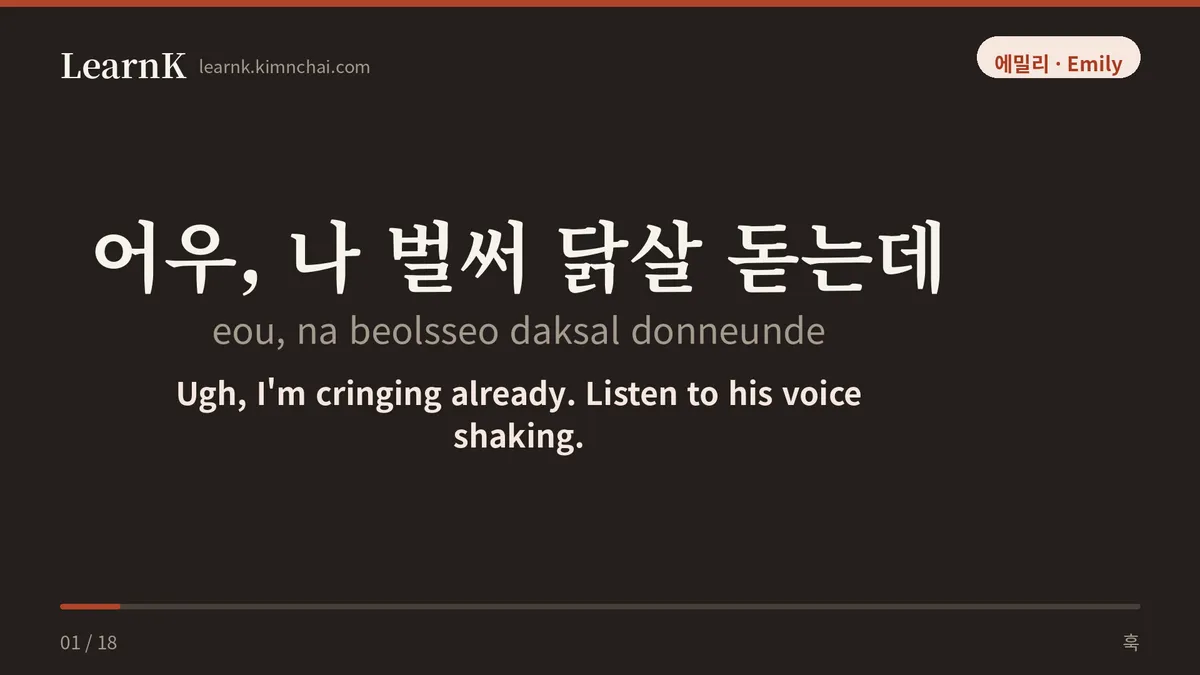
Emily: 어우, 나 벌써 닭살 돋는데. 목소리 떨리는 거 봐. Ugh, I’m cringing already. Listen to his voice shaking.
Jun-kyung: ‘나의 하나뿐인 공주님’ 이러잖아, 지금. 내 팔 좀 봐 봐. He just said “my one and only princess.” Look at my arm.
Emily: 진짜 닭살 제대로 돋았네. 근데 신부는 울어. You really have got full-on goosebumps. The bride’s crying, though.
Jun-kyung: 그러게. 남이 하면 오글거리는데 본인들은 진심이니까. I know. It’s cringey when someone else does it, but they mean every word of it.
Emily: 야, 너 나중에 저런 편지 쓸 거야? Hey — are you going to write a letter like that someday?
This Would Sound Off
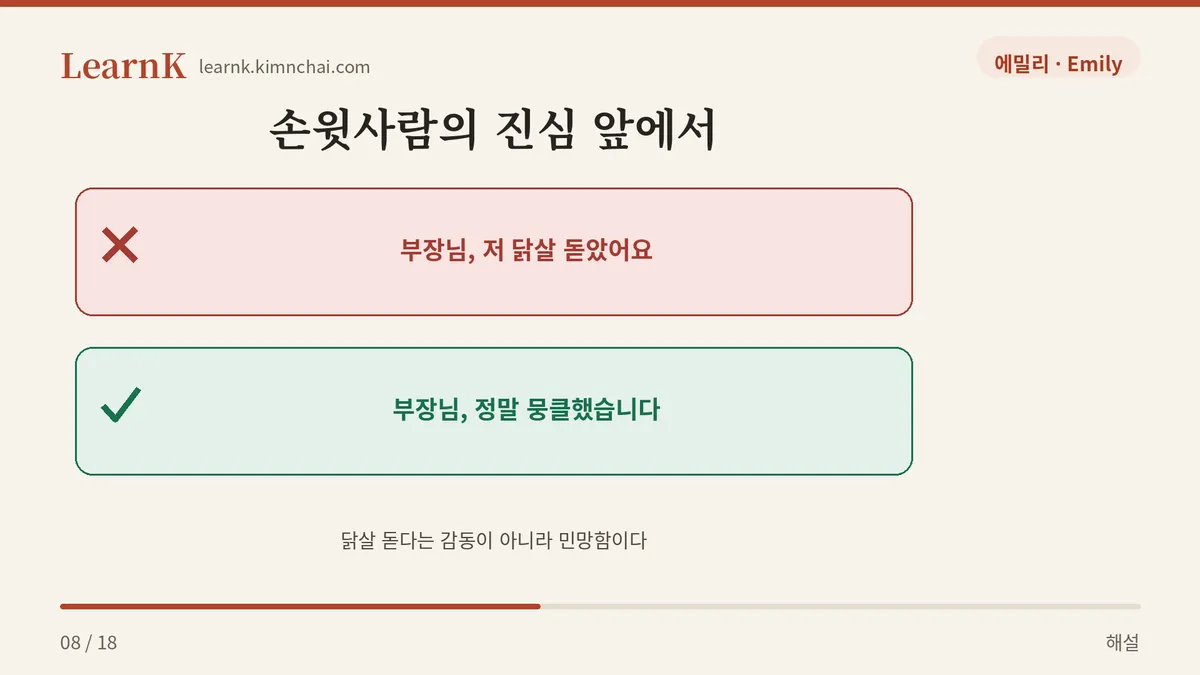
✗ (After listening to your department head’s retirement speech) 부장님, 아까 말씀하실 때 저 닭살 돋았어요. ✓ (After listening to your department head’s retirement speech) 부장님, 아까 말씀 들으면서 정말 뭉클했습니다. — Sir, listening to you speak earlier really moved me. → 닭살 돋다 doesn’t mean “I was moved,” it means “I was embarrassed.” Aim it at someone senior who has just spoken from the heart and you’ve essentially rated their sincerity as cheesy. For genuine emotion, use 뭉클하다 (mungkeulhada) or 가슴이 뭉클했습니다 (gaseumi mungkeulhaetseumnida).
✗ (The moment a singer nails a high note) 와, 방금 그 고음에서 닭살 돋았어. ✓ (The moment a singer nails a high note) 와, 방금 그 고음에서 소름 돋았어 (soreum dodasseo). — Wow, that high note just gave me chills. → Both point to the same bumps rising on your skin, but they run in opposite directions. 소름 돋다 is for being overwhelmed; 닭살 돋다 is for barely being able to stand it. Trying to praise a performance and landing a harsh review instead is the spot where learners slip most often.
Examples by Situation
① Commenting on a friend’s social media post A friend who’s just started dating posts couple photos every day with long captions attached. You leave a teasing comment.
- 야, 아침부터 닭살 돋게 왜 이래. (ya, achimbuteo daksal dotge wae irae.)
- Hey, why are you being so cheesy first thing in the morning?
‘닭살 돋게’ is an adverbial form meaning “to the point that I get 닭살.” It naturally folds in the idea that the other person’s behavior is the cause.
② Watching a drama together A scene where the male lead holds an umbrella over the heroine in the rain and delivers a long speech. Your younger sibling, sitting next to you, pulls a blanket over their head.
- 이 장면 닭살 돋아서 못 보겠어. 나 잠깐 나갔다 올게. (i jangmyeon daksal dodaseo mot bogesseo. na jamkkan nagatda olge.)
- This scene is too cringey to watch. I’m stepping out for a second.
Attaching ‘-아서/어서’ turns it into a reason. ‘닭살 돋아서 못 보겠다’ is a chunk you’ll genuinely hear all the time.
③ At a company workshop A team-bonding session where everyone reads a letter of praise to a coworker. A 선배 who is normally gruff starts reading in dead earnest.
- 선배가 저런 말 하니까 닭살 돋네요. 그래도 좋아요. (seonbaega jeoreon mal hanikka daksal donneyo. geuraedo joayo.)
- It’s kind of cringey coming from you, but I like it anyway.
This uses the polite ending ‘-네요’ and lowers the temperature by adding ‘그래도 좋아요’ at the end. When you use this expression in polite speech, propping it up like this is the safer move.
Polite and Casual Forms, and Similar Expressions
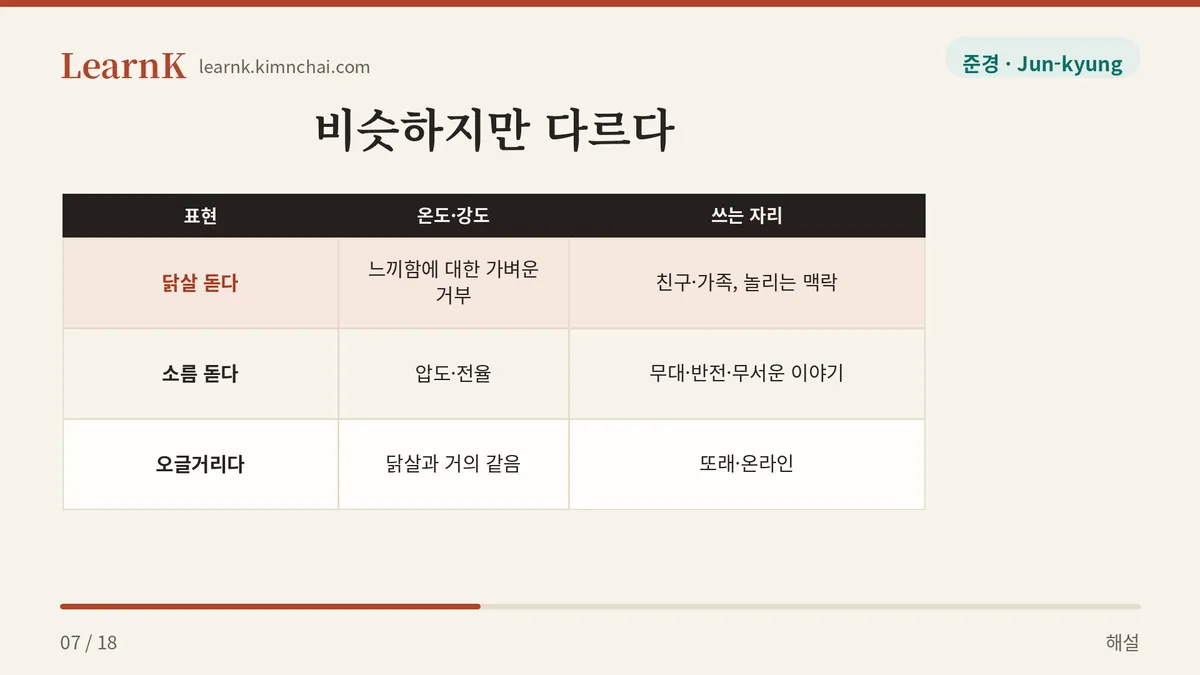
The casual forms are 닭살 돋아 / 닭살 돋네 / 닭살 돋는다, and the basic polite forms are 닭살 돋아요 (daksal dodayo) / 닭살 돋네요 (daksal donneyo). But the fact that a polite form exists doesn’t mean you can use it anywhere. In formal settings, or in the face of an older person’s sincerity, it’s best avoided no matter what form you put it in.
| Expression | Temperature / Intensity | Where it fits |
|---|---|---|
| 닭살 돋다 (daksal dotda) | Mild rejection of cheesiness, with a laugh in it | Friends, family, anyone you’re relaxed with. Teasing contexts |
| 소름 돋다 (soreum dotda) | Overwhelmed, electrified. Can be awe or fear | Performances, acting, plot twists, scary stories |
| 오글거리다 (ogeulgeorida) | Almost identical to 닭살 돋다, more colloquial | Peers, online. Not used toward seniors |
| 손발이 오그라들다 (sonbari ogeuradeulda) | The strongest. Unbearable levels | For emphasis. Long enough that it shows up in writing too |
| 느끼하다 (neukkihada) | A judgment on the person or their manner itself | Judges the target directly, so be careful using it to their face |
The pair that confuses people most is, unsurprisingly, 닭살 돋다 and 소름 돋다. The physical phenomenon is the same, but the direction of the feeling is the exact opposite. Awe gets 소름, embarrassment gets 닭살 — that one line is all you need to remember.
With 오글거리다, the two are nearly interchangeable. If you had to split them, 오글거리다 feels slightly younger and more casual, while 닭살 돋다 lands with every generation.
Cultural Background — The Skin of a Plucked Chicken
The picture behind this expression is exactly what the name says. Look at the skin of a plucked chicken and you’ll see little millet-sized bumps left behind wherever a feather was rooted. The bumps that rise on human skin look just like that, which is how the name 닭살 — literally “chicken flesh” — came about. When Koreans needed a name for a bodily sensation, they reached for something they saw in the kitchen every day. Korean has a lot of expressions built this way, likening a physical reaction to a visible object. Calling it 배꼽 빠지다 (baekkop ppajida), “my belly button fell out,” when you laugh until your stomach hurts works on the same logic.
As this once-sensory word crossed over into the psychological meaning of “cheesiness,” it became a fixture of everyday Korean conversation. Since 닭살 커플 in particular spread widely, it has cemented its place as vocabulary for assessing displays of affection. What’s interesting is that Korean dating culture was, for a long time, a little shy about public affection. Saying 사랑해 (saranghae), “I love you,” out loud in front of other people wasn’t common, and witnessing such a scene produced a reaction that mixed envy with embarrassment. 닭살 돋다 compresses that complicated feeling into a single phrase.
Watch enough Korean dramas and you’ll notice that the slot this expression occupies is almost fixed. The moment the male lead makes an earnest confession, the friend or younger sibling secretly watching the scene rubs their arm and tosses out a line. It’s a device for letting the steam out with a laugh right after the romance heats up. Viewers say the same thing at the same moment. Grumbling that it’s cringey while watching it to the very end — that’s how this expression is loved.
If a Korean friend at a restaurant or café suddenly starts rubbing their forearm, the body has usually gotten there before the words. Nine times out of ten, what comes next is 아, 닭살 (a, daksal) — “ugh, goosebumps.”
Today’s Quiz
Which of the following three situations is the most awkward place to use 닭살 돋다?
- When a friend reads the letter they’re going to give their partner out loud
- When an idol singer nails the final high note and sends a thrill through the audience
- When the couple at the next table call each other by baby-voiced nicknames
Show the answer
Answer: 2
Number 2 is a moment of awe and exhilaration, so 소름 돋았어 (soreum dodasseo) is the right choice. Saying 닭살 돋았어 here turns into a harsh review — “that high note was cheesy.” Numbers 1 and 3 are both situations that leave the listener embarrassed, so 닭살 돋는다 fits naturally.
Definitions and example sentences are from the National Institute of Korean Language’s Basic Korean Dictionary (krdict.korean.go.kr); that portion of this post, including our translations, is licensed under CC BY-SA 2.0 KR.