단짠 (danjjan): Sweet-and-Salty, the Addictive Flavor Koreans Can't Resist
단짠
If you watch Korean variety shows or 먹방 (meokbang, eating broadcasts), you’ll often catch a moment where someone dips a potato chip in chocolate, or gulps down cola while eating fried chicken, then throws their eyes wide open and shouts one word: 단짠 (danjjan). If you’re a learner hearing it for the first time, you might be baffled — no matter how hard you search the dictionary, you won’t find it. That’s because this isn’t exactly an official word; it’s a piece of slang, a trendy expression Koreans coined and use in everyday life.
Meaning and Nuance
단짠 joins the ‘단’ from 단맛 (danmat, sweet taste) and the ‘짠’ from 짠맛 (jjanmat, salty taste) into a single word. In other words, it points to a ‘sweet-and-salty taste’ — or the act of eating something sweet and something salty in alternation. The key nuance isn’t simply that two flavors are mixed together, but the addictiveness: the combination is astonishingly delicious, so your hand keeps reaching back for more.
That’s why Koreans stretch this endless loop of flavor into a rhythmic 단짠단짠 (danjjan-danjjan). It captures that never-ending cycle: eat salty fries and you crave sweet ice cream; eat something sweet and you crave something salty all over again. The feeling behind the expression is a delightful kind of torment — the joy of “I just can’t stop.”
Example Sentences by Situation
Situation 1 — Sharing snacks
이 초코 과자에 소금 팝콘 같이 먹어 봐. 완전 단짠이야! (i choko gwaja-e sogeum papkon gachi meogeo bwa. wanjeon danjjan-iya!) “Try eating this chocolate snack together with the salted popcorn. It’s totally 단짠!”
Here, you’re offering a friend a sweet snack alongside salty popcorn. Adding ‘완전 (wanjeon, completely)’ throws in a note of admiration — “this is 단짠 done exactly right.”
Situation 2 — Ordering delivery food
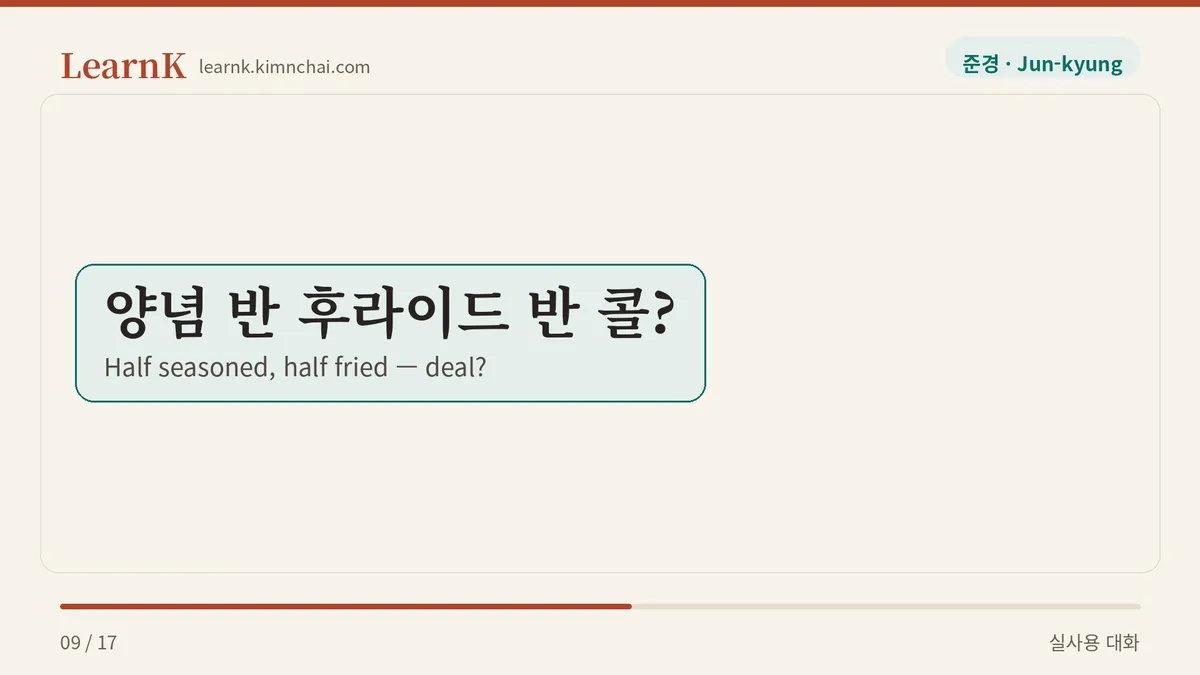
양념 반 후라이드 반 시키고 콜라도 하나 추가하자. 오늘은 단짠으로 가야지. (yangnyeom ban hurideu ban sikigo kollado hana chuga-haja. oneureun danjjan-euro gaji.) “Let’s order half seasoned, half fried chicken and add a cola too. Today we’re going 단짠.”
This is a situation where you order a half-and-half combo of sweet-and-spicy 양념치킨 (yangnyeom-chikin) and salty 후라이드치킨 (hurideu-chikin). ‘단짠으로 가다 (danjjan-euro gada)’ is a fun way of saying “I’m going to eat the 단짠 way.”
Situation 3 — Giving in to temptation while dieting
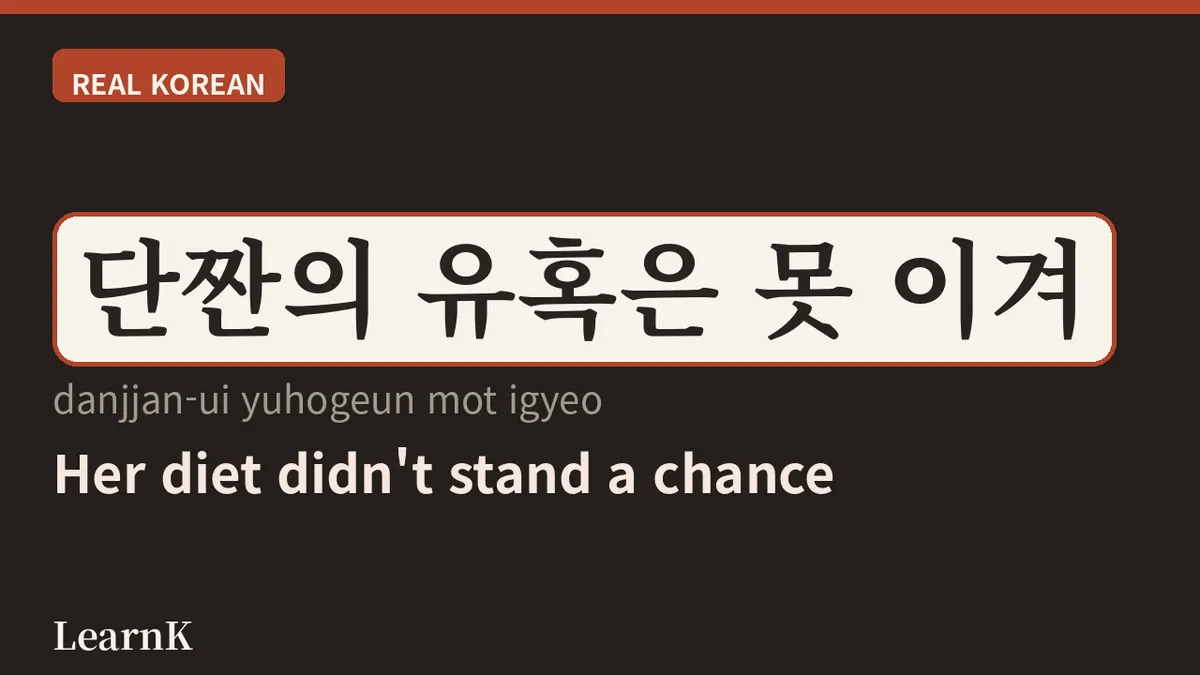
다이어트 한다면서 왜 또 꿀호떡에 감자칩이야? — 어쩔 수 없어, 단짠의 유혹은 못 이겨. (daieoteu handamyeonseo wae tto kkulhotteog-e gamjachib-iya? — eojjeol su eopseo, danjjan-ui yuhog-eun mot igyeo.) “You said you were on a diet — so why the honey-filled 호떡 and potato chips again? — I can’t help it, there’s no beating the temptation of 단짠.”
This is a scene where your resolve crumbles in front of a sweet honey 호떡 (hotteok) and salty potato chips. As in ‘단짠의 유혹 (danjjan-ui yuhok, the temptation of 단짠),’ the word works freely as a noun too.
Polite vs. Casual Speech, and Similar Expressions
단짠 is a casual word used among friends, but you can drop it into polite sentences just as easily.
- Casual: 이거 단짠이라 진짜 맛있어. (igeo danjjan-ira jinjja masisseo.) — “This is 단짠, so it’s really good.”
- Polite: 이건 단짠이라 정말 맛있어요. (igeon danjjan-ira jeongmal masisseoyo.) — “This is 단짠, so it’s really delicious.”
That said, since 단짠 is itself a slang term, in formal settings or official documents it feels more natural to spell it out as 달고 짠 맛 (dalgo jjan mat, a sweet and salty taste). There are expressions with a similar flavor sense — like 단매 (danmae), for enjoying spicy and sweet together, and 느끼함 잡는 맛 (neukkiham jamneun mat), a taste that washes away richness with something refreshing — but in popular recognition and frequency of use, 단짠 is overwhelmingly the winner.
Cultural Background
단짠 is an expression that exploded in popularity from the mid-2010s onward, riding the wave of variety shows and social-media 먹방 (meokbang) culture. In late-night snack scenes in Korean dramas, characters spread out fried chicken and beer, or 떡볶이 (tteokbokki) and fritters, and beam as they say “이 조합 못 참지 (i johap mot chamji — there’s no resisting this combo)” — that’s exactly the small comfort 단짠 provides. In fact, products like salty soy-braised side dishes and sweet braised dishes, salted caramel, and honey-butter potato chips are all aiming for this very ‘단짠 code.’ For Koreans, 단짠 isn’t merely a taste — it’s a word wrapped in feeling, like a small reward you hand to yourself at the end of a stressful day.
Closing Quiz
A friend is munching on salty popcorn, takes a bite of sweet chocolate, then reaches back for the popcorn again and cries out, “I can’t stop this!” What is the rhythmic, drawn-out four-syllable expression for this endless loop?
(Answer: 단짠단짠 (danjjan-danjjan))