데이트코스 (deiteukoseu) — The Answer Isn't Complete Until You Say What Comes After Dinner
Once weekend plans are set, Korean conversations move straight to the next question: “그래서 어디 갈 건데? (geuraeseo eodi gal geonde?)” — “So where are you going?” But if you answer with just “홍대 (Hongdae),” the conversation doesn’t end there. Where you’ll eat, what you’ll do after that, and where you’ll head once the sun goes down — only when you’ve laid all of it out does it feel like you’ve actually answered. And there’s a single word that bundles this whole day’s worth of moving around together.
데이트코스
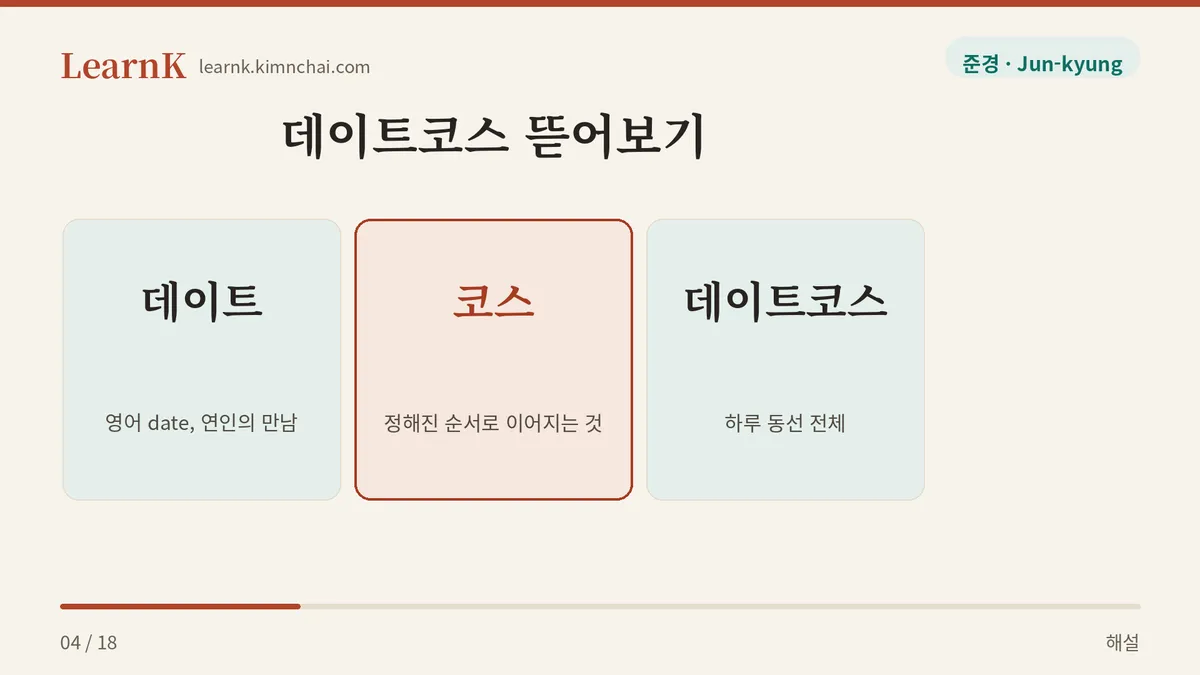
데이트코스 (deiteukoseu) refers to the places a couple stops at on a date and the order they visit them in — the entire route of the day. It isn’t the name of one place; it’s the name for a chain of places linked together. So when someone asks “오늘 데이트코스가 뭐야? (oneul deiteukoseuga mwoya?)” — “What’s the date course today?” — the other person usually rattles off not one spot but three or four, in order. “성수에서 파스타 먹고, 서점 갔다가, 한강 가서 맥주. (Seongsueseo paseuta meokgo, seojeom gatdaga, Hangang gaseo maekju.)” — “Pasta in Seongsu, then a bookstore, then beer by the Han River.” An answer like that is what counts as properly answering the question.
The nuance is fluttery and personal. It does mean making a plan, but the temperature is nothing like putting together a meeting agenda. This word comes attached to the feeling of “I thought this day through ahead of time.” That’s why the simple fact that someone put together a 데이트코스 is often read as proof that they care. And for the same reason, “아무 데나 가자 (amu dena gaja)” — “let’s just go wherever” — can land as a little hurtful.
The verbs that travel with it are all but fixed. 데이트코스를 짜다 (deiteukoseureul jjada), “to put together a date course,” is the most common, followed by 추천하다 (chucheonhada) “to recommend,” 알아보다 (arabo-da) “to look into,” and 정하다 (jeonghada) “to decide on.” People do say “데이트코스를 만들다 (deiteukoseureul mandeulda),” “to make a date course,” but it isn’t as natural as 짜다 (jjada). 짜다 carries the image of weaving threads into cloth — linking several pieces together in sequence — which fits this word well.
These days it stretches a bit beyond couples. Between two people who aren’t dating yet, or among friends heading out together, someone might ask half-jokingly, “오늘 데이트코스 뭐야? (oneul deiteukoseu mwoya?)” Still, the default is a couple.
Seeing It in a Real Conversation
Scene: The last subway train on a Friday night. Sitting side by side on the ride home, Jun-kyung brings up his first date tomorrow.
Jun-kyung: 야, 나 내일 그 사람이랑 처음 만나. 지금 심장 터질 것 같아. Hey, I’m meeting her for the first time tomorrow. My heart’s about to explode.
Emily: 뭘 벌써 터져. 데이트코스는 짜 놨어? Calm down. Have you planned out the date course yet?
Jun-kyung: 밥 먹고 커피. 그게 다야. Dinner, then coffee. That’s it.
Emily: 그건 코스가 아니라 그냥 저녁이지. 밥집에서 걸어갈 만한 데 하나만 더 붙여 봐. That’s not a course, that’s just dinner. Add one more spot within walking distance of the restaurant.
Jun-kyung: 아, 그 근처 천변 산책 어때? Oh — how about a walk along the stream nearby?
Emily: 오, 그럼 데이트코스 완성이네. 밥, 산책, 커피. 비 오면 어쩔 건지만 하나 더 생각해 두고. Nice, that’s a complete date course. Dinner, walk, coffee. Just have a backup plan in case it rains.
This Sounds Off
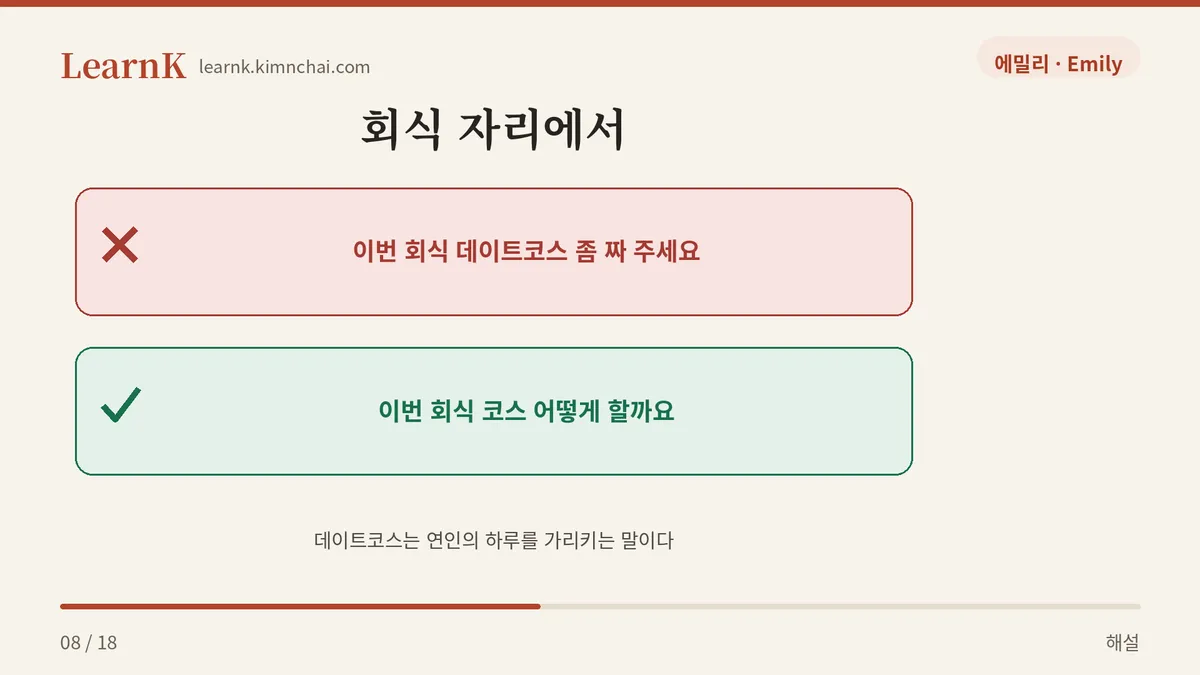
✗ (to your team lead) 팀장님, 이번 회식 데이트코스 좀 짜 주세요. (timjangnim, ibeon hoesik deiteukoseu jom jja juseyo.) ✓ (to your team lead) 팀장님, 이번 회식 코스 어떻게 할까요? (timjangnim, ibeon hoesik koseu eotteoke halkkayo?) → 데이트코스 points to a couple’s day together, so dropping it into a work setting invites misunderstanding unless it’s clearly a joke. For the order of stops on a group outing, you just say “코스 (koseu)” or “동선 (dongseon).”
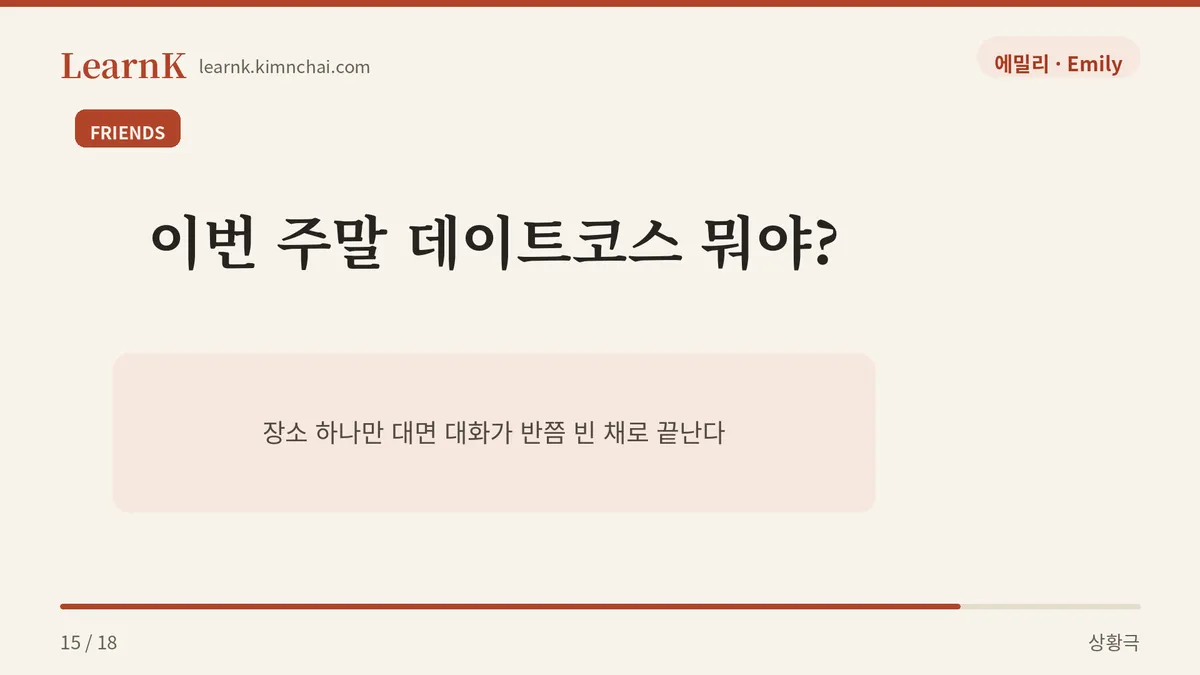
✗ 우리 오늘 데이트코스는 홍대 카페야. (uri oneul deiteukoseuneun Hongdae kapeya.) ✓ 우리 오늘 데이트코스는 홍대에서 밥 먹고, 카페 갔다가, 한강 가는 거야. (uri oneul deiteukoseuneun Hongdaeeseo bap meokgo, kape gatdaga, Hangang ganeun geoya.) → ‘코스’ itself means a connected sequence, so naming only one place leaves the sentence half-empty. If you really are only going to one place, “오늘은 홍대 카페에서 만나 (oneureun Hongdae kapeeseo manna)” — “let’s meet at a café in Hongdae today” — is the right way to put it.
Example Sentences by Situation
1. Asking a friend for advice
너 성수동 데이트코스 아는 데 있어? (neo seongsudong deiteukoseu aneun de isseo?) “Do you know any good date-course spots in Seongsu-dong?”
In Korea, planning a date isn’t so much something you do alone as something you ask the people around you about. Leading with a neighborhood name has hardened into a formula, so anything can go in the ‘성수동 (Seongsu-dong)’ slot — ‘연남동 (Yeonnam-dong)’, ‘부산 (Busan)’, ‘경주 (Gyeongju)’, you name it.
2. Making an effort ahead of an anniversary
이번 백일에는 내가 데이트코스 다 짤게. (ibeon baegireneun naega deiteukoseu da jjalge.) “For our 100-day anniversary, I’ll plan the whole date course.”
“내가 다 짤게 (naega da jjalge)” means “I’ll decide on the places,” but it’s simultaneously a declaration that “this time, I’ll be the one putting in the thought.” So while the sentence looks like it’s about logistics, it’s really closer to an expression of affection.
3. When the weather ruins the plan
비 오는 날 실내 데이트코스 좀 추천해 줘. (bi oneun nal sillae deiteukoseu jom chucheonhae jwo.) “Recommend me some indoor date courses for a rainy day.”
Come monsoon season, this sentence floods the entire internet. Tacking on modifiers like ‘실내 (sillae)’ indoor, ‘겨울 (gyeoul)’ winter, ‘벚꽃 (beotkkot)’ cherry blossom, or ‘당일치기 (dangilchigi)’ day-trip to narrow the conditions is this word’s classic usage.
Formal and Casual Speech, and Similar Expressions
The word itself carries no honorific level. Change the sentence ending and it becomes formal as is. Casually you’d say 데이트코스 짰어? (deiteukoseu jjasseo?), and politely 데이트코스를 미리 짜 두었습니다 (deiteukoseureul miri jja dueotseumnida). That said, in genuinely formal settings people don’t tend to bring this word out at all — it holds a private warmth to it.
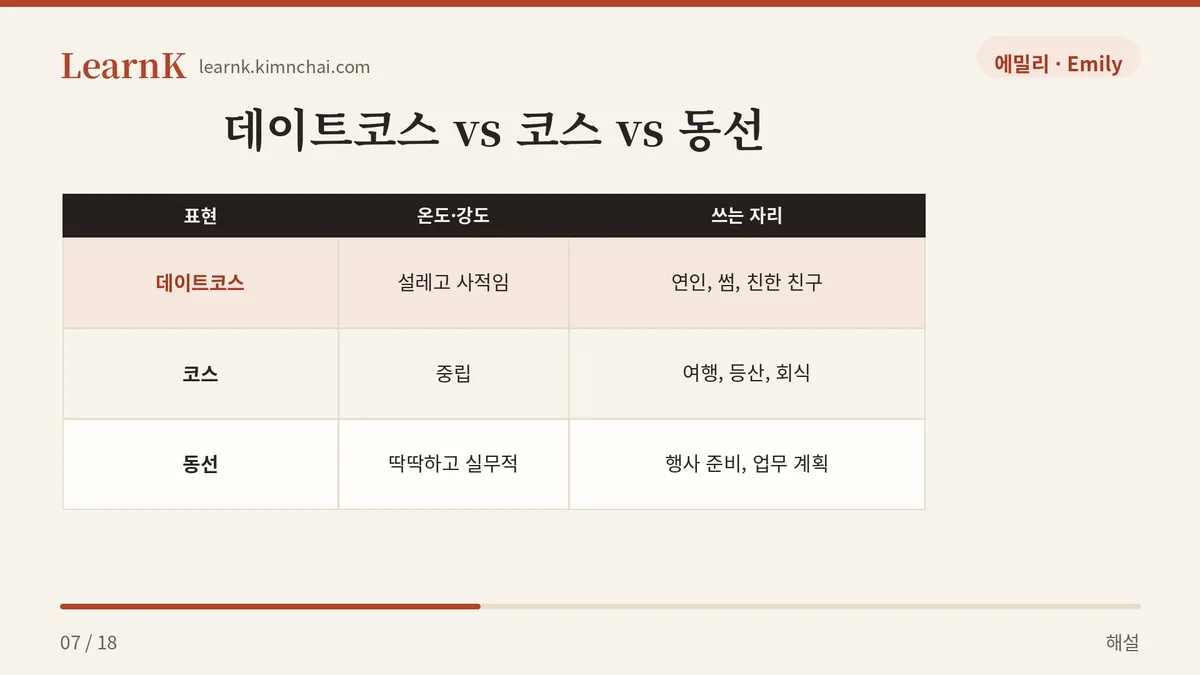
| Expression | Temperature / Intensity | Where It’s Used |
|---|---|---|
| 데이트코스 (deiteukoseu) | Fluttery, personal | Couples, people in the “talking” stage, close friends, blog search terms |
| 코스 (koseu) | Neutral | Any sequenced itinerary — travel, hiking, company dinners |
| 동선 (dongseon) | Stiff, operational | Event prep, work planning, store layout |
| 일정 (iljeong) | Neutral, time-focused | Settings where what time matters more than where |
Even for the exact same day, “데이트코스 짰어 (deiteukoseu jjasseo)” and “일정 정했어 (iljeong jeonghaesseo)” sound completely different. The first has a flutter in it; the second brings a planner notebook to mind.
Cultural Background — A Word the City Made
The word formation is simple: it’s a Korean-made English compound, sticking together date and course. Which is why saying “date course” to an English speaker doesn’t really land. In English, date plan or itinerary comes closer. ‘코스 (koseu)’ is a loanword deeply rooted in Korean, used broadly for anything that “follows a set sequence” — 등산 코스 (deungsan koseu) a hiking course, 정규 코스 (jeonggyu koseu) a regular course, 코스 요리 (koseu yori) a multi-course meal. Just as a course meal arrives in order from appetizer to dessert, a 데이트코스 runs in order from the first meal to the last drink.
Part of why this word became so common is urban density. In the busy districts of Seoul or Busan, restaurants, cafés, bookstores, movie theaters, and walking paths are all within a ten-minute walk. Rather than driving out to one destination and coming back, stringing together three or four places on foot within a single neighborhood became the default. So the question inevitably shifted from “어디 갈까 (eodi galkka)” — “where should we go?” — to “코스 어떻게 할까 (koseu eotteoke halkka)” — “how should we do the course?”
Its life as a search term is a big part of it too. Every time the season turns, phrases like ‘벚꽃 데이트코스 (beotkkot deiteukoseu)’ cherry-blossom date course and ‘겨울 실내 데이트코스 (gyeoul sillae deiteukoseu)’ winter indoor date course fill the search bar, and posts and videos rounding up the results come pouring out. In Korean dramas, too, this word shows up more often as a situation than as a line of dialogue: the scene where the lead hauls their date from place to place all day long, visibly having prepared it all with care — and then the scene where the rain comes down and the whole plan falls apart. Because a story needs both the heart that makes a plan and the moment that plan collapses, this word always sits somewhere between anticipation and things going sideways.
Today’s Quiz
Which of the following sentences uses 데이트코스 (deiteukoseu) most naturally?
- 부장님, 내일 출장 데이트코스 확인 부탁드립니다. (bujangnim, naeil chuljang deiteukoseu hwagin butakdeurimnida.)
- 이번 주말 데이트코스는 밥 먹고, 전시 보고, 야경 보러 가는 걸로 정했어. (ibeon jumal deiteukoseuneun bap meokgo, jeonsi bogo, yagyeong boreo ganeun geollo jeonghaesseo.)
- 오늘 데이트코스는 우리 집이야. (oneul deiteukoseuneun uri jibiya.)
The answer is number 2. Three places are linked in sequence, so the word ‘코스’ is doing its job. Number 1 is a work setting, which clashes with the word’s private warmth, and number 3 has only one place, so there’s no course to speak of. For number 3, “오늘은 그냥 우리 집에서 보자 (oneureun geunyang uri jibeseo boja)” — “let’s just hang out at my place today” — is the natural way to say it.
Definitions and example sentences are from the National Institute of Korean Language’s Basic Korean Dictionary (krdict.korean.go.kr); that portion of this post, including our translations, is licensed under CC BY-SA 2.0 KR.