돌잔치 (doljanchi) — Why the Whole Family Gathers for a Baby's First Birthday
돌잔치
돌잔치 (doljanchi) means a feast held to celebrate a child’s first birthday. A buffet restaurant on a Saturday afternoon, a balloon arch standing at the entrance, and on a small table in front of the stage, a skein of thread, some banknotes, and a pencil laid out in a row. When a baby in a 한복 (hanbok) is carried out in her mother’s arms, twenty or so adults lift their phones at the same moment. If you’ve ever walked into this scene in Korea, that gathering was a 돌잔치.
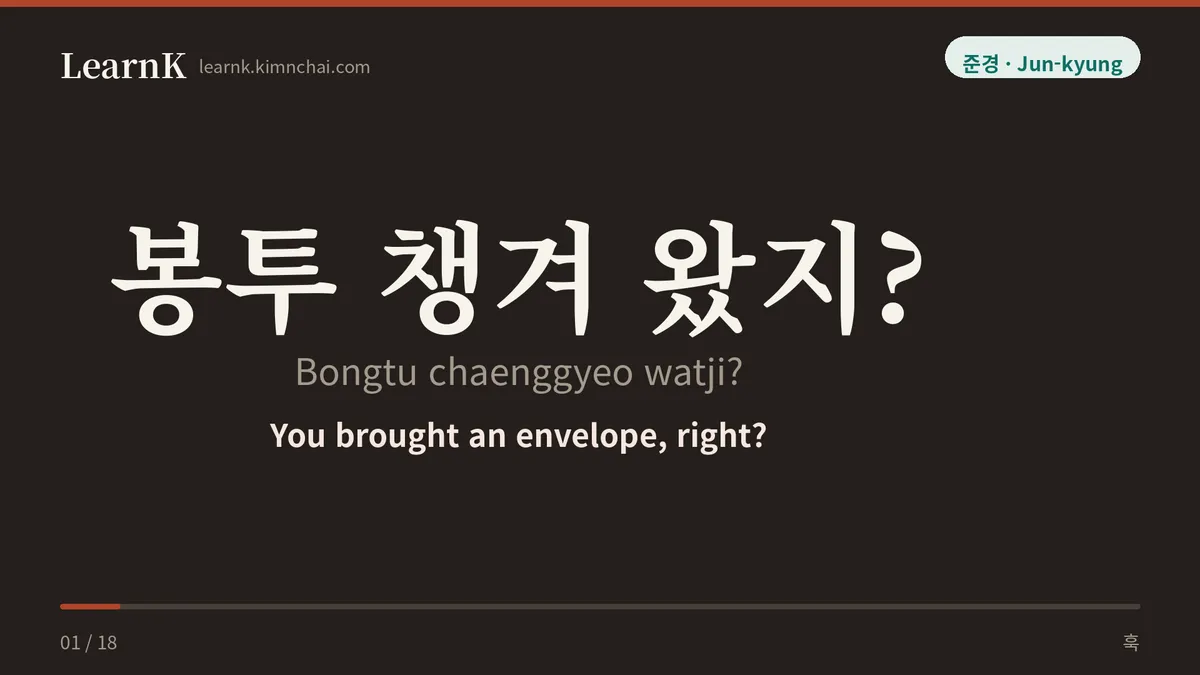
The word is a compound of 돌 (dol) and 잔치 (janchi). 돌 (dol) is a native Korean word for the day a baby turns exactly one year old, and 잔치 (janchi) is an occasion where people gather to eat and enjoy themselves. So a 돌잔치 comes only once in a person’s whole life. Once the child turns two, that’s a birthday party, not a 돌잔치. Korean does use 돌 as a counter for years — as in 두 돌 (du dol) or 세 돌 (se dol) — but as the name of a celebration, 돌잔치 points to the first birthday and nothing else.
The nuance is basically sunny. It’s a word for a joyous occasion, and sentences containing it tend to come with laughter attached. The temperature shifts subtly, though, the moment it’s paired with 초대 (chodae, “invitation”). In Korea, a 돌잔치 invitation is understood to come as a set with 축의금 (chugui-geum, congratulatory money). That’s why parents these days so often say “부담 주기 싫어서 가족끼리만 해요” (budam jugi sireoseo gajokkkiri-man haeyo, “I don’t want to put anyone out, so we’re just doing it with family”). The meaning is simple, but the situations you use it in are delicate — that kind of word.
Checking the National Institute of Korean Language dictionary
돌잔치 「noun」 아이의 첫 번째 생일을 축하하는 잔치. [en] doljanchi — A party to celebrate the first birthday of a child. [ja] はつたんじょういわい【初誕生祝い】 — 赤ちゃんの初めての誕生日を祝う宴会。 [es] doljanchi, fiesta de primer cumpleaños — Fiesta que se organiza para celebrar el primer cumpleaños del niño. [zh] 周岁宴 — 庆祝孩子第一个生日的宴会。 — National Institute of Korean Language, Basic Korean Dictionary (krdict.korean.go.kr)
The dictionary carries no Portuguese definition, so let us note that the line below is our own translation, made for this post. [pt] doljanchi, festa de primeiro aniversário — festa para celebrar o primeiro aniversário de uma criança.
From the definition alone, it looks like nothing more than a “first birthday party.” But read the real-life example sentences the dictionary carries alongside it, and you start to see where this word actually sits in Korean life.
진수네 아기 다음 주에 돌잔치 한다던데? — National Institute of Korean Language, Basic Korean Dictionary (krdict.korean.go.kr)
Jinsune agi daeum jue doljanchi handadeonde?
→ This is casual speech (반말, banmal) passing news between friends. The ending -다던데 (-dadeonde) means “I heard this from someone — do you know about it too?”, so hidden inside this one line is the question “Did you get invited too? Should we go together?” News of a 돌잔치 travels from person to person exactly like this.
우리 아이 돌잔치 준비는 이제 다 된 건가요? — National Institute of Korean Language, Basic Korean Dictionary (krdict.korean.go.kr)
Uri ai doljanchi junbineun ije da doen geongayo?
→ A parent checking in with a spouse or an event coordinator. The sentence carries, plainly, the fact that a 돌잔치 is perceived as something you “put on” — an event that requires preparation. Booking the venue, the guest list, the 한복 (hanbok), the photo shoot, the return gifts: there’s quite a lot to handle.
민준은 아들의 돌잔치에 와 준 손님들에게 답례하는 뜻으로 작은 선물을 준비했다. — National Institute of Korean Language, Basic Korean Dictionary (krdict.korean.go.kr)
Minjuneun adeurui doljanchie wa jun sonnimdeurege damnyehaneun tteuseuro jageun seonmureul junbihaetda.
→ A sentence that shows the 답례품 (damnyepum, return gift) custom. When guests give congratulatory money, the host always gives something back. Rice cakes, towels, a small potted plant — things that aren’t expensive but can be pressed into a guest’s hands on the way out.
요즘은 사람들이 돌잔치에 필요 이상으로 많은 돈을 쓰고 있다는군요. — National Institute of Korean Language, Basic Korean Dictionary (krdict.korean.go.kr)
Yojeumeun saramdeuri doljanchie piryo isangeuro maneun doneul sseugo itdaneungunyo.
→ The fact that this line made it into a dictionary example tells you how long the debate over the scale of 돌잔치 has been running in Korean society. It’s an especially useful sentence for learners, because it shows that the word 돌잔치 isn’t used only for pure celebration.
A real conversation
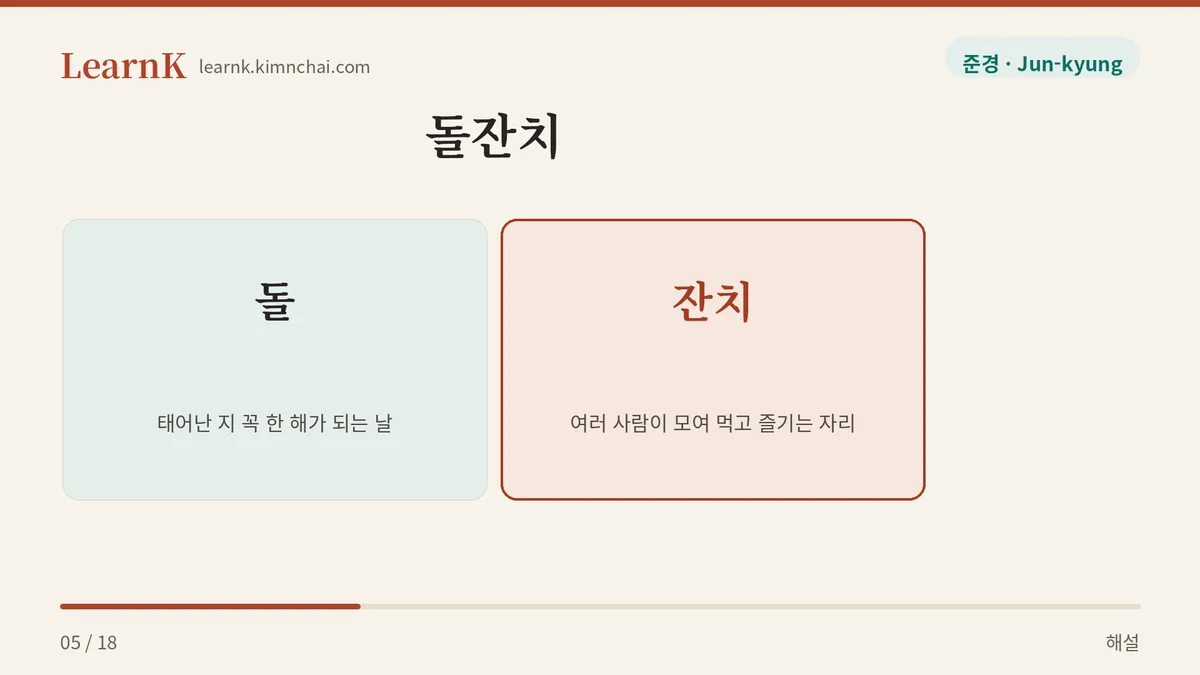
Setting: Saturday afternoon, at the entrance of a buffet restaurant. You’ve arrived at a friend’s baby’s doljanchi and are standing in front of the reception desk.
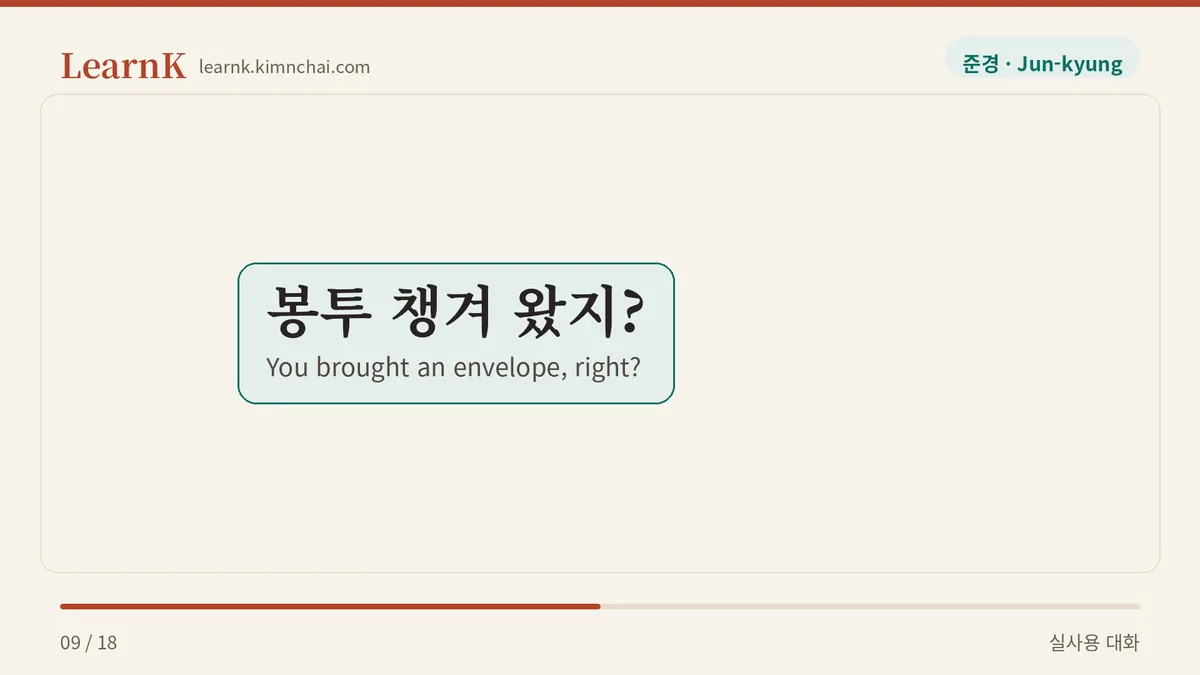
Jun-kyung: 봉투 챙겨 왔지? 저기 접수대에 이름 쓰고 내면 돼. You brought an envelope, right? Just write your name at that desk and hand it in.
Emily: 응, 근데 나 한국에서 돌잔치 오는 거 처음이야. 얼마 넣는 게 맞아? Yeah, but this is my first time at a doljanchi in Korea. How much is the right amount?
Jun-kyung: 친한 사이면 오만 원, 그냥 아는 사이면 삼만 원. 너무 신경 쓰지 마. Fifty thousand won if you’re close, thirty if you just know them. Don’t overthink it.
Emily: 아, 다행이다. 근데 저 상 위에 실이랑 돈은 왜 놔둔 거야? Oh, good. But why are the thread and the money laid out on that table?
Jun-kyung: 돌잡이야. 아기가 뭘 집는지 보는 거. 돌잔치의 하이라이트지. That’s doljabi. You watch what the baby grabs. It’s the highlight of the doljanchi.
Emily: 귀엽다. 우리 쪽은 첫 생일에 그냥 케이크만 자르는데. Cute. Back home we just cut a cake for the first birthday.
Using it this way sounds off
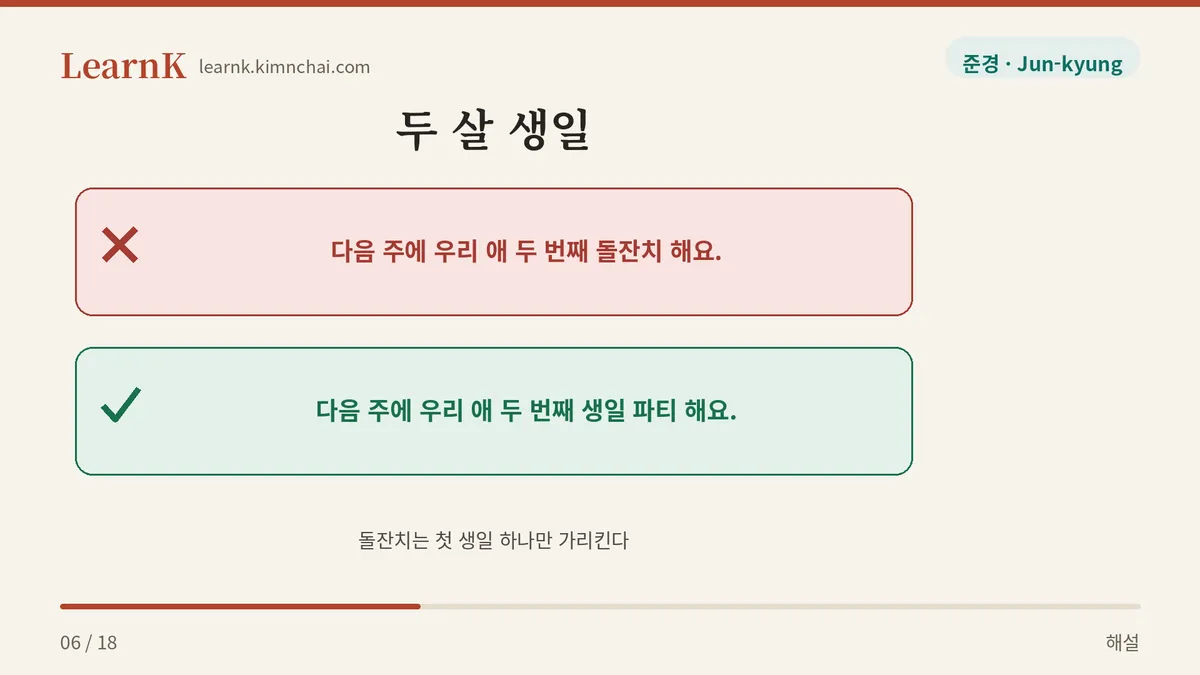
✗ For a child’s second birthday — 다음 주에 우리 애 두 번째 돌잔치 해요. ✓ For a child’s second birthday — 다음 주에 우리 애 두 번째 생일 파티 해요. → 돌잔치 refers to the first birthday and only the first, so “a second 돌잔치” doesn’t hold together. The expression 두 돌 (du dol) does exist, but that’s for counting age, not the name of a celebration.
✗ In a company group chat — 다음 주 토요일 저희 아이 돌잔치입니다. 다들 오세요! ✓ In a company group chat — 다음 주 토요일 아이 돌잔치가 있어 자리를 비웁니다. 마음만 받겠습니다. → Grammatically both are perfectly fine. The problem is the setting. In Korea these days, scattering 돌잔치 invitations widely reads less like a request for congratulations and more like an invoice for congratulatory money. Reaching out individually to the people close to you, and simply sharing the news in the group chat, goes down far more smoothly.
Example sentences by situation
1. Replying to an invitation
돌잔치 축하드려요. 그날 꼭 갈게요. (doljanchi chukhadeuryeoyo. geunal kkok galgeyo.)
The safest possible reply, packing congratulations and an RSVP into one line. Because you’re speaking to the parents rather than the baby, you use 축하드려요 (chukhadeuryeoyo). To sound a touch more polite, adding “아기 보러 갈게요” (agi boreo galgeyo, “I’ll come see the baby”) after it feels natural.
2. When you can’t make it
돌잔치에 못 가서 미안해. 선물은 따로 보낼게. (doljanchie mot gaseo mianhae. seonmureun ttaro bonaelge.)
In Korea, people are hurt less by your not coming than by your saying nothing at all. The convention is to pair “I can’t make it” with how you plan to send your feelings instead. In practice that means transferring congratulatory money to their account, or sending a gift like a 배냇저고리 (baenaetjeogori, a newborn’s first jacket**)** or baby supplies.
3. When parents explain the scale
돌잔치는 가족끼리 조촐하게 하려고요. (doljanchineun gajokkkiri jocholhage haryeogoyo.)
The most frequently heard sentence of the last few years. 조촐하게 (jocholhage) means “small and modest,” but folded into it is a courtesy: “please don’t feel slighted that we’re not inviting you.” If someone says this to you, a good response is to take it up with “요즘 다들 그렇게 하더라” (yojeum dadeul geureoke hadeora, “everyone’s doing it that way these days”).
Formal vs. casual speech, and similar expressions
돌잔치 itself is a noun, so it carries no honorific level of its own. The register is decided by the verb attached to it. To a friend: “다음 주에 돌잔치 해?” (daeum jue doljanchi hae?); to someone older or senior: “다음 주에 돌잔치 하신다면서요?” (daeum jue doljanchi hasindamyeonseoyo?). When talking about a happy occasion in someone else’s family, the most natural thing is to put the parent’s name in front, as in ”○○ 씨 아기 돌잔치” (○○-ssi agi doljanchi).
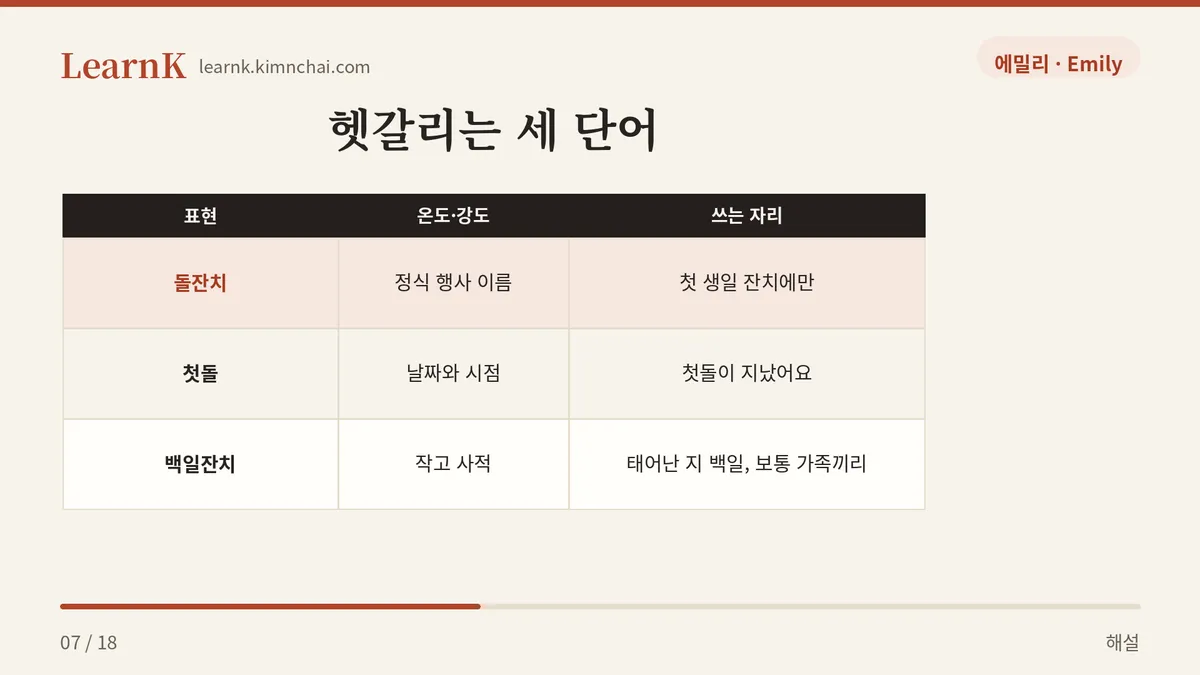
Here’s how the similar-looking words differ.
| Expression | Temperature / intensity | Where it’s used |
|---|---|---|
| 돌잔치 (doljanchi) | The formal name of the event, neutral | Anywhere — invitations, conversation. First birthday only |
| 첫돌 (cheotdol) | Points to the date and the milestone | In talk about age, as in “첫돌이 지났어요” (“she’s past her first birthday”) |
| 백일잔치 (baegiljanchi) | Smaller and more private | 100 days after birth. Usually family only |
| 돌 파티 (dol pati) | Light and casual | Young parents, social media posts |
| 생일 파티 (saengil pati) | Neutral, any age | From age two all the way to adults |
Cultural background — the objects on the table
The heart of a 돌잔치 is 돌잡이 (doljabi). It’s the segment where a spread of objects is laid out in front of the baby and everyone watches to see which one she grabs. Traditionally, thread meant a long life, money meant a comfortable one, and a brush or a book meant scholarship. These days the table also holds things like a stethoscope, a microphone, a computer mouse, a soccer ball, and a judge’s gavel. If the baby grabs the microphone the room erupts; if she grabs the money, the adults laugh and say “of course our kid is the practical one.” Nobody, of course, takes the result seriously. Everyone is there to laugh and take photos. The reason 돌잡이 scenes are a staple of Korean family dramas and variety shows is that this brief moment holds laughter and anticipation at once.
Why the first birthday, of all days? Before modern medicine, it was not rare in Korea for a newborn not to make it through the year. So 백일 (baegil, the 100th day) and 첫돌 (cheotdol, the first birthday) were in themselves proof of survival — something worth throwing a feast and telling the neighbors about. That worry is gone now, but the form remains. The custom of giving a small gold ring called a 돌반지 (dolbanji) comes from here too. The idea was to gather a little gold, bit by bit, for the child’s own future. And the story of how, during the 1997 financial crisis, citizens across the country took part in the gold-collecting campaign and brought out the 돌반지 tucked away in their wardrobes is still told often today. Which tells you just how surely every household had one.
Recent changes are worth knowing about as well. The old approach of renting a large buffet hall and inviting hundreds has visibly declined. There’s the 스몰 돌 (seumol dol, “small dol”) with a dozen or so family members, the 돌스냅 (dolseunaep, “dol snap”) where you only take studio photos, and plenty of families who skip the feast entirely and take a family trip instead. So if you ask a Korean today “돌잔치 해요?” (doljanchi haeyo?, “Are you having a doljanchi?”), the first thing back is often “크게는 안 하고요” (keugeneun an hagoyo, “nothing big”). The meaning of the word hasn’t changed, but the scene it points to is still changing right now.
Today’s quiz
Jun-kyung said this to Emily. His nephew turned exactly one year old last month.
우리 조카 다음 주에 ______ 한대. 같이 갈래?
What goes in the blank?
① 백일잔치 (baegiljanchi) ② 돌잔치 (doljanchi) ③ 집들이 (jipdeuri) ④ 두 번째 생일 파티 (du beonjjae saengil pati)
Answer: ② 돌잔치 (doljanchi)
It’s the birthday celebration for a child who has turned one, so 돌잔치 is correct. ① 백일잔치 (baegiljanchi) is the smaller gathering held 100 days after birth; ③ 집들이 (jipdeuri) is inviting people over to a home you’ve just moved into, so it has nothing to do with babies. ④ doesn’t match the age. One more thing to keep in mind: if you’re invited, bring an envelope — and when 돌잡이 (doljabi) is about to start, it’s a good idea to have your phone camera already open.
Definitions and example sentences are from the National Institute of Korean Language’s Basic Korean Dictionary (krdict.korean.go.kr); that portion of this post, including our translations, is licensed under CC BY-SA 2.0 KR.