돈쭐내다 (donjjullaeda) — the Korean slang for punishing someone with money instead of a scolding
돈쭐내다
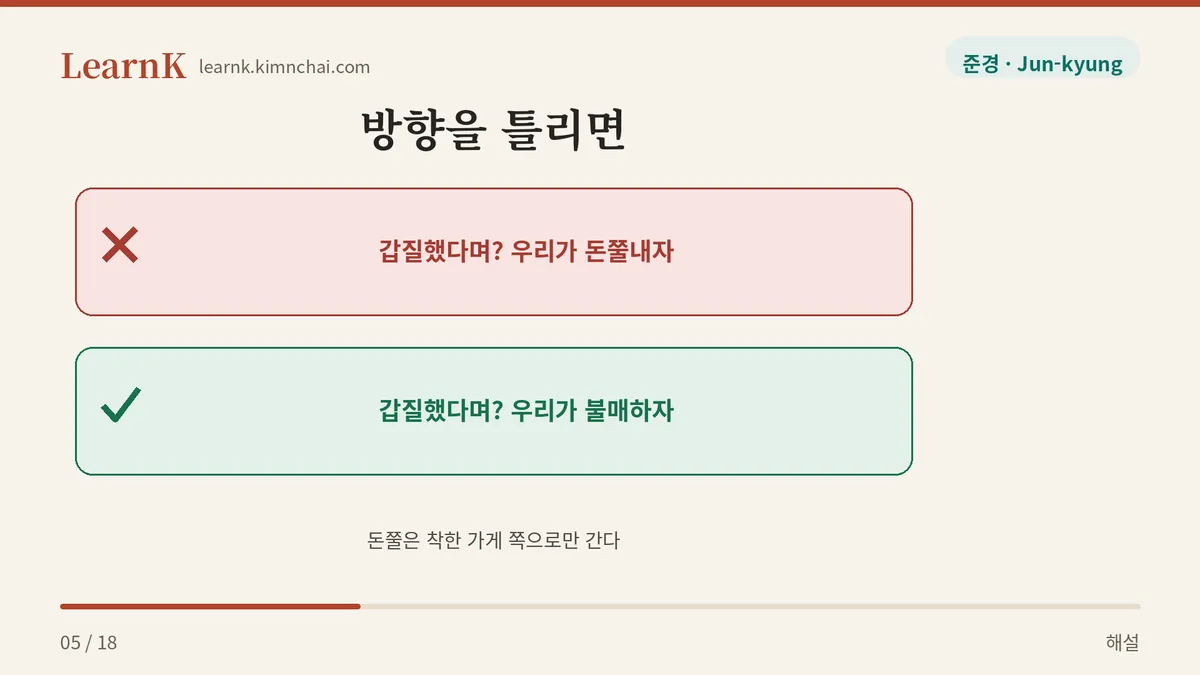
돈쭐내다 (donjjullaeda) is what happens when word gets out that a shop has done something kind and customers deliberately flock there to buy things and push up its sales — in other words, instead of giving the owner a 혼쭐 (honjjul), a scolding, they give the owner a 돈쭐 (donjjul), a “money-scolding.” It’s a piece of slang born on the Korean internet: take a word that means punishment, slot 돈 (don), “money,” into it, and the direction of the whole thing flips to the opposite.
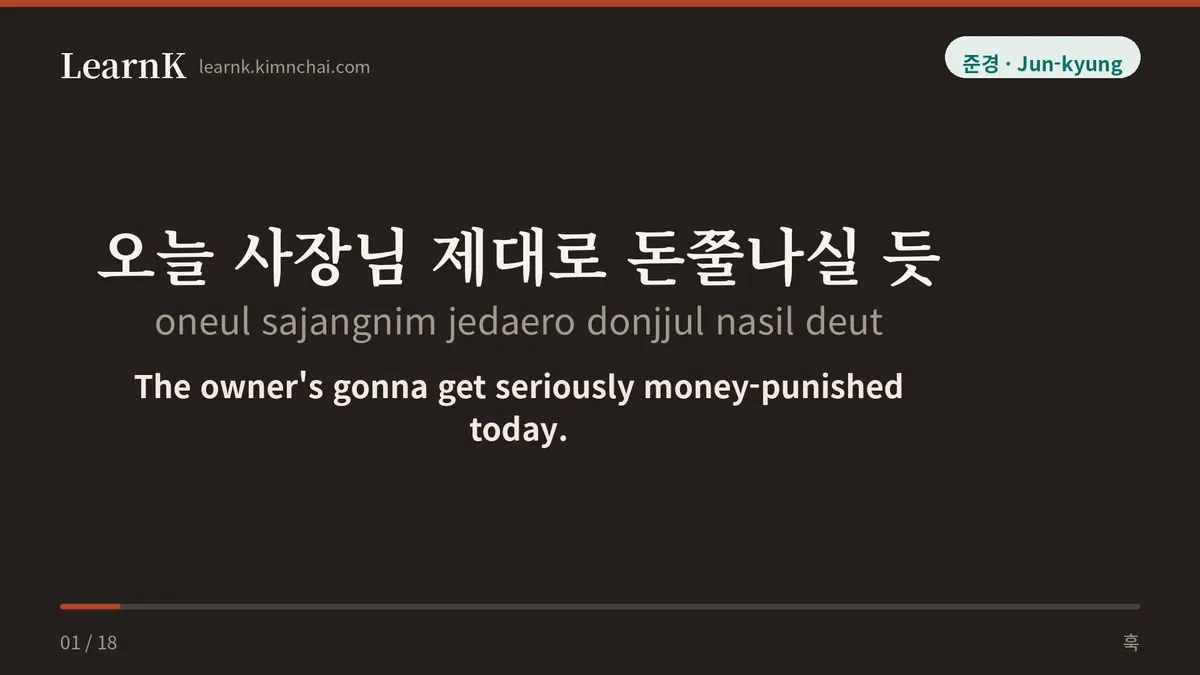
The scene usually plays out the same way. The owner of a small neighborhood shop has been quietly doing something for years — feeding a kid whose family is struggling, handing a cup of coffee to an elderly person collecting cardboard — and one day it turns up on the news or on social media. The next morning, there’s a line of total strangers in front of the shop. They didn’t come because they’re hungry; they came to buy. The comment section under the article fills up with things like “가게 주소 어디예요? (gage juso eodiyeyo?)” — “What’s the shop’s address?” — and “오늘 저 사장님 제대로 돈쭐 나시겠네 (oneul jeo sajangnim jedaero donjjul nasigenne)” — “That owner is going to get seriously money-punished today.” The whole impulse of “I saw someone do good, so now I want to do something too” is packed into a single word.
The first thing to pin down is direction. 돈쭐내다 (donjjullaeda) is always a reward, never a punishment. Because the original word, 혼쭐내다 (honjjullaeda), means “to give someone a sharp scolding,” learners who meet this word for the first time tend to read it as “scold with money = punish someone financially.” It’s the exact opposite. The word borrows only the shell of a punishment word and fills the inside with encouragement: “We’re going to buy more from you than you can handle.” That’s the joke.
The second is the target. A 돈쭐 (donjjul) is aimed at a shop, not a person — more precisely, at someone running a business. You don’t use it for treating a friend to a birthday dinner. Money has to change hands, yes, but that money has to become sales for the word to work.
The third is temperature. This is a notch giddier than sincere gratitude, with a streak of humor running through it. The exaggeration — “let’s line up and buy so much we wear the owner out” — is the punchline, so it doesn’t belong in an official press release or a formal thank-you.
It helps to learn the forms together, too. The noun is 돈쭐 (donjjul); from the customers’ side, acting on the shop, it’s 돈쭐내다 (donjjullaeda); from the shop’s side, on the receiving end, it becomes 돈쭐나다 (donjjullada). There’s one pronunciation trap. When ㄴ follows a final ㄹ, the two link up and come out as [ㄹㄹ], so even though it’s written 돈쭐내다, it comes out of your mouth as [돈쭐래다] (donjjullaeda). It’s the same rule that makes 설날 (seollal) sound like [설랄].
Seeing it in a real conversation
Scene: In front of a neighborhood fried chicken place. Normally there are tables to spare, but today the line stretches to the end of the alley.
에밀리: 어? 이 집 원래 이렇게 사람 많았어? 나 지난주에 왔을 땐 텅 비었는데. Huh? Was this place always this crowded? It was completely empty when I came last week.
준경: 사장님이 형편 어려운 애들한테 몇 년째 조용히 치킨 내주셨대. 그게 어제 뉴스에 나왔거든. Turns out the owner’s been quietly giving chicken to kids in need for years. It was on the news yesterday.
에밀리: 아, 그래서 다들… 아 알겠다, 돈쭐내러 온 거구나. Ah, so that’s why everyone… oh, I get it — they came to “punish him with money.”
준경: 야, 너 이런 말도 알아? 맞아, 오늘 사장님 제대로 돈쭐나실 듯. Whoa, you even know that word? Yeah, the owner’s gonna get seriously “money-punished” today.
에밀리: 나도 두 마리 시켜야지. 이런 분은 좀 돈쭐내 드려야 되잖아. Then I’ll order two. Someone like this deserves to get money-punished, right?
준경: 그래, 줄 서자. 앞으로 한 시간은 각오해야겠는데. Alright, let’s line up. Looks like we’re in for an hour, though.
These uses sound off
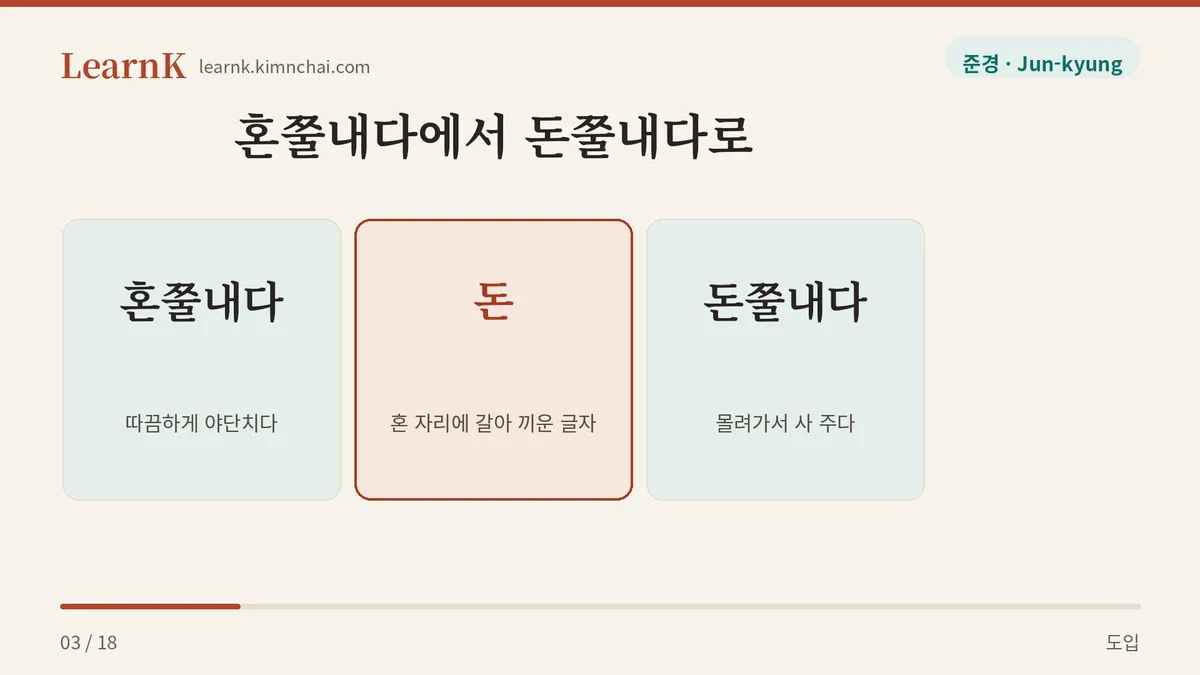
✗ 그 가게 사장 갑질했다며? 우리가 돈쭐내자. (geu gage sajang gapjilhaetdamyeo? uriga donjjullaeja.) — “I heard that shop owner abused his staff? Let’s money-punish him.” ✓ 그 가게 사장 갑질했다며? 우리가 불매하자. (geu gage sajang gapjilhaetdamyeo? uriga bulmaehaja.) — “I heard that shop owner abused his staff? Let’s boycott them.” → Because the original word is 혼쭐내다 (honjjullaeda), it’s easy to mistake this for a punishment word, but a 돈쭐 (donjjul) is always a reward. Saying you’ll give a badly behaved shop a 돈쭐 comes out as “as punishment, we’ll make sure you earn money” — which makes no sense.
✗ (treating a friend on their birthday) 야, 오늘은 내가 너 돈쭐내 줄게. (ya, oneureun naega neo donjjullae julge.) — “Hey, today I’ll money-punish you.” ✓ (treating a friend on their birthday) 야, 오늘은 내가 쏠게. (ya, oneureun naega ssolge.) — “Hey, today it’s on me.” → 돈쭐 (donjjul) doesn’t live in the world of one friend picking up the tab for another; it only works where a shop that did something good gets a boost in sales. Use it between friends and it won’t land — you’ll just get a “what are you talking about?”
Example sentences by situation
1. In the neighborhood group chat — the morning after the local paper runs a piece on the owner of your regular bakery, who’s been donating quietly for years.
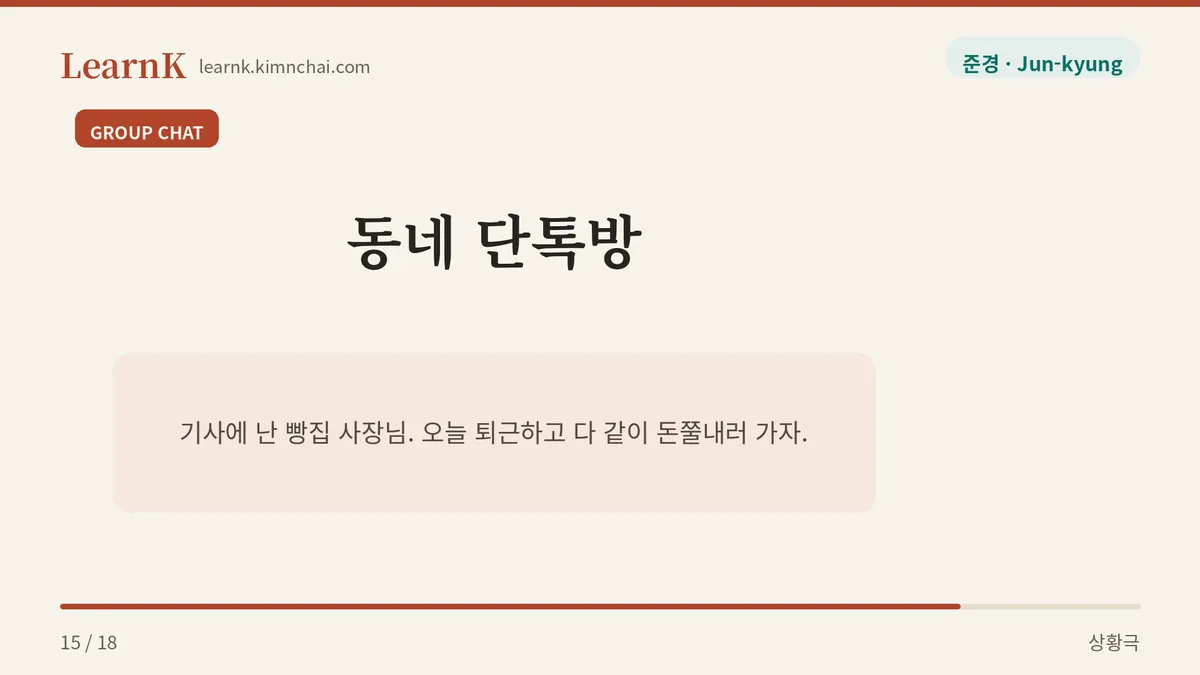
우리 동네 빵집 사장님 기사 봤어? 오늘 퇴근하고 다 같이 돈쭐내러 가자. (uri dongne ppangjip sajangnim gisa bwasseo? oneul toegeunhago da gachi donjjullaereo gaja.) Did you see the article about our neighborhood bakery owner? Let’s all go “punish him with money” after work today.
2. Walking into the shop — a joke a first-time customer offers in place of a hello. The owner who hears it usually laughs and waves it off with “아이고, 뭘 이런 걸로… (aigo, mwol ireon geollo…)” — “Oh please, it’s nothing…”
사장님, 저희 오늘 돈쭐내 드리러 왔어요. 제일 큰 걸로 두 개 주세요. (sajangnim, jeohui oneul donjjullae deurireo wasseoyo. jeil keun geollo du gae juseyo.) Sir, we came to “punish you with money” today. Two of the biggest ones, please.
3. The follow-up a few days later — when you’re reporting on how the shop turned out, you use the receiving-end form, 돈쭐나다 (donjjullada).
폐업 직전이었던 그 국숫집, 사연 알려지고 나서 아주 돈쭐났대. (pyeeop jikjeonieotdeon geu guksujip, sayeon allyeojigo naseo aju donjjullatdae.) That noodle place that was about to close down — after the story got out, they got totally “money-punished.”
Polite and casual forms, and similar expressions
In casual speech you’ll hear “돈쭐내자 (donjjullaeja),” “돈쭐내러 가자 (donjjullaereo gaja),” and “돈쭐냈어 (donjjullaesseo).” To raise it to polite speech, “돈쭐내러 갑시다 (donjjullaereo gapsida)” sounds natural, and when you need to show respect to the owner, you attach -어 드리다 (-eo deurida) and say “돈쭐내 드려야죠 (donjjullae deuryeoyajyo).” That said, the word itself is jokey new slang, so with an older shop owner you’re meeting for the first time, something like “잘되셨으면 해서 왔어요 (jaldoesyeosseumyeon haeseo wasseoyo)” — “We came because we want to see you do well” — is the safer choice.
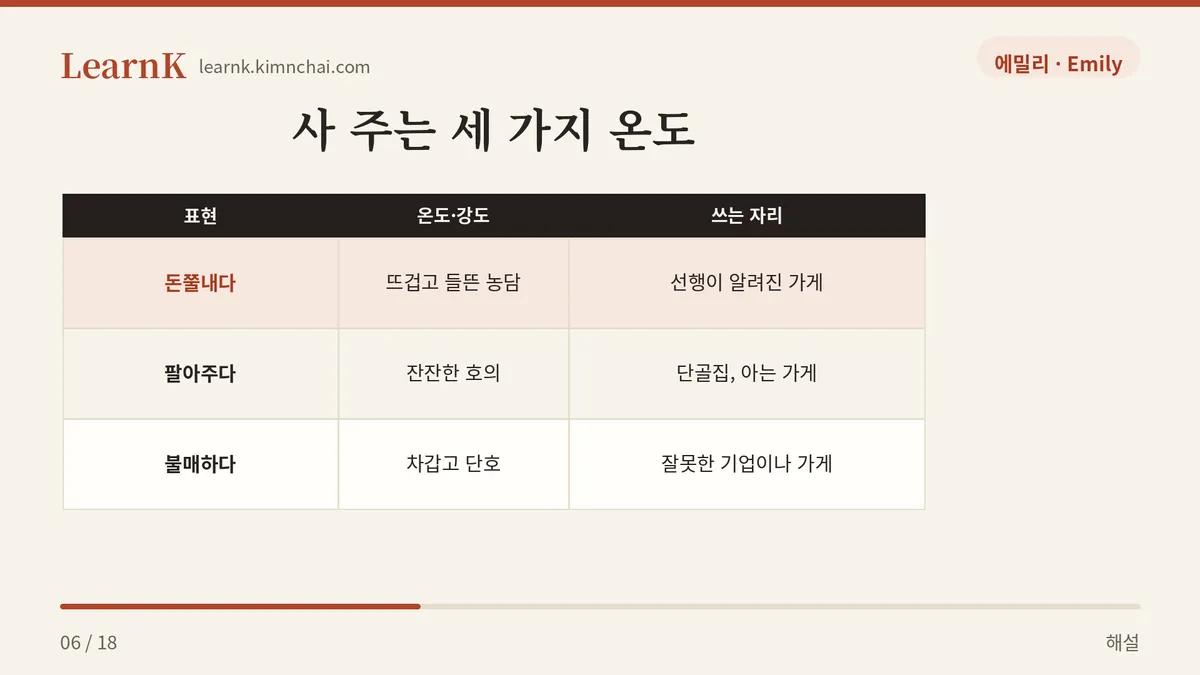
| Expression | Temperature / intensity | Where it’s used |
|---|---|---|
| 돈쭐내다 (donjjullaeda) | Hot and giddy; praise with a joke in it | A shop whose good deed got out. Among peers, on social media, in comment sections |
| 팔아주다 (parajuda) | Quiet goodwill | Your regular haunts, shops you know. Fine anywhere |
| 불매하다 (bulmaehada) | Cold and firm; punishment | Companies or shops in the wrong. Works in public settings too |
| 혼쭐내다 (honjjullaeda) | A sharp scolding | Directed at someone who did wrong. The original word behind 돈쭐 (donjjul) |
Both may amount to “buying something,” but 팔아주다 (parajuda) is the posture of a quiet regular, while 돈쭐내다 (donjjullaeda) is an event — a crowd showing up all at once. Buying yourself a coffee there every day is 팔아주다 (parajuda), not 돈쭐내다 (donjjullaeda).
Cultural background — a word that rewards instead of punishes
The wordplay is right there on the surface. Take 혼쭐내다 (honjjullaeda) and swap 돈 (don), “money,” into the slot held by 혼 (魂, hon), “spirit.” To get a 혼쭐 (honjjul) is to be harassed until your spirit leaves your body; to get a 돈쭐 (donjjul) is to have orders pour in until you’re run off your feet. The picture of being worn out stays exactly the same, and only the cause changes — a classic move in Korean wordplay. The humor is in painting an owner overwhelmed by too many customers as if it were a “punishment,” and laughing about it.
The word spread widely around the height of COVID-19. In a stretch when customers vanished and shops were closing one after another, stories kept surfacing about small shop owners who had been quietly feeding kids from struggling families for years — and each time, people flocked to those shops. In a period when there was no obvious way to help, the surest form of encouragement people could find was to go and buy something. That’s why the word carries the sense not of ordinary spending but of applause paid in money.
As a result, 돈쭐 (donjjul) travels in the company of phrases like 착한 가게 (chakhan gage), “good shop,” and 선한 영향력 (seonhan yeonghyangnyeok), “positive influence.” In Korean dramas and variety shows, too, a scene revealing a neighborhood shop owner’s good deed is often followed by a shot of a line out the door the next day — and if you compress that scene into one word, this is exactly the word. Conversely, the word never shows up in front of a company that did something wrong. That territory belongs to 불매 (bulmae), the boycott. Given how Koreans treat spending as a kind of statement, 돈쭐 (donjjul) and 불매 (bulmae) are two sides of the same coin.
Today’s quiz
Which of the following uses 돈쭐내다 (donjjullaeda) naturally?
① 그 사장 직원한테 갑질했대. 우리가 돈쭐내자. (geu sajang jigwonhante gapjilhaetdae. uriga donjjullaeja.) — “I heard that owner abused his employees. Let’s money-punish him.” ② 폐업 직전이던 그 국숫집, 사연 알려지고 나서 아주 돈쭐났대. (pyeeop jikjeonideon geu guksujip, sayeon allyeojigo naseo aju donjjullatdae.) — “That noodle place that was about to close down got totally money-punished after the story got out.” ③ 야, 오늘 내 생일이니까 네가 나 돈쭐내라. (ya, oneul nae saengirinikka nega na donjjullaera.) — “Hey, it’s my birthday, so you money-punish me.”
Answer: ②
① means “let’s punish him,” so 불매하자 (bulmaehaja), “let’s boycott,” is the right call. ③ is one friend treating another, so it needs 쏘다 (ssoda) or 사다 (sada), “to treat, to buy.” A 돈쭐 (donjjul) only ever points toward a shop that did good — and when you tell it from the shop’s side, it switches to 돈쭐나다 (donjjullada). Get those two things down and you’ve got this word.