도른자 (doreunja) — When "You're Insane" Becomes the Highest Compliment
도른자 (doreunja)
도른자 (doreunja) is Korean internet slang for a person who throws themselves into something so far past the line of common sense — or pulls off something so absurd — that all you can do is stare. Read literally, it means “a person who has lost their mind,” but in actual conversation it lands much closer to admiration than to an insult.
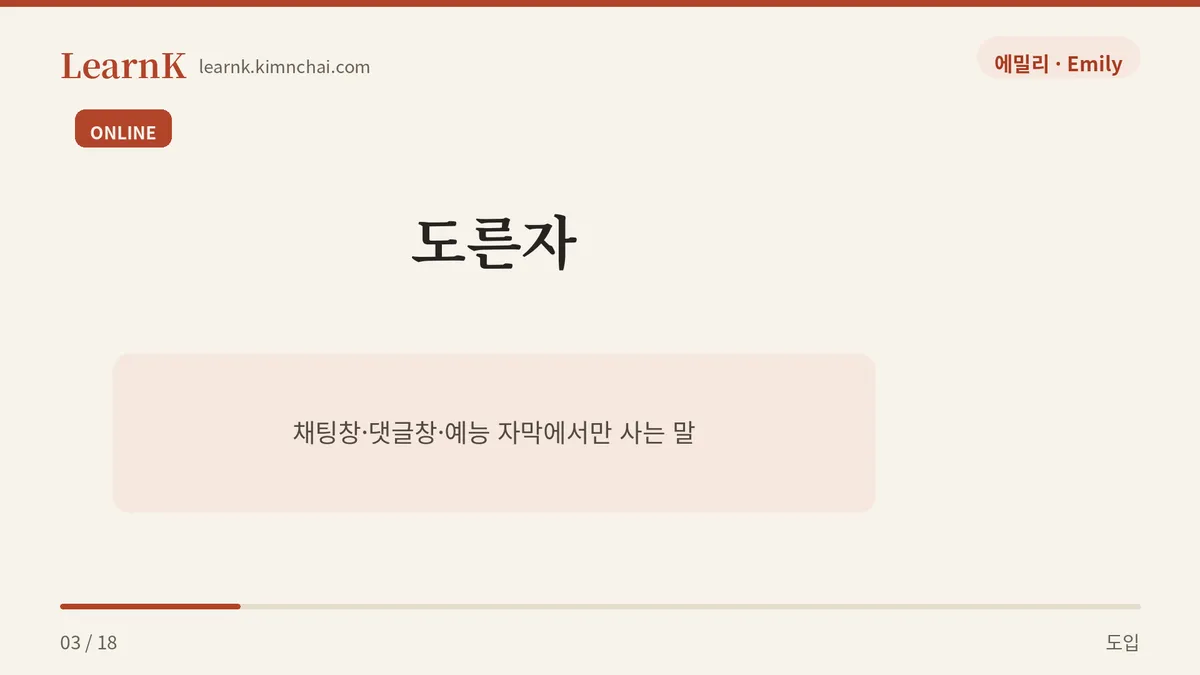
Here’s the kind of moment it comes out. A friend tells you they sat in a PC café from five in the morning just to land one concert ticket. You hear that the owner of your neighborhood bakery has been baking a single kind of croissant at three a.m. every day for three years. Someone posts on an online forum a life-size car built from 400 ramyeon wrappers taped together. Half the comments underneath say the exact same thing — “도른자.”
Learners who hear this for the first time are usually thrown. 돌다 (dolda) means to go out of your mind, and yet the person who just got told “너 도른자다 (neo doreunja-da)” laughs and answers “고마워 (gomawo)” — thanks. The moment you understand that mismatch, an important piece of spoken Korean grammar opens up for you.
The temperature of 도른자 (doreunja) is mixed like this: surprise is the biggest part, then respect, with a thin layer of “what is wrong with you” laid on top. The key point is that it’s used when the amount of effort has left the normal range. You don’t use it for someone who is simply good at something. A friend who did well on the exam is 대단하다 (daedanhada); a friend who sat there fourteen hours a day starting three weeks before the exam is 도른자 (doreunja). It’s a word that looks at how extreme the process was, not at the result.
In sentences it mostly shows up frozen into predicate-like forms: 도른자다 (doreunjada), 도른자네 (doreunjane), 도른자 아니냐 (doreunja aninya), 도른자 인정 (doreunja injeong). These are third-person exclamations by default, and saying “너 도른자야 (neo doreunja-ya)” straight to someone’s face only works between very close friends. Sticking it on yourself is common too — “나도 내가 도른자 같아 (nado naega doreunja gata)” is a rather convenient sentence that lets you be modest and brag at the same time.
Seeing it in a real conversation
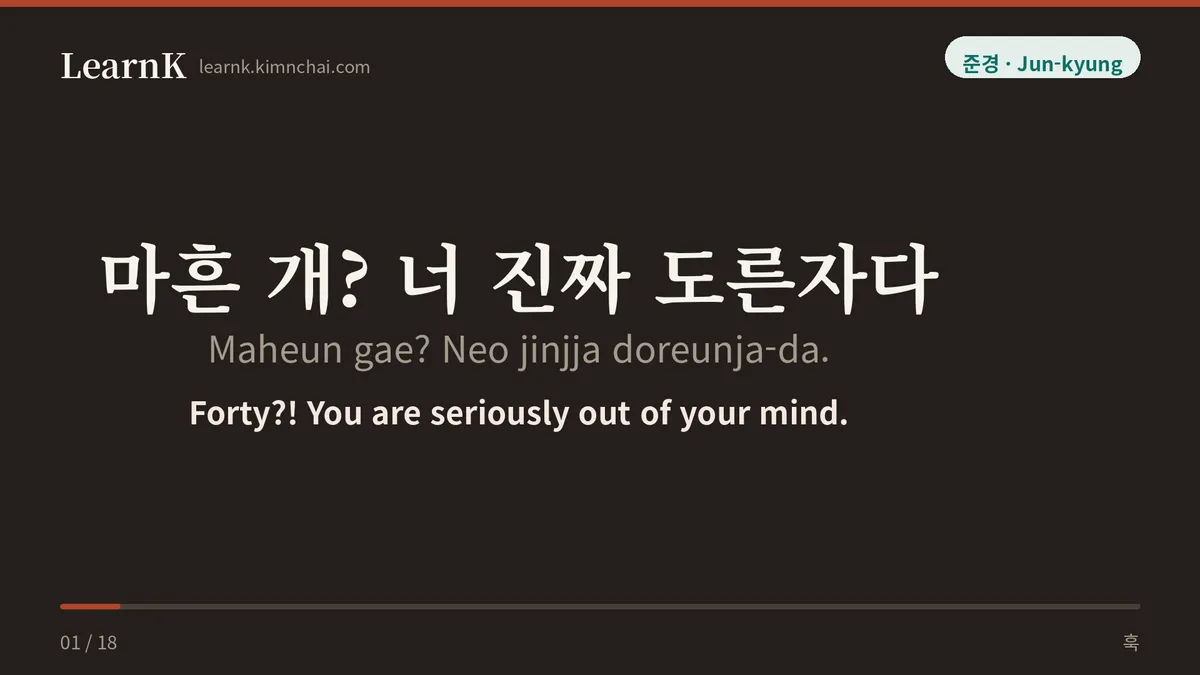
Scene: Emily’s housewarming party. Jun-kyung goes looking for the bathroom and opens the wrong door — the small room.
Jun-kyung: 야, 이 방 뭐야. 벽 한 면이 전부 LP네? Hey, what is this room? An entire wall of LPs?
Emily: 아, 거기? 한 천이백 장쯤 돼. 이사할 때 그것만 박스 마흔 개였어. Oh, that? About 1,200 of them. Forty boxes just for those when I moved.
Jun-kyung: 마흔 개?? 너 진짜 도른자다. Forty?! You are seriously out of your mind.
Emily: 칭찬으로 들을게. 근데 저 아래 칸은 아직 못 뜯었어. I’ll take that as a compliment. But I haven’t even unpacked that bottom shelf yet.
Jun-kyung: 아니, 이걸 다 듣긴 해? Wait — do you actually listen to all of these?
Emily: 하루에 한 장씩, 삼 년째. 나도 가끔 내가 도른자 같아. One a day for three years. Sometimes even I think I’m a doreunja.
These uses sound off
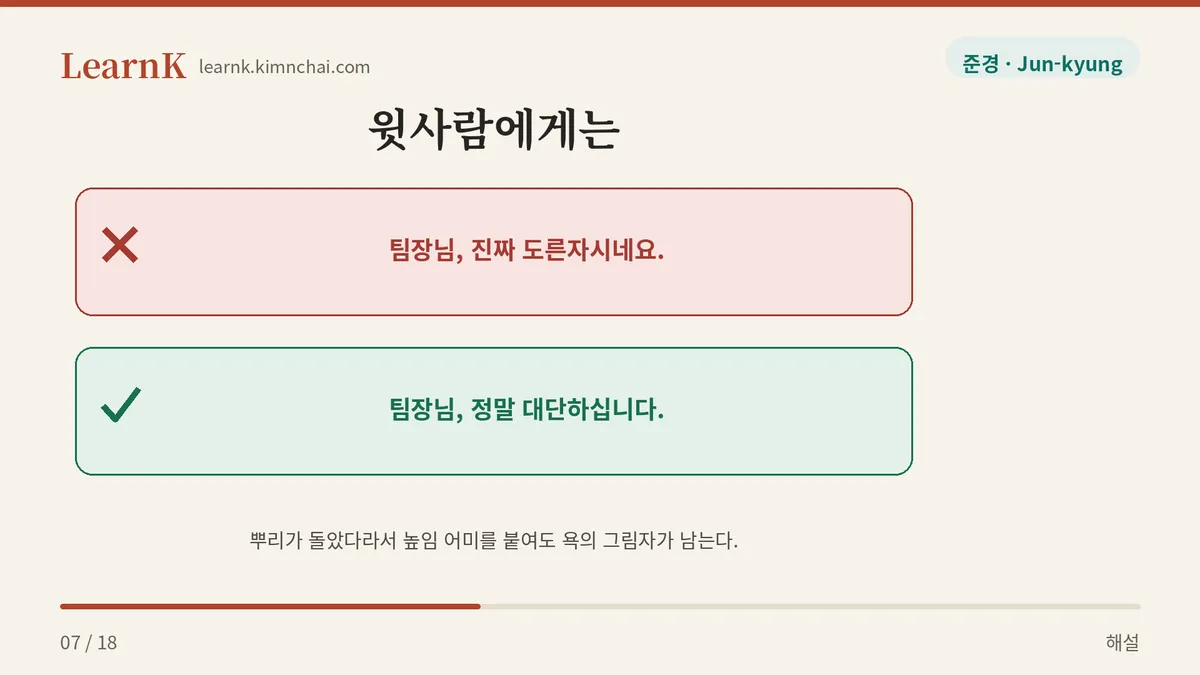
✗ (To your team lead) 팀장님, 주말에 보고서 다 쓰셨다고요? 진짜 도른자시네요. (Timjangnim, jumal-e bogoseo da sseusyeotdagoyo? Jinjja doreunja-sineyo.) — “Boss, you wrote the whole report over the weekend? You’re honestly out of your mind.”
✓ (To your team lead) 팀장님, 주말에 다 쓰셨다고요? 진짜 대단하십니다. (Timjangnim, jumal-e da sseusyeotdagoyo? Jinjja daedanhasimnida.) — “Boss, you wrote the whole thing over the weekend? That’s really impressive.”
→ Because the root is 돌았다 (dorattda), “went crazy,” attaching the honorific ending -시- (-si-) doesn’t erase the shadow of the insult. With someone above you, no matter how big your admiration is, you have to swap in a different word.
✗ (To someone you just met today, straight to their face) 회사 그만두고 창업하셨어요? 와, 도른자다. (Hoesa geumandugo changeophasyeosseoyo? Wa, doreunja-da.) — “You quit your job and started your own company? Wow, you’re insane.”
✓ (Telling a friend about that person) 걔 회사 때려치우고 창업했대. 도른자 아니냐? (Gyae hoesa ttaeryeochiugo changeophaetdae. Doreunja aninya?) — “Apparently he quit his job and started his own company. Isn’t that insane?”
→ 도른자 (doreunja) is fundamentally a word for marveling at someone who isn’t in the room. Used to someone’s face it sounds less like admiration and more like a verdict, and between people who aren’t close it can escalate into a fight.
Example sentences by situation
1. When you hear the tale of a friend’s ticketing campaign
You hear they reserved seats at three different PC cafés to catch one ticket, and this is the line you toss out — exasperated and full of respect at the same time.
표 한 장 잡겠다고 피시방을 세 군데나 잡았대. 도른자네 진짜. (Pyo han jang japgetdago pisibang-eul se gunde-na jatdae. Doreunjane jinjja.) — They booked three whole PC cafés just to get one ticket. That is genuinely insane.
2. When you’re humbling yourself but quietly bragging
This is the use where you pin the word on yourself before anyone else can compliment you. It’s a detour Koreans reach for often, when saying “I’m a hard worker” with a straight face would be too embarrassing.
나 요즘 새벽 다섯 시에 일어나서 뛰어. 나도 내가 도른자 같아. (Na yojeum saebyeok daseot si-e ireona-seo ttwieo. Nado nae-ga doreunja gata.) — These days I get up at five in the morning to run. Even I think I’ve lost it.
3. In a shop review or a social media post
The word points at a person, but what it’s really praising is what that person made. You use it when the portion size makes no sense for the price, or when the care put in goes past common sense.
사장님 도른자인 듯. 이 가격에 이 양이 나온다고? (Sajangnim doreunja-in deut. I gagyeog-e i yang-i naonda-go?) — The owner must be out of their mind. This much food at this price?
Polite vs. casual speech, and similar expressions
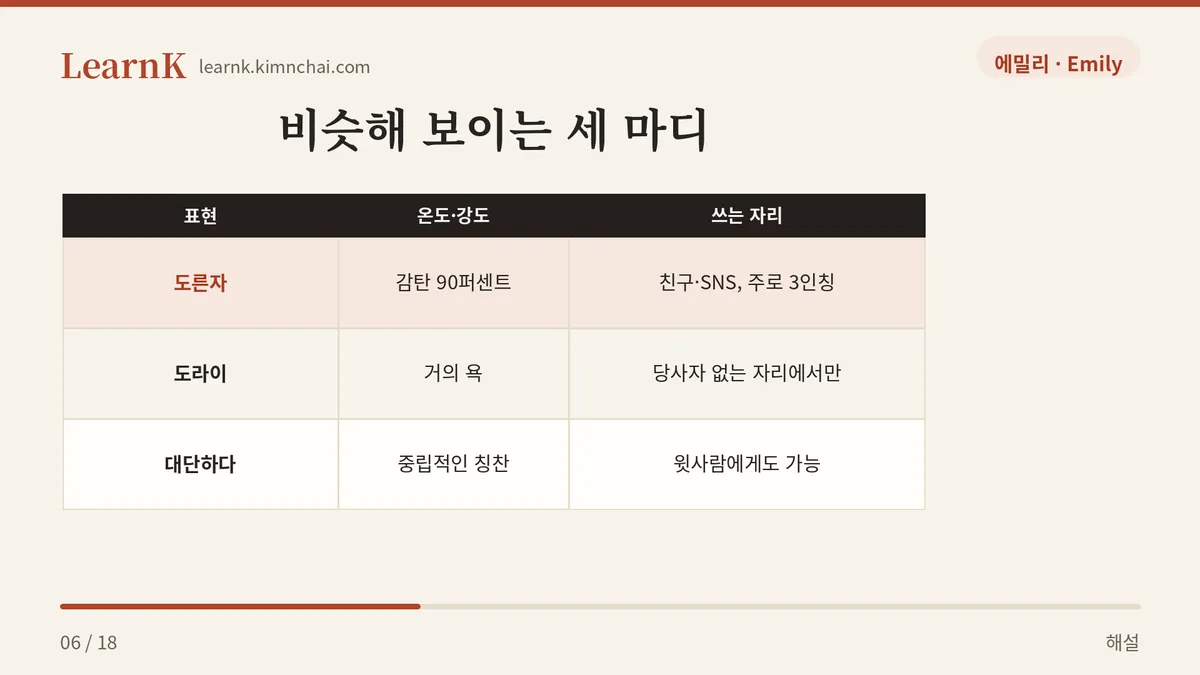
One thing to know up front: 도른자 (doreunja) has no usable polite form. A word like “도른자세요 (doreunja-seyo)” simply doesn’t exist, and “도른자시네요 (doreunja-sineyo)” turns rude, as we saw above. If the situation calls for polite speech, you have to change the word itself.
| Expression | Temperature & strength | Where it’s used |
|---|---|---|
| 도른자 (doreunja) | 90% admiration + 10% disbelief. Very strong | Friends, social media, online forums. Mostly third person. Off-limits with superiors or in formal settings |
| 미쳤다 (michyeotda) | About as strong, but doesn’t have to be about a person | Between friends. Works for things and situations too, as in “이 맛 미쳤다 (i mat michyeotda)” — “this flavor is insane” |
| 독하다 (dokhada) | Admiration with a chill mixed in | When you’re pointing at someone’s grit or ruthless drive. Careful with superiors |
| 대단하다 (daedanhada) | Neutral praise | Anywhere. Works with superiors too (대단하십니다, daedanhasimnida) |
| 도라이 (dorai) | Close to an outright insult | Only when the person isn’t there. Never to their face |
The trickiest pair in the table is 도른자 (doreunja) and 도라이 (dorai). They sound alike and share a root, but they point in opposite directions. 도라이 (dorai) tears a person down; 도른자 (doreunja) generally lifts them up. If you’re not sure, the safe move is to not use 도라이 (dorai) at all.
Cultural background — how “a person who lost it” became a compliment
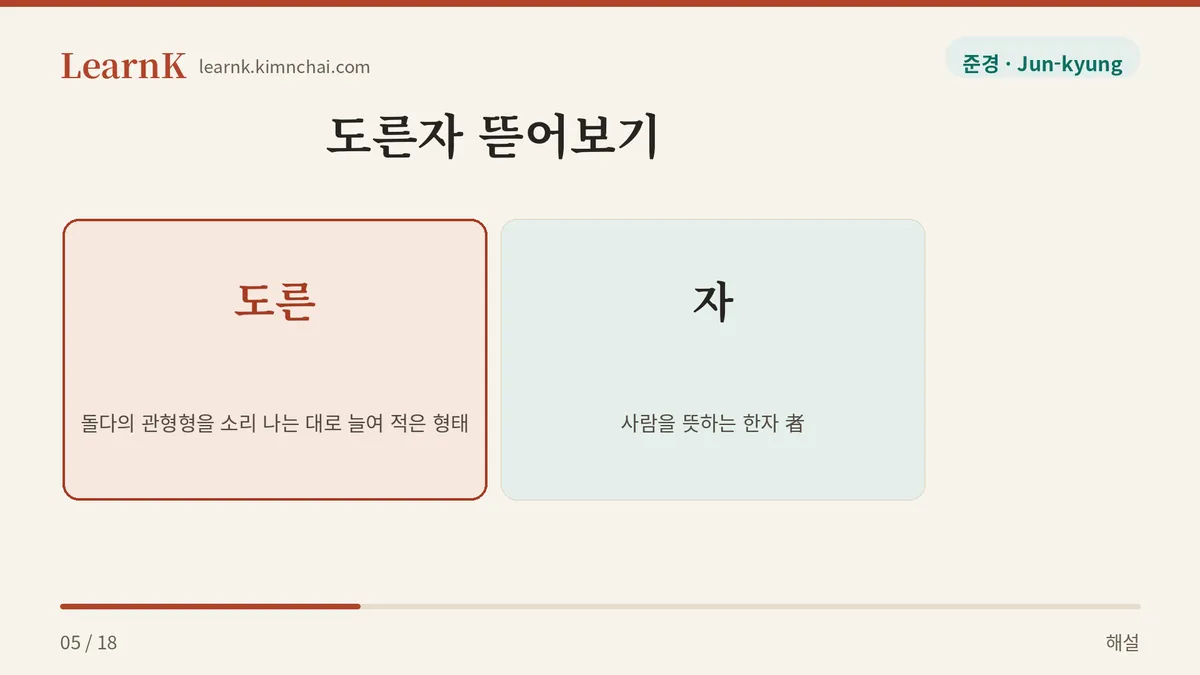
The word formation is fairly transparent. It’s the adnominal form of 돌다 (dolda) plus the Sino-Korean character 者 (자, ja, “person”). In standard spelling it should come out as 돈 자 (don ja), but the internet stretched it out phonetically into 도른 (doreun), and that spelling stuck. In the late 2010s, Korean internet writing had a running trend of deliberately breaking spelling rules to create flavor, and 도른자 (doreunja) settled in on top of that current. That’s why the word still carries zero scent of written language — it never shows up in newspaper articles; it lives in chat windows, comment sections, and variety-show subtitles.
What’s more interesting is how the meaning flipped. In Korean, 미쳤다 (michyeotda) — “crazy” — has long been used as the ultimate praise. If a song is good, you say “이 노래 미쳤다 (i norae michyeotda).” If food is delicious, you say “맛이 미쳤다 (mas-i michyeotda).” Once admiration passes a certain size, positive words can’t carry it anymore, so the language borrows the intensity of a negative one. 도른자 (doreunja) is what you get when that borrowing is applied to a person.
On top of that sits one more distinctly Korean feeling: a culture that respects extremes of effort but finds it mutually mortifying to praise them with a straight face. Instead of saying “I respect your diligence,” you toss out “도른자네 (doreunjane)” — the respect gets across and the awkwardness disappears. A compliment wearing the costume of an insult creates that safe distance.
Watch any variety show these days and the moment a cast member shows some beyond-reason obsession, those two-and-a-half characters flash across the middle of the screen in huge type. The subtitle is speaking the viewer’s reaction for them — and the fact that what goes in that slot is 도른자 (doreunja) rather than 대단하다 (daedanhada) shows you exactly where this word sits. You’ll hear it in dramas too, in lines given to a junior colleague or a group of friends, but almost never out of the mouth of a boss or an older adult. Deciding who gets the line is itself a device for revealing a character’s age and relationships.
Today’s quiz
Your team lead spent the entire weekend on it and finished the whole presentation deck alone. You want to express your amazement. Which is most appropriate?
- 팀장님, 진짜 도른자시네요. (Timjangnim, jinjja doreunja-sineyo.) — “Boss, you’re seriously out of your mind.”
- 팀장님, 정말 대단하십니다. (Timjangnim, jeongmal daedanhasimnida.) — “Boss, that’s really impressive.”
- 팀장님, 도라이 아니세요? (Timjangnim, dorai anisaeyo?) — “Boss, are you a lunatic?”
Answer: 2.
Options 1 and 3 both trace back to 돌았다 (dorattda), so no amount of honorific endings will keep them from sounding rude to someone above you. Number 3 in particular isn’t admiration at all — it’s just an insult. All you need to remember is that 도른자 (doreunja) is for peers, and preferably for moments when the person in question isn’t there. To your team lead: “정말 대단하십니다 (jeongmal daedanhasimnida).” To a teammate, when you’re passing along the story about your team lead: “팀장님 주말에 그거 혼자 다 하셨대. 도른자 아니냐? (Timjangnim jumal-e geugeo honja da hasyeotdae. Doreunja aninya?)” — split the word by setting like that, and you’ll be fine.
The definitions, example sentences, and dialogue in this post are all original writing. 도른자 (doreunja) is not a headword in the National Institute of Korean Language’s Basic Korean Dictionary (krdict.korean.go.kr), so no dictionary material is quoted here.