뒷목 잡다 (dwinmok japda) — Why Koreans Grab the Back of Their Neck When They Get Angry
뒷목 잡다 (dwinmok japda)
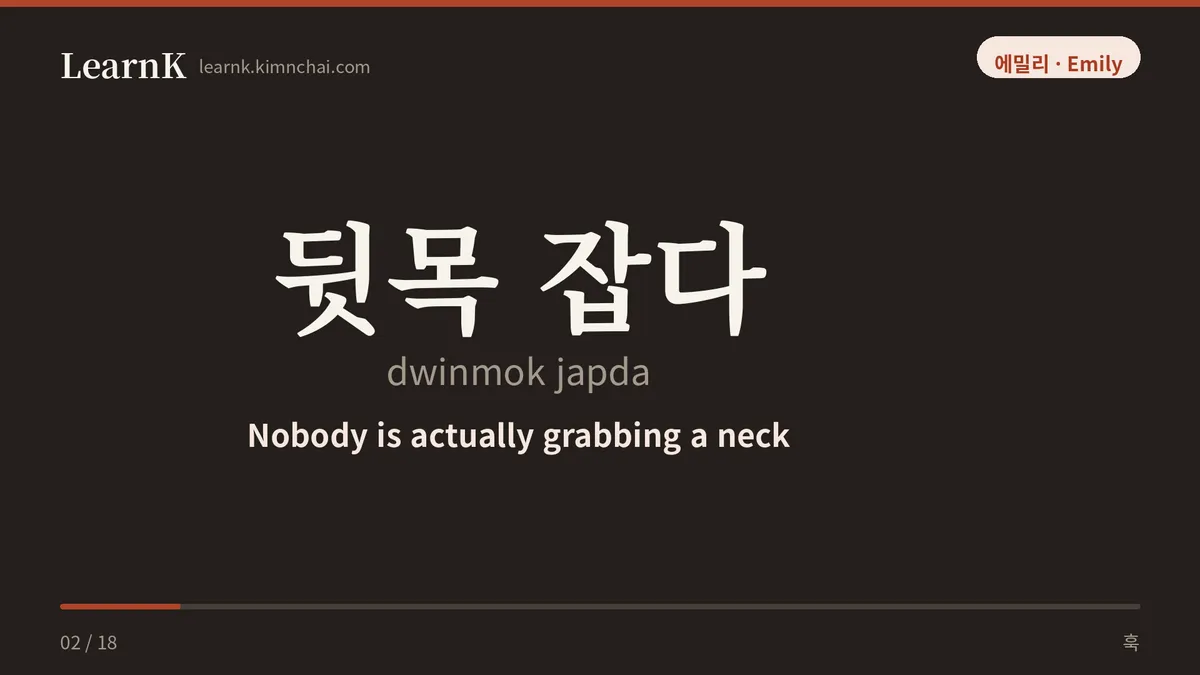
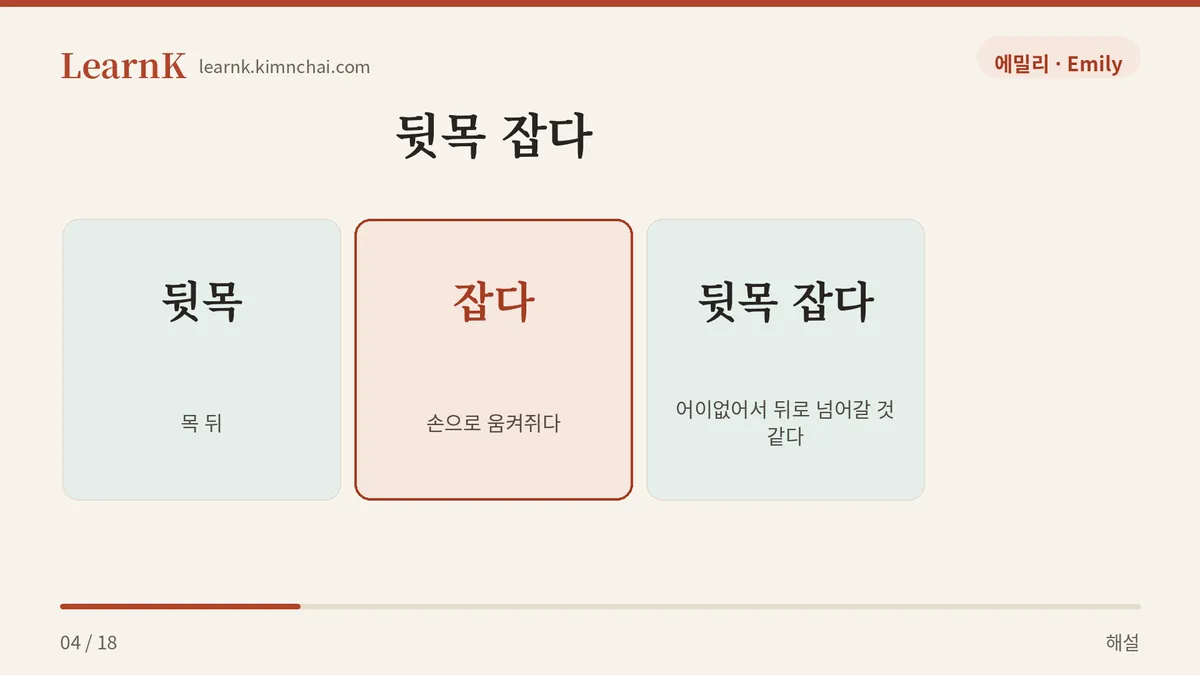
뒷목 잡다 (dwinmok japda) describes the state of being so exasperated, or so angry, that you feel like you’re about to keel over backwards. Read literally, it’s the physical act of “grabbing the back of your neck with your hand” — but the person actually saying it never grabs their neck. When the secondhand seller you’ve waited 30 minutes for stops answering. When the file you stayed up all night writing didn’t save. When “so, when are you getting married?” comes around for the third time at the holiday dinner table. In those moments, Koreans reach for their mouth instead of their hand: “아, 진짜 뒷목 잡겠네 (dwinmok japgenne).” (“Ugh, I’m seriously about to lose it.”)
The heart of this expression isn’t the anger itself — it’s the sheer size of the absurdity. If you’re just plain mad, 열받아 (yeolbada) does the job. 뒷목 잡다 is for when anger comes mixed with disbelief: the kind of situation where 이게 말이 돼? (ige mari dwae?) — “Is this for real?” — comes out of your mouth first. That’s why the temperature runs hot while the face is often smiling. Used about yourself, it turns into a joke — an exaggerated, full-body way of saying “that is how ridiculous it was.”
The flip side: you don’t use it for things that are genuinely sad or frightening. Lay this phrase over someone’s illness, an accident, or a breakup — situations with no room for a laugh — and you become the person treating another’s misfortune as a spectacle. Knowing where that line sits matters far more than knowing the definition.
In a sentence, it usually shows up in these shapes.
- 뒷목 잡겠다 (dwinmok japgetda) — the feeling surging up right now. The most common form.
- 뒷목 잡을 뻔했다 (dwinmok jabeul ppeonhaetda) — looking back on something that already happened.
- 뒷목 잡을 일 (dwinmok jabeul il) — used like a noun. “그건 진짜 뒷목 잡을 일이지 (geugeon jinjja dwinmok jabeul iriji).” — “That is genuinely something to lose it over.”
- 뒷목 잡으시겠다 (dwinmok jabeusigetda) — teasing a third party (usually a parent) as if you were worried about them.
See It in a Real Conversation
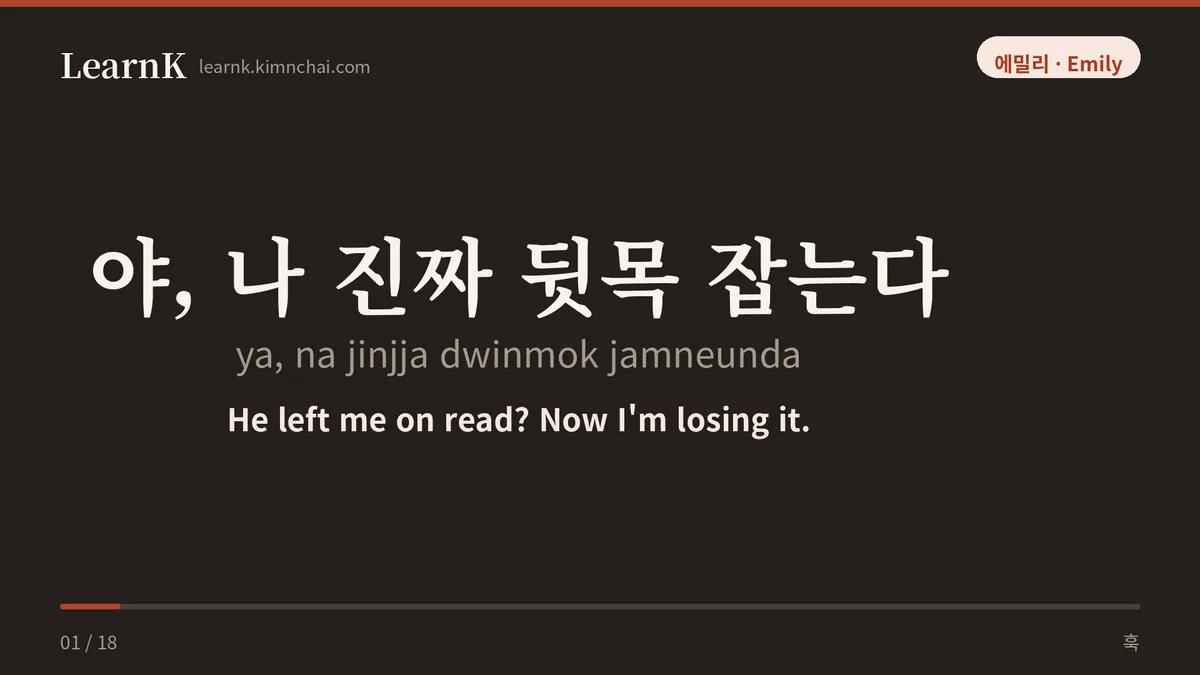
Situation: Saturday afternoon, the agreed meeting spot in front of an apartment complex for a secondhand sale. They’ve been waiting for the seller for 30 minutes now.
Jun-kyung: 야, 벌써 30분이야. 전화도 안 받네. Hey, it’s been 30 minutes already. He’s not picking up either.
Emily: 아 진짜 뒷목 잡겠네. 나 이거 사려고 약속도 미뤘는데. Ugh, this is unbelievable. I even pushed back my other plans to buy this.
Jun-kyung: 아까 보낸 톡은 읽었어. 읽고 씹은 거지 뭐. He read the message I sent earlier. He’s just ignoring it.
Emily: 뭐? 읽씹? 야, 나 진짜 뒷목 잡는다. What? He read it and left me on read? Okay, now I’m losing it.
Jun-kyung: 진정해. 그냥 다른 데서 사자, 내가 커피 살게. Calm down. Let’s just buy it somewhere else — coffee’s on me.
Emily: 커피는 됐고, 후기부터 남기고 갈래. Forget the coffee, I’m leaving a review first.
These Uses Sound Off
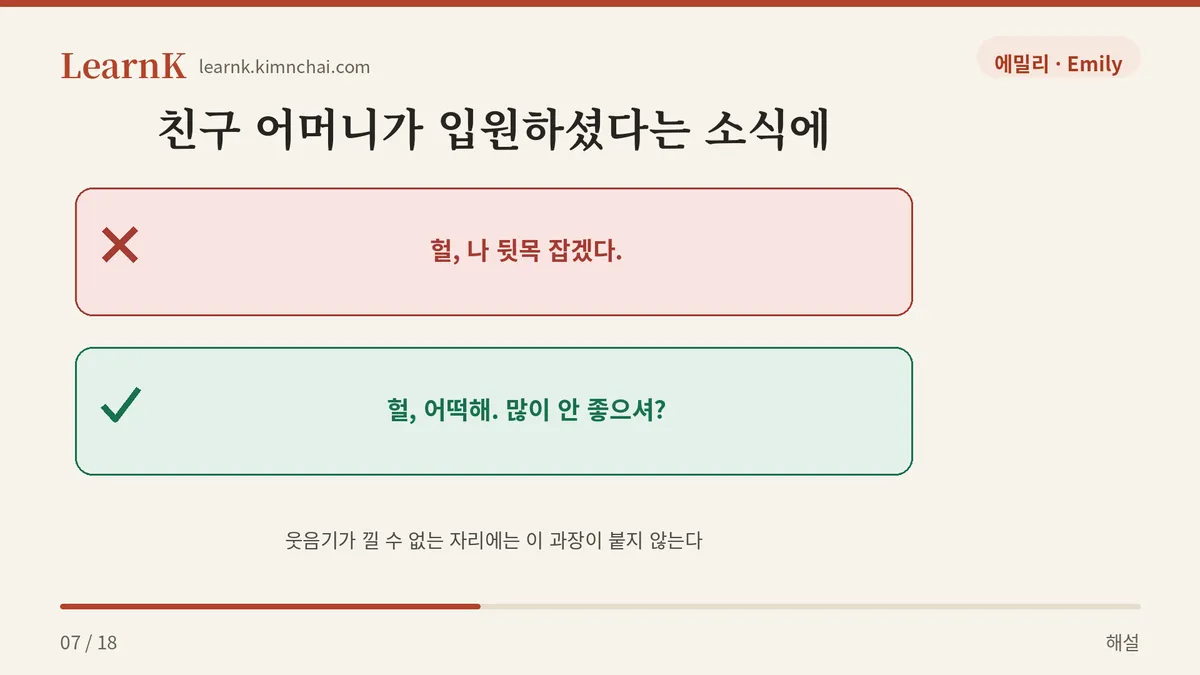
✗ (On hearing that a friend’s mother has been hospitalized) 헐, 나 뒷목 잡겠다. (heol, na dwinmok japgetda.) — Whoa, I’m about to lose it. ✓ (On hearing that a friend’s mother has been hospitalized) 헐, 어떡해. 많이 안 좋으셔? (heol, eotteokhae. mani an joeusyeo?) — Oh no, what do we do. Is she in bad shape? → 뒷목 잡다 is an exaggeration that attaches to absurdity, so using it where real concern belongs makes you sound like a bystander watching someone else’s trouble for entertainment.
✗ (In an executive briefing) 상무님, 저희도 이 수치 보고 뒷목 잡았습니다. (sangmunim, jeohuido i suchi bogo dwinmok jabatseumnida.) — Sir, we lost it when we saw these numbers too. ✓ (In an executive briefing) 저희도 이 수치를 확인하고 상당히 당황했습니다. (jeohuido i suchireul hwaginhago sangdanghi danghwanghaetseumnida.) — We were quite taken aback when we confirmed these figures as well. → It’s an exaggerated phrase that grew up in speech and on the internet, so in a formal setting it makes you sound like you’re taking the matter lightly. Here’s the trap: attaching the polite -습니다 (-seumnida) ending doesn’t make it formal.
Example Sentences by Situation
1. When the course-registration server crashes right before you pay
세 시간 기다렸는데 마지막에 오류라니, 진짜 뒷목 잡겠다. (se sigan gidaryeonneunde majimage oryurani, jinjja dwinmok japgetda.) Three hours of waiting and then an error at the very end — I’m seriously about to lose it.
This is close to talking to yourself. Even with someone standing next to you, it’s not a line that expects an answer; it’s more like measuring the size of your feelings out loud.
2. When a younger brother sneaks out in his older brother’s new sneakers and drops them in a mud puddle
엄마가 이거 보시면 뒷목 잡으실 거야. (eommaga igeo bosimyeon dwinmok jabeusil geoya.) If Mom sees this, she’s going to lose it.
The subject here isn’t “I” — it’s Mom. Putting a third party in the subject slot softens “brace yourself, you’re getting in trouble” into something that lands like a joke. Whether Mom would actually get angry doesn’t matter.
3. When a friend breaks up and gets back together with the same person for the fifth time
야, 나 진짜 뒷목 잡을 뻔했어. 또 걔야? (ya, na jinjja dwinmok jabeul ppeonhaesseo. tto gyaeya?) Hey, I almost lost it for real. Him again?
This is less anger than sheer speechlessness. Adding -을 뻔했다 (-eul ppeonhaetda) backs the emotion up a step and turns it into a scolding, teasing tone.
Politeness Levels and Similar Expressions
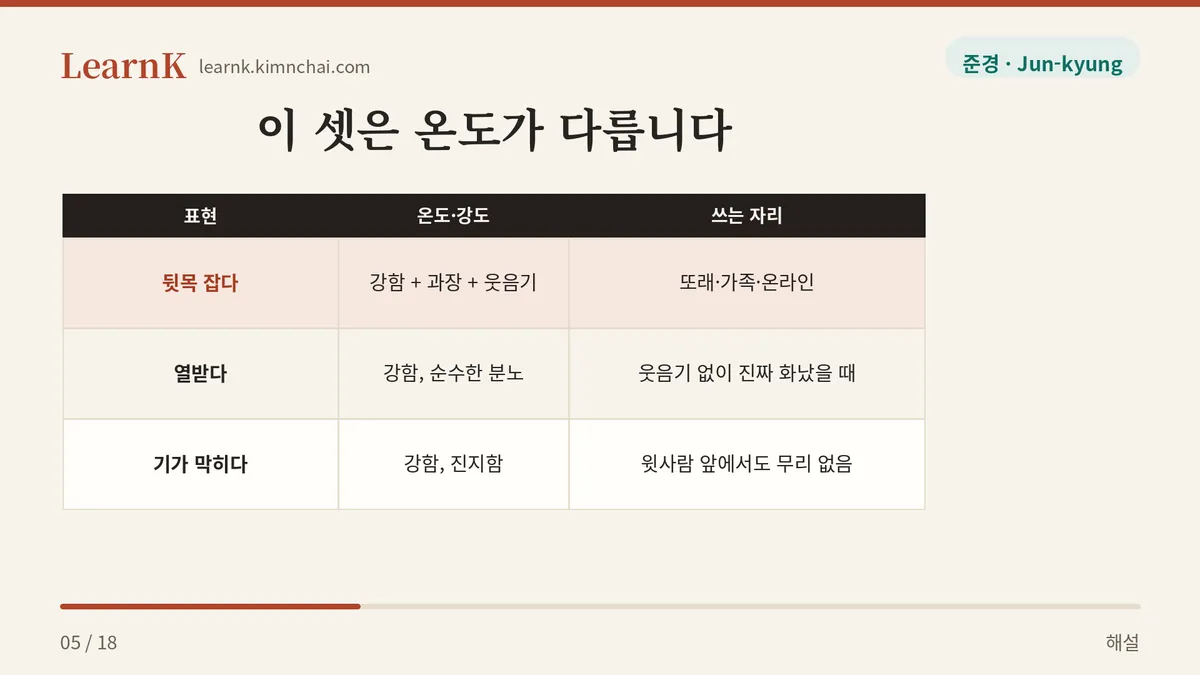
| Expression | Temperature / Intensity | Where it fits |
|---|---|---|
| 뒷목 잡다 (dwinmok japda) | Strong + exaggerated + a laugh in it | Peers, family, online. Not for formal settings |
| 혈압 오르다 (hyeorap oreuda) | Strong + exaggerated | Practically a sibling of 뒷목 잡다. The same picture of the body |
| 기가 막히다 (giga makhida) | Strong, serious | Anywhere. Fine even in front of a senior |
| 어이없다 (eoieopda) | Medium | Everyday use across the board. Polite forms like “어이없네요 (eoieomneyo)” sound natural too |
| 열받다 (yeolbatda) | Strong, pure anger | Among peers. For when you’re genuinely mad, with no laugh in it |
It’s not that you can’t use it in polite speech. It’s just that it only survives in teasing contexts — something like “부장님 이거 보시면 뒷목 잡으시겠는데요 (bujangnim igeo bosimyeon dwinmok jabeusigenneundeyo)” (“If the manager sees this, he’s going to lose it”). The moment you ask that boss directly, “뒷목 잡으셨어요? (dwinmok jabeusyeosseoyo?)” — “Did you lose it?” — it becomes rude. It’s the setting, not the verb ending, that decides how formal this expression is.
Cultural Background — A Gesture Made by K-Dramas
The picture this phrase paints is simple. When you get seriously angry, blood rushes and the back of your neck stiffens — that bodily experience was transferred straight into a hand gesture. Korean has an unusual number of idioms that measure emotion with body parts. 배꼽 빠지다 (baekkop ppajida), “your belly button falls out,” draws the size of laughter; 간이 크다 (gani keuda), “a big liver,” draws boldness; and 뒷목 잡다 draws the size of anger.
On top of that, Korean dramas added the decisive image. The company chairman or the mother-in-law learns some shocking truth, can’t get a word out, clutches the back of her neck, and sinks to the floor — repeated for decades, that scene became a symbol. No dialogue needed. From that one gesture alone, viewers read: “this person has just gone past what they can handle.” So when Koreans use this phrase today, they’re also, in effect, pasting that drama scene onto their own situation and making themselves look a little ridiculous on purpose.
Online, it gets even shorter. In communities and group chats, people sometimes leave just the single word “뒷목… (dwinmok…)” with no verb at all, or replace it entirely with a 짤 (jjal, reaction image) of someone grabbing their neck and collapsing. It’s hardened into an image as much as an expression.
Today’s Quiz
Which of the following is the best situation for using 뒷목 잡다 (dwinmok japda)?
- Hearing that a friend’s dog has crossed the rainbow bridge
- Waiting in line for three hours, only for the shop to run out of ingredients at the customer right in front of you
- Congratulating your manager, whose promotion has just been confirmed
Answer: 2
뒷목 잡다 only comes alive when “anger + absurdity + a bit of a laugh” are all present at once. Number 2 makes you angry, but there’s nobody to blame, and it’ll be a story you laugh about later — exactly this expression’s territory. Number 1 is a grief with no room for a laugh, so laying this phrase over it trivializes the situation. Number 3 misses twice: it’s a congratulatory moment, and it’s in front of a senior.