어쩌라고 (eojjeorago) — The Four Syllables That Shut a Conversation Down
어쩌라고
어쩌라고 (eojjeorago) is what you snap back at someone when you mean, “So what exactly am I supposed to do about it?” It’s less a question than a declaration: no apology, no comfort, and no solution is coming. When somebody unloads a long complaint on you, and it isn’t your fault and there’s nothing you could do about it anyway, Koreans shut the door on that conversation with just four syllables.
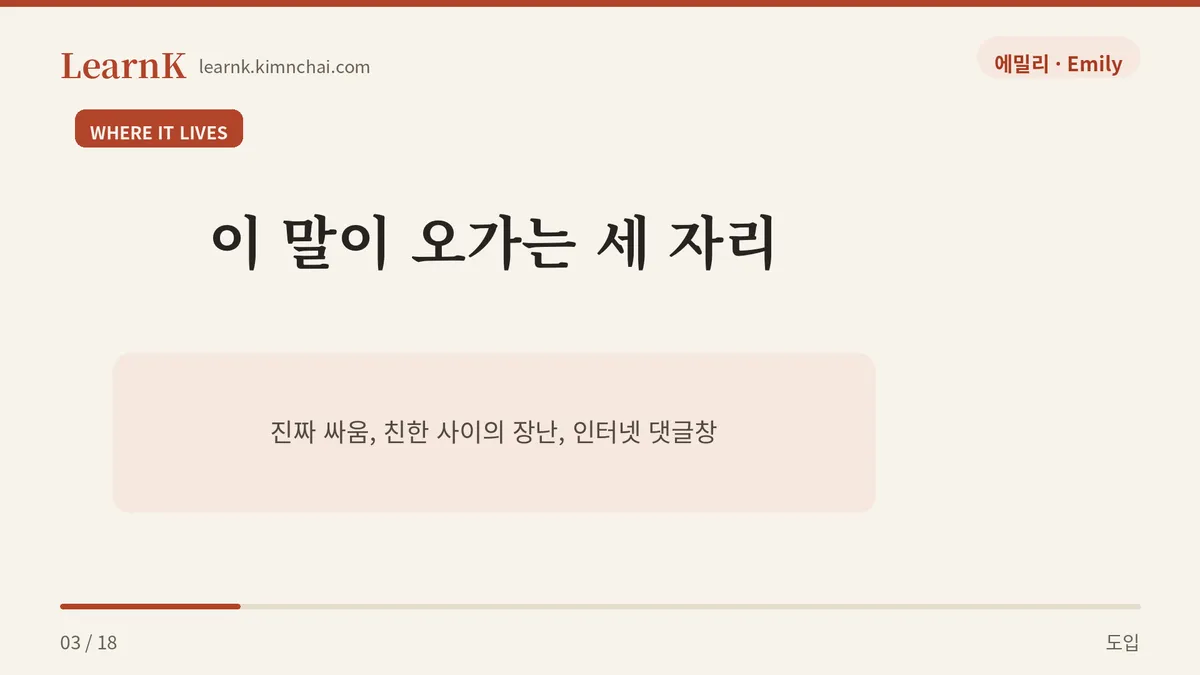
There are three main places this expression actually gets used. The first is a genuine fight. Two people are pushing responsibility back and forth, and the moment one of them drops this line, the conversation is effectively over. The second is teasing between very close friends. When a friend is milking a minor complaint, you laugh and hit them with “어쩌라고” — here it becomes a joke meaning, “I hear you, and I’m still not helping.” The third is internet comment sections. When someone can’t be bothered to argue back with logic, they toss out these four syllables and leave.
The temperature is decided by your face and your intonation. Lift the end slightly — 어쩌라고? — and it sounds like an actual question, which softens it a little; drop it flat and it lands ice cold. The key point is that adding polite endings does not make it gentler. 어쩌라고요 (eojjeoragoyo) is polite in form only; its power to shove the other person away is fully intact. That’s why, for Korean learners, this expression is far more about how not to use it than how to use it.
A Real Conversation
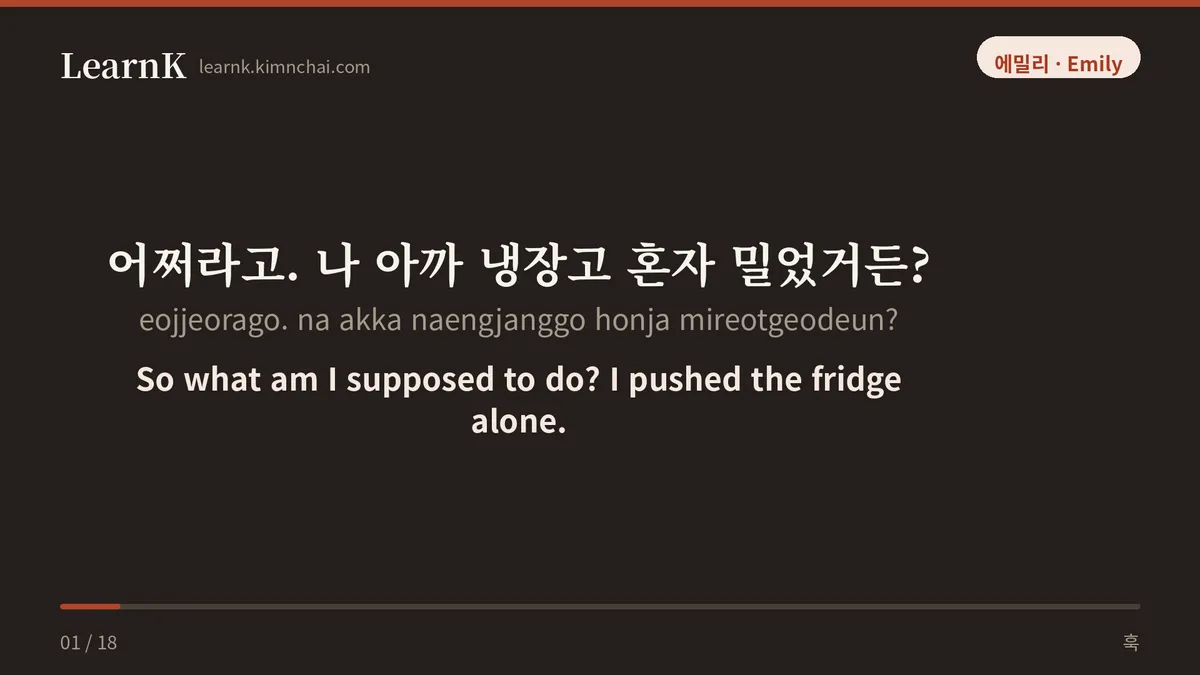
Setting: The evening of moving day. All the boxes are inside, and the two of them have slumped down onto the floor of the empty living room.
Jun-kyung: 아 진짜 허리 나갔다. 나 내일 못 일어날 것 같은데. Ugh, my back is done. I don’t think I can get up tomorrow.
Emily: 어쩌라고. 나 아까 냉장고 혼자 밀었거든? So what do you want me to do about it? I pushed the fridge by myself earlier, you know.
Jun-kyung: 야, 그건 좀 심하다. 위로 한마디를 안 해 주냐. Hey, that’s harsh. Not even one word of sympathy?
Emily: 농담이야, 농담. 근데 너 아까 뭐랬어? 짐 별로 없다며. I’m kidding, kidding. But what did you say earlier? You said there wasn’t much stuff.
Jun-kyung: 그거야… 눈대중이었지. Well… that was just a rough guess.
Emily: 그러니까 어쩌라고가 절로 나오지. 일어나, 짜장면 시켰어. That’s exactly why “so what am I supposed to do” just comes out. Get up, I ordered jjajangmyeon.
Where It Sounds Wrong
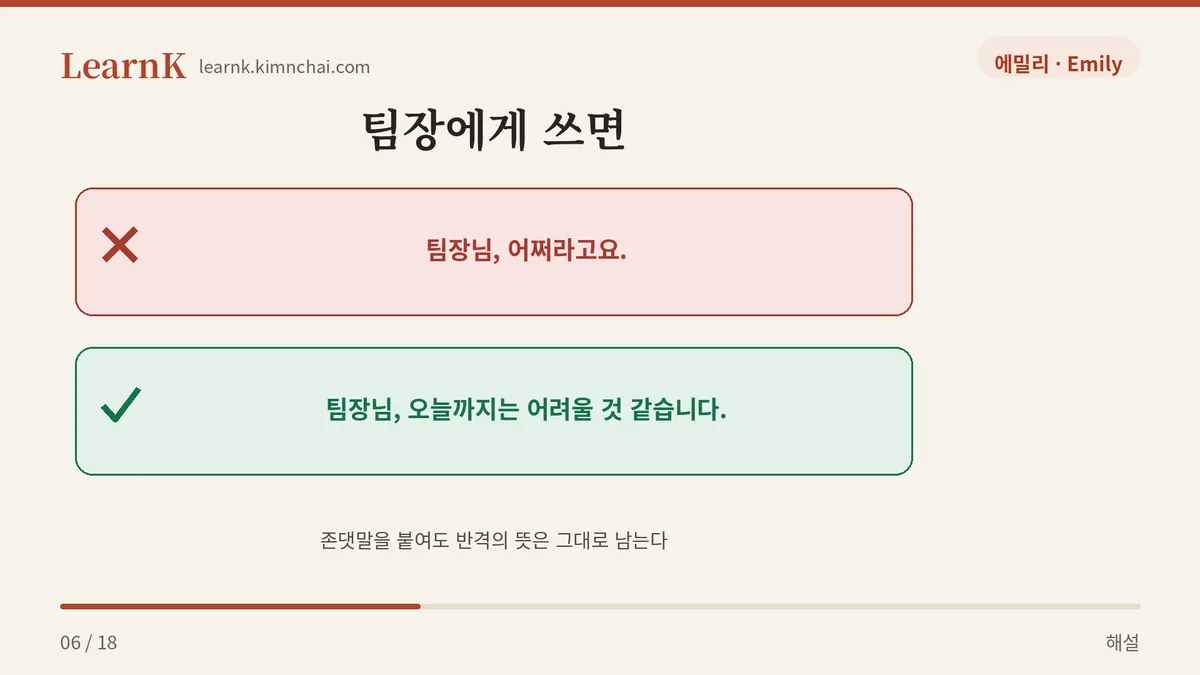
✗ (to your team lead) 팀장님, 이걸 오늘까지 하라고요? 어쩌라고요. Sir, you want this done by today? So what am I supposed to do about it? ✓ (to your team lead) 팀장님, 오늘까지는 어려울 것 같습니다. 일정을 어떻게 조정하면 될까요? Sir, I don’t think today is going to work. How should we adjust the schedule? → Even with the polite ending ‘-요 (-yo)’ attached, the counterattack — “don’t dump the responsibility on me” — stays exactly where it was. Aimed at someone senior to you, it goes past protest and lands as insubordination.
✗ (to a friend crying after losing their dog) 어쩌라고. 나도 요즘 힘들어. So what am I supposed to do? I’m having a hard time these days too. ✓ (to a friend crying after losing their dog) 무슨 말을 해야 할지 모르겠다. 옆에 있을게. I don’t know what to say. I’ll stay right here with you. → It may pass as teasing between close friends, but when the other person is genuinely hurting, it doesn’t land as a joke. This expression draws a line that says, “Your feelings are not my responsibility.”
Example Sentences by Situation
1. When a friend turns up an hour late without a word and offers only “차가 막혔어 (cha-ga makyeosseo)” — “traffic was bad”
한 시간을 기다렸는데 차가 막혔다는 말 한마디면 나더러 어쩌라고? (han sigan-eul gidaryeonneunde cha-ga makyeotdaneun mal hanmadi-myeon nadeoreo eojjeorago?) I waited a whole hour, and one line about traffic is supposed to be enough — so what am I supposed to do with that? → Here 나더러 (nadeoreo) or 나보고 (nabogo) has been added in front. With that lead-in, the line tilts away from a pure attack and toward wounded protest — “think about where I’m standing, too.”
2. When your younger sibling trashes their own room, gets scolded by Mom, and then takes it out on you
네가 어질러 놓고 왜 나한테 어쩌라고 그래? (nega eojilleo noko wae na-hante eojjeorago geurae?) You’re the one who made the mess — why are you throwing this at me? → In the form 어쩌라고 그래 (eojjeorago geurae), it means “why are you talking to me like that?” This shape points at the other person’s attitude itself.
3. When a coworker keeps lamenting something that’s already been finalized — said to wrap things up, not out of irritation
이미 나간 건데 지금 와서 어쩌라고요. 다음 편에서 고치죠. (imi nagan geonde jigeum waseo eojjeoragoyo. da-eum pyeon-eseo gochijyo.) It’s already gone out; what do you want us to do about it now? Let’s fix it in the next installment. → Attaching an alternative right afterward visibly reduces the aggression. This is just about the only way to use this expression and still keep the relationship undamaged.
Similar Expressions, Polite and Casual
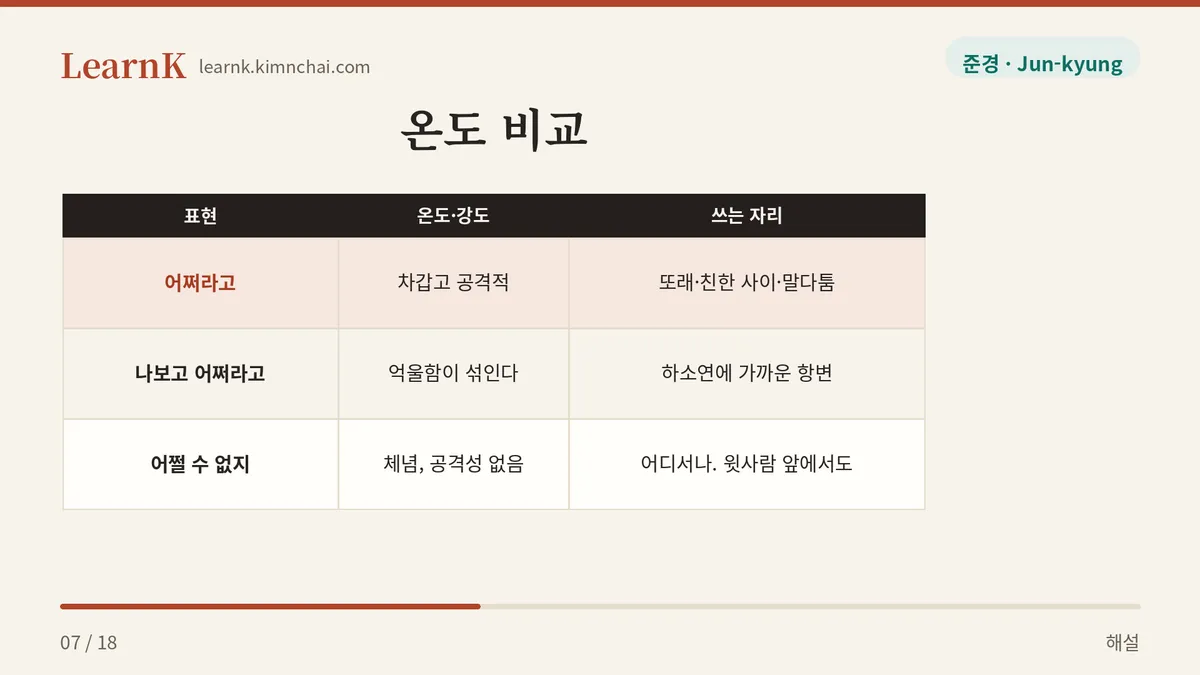
| Expression | Temperature & strength | Where it’s used |
|---|---|---|
| 어쩌라고 (eojjeorago) | Cold and aggressive. It ends the conversation | Peers, close friends, arguments. Never with someone senior to you |
| 나보고 어쩌라고 (nabogo eojjeorago) | Mixed with a sense of unfairness, so a little less sharp | Protest that leans toward venting |
| 어쩌란 말이야 (eojjeoran mariya) | Frustration, appeal | When the situation is maddening rather than the person being at fault |
| 그래서요? (geuraeseoyo?) | Polite on the outside, cold underneath | The chillier version for polite-speech settings |
| 어쩔 수 없지 (eojjeol su eopji) | Resignation. No aggression | Anywhere. Perfectly fine even in front of someone senior |
The polite forms 어쩌라고요 and 어쩌란 말씀이세요 (eojjeoran malsseumiseyo) are grammatically honorific, but in practice they’re closer to protest of the same intensity in polite wrapping. The bottom row, 어쩔 수 없지, handles the same “there’s nothing to be done” situation without pushing the other person away. That’s the one learners should safely master first.
Cultural Background — Four Syllables That Close the Door
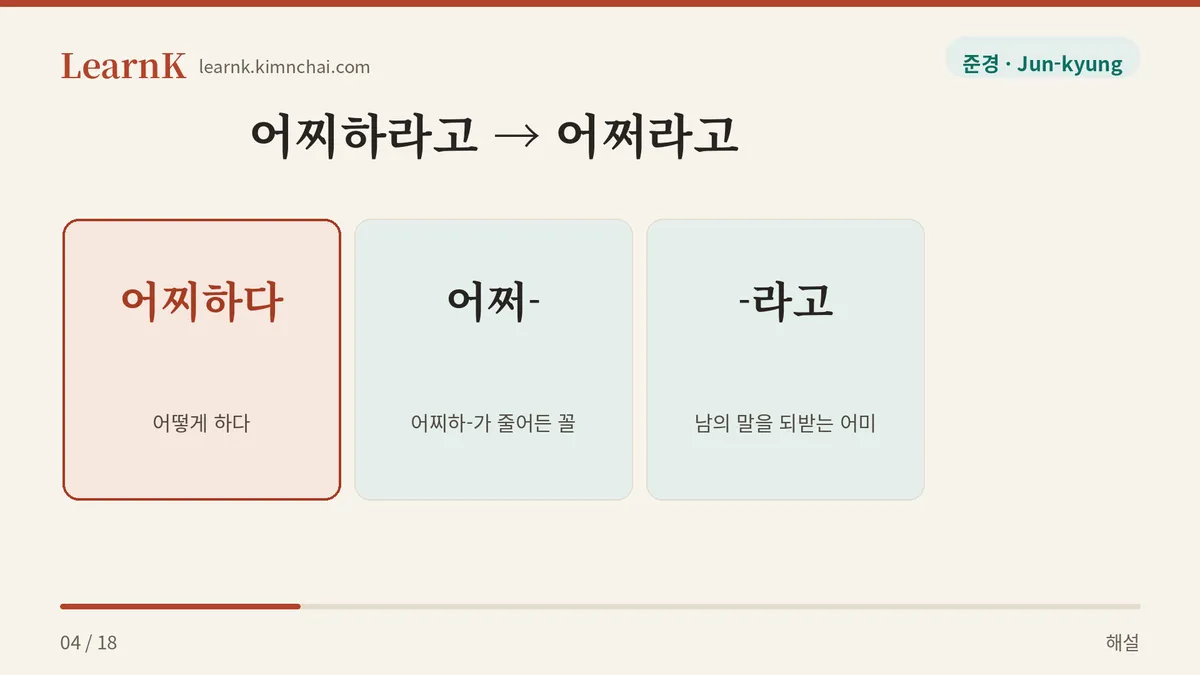
어쩌라고 is a contraction of 어찌하라고 (eojjihalago). ‘어찌하다’ shortens to ‘어쩌다’, and onto that goes the ending ‘-라고’, used when relaying someone else’s words. So the skeleton of this expression is, “What are you telling me to do here, exactly?” Because its structure picks up what the other person just said and hands it straight back, it carries a strong counterattacking force despite being so short.
In Korean dramas, this line is usually placed at the point where a relationship snaps. It comes out briefly in the scene where a character who has been enduring everything finally raises their voice — or, conversely, where a cold character brushes past someone’s tears. A single line of dialogue shows, without explanation, that “this person has no intention of accommodating the other person anymore.” In a conversational culture that prizes consideration and reading the room, a phrase that declares you won’t take on someone’s circumstances at all hits that much harder.
Around 2021, an offshoot of this expression, 어쩔티비 (eojjeol-tibi), was hugely popular among teenagers. It’s wordplay that sticks a completely unrelated word after ‘어쩔’ to make “I’m not listening to you” sound ridiculous — the original line is so sharp that laughter was used to blunt it. That said, this bit of slang is very much tied to its moment, so an adult using it now would sound more awkward than funny.
Today’s Quiz
In which of the following situations would using 어쩌라고 not be badly out of place?
- When your department head suggests rescheduling the team dinner
- When a friend has spent thirty minutes moaning about their soccer team losing
- When a junior colleague comes to apologize for their own mistake
Answer: 2. When a close friend keeps grumbling about something that isn’t your responsibility, an “어쩌라고” tossed out with a smile is taken as teasing. Number 1 becomes insubordination the moment you aim it at someone senior, and number 3 shoves away a person who is apologizing, which damages the relationship. The right response to an apology is “괜찮아, 다음엔 조심하자 (gwaenchana, da-eumen josimhaja)” — “It’s fine, let’s be careful next time.”