억까 (eok-kka) — “Isn't That Just Nitpicking to Tear Someone Down?”
억까 (eok-kka)
억까 (eok-kka) means tearing someone down by forcing a flaw onto them when the evidence doesn’t really support it — or that kind of unfair criticism itself. When you’re watching a baseball game and the person next to you says of his own team’s cleanup hitter, “That guy can’t hit, never could,” or when the comments under a stage video from an idol group that debuted two months ago fill up with “No talent — they only got famous on their looks,” Koreans have a short line ready: “야, 그건 좀 억까 아니야? (Ya, geugeon jom eok-kka aniya?)” — “Hey, isn’t that a bit of an unfair bash?”
What makes this word interesting is that it isn’t saying the content of the criticism is false. 억까 (eok-kka) targets the attitude behind the criticism. It doesn’t mean there’s no flaw at all — it means someone is straining way too hard to find one. It’s a fact that the cleanup hitter struck out three times today. But telling a guy who hit the game-winner yesterday that he “never could hit” takes one fact and drags it all the way to a conclusion that isn’t a fact. Korean speakers aim at exactly that gap and call it 억까 (eok-kka).
So 억까 (eok-kka) is not a way of saying “don’t criticize.” If anything, it’s close to the opposite. The person who brings the word out is usually drawing a line: “You’re allowed to criticize — but this isn’t criticism, it’s a stretch.” In Korean online culture, that line matters quite a bit. Being able to split well-grounded critique from baseless trash-talk with a single word is what makes this expression useful.
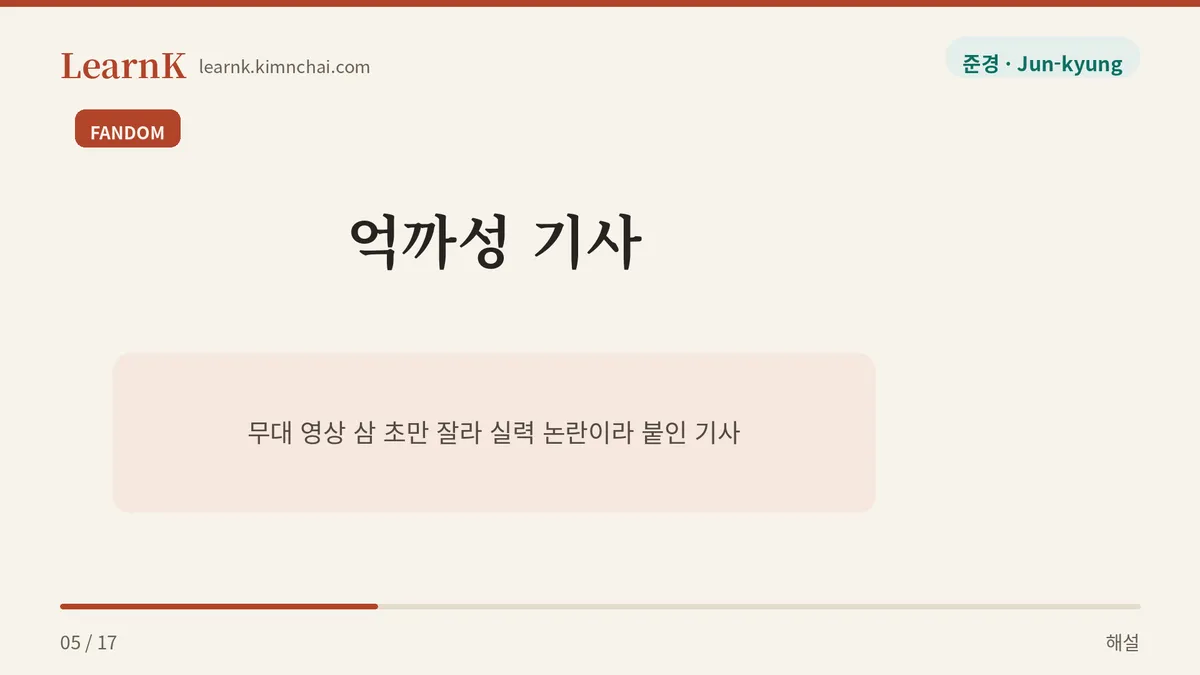
The tone is light and colloquial. You use it with friends, in online communities, in group chats. It doesn’t show up in official documents or meeting minutes, and even news articles handle it carefully with quotation marks, as in “이른바 ‘억까’ (ireuba ‘eok-kka’)” — “so-called ‘eok-kka.’” It works as a plain noun, and it conjugates freely: 억까하다 (eok-kka-hada), 억까당하다 (eok-kka-danghada), and 억까성 (eok-kka-seong) — as in 억까성 기사 (eok-kka-seong gisa, “a hit-piece-ish article”) or 억까성 댓글 (eok-kka-seong daetgeul, “a bashing-type comment”).
Seeing It in Real Conversation
Setting: the third-base stands at Jamsil Baseball Stadium, bottom of the 7th. The team’s cleanup hitter strikes out for the third time today and heads back to the dugout.
Jun-kyung: 아 진짜, 저 형 요즘 왜 저래. 오늘만 삼진 세 개야. Ugh, seriously, what’s wrong with him lately. Three strikeouts today alone.
Emily: 야, 그건 좀 억까 아니야? 어제 결승타 친 사람인데. Hey, isn’t that a bit of an unfair bash? He’s the guy who hit the game-winner yesterday.
Jun-kyung: 아니 어제는 어제고 오늘은 오늘이지… 알았어, 인정. 내가 좀 심했다. Well, yesterday is yesterday and today is today… okay, fine. I was too harsh.
Emily: 커뮤니티 가 봐. 맨날 저 선수만 억까하는 사람들 꼭 있어. 너까지 왜 그래. Go look at the forums. There are always people who only pile on him. Why are you joining in?
Jun-kyung: 야, 나는 팬이니까 하는 소리지! 그래도 아까 투수 교체 타이밍은 진짜 아니었다. Hey, I say it because I’m a fan! Still, that pitching change earlier was genuinely bad.
Emily: 그건 억까 아니고 팩트. 그건 나도 같이 깔게. That one’s not unfair bashing, that’s a fact. I’ll pile on with you for that.
Those last two lines show the word at its best. Emily isn’t blocking criticism itself — she’s separating criticism that has grounds from criticism that doesn’t. “그건 억까 아니고 팩트 (geugeon eok-kka anigo paekteu)” — “that’s not eok-kka, that’s a fact” — has hardened into something close to a fixed phrase in Korean online communities.
Where It Sounds Off
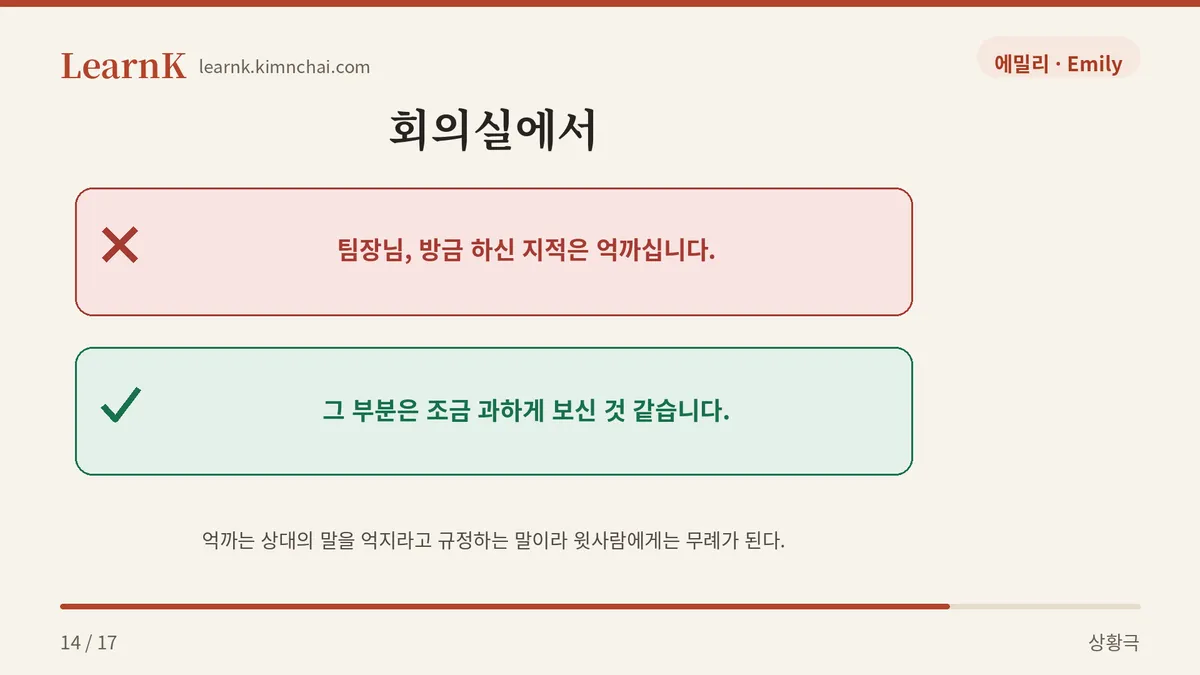
✗ (to your team lead) 팀장님, 방금 하신 지적은 억까십니다. (Tim-jang-nim, banggeum hasin jijeogeun eok-kka-simnida.) — “Team lead, the point you just made is an unfair bash.”
✓ (to a coworker your age) 야, 방금 그건 좀 억까 아니야? (Ya, banggeum geugeon jom eok-kka aniya?) — “Hey, wasn’t that a bit of an unfair bash?”
→ Two things go wrong at once here. First, 억까 (eok-kka) is community slang, so bolting a formal polite ending onto it doesn’t make it formal. Second, it’s a word that labels what the other person said as 억지 (eokji, “forcing it”), so using it on someone senior to you goes past disagreement into rudeness. With a superior, something like “그 부분은 조금 과하게 보신 것 같습니다 (geu bubuneun jogeum gwahage bosin geot gatseumnida)” — “I think you may be reading that part a little harshly” — is the safe choice.
✗ (with the sales figures on the table) 이번 분기 30% 빠졌잖아. — 야, 그건 억까지. (Ibeon bungi samsip peosenteu ppajyeotjanha. — Ya, geugeon eok-kka-ji.) — “We dropped 30% this quarter.” — “Hey, that’s just an unfair bash.”
✓ (with the sales figures on the table) 이번 분기 30% 빠졌잖아. — 그건 억까가 아니라 팩트지. 인정할 건 인정하자. (Ibeon bungi samsip peosenteu ppajyeotjanha. — Geugeon eok-kka-ga anira paekteu-ji. Injeonghal geon injeonghaja.) — “We dropped 30% this quarter.” — “That’s not an unfair bash, that’s a fact. Let’s own what we need to own.”
→ If you slap 억까 (eok-kka) onto criticism backed by hard numbers, the word turns into a shield against anything you don’t want to hear. 억까 (eok-kka) points at “there’s no evidence for this,” not at “this hurts my feelings.” Korean speakers call each other out for this misuse too — “억까라고 하면 다 억까냐 (eok-kka-rago hamyeon da eok-kka-nya)”: “Is it eok-kka just because you say it is?”
Example Sentences by Situation
① Lunch break at work, when a colleague is running down the new hire
Your colleague declares that the new hire “has no manners” because he didn’t say good morning today. In fact, the new hire took a half day off yesterday and hadn’t clocked in yet this morning. That leap from a single fact to a verdict on someone’s whole character is exactly where 억까 (eok-kka) shows up.
야, 그건 좀 억까 같은데. 걔 어제 반차 썼잖아. Ya, geugeon jom eok-kka gateunde. Gyae eoje bancha sseotjanha. (Hey, that feels like a bit of a forced takedown. He took a half day off yesterday, remember?)
② Scrolling through delivery app reviews
On a day of pouring rain, someone left a one-star review because the delivery was five minutes late. Not a single word about how the food tasted. This is when Koreans reach for 억까 (eok-kka), often alongside 별점 테러 (byeoljeom tereo, “star-rating terrorism”).
비 와서 5분 늦은 걸로 별점 하나는 억까지. Bi waseo o-bun neujeun geollo byeoljeom hananeun eok-kka-ji. (One star because it was five minutes late in the rain? That’s just piling on unfairly.)
③ In a fandom, over a single article
An article goes up built around a three-second clip cut from a stage video, headlined “Skill Controversy.” Fans tag pieces like this as 억까성 (eok-kka-seong). The suffix -성 (-seong) attached to a noun means “having that quality,” so 억까성 기사 (eok-kka-seong gisa) is “an article that’s basically a hit piece.”
이건 비판이 아니라 억까성 기사예요. Igeon bipani anira eok-kka-seong gisayeyo. (This isn’t criticism — it’s an article written to tear them down on purpose.)
All three examples share one thing. The speaker isn’t defending the target unconditionally; they’re objecting to the distance between the evidence and the conclusion. Once you have a feel for that, 억까 (eok-kka) becomes an easy word to use.
Politeness Levels and Similar Expressions
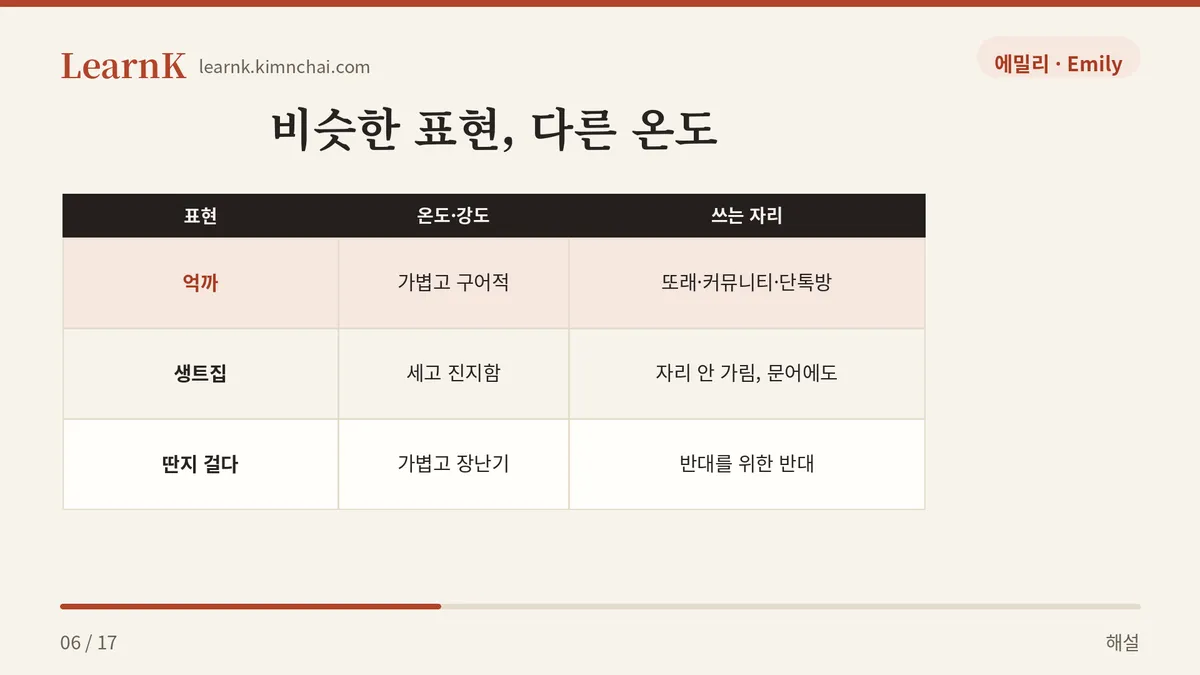
억까 (eok-kka) was born in a 반말 (banmal, casual speech) culture. You can attach polite endings — “억까예요 (eok-kka-yeyo),” “억까 아닐까요? (eok-kka anilkkayo?)” — and people really do, but that’s the soft politeness used among peers and online. With a boss, a client, or in a job interview, you need an entirely different word. There, spell it out: 과한 비판 (gwahan bipan), “excessive criticism,” or 근거 없는 비난 (geungeo eomneun binan), “baseless accusation.”
| Expression | Tone & intensity | Where it’s used |
|---|---|---|
| 억까 (eok-kka) | Light and colloquial, slightly defensive | Peers, online communities, group chats. Not with seniors |
| 억빠 (eok-ppa) | The flip side of 억까, teasing | Peers, online communities. For over-the-top praise with no basis |
| 생트집 (saengteujip) | Strong and serious, with anger mixed in | Any age or setting. Also used in writing |
| 트집 잡다 (teujip japda) | Neutral to negative, standard | Anywhere, including formal settings |
| 딴지 걸다 (ttanji geolda) | Light and playful | Peers. For contrarianism for its own sake |
| 실드 치다 (sildeu chida) | Light and colloquial | Peers, online communities. The opposite of 억까 — the defending side |
The trickiest pair is 억까 (eok-kka) and 생트집 (saengteujip). 생트집 means “manufacturing a complaint out of nothing,” so the meanings overlap almost entirely — but the temperature is far hotter and more serious. It’s the word for what a mother-in-law does to a daughter-in-law, or a customer to a shop clerk. 억까 (eok-kka), by contrast, is closer to something baseball fans toss around while cracking up. In the same situation, saying “생트집 잡지 마세요 (saengteujip japji maseyo)” starts a fight, while “그건 좀 억까다 (geugeon jom eok-kka-da)” usually gets an “인정 (injeong)” — “fair enough” — and everyone moves on.
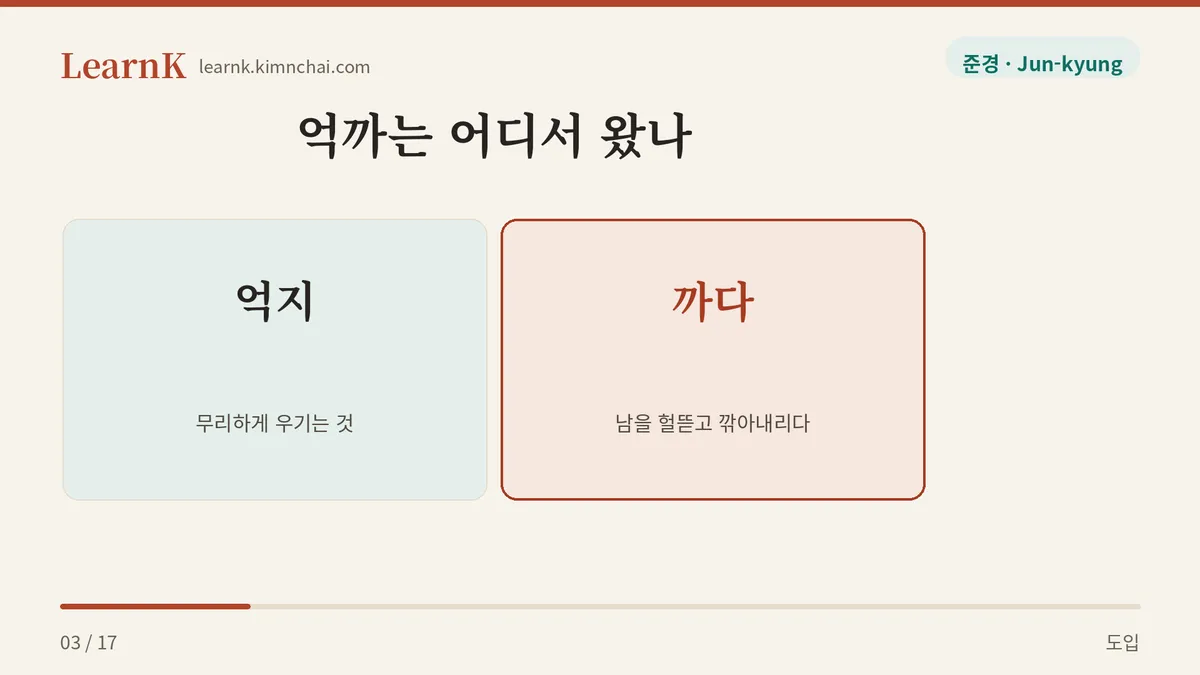
Cultural Background — Between 억지 and 까다
The word-building here is transparent. Take the first syllable of 억지 (eokji) — insisting on something unreasonable — and attach 까다 (kkada), slang for running someone down and tearing them apart. Two syllables. This is a favorite pattern for Korean neologisms: keep only the first syllable of the front word, add a verb stem behind it, and you have a noun.
To really understand this word, you need to know its partner, 억빠 (eok-ppa). 억빠 is “빠는 (ppa-neun)” something by force — hyping it up excessively with no basis. The 빠 (ppa) here is a suffix for a devoted fan. When Korean online communities argue about anything, they use these two words like the pans of a scale. Run it down too hard, that’s 억까 (eok-kka); hype it up too hard, that’s 억빠 (eok-ppa). And finding the “fair assessment” somewhere in between becomes the goal of the debate. Part of why 억까 (eok-kka) spread so widely is the instinct to pin down a balance point with language, in online spaces where emotional opinion swings hard to one side.
In practice, the expression lives most actively in sports and idol fandoms. In both worlds, performance and skill show up as numbers, so the border between “grounded criticism” and “baseless attack” is a permanent point of contention. Baseball broadcast chat rooms, soccer forums, the comment sections right after a music show announces its rankings — those are where 억까 (eok-kka) flies fastest. Lately it has spilled past that fence into conversations at work, at school, and at home. When a younger sibling says “엄마는 나만 뭐라 해 (Eommaneun naman mwora hae)” — “Mom only ever scolds me” — someone can shoot back, “그건 네 억까야 (Geugeon ne eok-kka-ya)”: “That’s your own unfair take.”
Korean dramas often channel this same sensibility in scenes about office politics or school rumors. Rather than putting the word 억까 (eok-kka) directly into the dialogue, though, they tend to stage it: an innocent character gets cornered by a single rumor, and a friend watching it happen asks, “걔가 뭘 그렇게 잘못했는데 (Gyaega mwol geureoke jalmothaenneunde)” — “What exactly did they do that was so wrong?” If you think of 억까 (eok-kka) as the one word that fits perfectly in the place of that question, it clicks fast.
Today’s Quiz
Which of the following uses 억까 (eok-kka) most naturally?
- 부장님, 방금 하신 말씀은 억까이십니다. (Bujang-nim, banggeum hasin malsseumeun eok-kka-isimnida.) — “Director, what you just said is an unfair bash.”
- 3연패 했다고 감독 경질하라는 건 좀 억까 아니야? (Sam-yeonpae haetdago gamdok gyeongjilharaneun geon jom eok-kka aniya?) — “Demanding the manager be fired over a three-game losing streak — isn’t that a bit of an unfair bash?”
- 오늘 이 김치찌개 진짜 억까다. (Oneul i gimchi-jjigae jinjja eok-kka-da.) — “This kimchi stew today is really eok-kka.”
See the answer
Answer: 2
The three-game losing streak is a fact, but jumping from that alone to “fire the manager” is a case of the conclusion running out ahead of the evidence. That’s precisely what 억까 (eok-kka) takes aim at. Sentence 1 attaches the highest honorific ending to a piece of community slang and labels a senior’s words as “forcing it,” so it’s awkward and rude on two counts. Sentence 3 uses 억까 (eok-kka) to rate the taste of food — but the word refers to criticism aimed at a person or a target, so it doesn’t apply to flavors, weather, or the condition of an object.
The definition, example sentences, and dialogue in this post are all original writing. ‘억까 (eok-kka)’ is not listed as a headword in the National Institute of Korean Language’s Basic Korean Dictionary (krdict.korean.go.kr), so this entry carries no dictionary citations.