억텐: Forced-Up Energy — Is It Real or Fake?
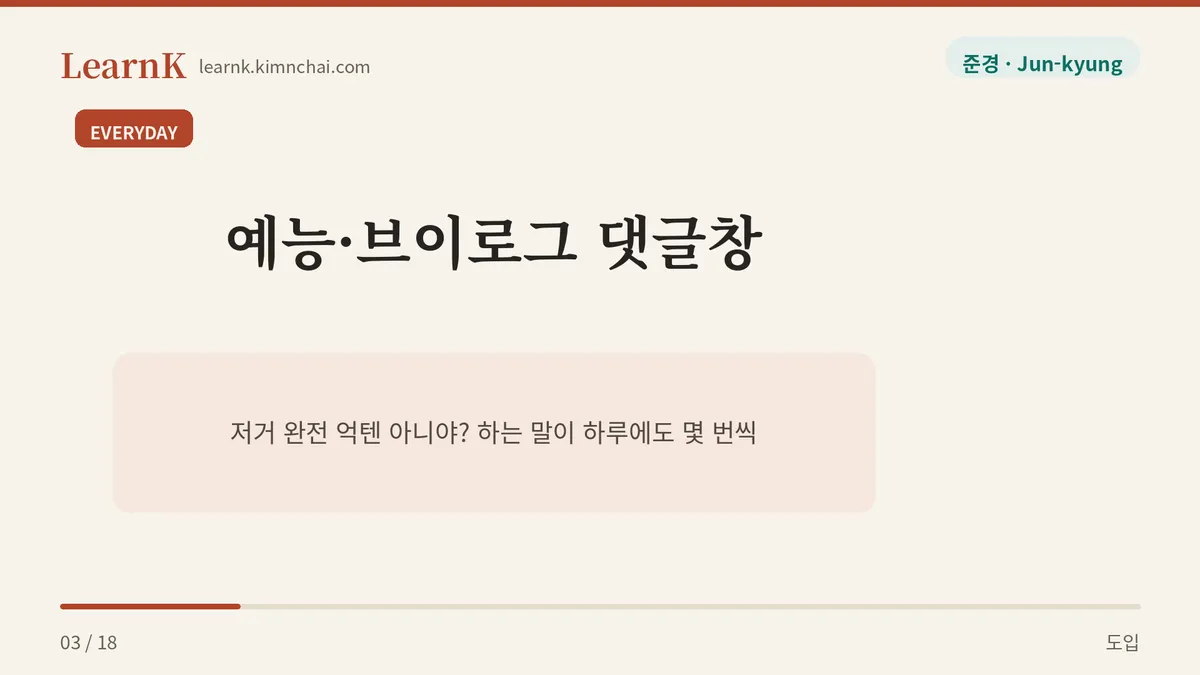
When you watch Korean variety shows or YouTube these days, there’s always that moment where someone suddenly raises their voice two tones and shouts, “우와~ 대박! (uwa~ daebak!)” — “Wow, amazing!” But if you look closely at their face, their eyes aren’t smiling at all. And right away, a comment pops up in the chat: “저거 완전 억텐 (eokten) 아니야?” — “Isn’t that total 억텐?” Today, let’s take a deep dive into this slang word that young Koreans use several times a day: 억텐 (eokten).
억텐
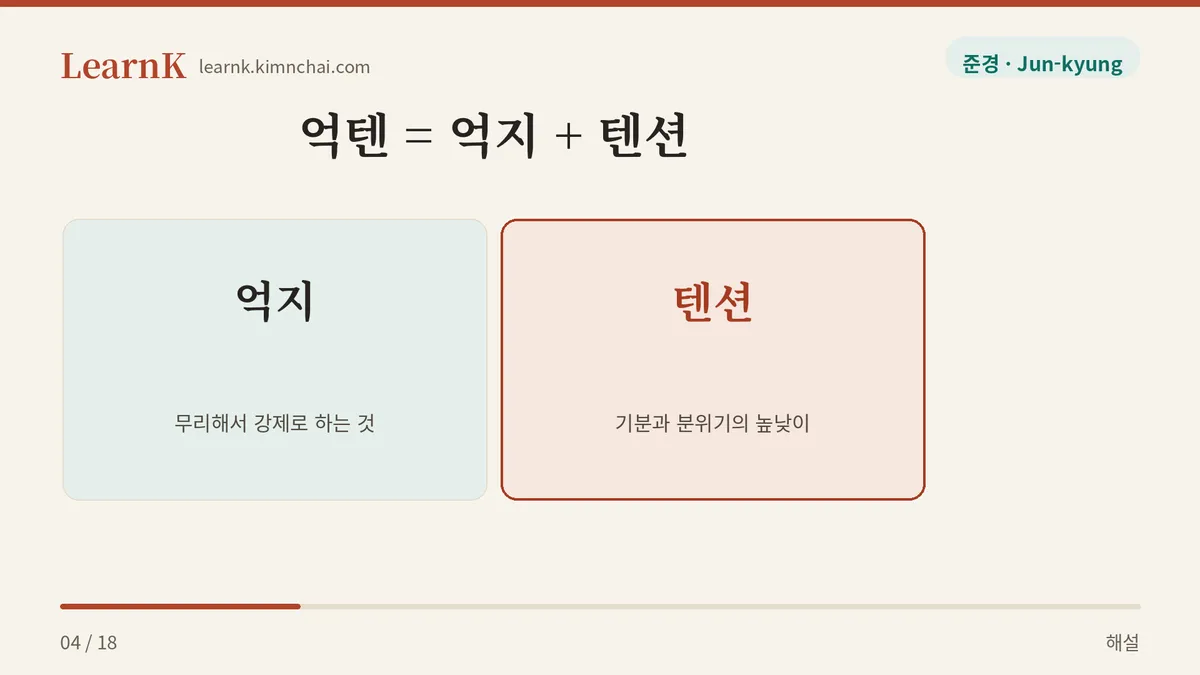
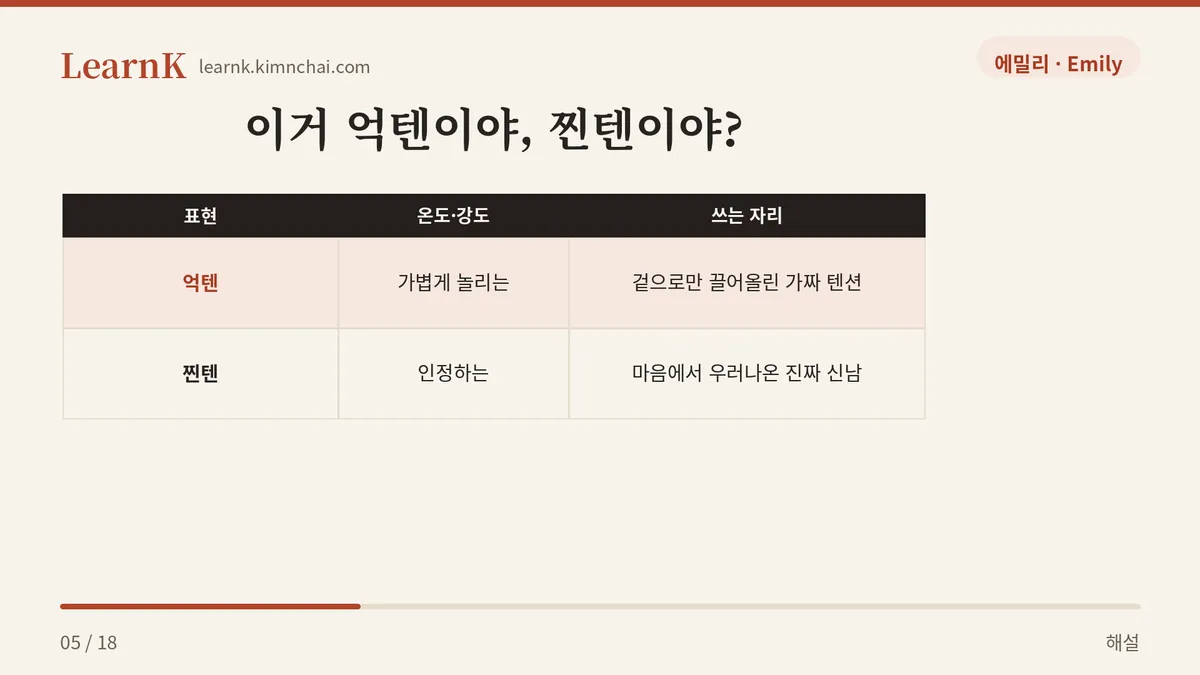
억텐 (eokten) is a shortened form of 억지 텐션 (eokji tension). 억지 (eokji) means “forcing something, doing it against the natural flow,” and 텐션 (tension) comes from the English word “tension,” but in Korea it means “the level of one’s mood, vibe, or energy.” So 억텐 refers to fake energy that you force up on the outside even though you’re not really excited on the inside.
The important thing here is the nuance. 억텐 isn’t a serious accusation like calling someone a liar or a fraud — it’s closer to a light, playful tease about “someone knowingly trying hard to keep the vibe going.” The new employee who forces out a big laugh at the boss’s joke at a company dinner, the YouTuber who suddenly bursts with energy the moment the camera turns on, or you yourself pretending to be excited for a friend even though you’re exhausted — these are all 억텐 moments.
It’s easier if you learn the opposite first
To really understand 억텐, you need to know its partner word: 찐텐 (jjinten). 찐 (jjin) is a slang word meaning “real,” so 찐텐 (jjinten) means “real tension” — genuine excitement that comes straight from the heart. Koreans often pair these two up to judge a situation, asking, “이거 억텐이야, 찐텐이야?” — “Is this 억텐 or 찐텐?” It’s a witty way of asking whether an emotion is real or just an act.
Example sentences by situation
Situation 1 — Looking at a friend’s social media photo
야, 너 여행 가서 하나도 안 즐거워 보이던데? 사진 속 미소 완전 **억텐 (eokten)**이더라. (Hey, you didn’t look like you were having any fun on your trip. That smile in the photo was total 억텐.)
Here, a friend is teasing them about a photo where they forced a smile despite being worn out. It’s not criticism — it’s affectionate teasing between people who know each other well.
Situation 2 — Coworkers whispering in the meeting room
팀장님 아이디어에 다들 박수 쳤지만, 솔직히 다 **억텐 (eokten)**이었잖아. (Everyone clapped for the team leader’s idea, but honestly, it was all 억텐.)
This captures that awkward moment when you go along with something out of politeness even though you don’t actually like it. Any office worker can relate.
Situation 3 — Admitting it about yourself
오늘 컨디션 최악이라 방송 내내 억텐 (eokten) 좀 썼어. 티 났지? (I felt terrible today, so I put on some 억텐 the whole broadcast. It showed, right?)
This is an example of using it about yourself. It often combines with verbs like 쓰다 (sseuda) and 부리다 (burida), as in ‘억텐을 쓰다’ (“to put on 억텐”) and ‘억텐을 부리다’ (“to act with 억텐”).
Polite vs. casual speech, and similar expressions
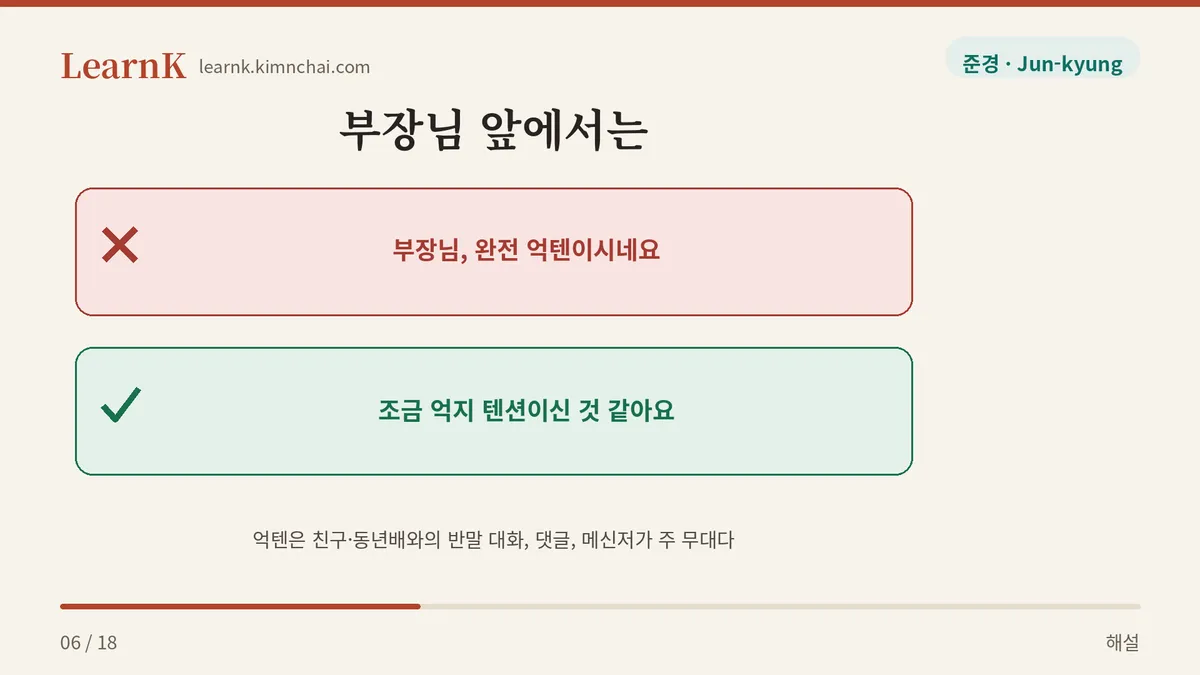
Since 억텐 is internet slang by origin, it’s rarely used in formal settings or with people older than you. Its main stage is casual conversation with friends and peers, comment sections, and messenger chats. If you really wanted to soften it into polite speech, you’d spell it out and say it indirectly, like “조금 억지 텐션이신 것 같아요 (jogeum eokji tension-isin geot gatayo)” — “You seem to be forcing your energy a little.”
A similar expression is 오버 (over) — “to react in an exaggerated way.” 억텐 has a different flavor from 국뽕 (gukppong), but it overlaps with 가식 (gasik, pretense/superficiality) in that both point out fake emotions. The key difference, though, is that 가식 is serious criticism, while 억텐 is far lighter and more humorous.
Cultural background
In Korea’s variety show and idol culture, “managing your tension” matters a lot. There’s an unspoken pressure that you always have to be bright and lively in front of the camera. So viewers sharply pick out which moments are real enjoyment and which are staged energy, enjoying the game of “찐텐 vs. 억텐.” This reflects the sensibility of today’s young Koreans, who value “real emotion” over a flawless-looking surface. Even in dramas, there are frequent scenes where one character sees another putting on a forced cheerful front and gently calls out their true feelings, saying, “너 지금 무리하고 있잖아 (neo jigeum muri-hago itjanha)” — “You’re pushing yourself right now.” 억텐 basically compresses that exact moment into a single word.
Closing quiz
On the day a friend bombs an exam, they force a smile and loudly say, “괜찮아, 하나도 안 속상해! (gwaenchana, hana-do an sokssanghae!)” — “I’m fine, I’m not upset at all!” But their eyes are brimming with tears. What could you call that cheerful voice of theirs?
(Answer: 억텐 (eokten) — because it’s fake tension forced up in a way that doesn’t match their true feelings!)