얼굴천재 (eolgulcheonjae) — When “Handsome” Just Doesn’t Cover It

얼굴천재
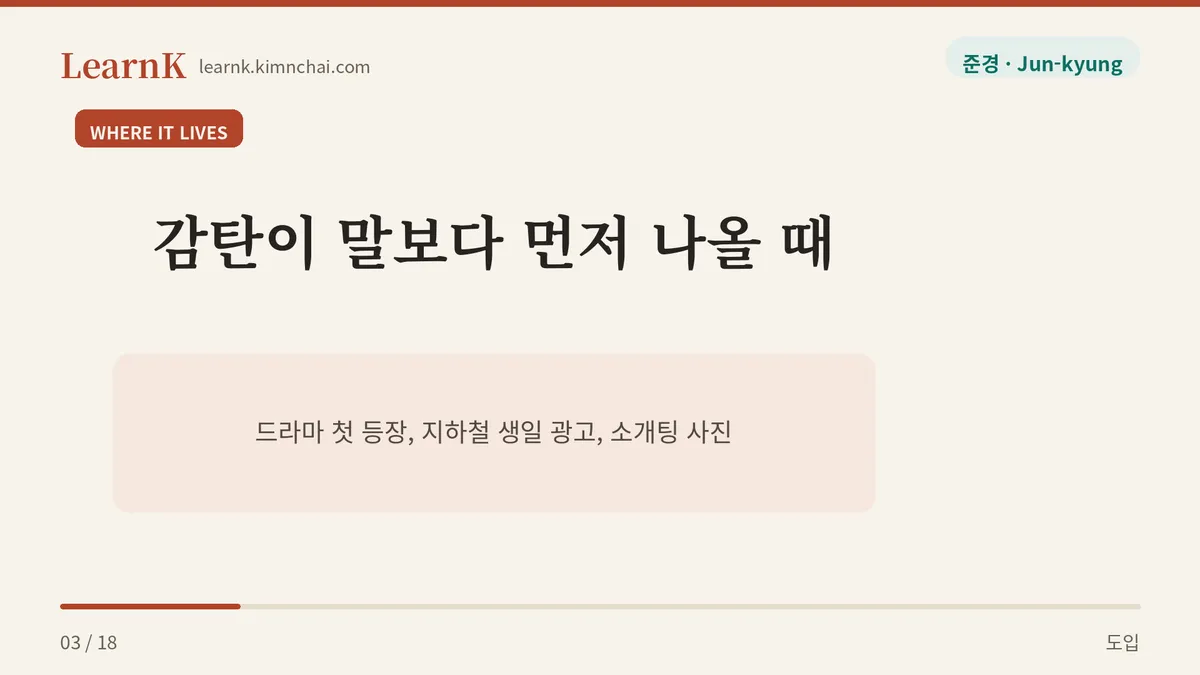
얼굴천재 (eolgulcheonjae) describes someone so unrealistically handsome or beautiful that you could call them “a genius on the strength of their face alone.” The scene where the lead first walks onscreen in a drama, the spot in front of an idol’s birthday ad taped to a subway station pillar, the moment a friend holds out a photo of their blind-date match — the places Koreans pull this word out are pretty well fixed. You use it when admiration jumps out ahead of words, and you want to wrap that admiration in something a little funny.
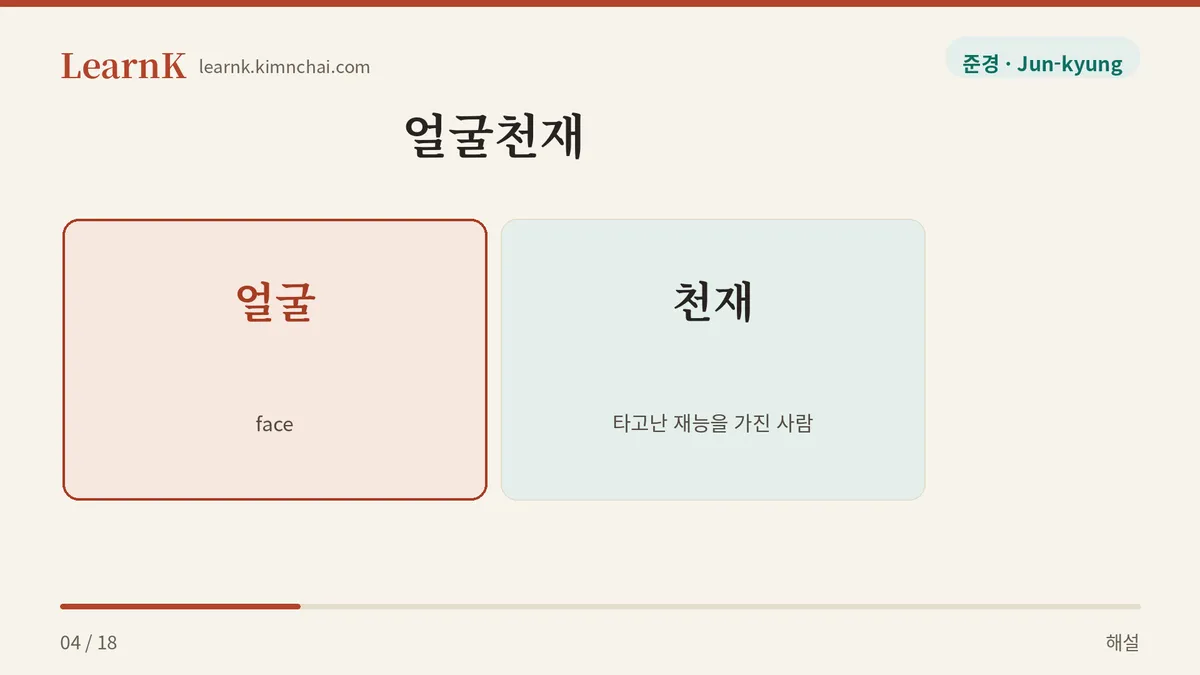
The word is a compound made by sticking 얼굴 (eolgul, face) and 천재 (cheonjae, genius) straight together. 천재 (cheonjae) originally points to innate talent, but in 얼굴천재 that talent hangs on exactly one place: how you look. The whole joke — “I don’t know about anything else, but God poured it all into that face” — is packed inside the word itself. So 얼굴천재 always comes with praise, exaggeration, and a bit of laughter traveling alongside it.
Here’s the temperature reading. If 잘생겼다 (jalsaenggyeotda) is a level statement of fact, 얼굴천재 isn’t a statement of fact at all — it’s closer to an exclamation. The speaker knows it’s an overstatement when they say it, and the listener takes it that way too. That’s why the word is mostly used in the third person. It’s for the actor on the screen, the idol in the photo, the person walking by in the distance. Throw it directly at someone standing right in front of you and it lands less as serious praise than as a joke or light flirting.
It doesn’t pick a gender. You use it for men and for women. It doesn’t much pick an age either — people stick it jokingly onto a photo of a niece or nephew who just turned one, and even onto a photo of a dog. What it definitely does pick is formality. It was born and raised on the internet and in fandom, so it almost never appears in documents, in the body of a news article, or in official company settings.
A real conversation

Scene: A subway platform on the way home from work. Idol birthday ads are lined up on pillar after pillar.
Emily: 야, 이 광고 저번 주에도 있었잖아. 사진이 바뀌었네? Hey, this ad was here last week too. The photo changed, huh?
Jun-kyung: 팬들이 돈 모아서 한 달 내내 거는 거래. 근데 진짜… 얘 얼굴천재다. Apparently fans chip in and keep it up for a whole month. But seriously… this kid is a face genius.
Emily: 인정. 나 처음엔 그림인 줄 알았어. Agreed. I thought it was a drawing at first.
Jun-kyung: 그치? 조명발도 아니야. 예능에서 봤는데 실물이 더 낫더라. Right? And it’s not the lighting either. I saw him on a variety show and he looks even better in person.
Emily: 근데 너도 오늘 머리 자르고 오니까 좀 얼굴천재 같은데? But you know, with that new haircut you’re looking kind of face-genius yourself.
Jun-kyung: 야, 놀리지 마. …근데 한 번만 더 해 봐. Hey, quit teasing. …Actually, say it one more time.
Using it this way sounds off
✗ (To an executive at a client company) 이사님, 사진 보니까 정말 얼굴천재시네요. ✓ (To a friend) 야, 저 배우 진짜 얼굴천재다. → It’s internet slang that came out of fandom, so using it with someone older than you or in a work setting sounds less like a compliment and more like you’re messing around. In formal situations, something like 인상이 참 좋으십니다 (insangi cham joeusimnida) is the safe choice.
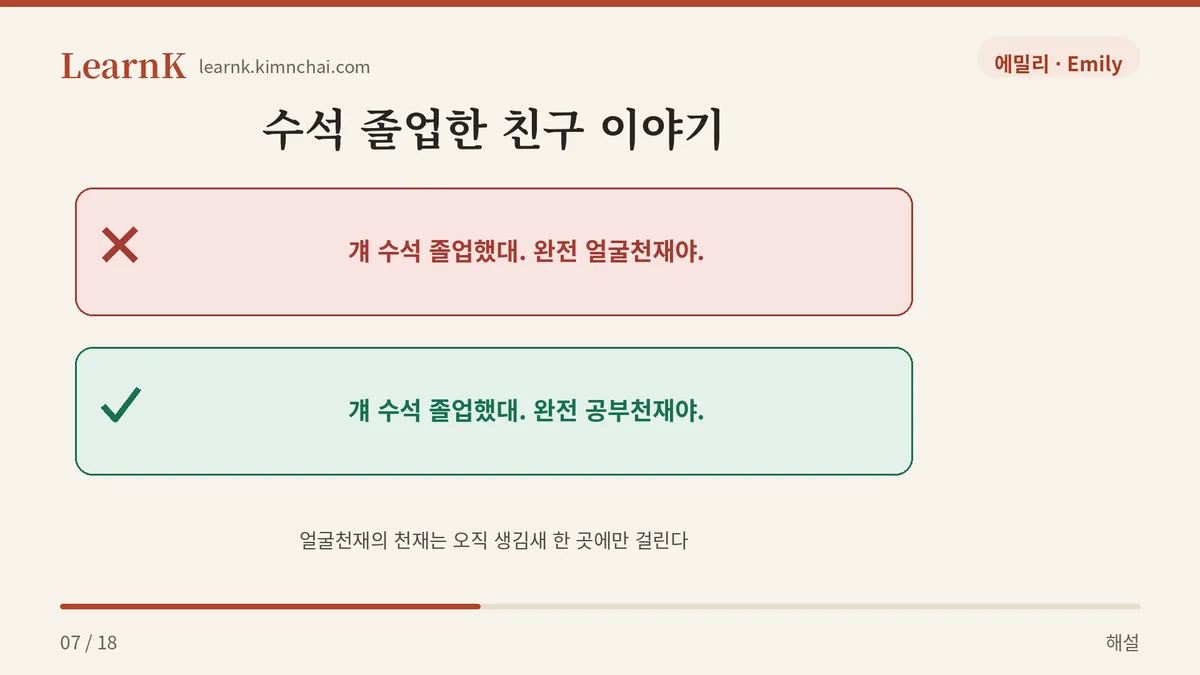
✗ 걔 이번에 수석 졸업했대. 완전 얼굴천재야. ✓ 걔 이번에 수석 졸업했대. 완전 공부천재야. → Just because 천재 (cheonjae) is attached doesn’t make it praise for someone’s abilities in general. The 천재 in 얼굴천재 hangs on exactly one place: looks. Use it to mean “smart” and the meaning goes completely off the rails — that’s what 공부천재 (gongbucheonjae, study genius) is for.
Example sentences by situation
1. When a friend shows you a photo of the person they’re meeting for a blind date
와, 이 사람 완전 얼굴천재네. 어디서 이런 사람을 만났어?
(wa, i saram wanjeon eolgulcheonjae-ne. eodiseo ireon sarameul mannasseo?) Wow, this person is a total face genius. Where did you even meet someone like this?
The 완전 (wanjeon) in front originally means “completely,” but in everyday speech these days it works as an intensifier along the lines of “really” or “so.” It’s the word that pairs up with 얼굴천재 most often.
2. When a younger cousin you haven’t seen in ages has grown up beyond recognition
얘 언제 이렇게 컸어? 우리 조카 이제 얼굴천재 다 됐네.
(yae eonje ireoke keosseo? uri joka ije eolgulcheonjae da dwaenne.) When did this kid grow up like this? Our little one has become a full-on face genius.
다 됐네 (da dwaenne) is an exclamation meaning “you’ve completely turned into that, haven’t you.” It’s the kind of phrasing grown-ups often use around the table on holidays, so pairing it with a piece of new slang like 얼굴천재 gives it a slightly funny flavor.
3. When your photo comes out well and you post it on social media while poking fun at yourself
오늘따라 얼굴천재인 것 같아서 한 장 남김.
(oneulttara eolgulcheonjaein geot gataseo han jang namgim.) Feeling like a face genius today, so I’m leaving one photo behind.
Used about yourself, it isn’t bragging — it turns into a joke where you make yourself the punchline. That’s why you trail the ending off with something like -인 것 같아서 (in geot gataseo, “I feel like I might be…”). State it flatly and it really does become a brag.
Politeness levels and similar expressions
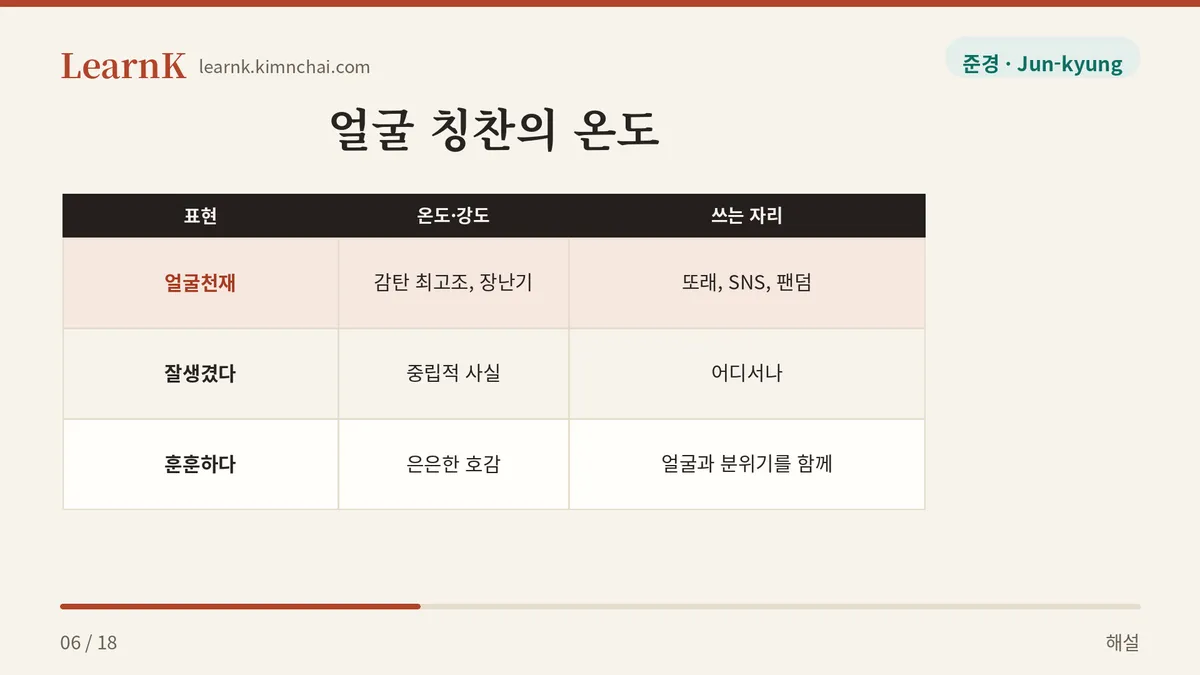
얼굴천재 is a noun, so grammatically you can dress it in honorific form, as in “얼굴천재세요.” In practice, though, almost nobody says that. The word itself is tuned to the temperature of casual speech and internet talk, so putting honorific clothes on it leaves the clothes hanging loose. With someone senior to you, you’re better off switching to the last row of the table below.
| Expression | Temperature / intensity | Where it’s used |
|---|---|---|
| 얼굴천재 (eolgulcheonjae) | Admiration at its peak, mixed with playfulness | Peers, social media, fandom. Not with seniors or in official settings |
| 잘생겼다 / 예쁘다 (jalsaenggyeotda / yeppeuda) | Neutral statement of fact | Anywhere |
| 훈훈하다 (hunhunhada) | Gentle warmth, easy to receive | Peers. Praises looks and vibe together |
| 조각미남 (jogakminam) | Strong, but feels a bit dated | Peers, article headlines. Men only |
| 인상이 좋으시네요 (insangi joeusineyo) | Polite and safe | Seniors, people you’ve just met |
The difference from 훈훈하다 (hunhunhada) especially matters. 훈훈하다 is warm praise that covers not just the face but the person’s vibe, expression, and even personality, while 얼굴천재 is admiration for one single frame: the face. That’s why 훈훈하다 is fine to say to someone’s face, but repeating 얼굴천재 to someone’s face can start to sound like teasing.
Cultural background — the face on the subway pillar
The way the word is built is completely transparent: 얼굴 + 천재. That “X + 천재” frame is still alive, and it keeps producing new words like 춤천재 (chumcheonjae, 춤 + 천재, dance genius), 예능천재 (yeneungcheonjae, 예능 + 천재, variety-show genius), and 패션천재 (paesyeoncheonjae, 패션 + 천재, fashion genius). It’s a joking frame that singles out one field and says, “in this one area, you’re genius-level.” Flip that around and you’ll notice that 얼굴천재 leaves a small blank space that reads “…as for everything else, who knows.” Which is why the word is always wobbling somewhere between teasing and praise.
The field this word grew in is idol fandom. Korean idol groups have long had a position called 비주얼 담당 (bijueol damdang, visual member). Just as there’s a member in charge of vocals or a member in charge of dance, there’s a culture of setting aside and naming someone “in charge of the face.” It’s easiest to understand 얼굴천재 as fans’ admiration for that position, hardened into a single word.
Where that admiration spilled out into physical space is exactly the subway birthday ads that show up in the dialogue above. Since the mid-2010s, it’s become established practice for fans to pool money and put up birthday ads for their favorite member on subway station pillars or platform screen doors. You can still commonly see them at stations like Hongik University, Seongsu, and Gangnam. People passing by on their morning commute stopping in their tracks and muttering “얼굴천재네” — that’s where this word lives most naturally.
In dramas, too, the word arrives through the picture before it arrives through the lines. That familiar setup where the male lead appears in slow motion and everyone around him stops what they’re doing — today’s viewers sum it up in the live comment feed with the three syllables of 얼굴천재. A word that isn’t in the script gets added from the viewers’ side.
Today’s quiz
Which of the following is the most awkward place to use 얼굴천재?
- Showing a friend a photo of an actor you like
- Posting a photo from an idol’s stage performance to a fan community
- Greeting your interviewer for the first time at a company job interview
- Teasing a younger cousin you haven’t seen in a long time
Answer: 3. 얼굴천재 is internet slang used among peers, or about someone on the other side of a screen. Use it with a senior person you’ve just met in a setting as formal and tense as an interview, and it comes across not as a compliment but as bad manners. In a place like that, it’s safer to pick a lower-temperature phrase like 인상이 참 좋으십니다 (insangi cham joeusimnida). Options 1, 2, and 4 are all places where this word breathes most comfortably.