어서 오세요 — The First Greeting That Opens Korea's Doors
The moment you step into a Korean café, restaurant, convenience store, or clothing shop, there’s one phrase that catches your ear before anything else. Delivered in a bright, cheerful voice: 어서 오세요 (eoseo oseyo). Watch any K-drama and you’ll notice a shop clerk saying this every time the main character opens a door, and if you actually travel to Korea, you’ll hear it dozens of times a day. Today, let’s take a deep dive into this warm greeting that opens the door to daily life in Korea.
어서 오세요
어서 오세요 (eoseo oseyo) is a welcoming greeting used when you warmly receive someone. It corresponds to the English “Welcome!”, but if we unpack it a little more, it’s a combination of “어서” — the adverb meaning “quickly, without delay” — and “오세요 (oseyo),” the polite command form of “오다 (oda)” (to come). A literal translation would be closer to “come quickly, hurry on in,” but these days the sense of urging has almost entirely faded, and it has settled into a pure expression of hospitality meaning “I’m glad you came.”
In other words, it isn’t actually demanding that the other person hurry — think of it as a phrase offered with the feeling of “I’ve been waiting for you, welcome!” It’s both a shopkeeper’s greeting to a customer who has walked in and a host’s greeting to a guest who has come to visit their home.
Meaning and Nuance
- Core meaning: A welcoming greeting that warmly receives someone who has arrived (at a shop or home)
- Literal translation: 어서 (quickly) + 오세요 (please come) → “come on in quickly”
- Actual feel: “Welcome! / So glad you’re here”
- Politeness level: Polite speech (존댓말). The “-세요” ending courteously elevates the listener.
One interesting point is that this phrase has a different warmth depending on the situation. The “어서 오세요” a convenience store clerk tosses out mechanically is a light, ritual greeting, but the “어서 오세요” offered at the front door to a relative you haven’t seen in ages becomes heartfelt hospitality. It’s the same words, but the voice and facial expression complete the meaning.
Example Sentences by Situation
1) Walking into a restaurant (clerk → customer)
어서 오세요! 몇 분이세요? (eoseo oseyo! myeot bun-iseyo?) — Welcome! How many are in your party?
This is the classic scene of a clerk brightly greeting a customer and asking the number of guests the instant they open the door. It’s the most common combination you’ll hear in a Korean restaurant.
2) When a guest comes to your home (host → guest)
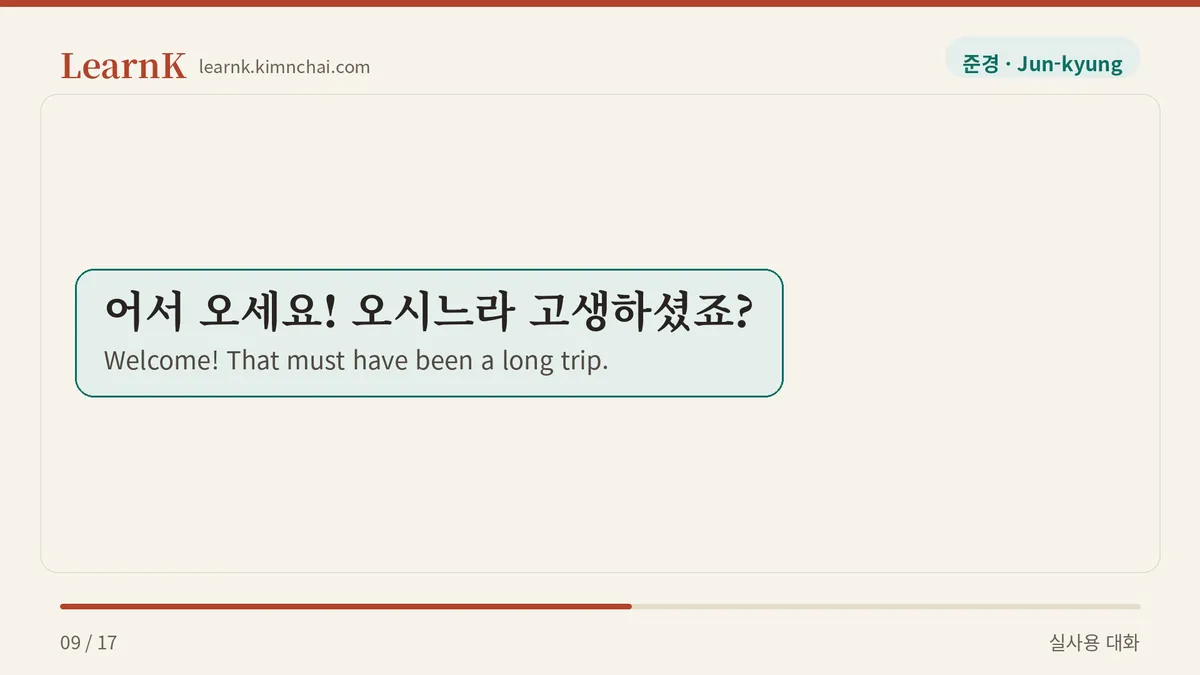
어서 오세요, 오시느라 고생하셨죠? (eoseo oseyo, osineura gosaenghasyeotjyo?) — Welcome, it must have been a long trip getting here!
This is what you say when greeting an invited guest at the front door. Adding a word about how they’re doing afterward makes it a much warmer and more courteous welcome.
3) To a shop regular (owner → a welcome customer)
아이고, 어서 오세요! 오랜만이에요. (aigo, eoseo oseyo! oraenmanieyo.) — Oh my, welcome! It’s been a while.
Adding the exclamation “아이고 (aigo)” up front doubles the sense of delight. It’s the heartwarming situation of recognizing a frequent customer and greeting them happily.
Comparing Polite/Casual and Similar Expressions
| Expression | Romanization | Situation |
|---|---|---|
| 어서 오세요 | eoseo oseyo | Polite speech, the most standard welcome |
| 어서 와 | eoseo wa | Casual speech, to friends and family |
| 어서 오십시오 | eoseo osipsio | Formal speech, hotels and upscale shops |
| 환영합니다 | hwanyeonghamnida | ”We welcome you,” for official events and signage |
When a close friend comes over to your place, you can greet them casually with “어서 와 (eoseo wa).” Conversely, in places that call for formality like department stores or hotels, you’d use the more courteous “어서 오십시오 (eoseo osipsio).” Developing a feel for choosing the right one to match the level of formality is important.
Cultural Background — A Phrase Filled with Jeong (정)
In Korean hospitality culture, “어서 오세요” carries a meaning beyond a simple greeting. The uniquely Korean sentiment of treating guests as precious is condensed into this short phrase. Scenes in dramas where a market vendor or a home-style diner owner calls out these words to a customer are a stock setup that shows the warm generosity of Korean society.
Especially in Korea, where self-employed small businesses are so common, this greeting has established itself as a kind of professional courtesy. Open the door of any shop and “어서 오세요” is sure to fly your way first — it’s like an unspoken promise that says, “We welcome you as our guest.” If you travel to Korea, a light nod or a smile in return is plenty when you hear it. You won’t be rude if you don’t respond at all, but meeting their eyes and smiling back makes for a much warmer first encounter.
Today’s Quiz
A close friend has come over to visit your home. When you warmly greet them at the front door, which expression is the most natural?
- 어서 오십시오 (eoseo osipsio)
- 어서 와 (eoseo wa)
- 환영합니다 (hwanyeonghamnida)
Show answer
The answer is number 2, 어서 와 (eoseo wa). Casual speech is natural between close friends. Options 1 and 3 are excessively formal, so using them with a friend would actually sound awkward.
The 어서 오세요 (eoseo oseyo) you learned today — listen for it next time you walk into a Korean shop. Before you know it, you’ll be smiling back too!