음방 (eumbang) — Why a Line Forms Outside the TV Station on Friday Evenings
음방 (eumbang)
At six o’clock on a Friday evening, a slightly odd scene unfolds outside the broadcasting stations of Yeouido, Seoul. People holding matching light sticks stand in a line that wraps all the way around the building — but this isn’t a concert hall, and none of them bought a ticket. What they’re waiting for is a two-hour live television broadcast. In fan-speak, it’s 음방 (eumbang).
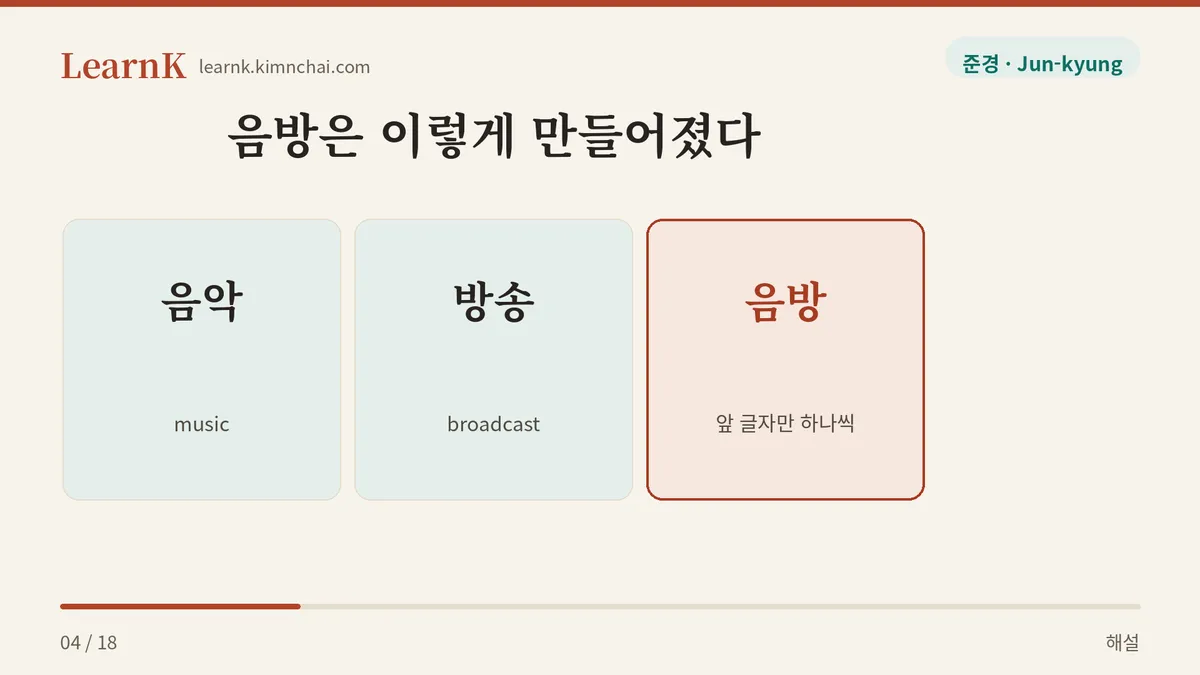
음방 (eumbang) is short for 음악방송 (eumak bangsong), literally “music broadcast”: a weekly music-ranking program where idol groups appear on TV to perform their new songs and compete for first place. Korea’s major networks and music channels each slot one of these into a different day of the week. The headliners are Mnet’s 《엠카운트다운》 M Countdown, KBS’s 《뮤직뱅크》 Music Bank, MBC’s 《쇼! 음악중심》 Show! Music Core, and SBS’s 《인기가요》 Inkigayo, with 《쇼 챔피언》 Show Champion and 《더 쇼》 The Show over on cable. Fans lump all six together and simply call them “this week’s 음방.”
Why does this word matter to a Korean learner? Because a huge share of K-pop-related Korean conversation turns on these two syllables. 음방 1위 (eumbang irwi) “first place on a music show,” 음방 활동 (eumbang hwaldong) “music-show promotions,” 첫 음방 (cheot eumbang) “first music show,” 음방 스케줄 (eumbang seukejul) “music-show schedule” — half the sentences in any fan community are built by sticking something onto this word. The fun part is that it gets used like a countable unit. It points not to the program itself but to a single broadcast appearance, so a sentence like 이번 주 음방 세 개 나가 (ibeon ju eumbang se gae naga) “they’re doing three music shows this week” sounds completely natural.
The tone is light and quick. It was born inside the fandom, so it lives between friends, online, and in subtitles. These days it has spread far enough to turn up in article headlines, but official press releases and announcements still spell out 음악방송 (eumak bangsong) in full. That’s exactly how much distance the word carries.
See It in Real Conversation
Scene: Friday evening, outside a broadcasting station in Yeouido. The line for studio audience seats has wrapped all the way around the building.
Jun-kyung: 와, 줄 봐라. 이거 몇 시간 서 있어야 되냐. Wow, look at this line. How many hours do we have to stand here?
Emily: 음방 방청이 원래 이래. 나 저번엔 네 시간 기다렸어. That’s just how music-show audiences work. Last time I waited four hours.
Jun-kyung: 네 시간? 야, 그냥 집에서 보면 안 돼? Four hours? Come on, can’t we just watch it at home?
Emily: 안 되지. 오늘 우리 애들 컴백 첫 음방이잖아. No way. Today’s their first music show since the comeback.
Jun-kyung: 아 맞다, 사녹도 오늘이랬지. 근데 너 내일 출근 아니야? Oh right, the pre-recording is today too. But don’t you have work tomorrow?
Emily: 출근은 내일의 나한테 맡기고. 지금은 음방만 생각할래. Tomorrow-me can deal with work. Right now I’m only thinking about the show.
When It Sounds Off
✗ (During a class presentation, in front of your professor and classmates) 요즘 아이돌은 음방 활동을 3주만 합니다. ✓ (During a class presentation) 요즘 아이돌은 음악방송 활동을 3주만 합니다. “These days idols only promote on music shows for three weeks.” → The meaning is identical, but 음방 is a fandom-born abbreviation, so it sounds too casual in a formal setting. In presentations, reports, and papers, spelling out 음악방송 (eumak bangsong) is the safer choice. Conversely, saying 음악방송 every single time when you’re talking with friends comes across as far too stiff.
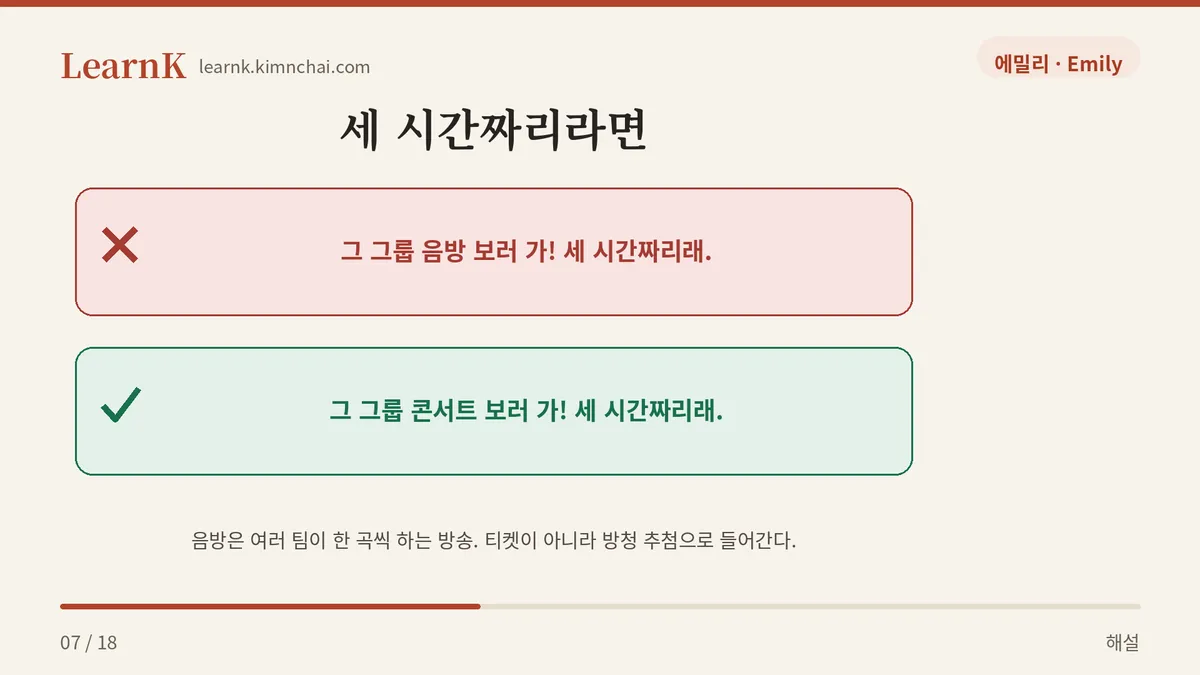
✗ (After scoring concert tickets) 다음 달에 그 그룹 음방 보러 가! 세 시간짜리래. ✓ (After scoring concert tickets) 다음 달에 그 그룹 콘서트 보러 가! 세 시간짜리래. “I’m going to see that group’s concert next month! I hear it’s three hours long.” → This is the mistake learners make most often. An 음방 is a television program where several teams each perform one song — not a standalone concert where one team performs for hours. Stage time is usually a single song of three to four minutes, and you don’t buy a ticket: you apply for 방청 (bangcheong), studio-audience admission, and get in by lottery.
Example Sentences by Situation
1. Your favorite group has a new album out, and you’re asking a friend about the schedule
이번 주 음방 스케줄 나왔어? (ibeon ju eumbang seukejul nawasseo?) — In full: 이번 주 음악방송 출연 일정 나왔어? “Is this week’s music-show appearance schedule out yet?”
When a group comes back, which day and which program they’ll appear on is usually announced early in the week. This is one of the most-traded sentences among fans, and since 스케줄 (seukejul) is a loanword and easy to pronounce, it’s a great one for beginners to start using right away.
2. The day after a long-established group wins first place for the very first time
어제 음방 1위 했대. 데뷔 5년 만에 처음이라 다들 울었대. (eoje eumbang irwi haetdae. debwi o-nyeon mane cheoeumiraseo dadeul ulleotdae.) — In full: 어제 음악방송에서 1위 했대. 데뷔 5년 만에 처음이라 다들 울었대. “I heard they took first place on a music show yesterday. It was their first time in the five years since debut, so everyone cried.”
-대 (-dae) is a casual ending used when you’re passing along something you heard. It carries the temperature of “I heard somewhere” rather than a news report, so news traveling between fans almost always takes this shape.
3. Promotions are winding down and you’re feeling wistful
오늘이 막방이야. 이번 음방 활동은 이걸로 끝. (oneuri makbangiya. ibeon eumbang hwaldongeun igeollo kkeut.) — In full: 오늘이 마지막 방송이야. 이번 음악방송 활동은 이걸로 끝이야. “Today’s the last broadcast. That’s it for this round of music-show promotions.”
막방 (makbang) is short for 마지막 방송 (majimak bangsong), “last broadcast.” It travels as a pair with 음방, so the two are worth memorizing together. Cutting the sentence off with a blunt 끝. (kkeut) “done.” is also a very common way to close a thought in speech.
Formality and Similar Expressions
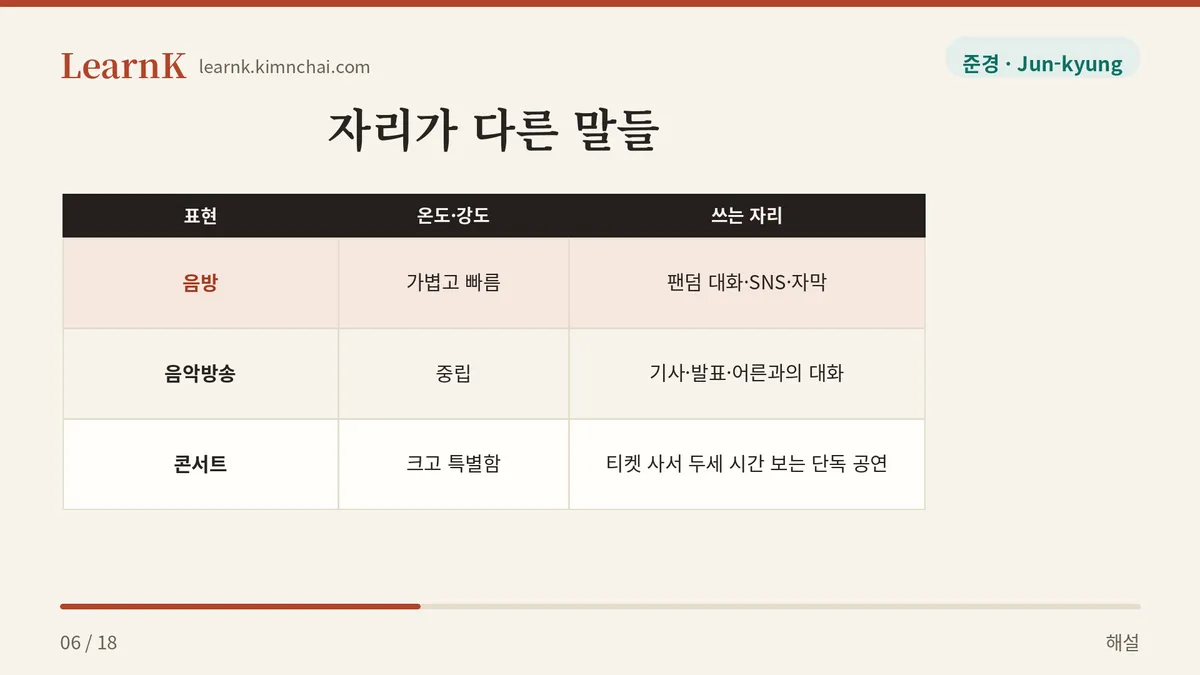
음방 is a noun, so it isn’t polite or casual in itself. What shifts is where you use it. Dropping it into a polite sentence like 음방 보러 가세요? (eumbang boreo gaseyo?) “Are you going to see a music show?” is completely fine with peers or with seniors and juniors you’re close to — but with an adult you’ve just met, or in a public setting, the other person may not know the word at all. In those cases you’re better off spelling out 음악방송.
Let’s line up a few expressions that look similar but sit in different places.
| Expression | Tone & intensity | Where it’s used |
|---|---|---|
| 음방 (eumbang) | Light and quick; insider talk | Fandom conversation, social media, subtitles. Not used in official documents or presentations |
| 음악방송 (eumak bangsong) | Neutral | Anywhere — article text, presentations, conversations with adults |
| 컴백 무대 (keombaek mudae) | Points to one specific episode | The single stage where a new song is unveiled |
| 콘서트 (konseoteu) | Large-scale and special | A standalone show you buy a ticket for and watch for two or three hours |
Cultural Background — A World That Trims Everything to Two Syllables
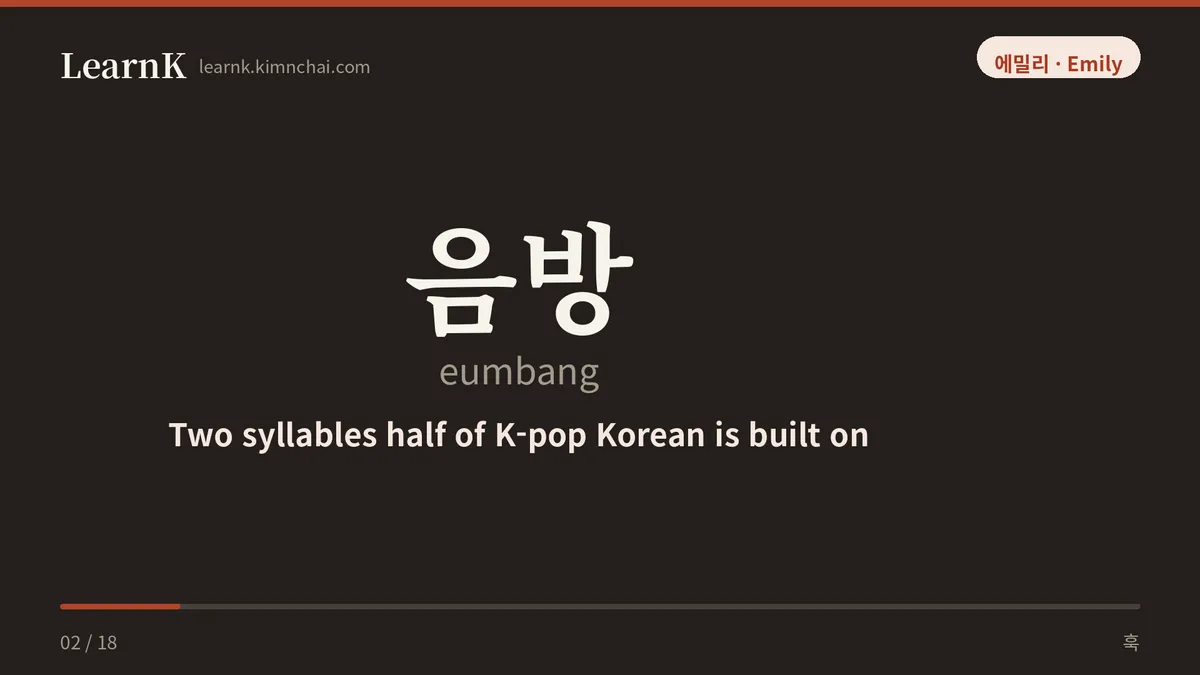
음방 is made by taking one syllable from each half of 음악방송. This shortening pattern is extremely common in Korean, and once you know the principle, a whole pile of K-pop vocabulary opens up at once. Program names get trimmed by the same rule — 《쇼! 음악중심》 becomes 음중 (eumjung), 《엠카운트다운》 becomes 엠카 (emka), 《인기가요》 becomes 인가 (inga), and 《뮤직뱅크》 becomes 뮤뱅 (myubaeng). In conversation, these short forms are what actually function as the basic form.
Some words come straight off the studio floor. 사녹 (sanok), which appeared in the dialogue above, is short for 사전 녹화 (sajeon nokhwa), “pre-recording” — a stage filmed in advance of the live broadcast. The live show airs in the evening, but pre-recordings happen in broad daylight, and that’s the real reason the line outside the station starts forming in the morning. From a fan’s point of view, it’s also a chance to see the stage twice in one day.
Rankings are calculated a little differently by each program, but they generally add up metrics like streaming performance, physical album sales, number of broadcast plays, and viewer voting. When first place is announced, the winning team comes back out to perform one more song, and that stage is called the 앙코르 무대 (angkoreu mudae), “encore stage.” So many members end up crying on it that in Korean fan culture, an 음방 1위 is less a report card than a rite of passage.
One more thing. 음방 활동 has a set rhythm to it. After a new album drops, a group typically cycles through several programs a week for two to four weeks, wraps up with the 막방, and then vanishes for a while. That’s why fan conversation rises and falls like a season. When a comeback is announced it starts with 드디어 음방 나온다 (deudieo eumbang naonda) “they’re finally back on music shows,” and a few weeks later it ends with 벌써 막방이라니 (beolsseo makbangirani) “the last broadcast already?” Once you know this cycle, you’ll also understand why a scene in a Korean variety show or drama — where an aspiring performer says 음방 한 번만 서 보고 싶다 (eumbang han beon-man seo bogo sipda) “I just want to stand on a music show stage once” — lands so heavily. Everyone watching knows that one time means a three-minute stage.
Today’s Quiz
Which of the following sentences uses 음방 naturally?
① 어제 그 가수 단독 음방에 갔는데 세 시간 동안 스무 곡을 불렀어. “I went to that singer’s solo eumbang yesterday, and they sang twenty songs over three hours.”
② 이번 주 목요일 음방에서 신곡 무대 처음 한대. “I heard they’re doing the new song’s first stage on Thursday’s eumbang this week.”
③ 아침에 라디오 음방 들으면서 출근했어. “I listened to a radio eumbang on my way to work this morning.”
Show the answer
Answer: ②
① describes one team singing twenty songs over three hours, so it should be 콘서트 (konseoteu), “concert.” And in ③, a radio music program isn’t called an 음방 — the word covers only television programs with stages and rankings. As in ②, “day of the week + 음방 + new-song stage” is where this word sits most comfortably.