개이득 (gae-ideuk) — The One Word Koreans Blurt Out When They Score Big Without Even Trying
개이득 (gae-ideuk) is the exclamation that jumps out when what you got is absurdly out of proportion to what you put in. It means something like “this is a total win, I came out way ahead.” The snack you were reaching for at the convenience store turns out to be buy-one-get-one-free; the secondhand bike you bought comes with a lock and a helmet thrown in; the restaurant you booked happens to be half price for that one day only — Koreans will blurt out a quick “개이득” right there on the spot. It’s less a sentence than an interjection, and the person saying it usually has a grin half-hung on their face.
There’s one condition attached to this word. You use it when you didn’t win it through effort, but rather got lucky, or had it roll into your lap out of nowhere. Studying for two months and getting a perfect score is not 개이득. Guessing on five questions, getting all five right, and that’s how you get a perfect score — that’s 개이득. So there’s always a little bit of a mischievous “huh, am I even allowed to have this?” feeling mixed in. The fact that it points to a windfall rather than a reward for hard work is the line that separates 개이득 from other expressions that look similar.
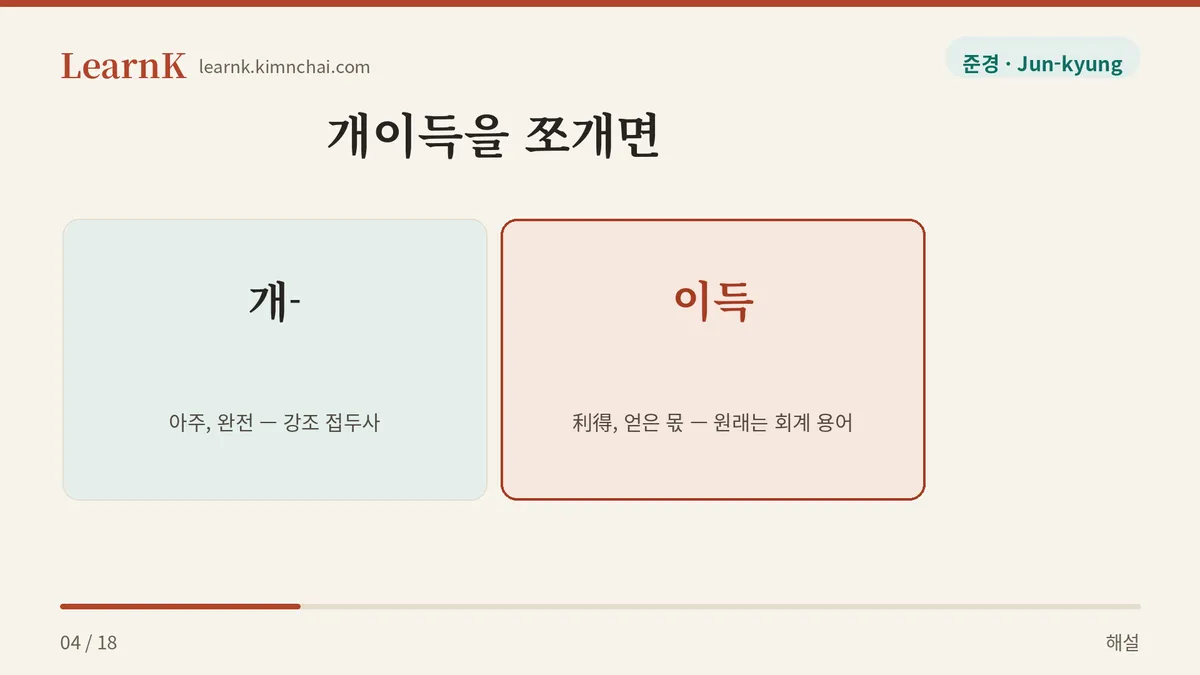
The intensity is very high, because the 개- (gae-) in front is an intensifying prefix meaning “really, totally.” If plain 이득이다 (ideugida) is a calm bit of arithmetic, 개이득 (gae-ideuk) is closer to shouting. But it’s rough in equal measure, which narrows down where you can use it. Among friends, among peers, on social media, in game chat, it flies back and forth several times a day — but in a meeting room or in front of someone older, it never comes out once. For a Korean learner, the thing to master before the meaning is exactly this sense of where it belongs.
Seeing it in a real conversation
Scene: In front of Exit 3 of the subway station. Emily, who just bought a bike through a secondhand sale, comes wheeling it out.
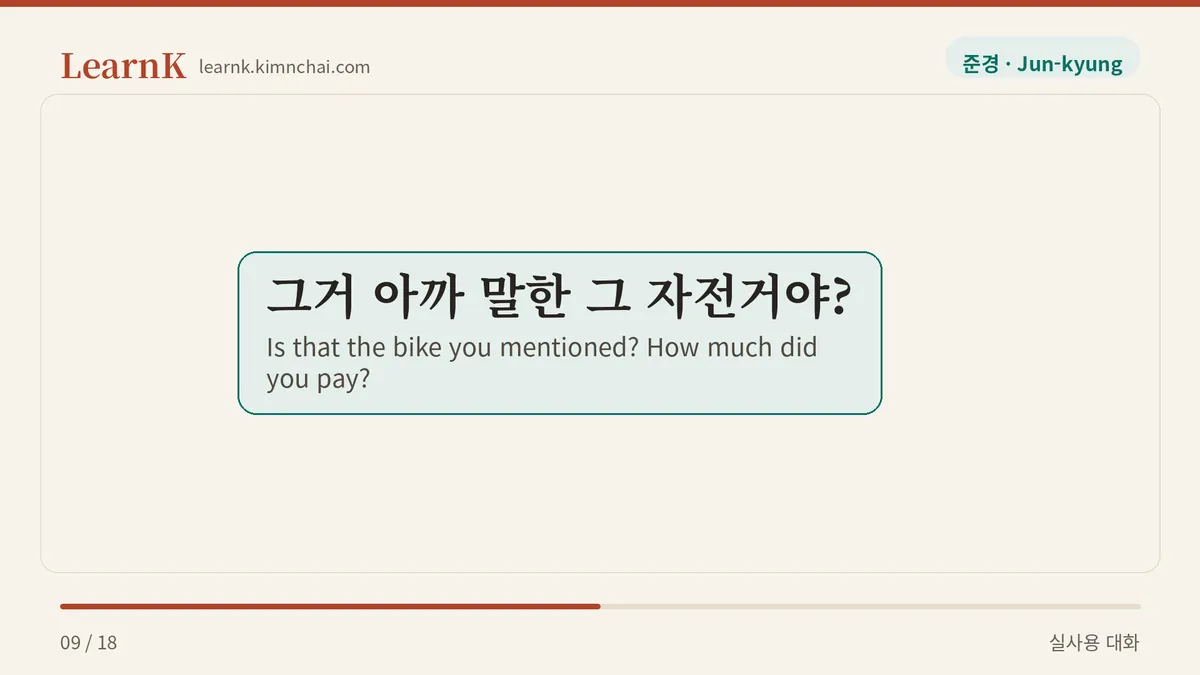
Jun-kyung: 어? 그거 아까 말한 그 자전거야? 얼마 줬는데? Huh? Is that the bike you mentioned earlier? How much did you pay?
Emily: 5만 원. 근데 아저씨가 자물쇠랑 헬멧까지 그냥 주셨어. Fifty thousand won. But the guy threw in the lock and the helmet for free.
Jun-kyung: 야, 그거 완전 개이득이네. 헬멧만 해도 3만 원인데. Dude, that’s a total steal. The helmet alone is thirty thousand.
Emily: 그치? 받으면서 속으로 “개이득” 했잖아. 표정 관리 하느라 혼났어. Right? I was screaming “jackpot” in my head the whole time. I could barely keep a straight face.
Jun-kyung: 근데 브레이크는 확인했어? 싸게 샀다가 수리비 더 나오면 그게 개손해야. But did you check the brakes? If the repair costs more than you saved, that’s a net loss.
Emily: 아까 한 바퀴 타 봤어. 멀쩡해. 이건 진짜 개이득 맞아. I already rode it around the block. It’s fine. This one’s a real win.
These usages sound off

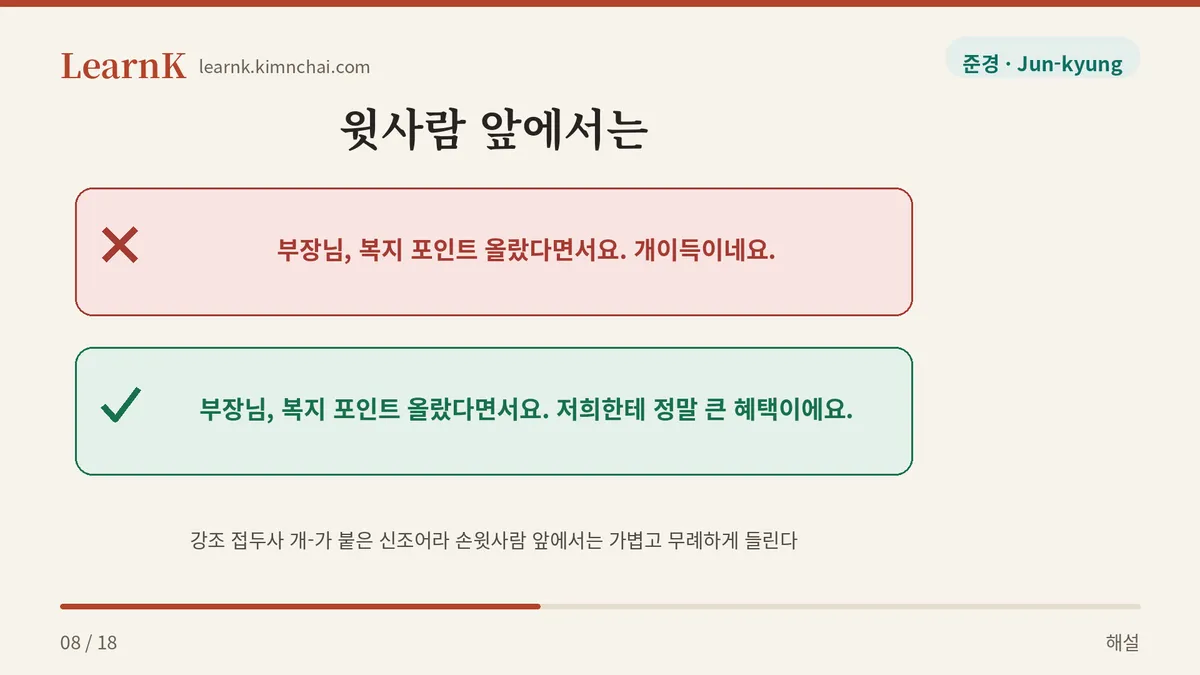
✗ (To your department head) 부장님, 이번에 복지 포인트 올랐다면서요. 개이득이네요. (Sir, I heard the benefit points went up this time. Total win.) ✓ (To your department head) 부장님, 이번에 복지 포인트 올랐다면서요. 저희한테 정말 큰 혜택이에요. (Sir, I heard the benefit points went up this time. That’s a really big benefit for us.) → Because it’s a coinage built on the intensifying prefix ‘개-’, in front of someone senior to you it lands as flippant, sometimes even rude. On top of that, tallying up something the company gave you as an “이득” (gain) makes you sound calculating. With people above you, it’s safer to switch over to something like ‘혜택이 크다 (hyetaegi keuda)’ — “the benefit is big” — or a simple thank-you.
✗ (To a friend whose car was totaled in an accident) 야, 보험금이 새 차값만큼 나왔다며? 너 개이득이네. (Hey, I heard the insurance payout was as much as a new car? You totally scored.) ✓ (To a friend whose car was totaled in an accident) 그래도 보험금이 제대로 나와서 정말 다행이다. (Still, I’m really glad the insurance paid out properly.) → 개이득 is a word for gaining something without losing anything. Pull it out in a moment where someone has lost a great deal and you end up converting their bad luck into arithmetic, which sounds ice-cold. The grammar is perfectly fine; it’s the temperature that’s completely off.
Example sentences by situation
1. At the supermarket 30 minutes before closing, in front of the sushi counter Right before the doors close, the discount stickers start stacking up. As you pick up something better than what you originally came for at half the price, half to yourself:
초밥 두 팩에 만 원? 이건 개이득이지. Chobap du paege man won? Igeon gae-ideukiji. Two packs of sushi for 10,000 won? Now that’s a steal.
2. The day you came in braced for overtime and the whole meeting got cancelled The meeting you thought would keep you pinned down all afternoon gets called off in a morning notice. Lowering your voice to the coworker beside you:
회의 취소됐대. 오늘 정시 퇴근이면 개이득 아니냐? Hoeui chwisodwaetdae. Oneul jeongsi toegeunimyeon gae-ideuk aninya? The meeting got cancelled. Leaving on time today — isn’t that a total win?
3. When you go to pay at the hair salon and they say there’s a promotion on You went in for just a cut, but this month’s promotion means the dye job comes free. Texting a friend at the register:
커트값만 냈는데 염색까지 해 줬어. 오늘 완전 개이득. Keoteutgamman naenneunde yeomsaekkkaji hae jwosseo. Oneul wanjeon gae-ideuk. I only paid for the cut and they dyed it too. Total jackpot today.
The three examples have something in common. In every one, a share you never planned for got tacked on as a bonus. Take that condition away and, no matter how big the gain is, 개이득 tends not to come out.
Formal and casual speech, and similar expressions
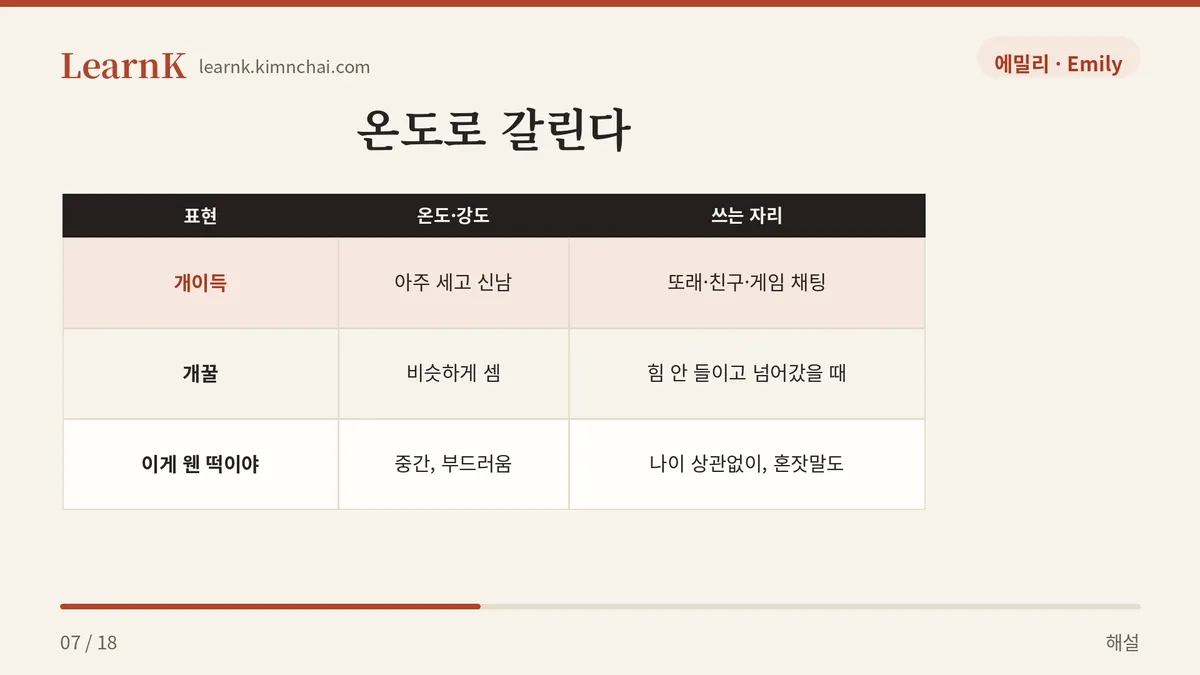
It’s better to think of 개이득 as simply not having a polite form. “개이득입니다” sounds strange not because it’s grammatically wrong, but because the temperature doesn’t match. In a formal setting, you don’t change the ending — you have to switch to an entirely different word.
| Expression | Tone & intensity | Where it’s used |
|---|---|---|
| 개이득 (gae-ideuk) | Very strong and excited. Almost an interjection | Peers, friends, social media, game chat. Not with people senior to you |
| 개꿀 (gaekkul) | Similarly strong. Leans toward “easy, painless” rather than profit | Peers, friends. When you got through something without any effort |
| 이게 웬 떡이야 (ige wen tteogiya) | Medium. An old idiom, so it’s gentler | Any age. Natural even muttered to yourself |
| 횡재했다 (hoengjaehaetda) | Neutral. Works in writing too | Anywhere. Fine in articles and essays |
| 혜택이 크네요 (hyetaegi keuneyo) | Low-key and well-mannered | With seniors, in work settings |
The opposite is built the same way. 개손해 (gaesonhae) is what Jun-kyung used in the conversation above: you use it when you thought you’d bought cheap but ended up out of pocket. 개이득 and 개손해 always travel as a pair.
Cultural background — the two faces of the prefix ‘개-’
‘개-’ wasn’t originally a nice thing to say. As in 개살구 (gaesalgu), 개떡 (gaetteok), and 개꿈 (gaekkum), it was a prefix attached to nouns meaning “wild, low-grade, pointless.” 개살구 is a sour apricot that’s hard to eat, and 개꿈 is a dream that means nothing. Then, passing through internet communities and game chat in the 2010s, ‘개-’ shed its negative coloring and hardened into a pure intensifier meaning “really, totally.” 개좋다 (gaejota), 개맛있다 (gaemasitda), 개꿀 (gaekkul), and 개이득 were all born that way.
이득 (ideuk, 利得), meanwhile, is a stiff Sino-Korean word that originally belonged in contracts and accounting ledgers. Slapping the roughest prefix in the Korean language onto that buttoned-up word — that mismatch is the joke at the heart of 개이득. It amounts to shouting an accounting term outside a convenience store.
This word spread through three channels. The first is gaming. When you opened a box and a rare item came out, the two syllables that went up in the chat window first were 개이득. The second is secondhand trading. Stories about picking something up cheap in a face-to-face sale became a genre of their own in online communities, and this word got attached to the post titles. The third is variety-show subtitles. When a cast member happens to win a prize or dodge a penalty, bold letters float up over the screen — this is how Korean variety shows ferry internet slang into the living room. You’ll also hear it now and then in dramas, as dialogue for characters in their twenties, but often the scene is handled so that a character who uses it in front of an adult catches a dirty look — meaning that even inside the story, the word wears a label reading “language for people your own age.”
So the generation gap is stark. For people in their twenties and thirties it’s everyday vocabulary, but for people over forty it can still sound crude. If you’re learning Korean, the safe way to handle this word is: always understand it; before you say it yourself, look at who you’re talking to.
Today’s quiz
The company CEO paid out a bonus to every employee with no advance notice. What would sound natural to say in each of these two situations?
① Quietly, to the coworker at the next desk who’s the same age as you — ② To the CEO, whom you run into in the elevator —
See the answer
① “야, 이거 완전 개이득 아니냐?” (Dude, isn’t this a total win?) — Between peers, over an unexpected windfall. This is where 개이득 fits best. ② “뜻밖의 소식이라 정말 감사합니다.” (It was unexpected news, and I’m truly grateful.) — In front of someone senior, it’s best to avoid not just 개이득 but the whole language of “이득” (gain) and tallying up.
Definitions and example sentences are from the National Institute of Korean Language’s Basic Korean Dictionary (krdict.korean.go.kr); that portion of this post, including our translations, is licensed under CC BY-SA 2.0 KR.