갬성 (gaemseong): The Word You Get When a Single ㅣ Sneaks Into 감성
갬성
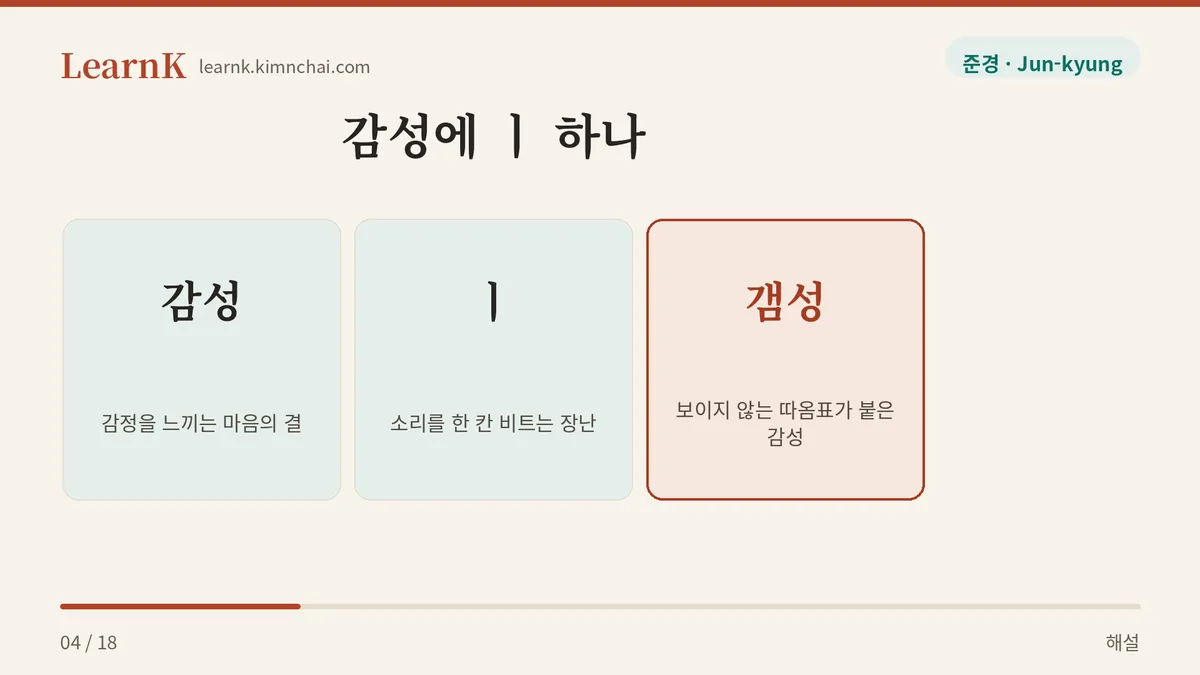
갬성 is a playfully twisted version of 감성, and it means the state of being completely soaked in a mood — or the photos, music, and places that are clearly going for that mood — pointed at with a half-teasing finger. Romanized, it’s 갬성 (gaemseong), and the word it grows out of is 감성 (gamseong) — a dignified word for the grain of a heart that feels things. Let one single vowel, ㅣ, slip in, and the temperature of the whole word changes.
Eleven at night. A friend photographs the lights on a Han River bridge, drops a black-and-white filter over it, and posts it with one short line underneath. The first comment to land is 갬성 터졌네 (gaemseong teojyeonne). It roughly means “you really nailed the mood,” but the tone is half laughter. It’s teasing, yet it isn’t an insult. If anything, there’s a compliment buried in it — nice shot. And this is exactly the spot where Korean learners slip with this word: in the dictionary it means the same thing as 감성, but in real life the two never sit in the same seat.
The difference between 감성 and 갬성 comes down to three things. First, 갬성 comes with invisible quotation marks around it. It’s the word you use the moment 감성 becomes “감성” — the moment we all notice that someone is working the mood. Second, 갬성 has laughter in it. When you’re genuinely moved, you say 감성; when something is a little cheesy but not unlikable, you say 갬성. Third, 갬성 gets used on yourself. A sentence that starts with 나 어제 갬성 터져서 (na eojeo gaemseong teojyeoseo) usually goes on to confess that you were digging through old photos at 3 a.m., or that you put on a ballad you never listen to and stared out the window. People use it to tease themselves even more often than they use it to tease others.
It’s a noun. It can’t act as a predicate on its own, so something always attaches behind it. The most common pairings are 갬성 터지다 (gaemseong teojida), 갬성 충만하다 (gaemseong chungmanhada), and 갬성 돋다 (gaemseong dotda), and it also goes in front to modify another noun — 갬성 카페 (gaemseong kape), 갬성샷 (gaemseong-syat), 갬성 플레이리스트 (gaemseong peulleiliseuteu). These days it goes straight onto shop signs and product names too.
Seeing It in Real Conversation
Setting: eleven at night, on a bench outside a convenience store by the Han River. Steam is just starting to rise off the cup ramyeon.
Jun-kyung: 야, 잠깐. 라면 그대로 둬 봐. 김 올라올 때 찍어야 돼. Hey, hold on. Leave the ramyeon like that. I have to shoot it while the steam is rising.
Emily: 뭐야, 또 사진이야? 나 배고파 죽겠는데. What, photos again? I’m starving here.
Jun-kyung: 뒤에 다리 불빛 나오게 앉아 봐. 이거 갬성 미쳤어. Sit so the bridge lights show behind you. The vibe on this is insane.
Emily: 국물 다 식겠다, 진짜. 너 그 갬성 때문에 나 이번 달에만 식은 라면 세 번 먹었어. The broth is going to go cold. Thanks to that aesthetic of yours I’ve eaten cold ramyeon three times this month alone.
Jun-kyung: 아 이번엔 진짜 한 장만. 자, 김 올라온다 올라온다. Okay, just one this time, I swear. There — the steam, the steam.
Emily: 됐고, 나 먼저 먹는다. 다 식은 라면엔 갬성도 안 남아. Forget it, I’m eating. There’s no vibe left in cold ramyeon either.
That last line shows the character of this word beautifully. Emily neither validates Jun-kyung’s 갬성 nor dismisses it entirely. She just takes the word back and returns it as a joke. That’s how 갬성 is meant to travel — back and forth.
These Uses Sound Off
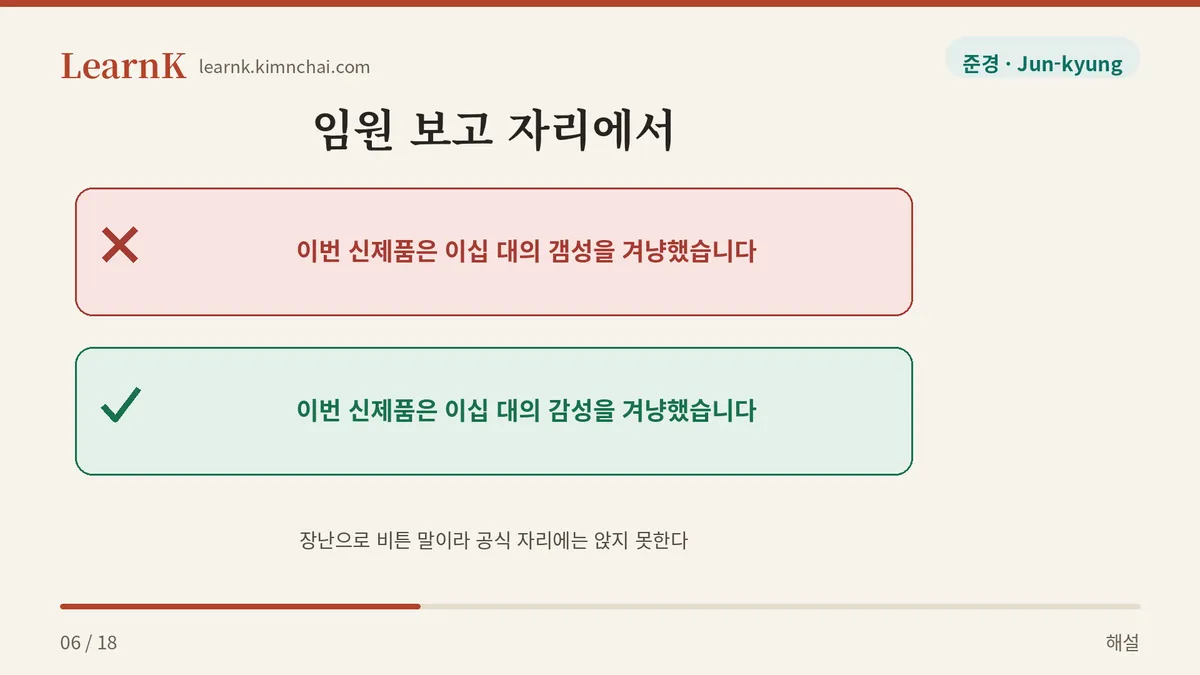
✗ (in a report to executives) 이번 신제품은 20대의 갬성을 겨냥했습니다. ✓ (in a report to executives) 이번 신제품은 20대의 감성을 겨냥했습니다. → 갬성 is a joke-twisted form, so it can’t take a seat in official documents, reports, or presentations. Even if your meaning gets across, your listeners will feel you came underprepared. In formal settings, go back to the original word, 감성.
✗ (to a friend crying while talking about a dog that was sick for a long time) 와, 지금 갬성 터졌네ㅋㅋ ✓ (to a friend crying while talking about a dog that was sick for a long time) 많이 힘들었겠다. 얼마나 예뻤을까. → Underneath 갬성 lies the observation that someone is “working the mood.” Attach it to real grief and you turn the other person’s feelings into a spectacle. It’s a word for moments you can laugh your way past.
Example Sentences by Situation
1. Picking a café with a friend — you’re looking for a place that photographs well. In Korea these days, coffee quality isn’t the only criterion.
여기 갬성 카페래. 창가 자리 예약해 놨어. yeogi gaemseong kape-rae. changga jari yeyakhae nwasseo. They say this place has a great aesthetic. I reserved the window seat.
2. Putting on a playlist on a rainy day — it’s raining outside and you can’t focus on what you were doing. This is how you narrate the moment you change the music.
비 오니까 갬성 충만해지네. 오늘은 일 못 하겠다. bi onikka gaemseong chungmanhaejine. oneureun il mot hagetda. The rain is filling me with mood. I’m not getting any work done today.
3. The next morning, teasing yourself — regretting in the morning what your overflowing feelings had you doing at dawn. An extremely common use.
어제 새벽에 갬성 터져서 옛날 사진 다 봤잖아. 지금 눈이 반쪽이야. eoje saebyeoge gaemseong teojyeoseo yennal sajin da bwatjanha. jigeum nuni banjjogiya. I got hit with all the feels at dawn and went through every old photo. Now my eyes are half shut.
Politeness Levels and Similar Expressions
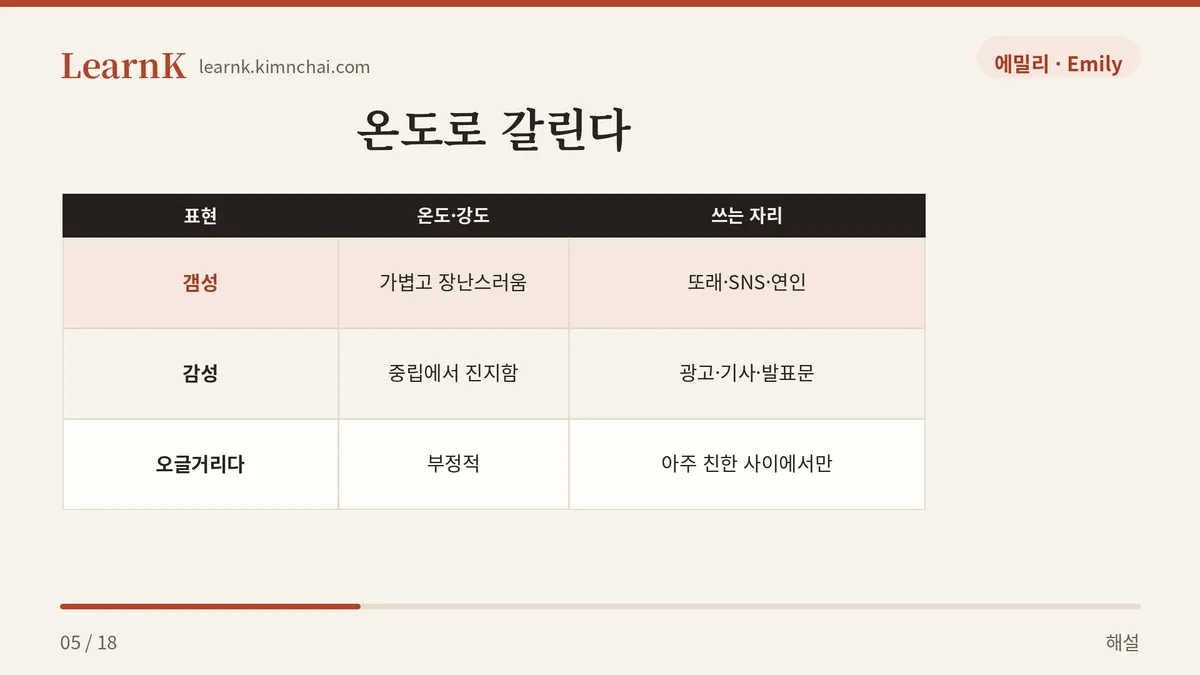
갬성 is a noun, so the word itself carries no casual/polite distinction. Change only the predicate that follows and you get 갬성 터지네 (banmal) / 갬성 터지네요 (jondaenmal). That said, adding 요 raises the form but leaves the word’s lightness exactly where it was. Say 갬성 터지시네요 to your boss and the grammar is fine, but the setting is still wrong. It’s a great illustration that politeness starts with word choice, not with verb endings.
| Expression | Temperature / intensity | Where it fits |
|---|---|---|
| 갬성 (gaemseong) | Light and playful; teasing with affection in it | Peers, social media, partners. Not in reports or with people above you |
| 감성 (gamseong) | Neutral to serious | Anywhere. Fine in ads, articles, and prepared remarks |
| 분위기 있다 (bunwigi itda) | Calm praise | Anywhere. For people, places, and photos alike |
| 오글거리다 (ogeulgeorida) | Negative; too cringey to look at | Only with close friends. Can genuinely sting |
The distance between 갬성 and 오글거리다 matters most of all. Both point at “laying the mood on too thick,” but 갬성 is a word that laughs and sits down next to you, while 오글거리다 draws a line. Tell a friend their photo is 갬성 터졌다 and it’s half compliment, half joke; say 오글거린다 and it’s just mockery.
Cultural Background — The Distance of a Single Filter
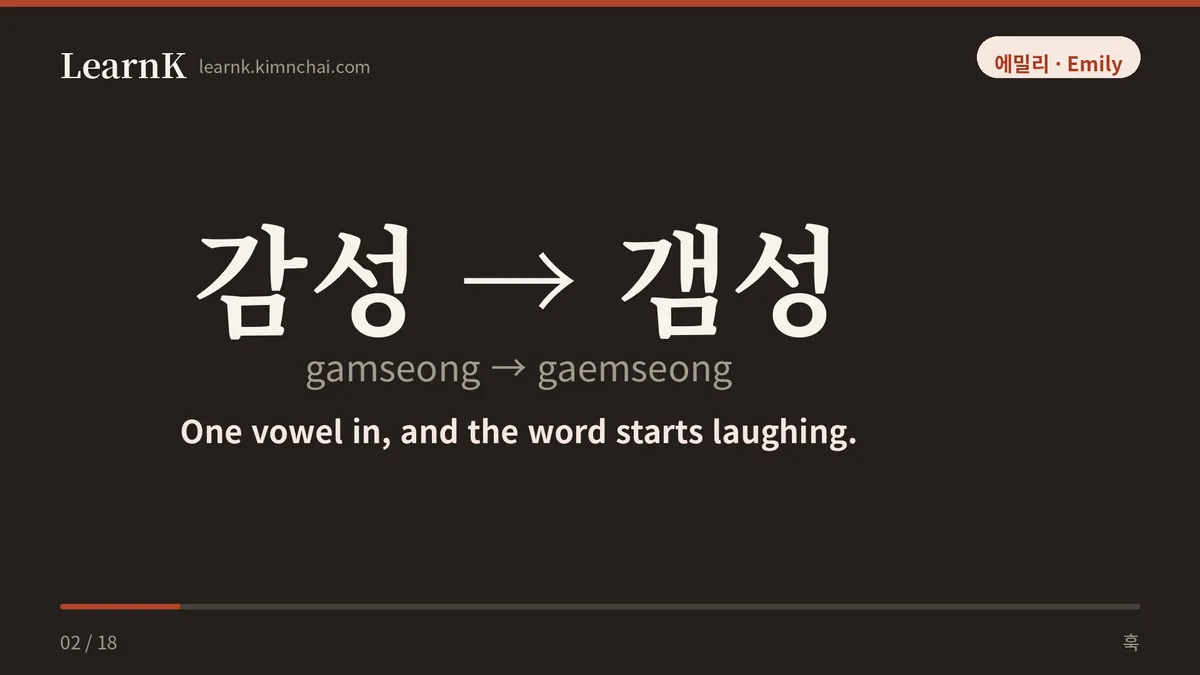
The word-formation is simple. The vowel ㅣ wedged itself into 감성 and out came 갬성. Korean internet speech has a long habit of bending a word’s sound a notch to make it cute or funny, and 갬성 stands squarely in that lineage. Shift the sound over by one step and the seriousness drains out while laughter fills the space — that’s the whole of this word, and its heart.
Behind its spread lies photo-sharing culture. As smartphones and filters became ordinary, anyone could edit their day into something presentable and post it — and at the same time, everyone came to know that the edit was an edit. The thin gap between a moment that is genuinely beautiful and a moment carefully arranged to look beautiful — 갬성 points at precisely that gap. Which is why Koreans are more comfortable using it on themselves than on other people. If you’re the first to say out loud that you’re working the mood right now, nobody else can tease you for it.
Korean dramas are full of scenes like this. One person is about to say something heartfelt in front of a night view, the person beside them laughs and breaks the mood, and because of that the two of them actually relax. It’s common enough that you can picture it without anyone quoting the lines — and 갬성 stands on the “breaking” side of that scene. It doesn’t deny the feeling; it’s a device that lets you take one step back so the feeling doesn’t get too heavy. When a Korean learner starts using this word naturally, they haven’t just picked up a word — they’ve picked up the sense of distance in Korean humor.
Today’s Quiz
Which of the following is the best situation for using 갬성?
- A meeting where you’re explaining a new brand’s design direction to your department head
- Seeing a friend post a photo of a coffee cup by a rainy window
- Offering words of comfort to the chief mourner at a funeral
Answer: 2
For a friend’s mood-heavy photo, 갬성 터졌네 is a perfect fit. Number 1 is a formal setting, so you’d need the original word 감성; number 3 is a place where real grief is sitting, and laying 갬성 on top of it makes the other person’s feelings seem trivial. There’s only one question to ask when choosing this word — can the two of us laugh together here, right now?
The definitions, example sentences, and dialogue in this post are all original writing. 갬성 is not a headword in the National Institute of Korean Language’s Basic Korean Dictionary (krdict.korean.go.kr), so this post contains no quotations taken from the dictionary.