갈비탕 (galbitang) — The One Bowl of Soup That Shows Up at Weddings and at Hangover Lunches
갈비탕 (galbitang)
갈비탕 (galbitang) means a soup made by chopping beef ribs into pieces and simmering them for a long, long time. The situations where this word gets said in Korea are more fixed than you’d expect: the basement banquet hall of a wedding venue on a Saturday afternoon, the office at twelve noon the day after a company dinner, a Korean restaurant you’ve walked into with your parents for the first time in ages. All three have one thing in common — today is not a day for eating just anything.
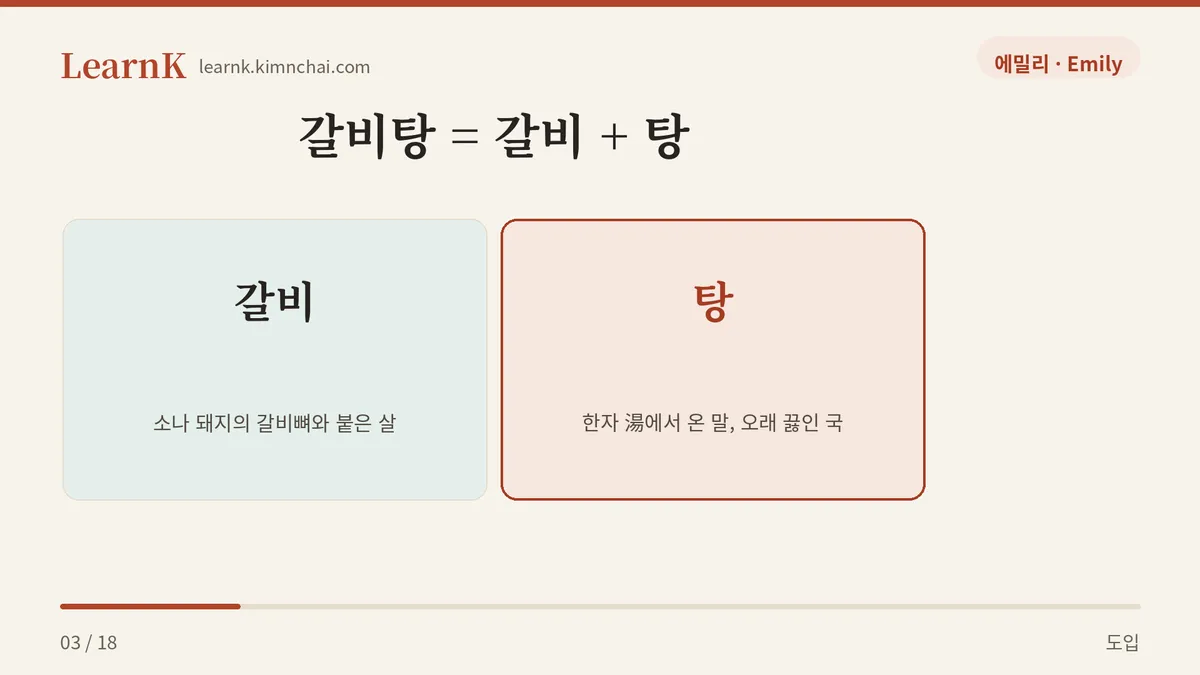
갈비 (galbi) refers to the rib bones of a cow or pig and the meat attached to them, and 탕 (tang) comes from the Chinese character 湯, meaning a soup boiled for a long time. So 갈비탕 is, exactly as the name says, a soup made by boiling galbi. The broth is a clear brown, and no chili powder goes into it. You tear the meat off the bone with your hands, spoon rice into the broth that’s left, and lay a piece of 깍두기 (kkakdugi, cubed radish kimchi**)** on top. The fact that people who can’t take spicy food, elders with weak teeth, and small children can all eat it has pretty much settled this dish’s entire character.
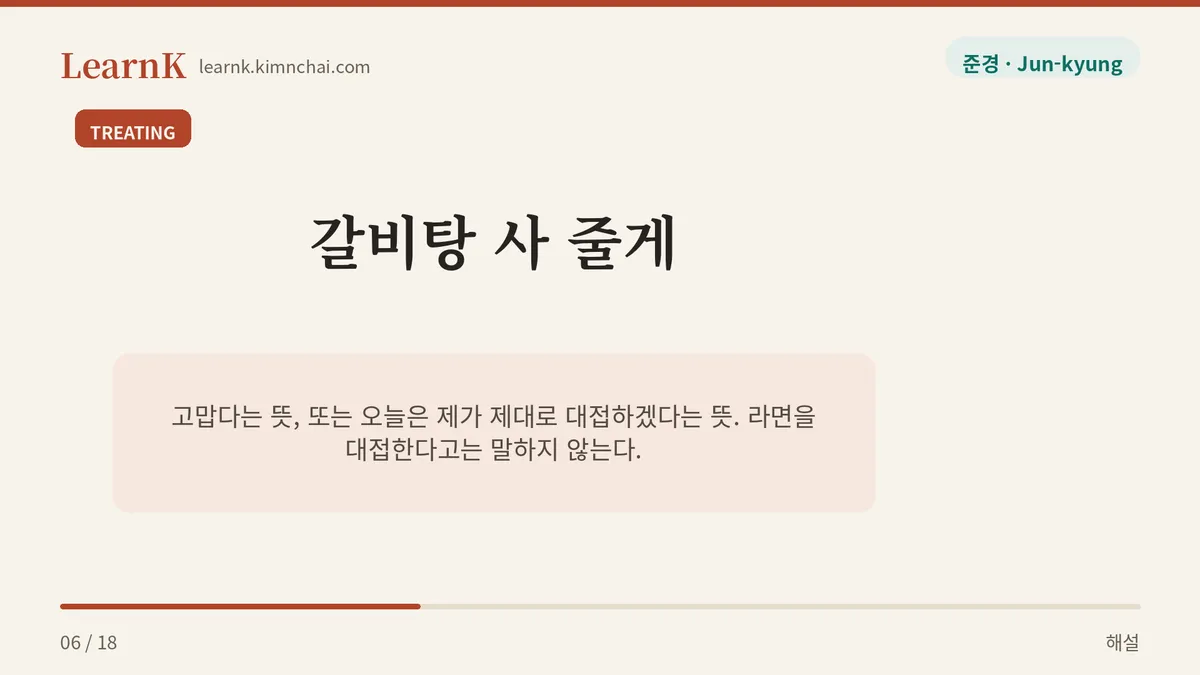
There’s one more thing worth knowing about the nuance. Among rice-and-soup meals, 갈비탕 sits on the pricier side. It’s placed a step above 설렁탕 (seolleongtang) or 순댓국 (sundaeguk). So 갈비탕 사 줄게 (galbitang sa julge) isn’t just a lunch suggestion — it lands as a signal that means thank you, or today I’m treating you properly. If you don’t feel this difference in temperature, you won’t understand why a Korean person has suddenly driven you to a galbitang restaurant.
Checking the National Institute of Korean Language Dictionary
First, here is exactly how the state-made dictionary defines this word.
갈비탕 「명사」 (noun) 소의 갈비를 잘라 넣고 오랫동안 끓인 국. (soui galbireul jalla neoko oraetdongan kkeurin guk.) — A soup made by cutting up beef ribs, putting them in, and boiling them for a long time. — National Institute of Korean Language, Basic Korean Dictionary (krdict.korean.go.kr)
Let’s also look at the multilingual translations carried in the same dictionary. Notice that the two core points of the definition — beef and long hours — repeat identically across all four languages.
[en] galbitang — A soup, made by boiling galbi, short ribs of beef, for long hours. [ja] カルビタン — 牛のあばら骨を骨ごとぶつ切りにして入れて長時間煮込んだスープ。 [es] galbitang, sopa de costilla de carne — Sopa cocida por largas horas con costillas cortas de ternera. [zh] 牛排骨汤 — 把牛的排骨切成块后长时间烧煮成的汤。 — National Institute of Korean Language, Basic Korean Dictionary (krdict.korean.go.kr)
A Portuguese translation is not carried in this dictionary. For reference, our own rendering would be something like galbitang — sopa de costela de boi cozida por longas horas, but we should make clear that this sentence is our translation, not a dictionary quotation.
Now let’s look at the actual usage examples the dictionary provides. Starting with the short ones.
갈비탕을 대접하다. 갈비탕 한 그릇. — National Institute of Korean Language, Basic Korean Dictionary (krdict.korean.go.kr)
갈비탕을 대접하다 (galbitang-eul daejeophada) — to serve someone galbitang. That temperature we talked about earlier survives right there in the dictionary example. You don’t really say you’re going to 대접하다 someone a bowl of ramyeon. The very fact that the verb 대접하다 (to serve, to treat a guest) attaches to it means this soup is food that goes on the table for guests.
갈비탕 한 그릇 (galbitang han geureut) — one bowl of galbitang. The counter for galbitang is 그릇 (geureut, bowl). This one short example heads off a learner mistake we’ll get to later.
Next are three full sentence examples.
새로 생긴 한식집에 가서 갈비탕을 먹고 왔어. — National Institute of Korean Language, Basic Korean Dictionary (krdict.korean.go.kr)
(saero saenggin hansikjibe gaseo galbitang-eul meokgo wasseo.) — “I went to that new Korean restaurant and had galbitang.” This is a sentence reporting on your day to a friend in casual speech. You can also read something else out of it: galbitang is a dish Koreans often order when they’re sizing up the skill of a newly opened restaurant. Soup dishes give themselves away immediately if they’re made carelessly.
고기가 들어간 국이 먹고 싶어서 갈비탕을 한 그릇 사 먹었다. — National Institute of Korean Language, Basic Korean Dictionary (krdict.korean.go.kr)
(gogiga deureogan gugi meokgo sipeoseo galbitang-eul han geureut sa meogeotda.) — “I wanted a soup with meat in it, so I bought myself a bowl of galbitang.” This is the situation of walking into a restaurant alone and taking care of it when your body wants meat. Galbitang is a menu item that feels completely natural for eating alone. Here too, the counter is 한 그릇 (han geureut).
그는 자기 갈비탕에 갈비가 얼마 안 들어 있다며 투덜거렸다. — National Institute of Korean Language, Basic Korean Dictionary (krdict.korean.go.kr)
(geuneun jagi galbitange galbiga eolma an deureo itdamyeo tudeolgeoryeotda.) — “He grumbled that there wasn’t much galbi in his galbitang.” This is a very Korean complaint. Galbitang gets judged not by the broth but by how many pieces of meat are in there. It’s a menu item with a price on it, so expectations run high — which is why you really do hear this grumbling often in Korean restaurants.
Seeing It in Real Conversation
Scene: The basement banquet hall of a wedding venue, Saturday afternoon. You hand over your meal ticket, take a seat, and what’s set down in front of you is — of course — that soup.
Jun-kyung: 어? 여기도 갈비탕 나오네. 한국 결혼식은 진짜 열에 아홉이 이거야. Huh, galbitang here too. Nine out of ten Korean weddings, it’s this.
Emily: 나 한국 처음 왔을 때 그게 제일 신기했어. 잔칫집마다 국이 똑같은 거. That was the strangest thing to me when I first came to Korea — every celebration, the exact same soup.
Jun-kyung: 많이 끓여 놔도 맛이 안 죽고, 어르신들도 편하게 드시니까. 그러니까 안 바뀌지. It holds up even when you cook a huge batch, and the elders can eat it easily. That’s why it never changes.
Emily: 근데 나 이거 아직도 좀 어려워. 뼈째 나오는데, 손으로 뜯어도 돼? Honestly this part still trips me up. It comes with the bone — is it okay to pick it up with my hands?
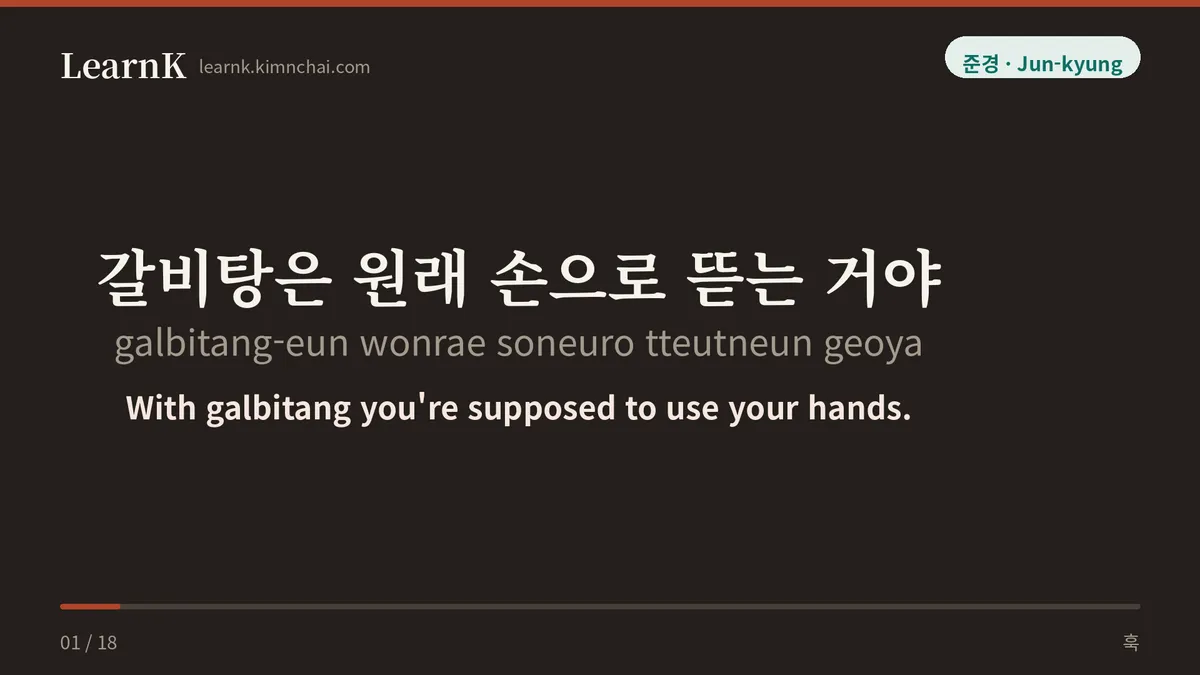
Jun-kyung: 당연하지. 갈비탕은 원래 손으로 뜯는 거야. 물수건 여기 있어. Of course. With galbitang you’re supposed to use your hands. Here’s a wet wipe.
Emily: 아 다행이다. 나 저번엔 포크로 낑낑댔잖아. Oh, what a relief. Last time I was struggling with a fork.
This Sounds Off
갈비탕 is the name of an object, so it never becomes rude on its own. Instead, let’s point out two misunderstandings learners genuinely run into.
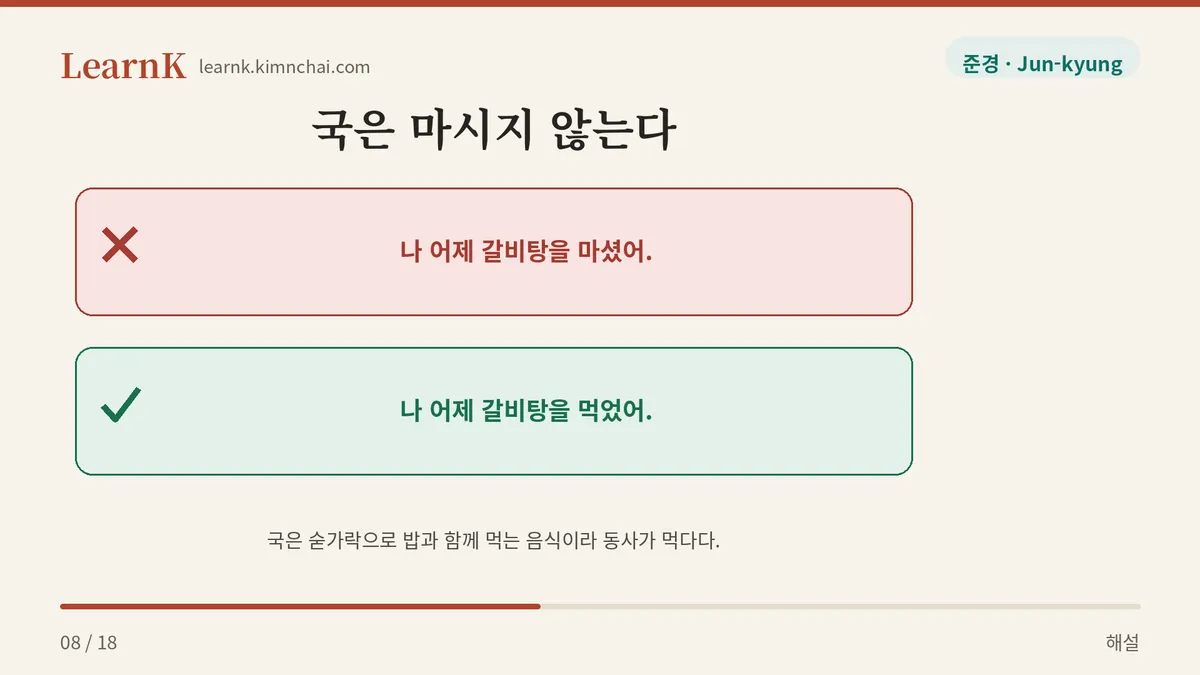
✗ (to a friend) 나 어제 갈비탕을 마셨어. (na eoje galbitang-eul masyeosseo.) ✓ (to a friend) 나 어제 갈비탕을 먹었어. (na eoje galbitang-eul meogeosseo.) → This is the mistake of attaching 마시다 (masida, to drink) to soup, following English or Chinese habits. In Korea, soup is something you eat with a spoon alongside rice, so the verb is 먹다 (meokda, to eat). 마시다 is used only in the exceptional case of lifting the bowl itself and gulping the broth down. The dictionary examples are all on the 갈비탕을 먹다 side too.
✗ (sitting down at a barbecue place) 여기 갈비탕 2인분 주세요. (yeogi galbitang i-inbun juseyo.) ✓ (at a barbecue place) 여기 갈비 2인분 주세요. (yeogi galbi i-inbun juseyo.) / (at a Korean restaurant) 갈비탕 두 그릇 주세요. (galbitang du geureut juseyo.) → Two things go wrong here. First, galbitang comes out portioned one bowl per person, so you count it in 그릇 (geureut, bowls), not 인분 (inbun, servings). Second, if you tack 탕 onto your order at a place where you came to grill meat, the whole menu item changes. The scene where your group is waiting on the charcoal and two bowls of soup arrive does actually happen.
Example Sentences by Situation
1. Lunch the day after a company dinner — recommending it as hangover food
어제 좀 과했지? 점심에 갈비탕이나 한 그릇 하자.
(eoje jom gwahaetji? jeomsime galbitang-ina han geureut haja.) — “Yesterday got a bit out of hand, didn’t it? Let’s just go have a bowl of galbitang for lunch.” In Korea, galbitang is one of the classic hangover-cure menu items. It isn’t spicy and the broth is warm, which makes it good for soothing your stomach. The particle 이나 (ina) here doesn’t mean let’s eat something impressive — it creates the feeling of let’s just casually have that, at least. Galbitang isn’t actually a light price, but saying it this way takes the pressure off.
2. An outing with your parents — recommending it to an elder
아버님, 오늘 점심은 갈비탕으로 하시겠어요? 여기가 뼈를 오래 곤다고 소문났어요.
(abeonim, oneul jeomsimeun galbitang-euro hasigesseoyo? yeogiga byeoreul orae gondago somunnasseoyo.) — “Father, would you like to go with galbitang for lunch today? This place has a reputation for simmering the bones a long time.” When recommending food to an elder you use 드시다 (deusida) instead of 먹다 (meokda), but since this is a situation of choosing off a menu, 하시겠어요 (hasigesseoyo) sounds natural. Choosing galbitang in itself carries the meaning today, I’m treating you.
3. To a friend who looks worn out
너 요즘 얼굴이 반쪽이다. 갈비탕이라도 먹고 기운 좀 차려.
(neo yojeum eolguri banjjogida. galbitang-irado meokgo giun jom charyeo.) — “Your face is half of what it was these days. At least eat some galbitang and get your strength back.” 얼굴이 반쪽이다 (eolguri banjjogida), literally “your face is half,” is an idiom meaning someone has lost weight and looks exhausted. In Korea, meat broth is thought of as food for taking care of your body, so it comes up often as the dish you recommend to someone who’s sick or worn down.
Polite and Casual Speech, and Similar Expressions
갈비탕 is a noun, so there’s no honorific level built into the word itself. The politeness is decided by the verb you use with it.
- (to restaurant staff) 갈비탕 두 그릇 주세요. (galbitang du geureut juseyo.)
- (to an elder) 갈비탕 드시겠어요? (galbitang deusigesseoyo?)
- (to a friend) 갈비탕 먹을래? (galbitang meogeullae?)
With an elder you use 드시겠어요 (deusigesseoyo), not 먹을래요 (meogeullaeyo). Keeping just this one thing straight changes the impression you make at the table.
Here’s how it compares with the neighboring dishes that are easy to mix up.
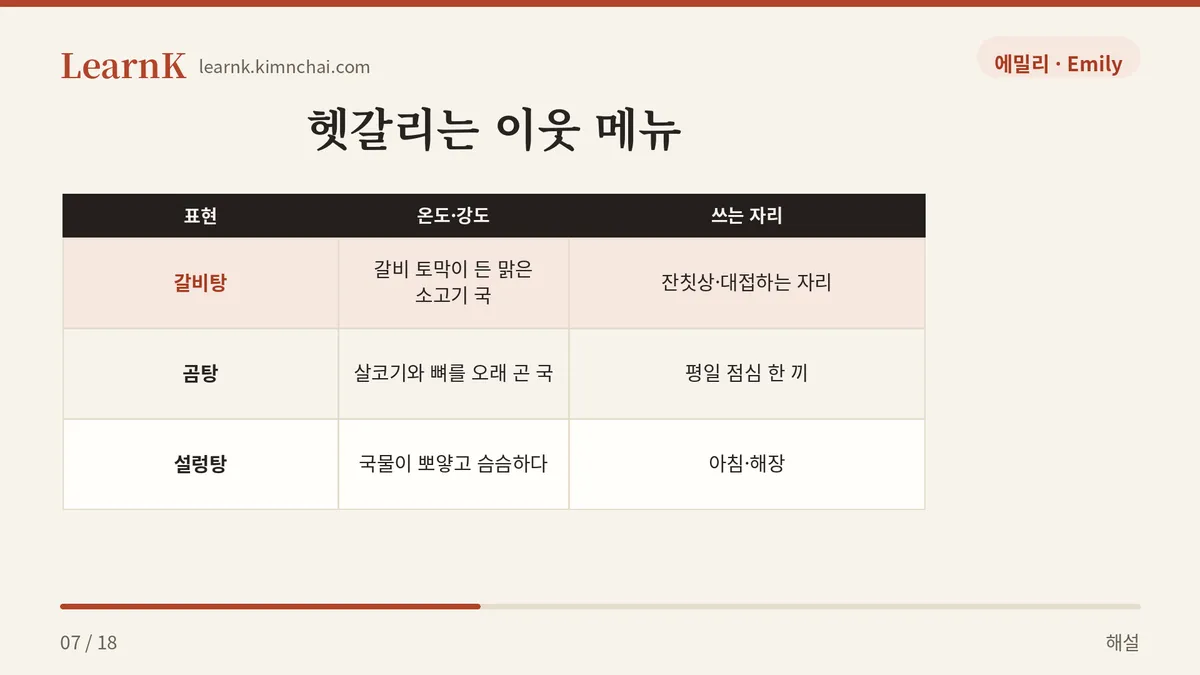
| Expression | Taste / character | Where it’s used |
|---|---|---|
| 갈비탕 (galbitang) | A clear beef soup with chunks of rib in it. The broth is rich and you tear the meat off with your hands | Celebration tables, occasions where you’re treating someone, hangover cures. On the pricier side among rice-and-soup meals |
| 곰탕 (gomtang) | Lean meat and bones simmered a long time. No rib chunks | An ordinary weekday lunch. Plainer than galbitang |
| 설렁탕 (seolleongtang) | Bones simmered until the broth turns milky and mild. You add the salt and scallions yourself | Breakfast, hangover cures. The most common rice-and-soup meal |
| 갈비찜 (galbijjim) | Ribs braised down in a soy-sauce marinade with no broth. Sweet and savory | The main dish at holiday and birthday tables. A side dish, not a soup |
Not everything with galbi in it is galbitang. If it’s submerged in broth, it’s 갈비탕 (galbitang); if it’s braised in seasoning and served on a plate, it’s 갈비찜 (galbijjim).
Cultural Background — The Soup of Celebration Days
Take the name apart and the structure is simple. 갈비 (galbi) is a native Korean word meaning the rib section, and 탕 (tang) comes from the Chinese character 湯 and refers to a soup boiled for a long time. Dishes with 탕 attached — 삼계탕 (samgyetang), 매운탕 (maeuntang), 감자탕 (gamjatang) — are generally heartier than a plain 국 (guk) and are placed at somewhat more formal occasions. Even among broth dishes, 미역국 (miyeokguk) and 된장국 (doenjangguk) are home cooking, while a 탕 tends to be the centerpiece of a full spread.
There are reasons galbitang became the de facto standard menu item at Korean wedding receptions. You can boil hundreds of servings in advance and the flavor doesn’t collapse; it isn’t spicy, so everyone from children to the elderly can eat it; and back when meat was precious, it was in itself a sign that you were treating your guests properly. That’s also why, when a wedding scene comes up in a Korean drama, the soup sitting in front of the guests is usually galbitang. Conversely, in funeral hall scenes, what appears is 육개장 (yukgaejang). Koreans can tell from one bowl of soup on the screen whether the occasion is a happy one or a sorrowful one.
In daily life it occupies two more places. One is the hangover cure, and one is 몸보신 (momboshin, restoring your body’s strength). A child facing an exam, a family member who’s been ill a long time, a friend who helped you move — this is the soup Koreans want to buy them. “Let’s go eat galbitang” is often another form of “I hope you’ve been eating well.”
Today’s Quiz
The day after a company dinner, you want to suggest galbitang to a colleague who says their stomach is burning. Which sentence is the most natural?
- 우리 점심에 갈비탕 마시러 갈까요? (uri jeomsime galbitang masireo galkkayo?)
- 우리 점심에 갈비탕 한 그릇 하러 갈까요? (uri jeomsime galbitang han geureut hareo galkkayo?)
- 우리 점심에 갈비탕 2인분 시킬까요? (uri jeomsime galbitang i-inbun sikilkkayo?)
The answer is number 2. Soup is not something you drink but something you eat, and galbitang is counted in 그릇 (geureut, bowls), not 인분 (inbun, servings). 한 그릇 하다 (han geureut hada) is a very Korean expression used when casually suggesting a rice-and-soup dish, so it’s worth memorizing whole.
Definitions and example sentences are from the National Institute of Korean Language’s Basic Korean Dictionary (krdict.korean.go.kr); that portion of this post, including our translations, is licensed under CC BY-SA 2.0 KR.