감자전 (gamjajeon) — The Words Koreans Reach For While Watching the Rain
When the monsoon rain starts drumming against the window, Koreans almost reflexively say the same thing: 비 온다. 감자전이나 부칠까? (bi onda. gamjajeonina buchilkka?) — “It’s raining. Should I fry up some gamjajeon?” 감자전 (gamjajeon) means a savory pancake made by finely grating or thinly slicing potatoes and frying them into a thin round on an oiled pan. It’s exactly what the name says — a 전 (jeon) fried from potatoes — and it’s humble food, made of nothing but potatoes and salt, plus a little onion at most.
But the reason this word is interesting for Korean learners isn’t the recipe. It’s where the word gets said. Yes, 감자전 is something you order at a restaurant, but far more often it shows up at home, as a suggestion someone tosses out while looking out the window. It’s what you say when it’s raining, there’s nothing in particular to do, and there’s someone there with you. That’s why 감자전 부쳐 줄까? (gamjajeon buchyeo julkka?) — “Want me to make some gamjajeon?” — carries less the temperature of a conversation about cooking and more that of “stay a little longer.”
There’s also one thing that sets 감자전 apart from other 전. Most 전 are made by mixing ingredients into a wheat-flour batter, but with 감자전, the starch (전분, jeonbun) that comes out of the grated potato holds the batter together on its own. You add almost no flour — or none at all. The result is crisp on the outside and chewy inside, a texture no other 전 has. That chewiness — 쫀득함 (jjondeukham) — is the first word Koreans reach for when they describe 감자전.
The nuance is worth pinning down too. 감자전 is not food for a formal spread. If the 동태전 (dongtaejeon), 육전 (yukjeon), and 산적 (sanjeok) that appear at holidays and memorial rites are “food you started preparing days ago,” 감자전 is thoroughly spur-of-the-moment. You make it when a guest shows up unannounced, when one more round of drinks is called for, when potatoes are all that’s left in the fridge. When someone says 감자전 부쳤어, 와서 먹어 (gamjajeon buchyeosseo, waseo meogeo) — “I made some gamjajeon, come eat” — that’s less a serving of food than an invitation.
A Real Conversation
Setting: a Saturday afternoon with monsoon rain pouring down, in the kitchen of Jun-kyung’s home. Emily has just come in, shaking off her umbrella.
Jun-kyung: 어유, 다 젖었네. 수건 저기 있어. Ugh, you’re soaked. There’s a towel over there.
Emily: 괜찮아, 금방 말라. 근데 이 냄새 뭐야? 들어오자마자 배고파졌어. I’m fine, it’ll dry fast. But what’s that smell? I got hungry the second I walked in.
Jun-kyung: 비 오길래 감자전 부치고 있었지. 막 첫 장 나왔어. It was raining, so I’ve been making gamjajeon. The first one just came off the pan.
Emily: 와, 진짜? 나 한국 산 지 15년인데 감자전은 아직도 못 부쳐. 맨날 다 부서져. Wow, really? I’ve lived in Korea for 15 years and I still can’t make gamjajeon. Mine always falls apart.
Jun-kyung: 어렵지 않아. 감자 갈아서 물기만 좀 빼면 돼. 밀가루도 안 넣어. It’s not hard. Just grate the potatoes and drain off some of the water. You don’t even add flour.
Emily: 아, 그래서 이렇게 쫀득하구나. 야, 간장 어디 있어? 나 젓가락도 가져올게. Ah, so that’s why it’s this chewy. Hey, where’s the soy sauce? I’ll grab chopsticks too.
Why This Sounds Off
감자전 isn’t a word you have to adjust depending on who you’re talking to — it’s just the name of a dish. So there’s no way to be rude with it. But there are two common misunderstandings that learners run into almost without exception.
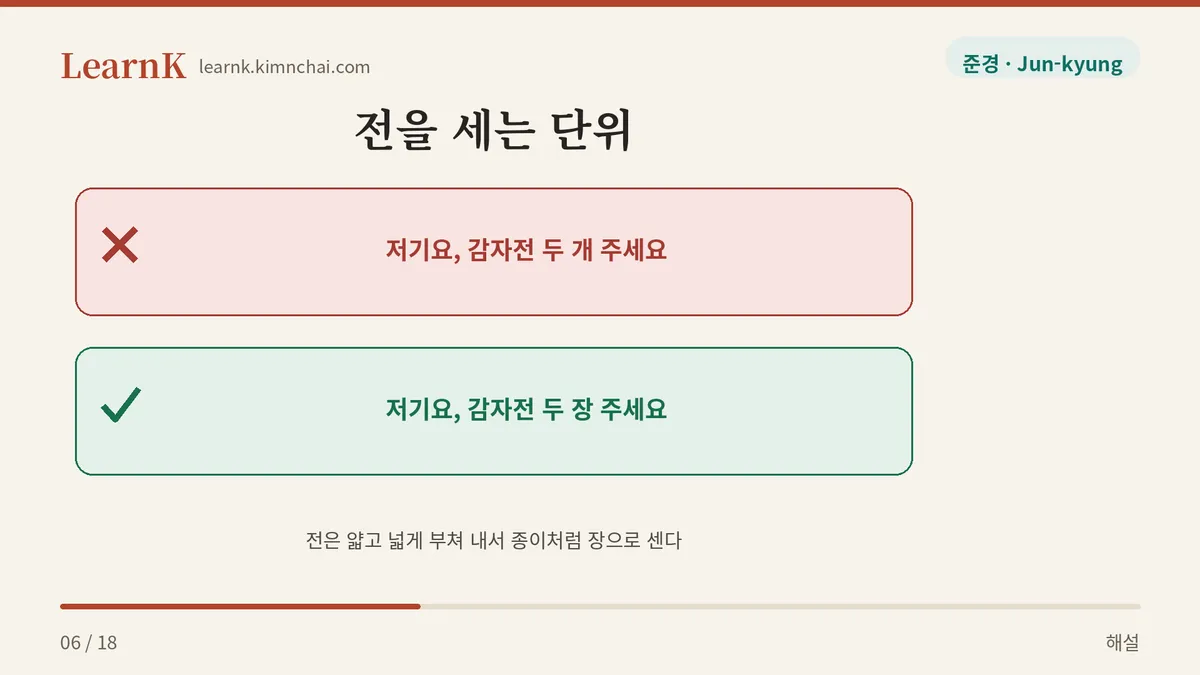
✗ 저기요, 감자전 두 개 주세요. ✓ 저기요, 감자전 두 장 주세요. → Because 전 is fried thin and wide, you count it like sheets of paper, with 장 (jang). People will understand you if you say 개 (gae), but to a native ear it sounds vaguely like a child talking. When it’s fried to fill a large pan and served whole, you can also use 한 판 (han pan) — “one panful.”
✗ 비 오는데 감자전 구울까? ✓ 비 오는데 감자전 부칠까? → 굽다 (gupda) is the verb for meat and fish cooked directly over heat. For 전, which you pan-fry in oil, the matching verb is 부치다 (buchida). This isn’t a grammar error so much as a mismatched pairing, which is exactly why native speakers immediately register, “ah, a foreigner.” Just remember that 전 (jeon), 부침개 (buchimgae), and 빈대떡 (bindaeddeok) all go with 부치다.
Example Sentences by Situation
1. Rain suddenly pours down on your way home from work, and you text a friend
오늘 같은 날엔 감자전에 막걸리지. 우리 집으로 와. (oneul gateun naren gamjajeone makgeolliji. uri jibeuro wa.) A day like this calls for gamjajeon and makgeolli. Come over to my place.
A에 B지 (A-e B-ji) is an idiomatic Korean pairing pattern that means “of course B goes with A.” Rainy day–jeon–makgeolli is a combination so well established in Korea that it’s practically official, so this one sentence conveys your entire mood right now.
2. Ordering at a restaurant on a trip to Gangwon-do
여기 감자전 한 장이랑 메밀국수 하나 주세요. (yeogi gamjajeon han jangirang memilguksu hana juseyo.) One gamjajeon and one buckwheat noodle dish, please.
Gangwon-do is one of Korea’s signature potato-growing regions, and 감자전 is almost never missing from a menu there. Ordering it alongside 메밀국수 (memilguksu, buckwheat noodles) or 감자옹심이 (gamja-ongsimi, potato dumpling soup) is a common combination. And ~이랑 ~ 주세요 (~irang ~ juseyo) is the most comfortable colloquial way to string items together when ordering.
3. To a guest at your home, in polite speech
감자전 조금 부쳤는데 식기 전에 드세요. (gamjajeon jogeum buchyeonneunde sikgi jeone deuseyo.) I made a little gamjajeon — please eat it before it gets cold.
When serving food in Korea, it’s polite to downplay it — you say “I made a little” rather than “I prepared a lot.” Even when it’s a heaping plate, you call it 조금 (jogeum, “a little”). And because 전 goes soggy once it cools, 식기 전에 (sikgi jeone, “before it gets cold”) follows along almost as a set phrase.
Formal vs. Casual, and Related Words
감자전 itself carries no politeness level. Formal and casual speech split at the predicate that follows it. To a friend it’s 감자전 부쳐 줄까? (gamjajeon buchyeo julkka?); to someone older or senior to you it becomes 감자전 부쳐 드릴까요? (gamjajeon buchyeo deurilkkayo?). When the person offering the food is your elder, the pairing is 드세요 (deuseyo) from them, and 잘 먹겠습니다 (jal meokgetseumnida) from you as the one receiving it.
Here’s how the related words sit relative to one another.
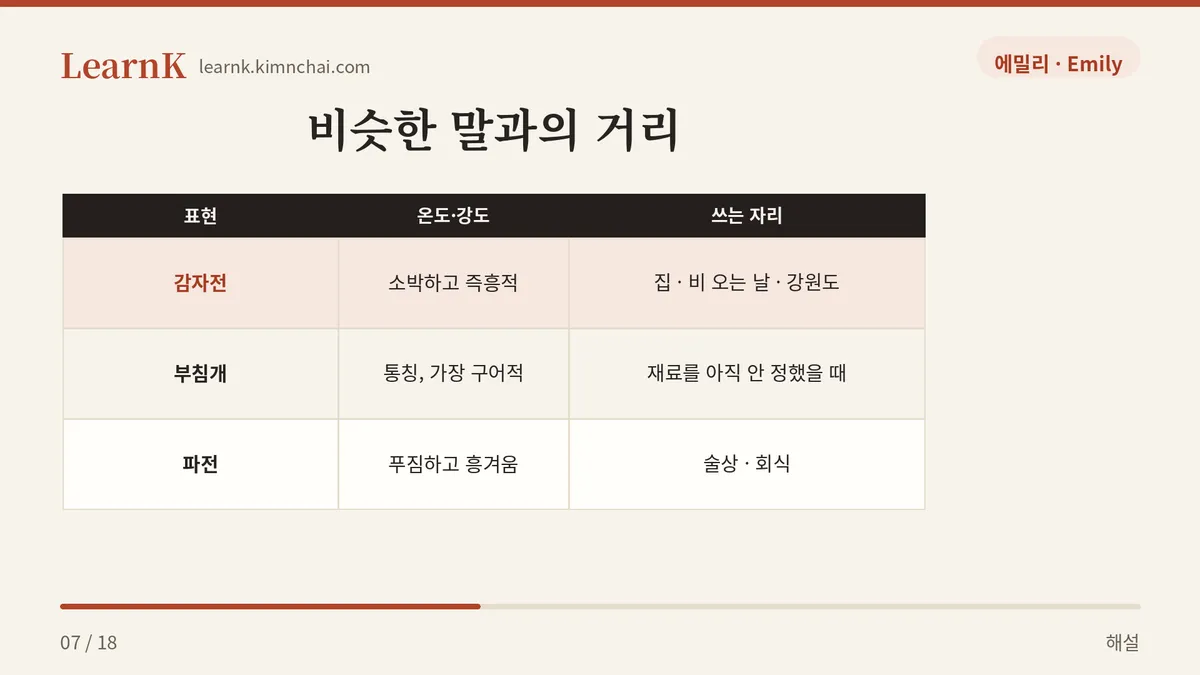
| Expression | Temperature / intensity | Where it’s used |
|---|---|---|
| 감자전 (gamjajeon) | humble, spontaneous | at home; rainy days; Gangwon-do restaurants |
| 부침개 (buchimgae) | the general term, most colloquial | when you haven’t settled on ingredients yet. “부침개나 부칠까? (buchimgaena buchilkka?)” |
| 파전 (pajeon) | generous, festive | drinking tables; work dinners; the star player of rainy days |
| 전 (jeon) | formal and dignified | holiday tables; memorial rites; banquet spreads |
To sum up: 부침개 is the big-umbrella word, so 감자전 and 파전 both fit under it. 전 is the more formal way of naming the same food, which is why you hear it often in holiday contexts. In between them, 감자전 occupies exactly the spot marked “at home, right now, with whatever’s on hand.”
Cultural Background — Rain, Potatoes, and Gangwon-do
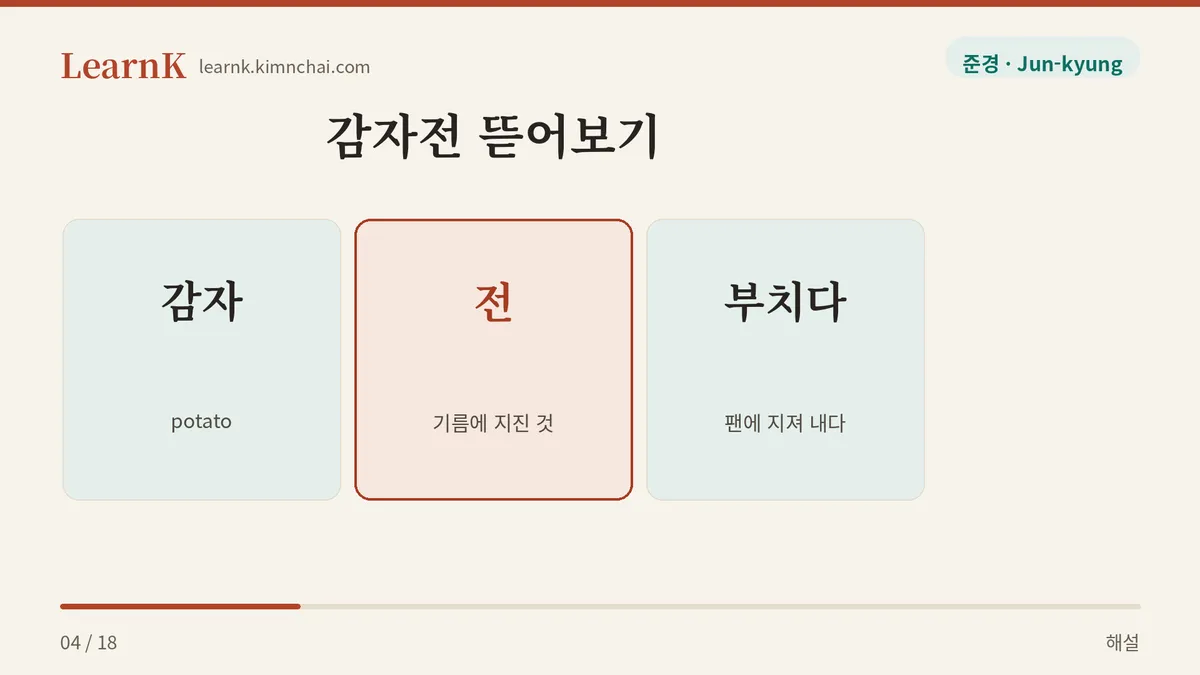
First, the word formation. 감자전 is 감자 + 전(煎). The character 煎 means “pan-fried in oil,” and it attaches to the name of an ingredient — as in 동태전 (dongtaejeon, pollock), 호박전 (hobakjeon, zucchini), 부추전 (buchujeon, garlic chives) — to mean “that ingredient, fried in oil.” So even when you meet a new 전 name, knowing the ingredient in front unlocks the meaning immediately.
Second, why rainy days specifically. In Korea, “jeon on a rainy day” is close to a national habit, and every year there’s a news item saying that sales of pancake mix actually rise when it rains. The most widely repeated explanation is that the sizzle of batter in hot oil sounds like falling rain. It’s a story people enjoy passing around rather than a verified fact — but that in itself shows how firmly this pairing is lodged in the Korean sensibility.
Third, region. Gangwon-do has long been the signature potato region, and “Gangwon-do food” calls to mind 감자전, 감자옹심이 (gamja-ongsimi), and 감자떡 (gamjaddeok) side by side. For travelers, 감자전 is a way of remembering that region by taste. In Korean dramas and variety shows, too, there’s a scene that keeps recurring: on a rainy day, the characters gather in the kitchen, fry up some jeon, and share makgeolli — and what they talk about is usually not the cooking but their lives. A table with 감자전 on it is generally too big for one person and just right for two. That’s exactly why this dish always arrives together with conversation.
Today’s Quiz
You go over to a friend’s place and there’s a warm, nutty smell coming from the kitchen. Your friend is making gamjajeon. Which sentence is the most natural Korean here?
- 어? 너 감자전 굽고 있어?
- 어? 너 감자전 부치고 있어?
- 어? 너 감자전 두 개 튀기고 있어?
Answer: 2
전 is food pan-fried in oil, so it pairs with 부치다 (buchida). The 굽다 (gupda) in option 1 is for things cooked directly over heat, like meat or fish, and option 3 gets both the verb (튀기다, twigida, “to deep-fry”) and the counter (개, gae) wrong. It’s worth remembering alongside this that 전 is counted 한 장, 두 장 (han jang, du jang).
The definitions, example sentences, and dialogue in this post are all original work written by us.