Gamjatang — A Spicy Pot You Eat Straight Off the Bone
감자탕 (gamjatang)
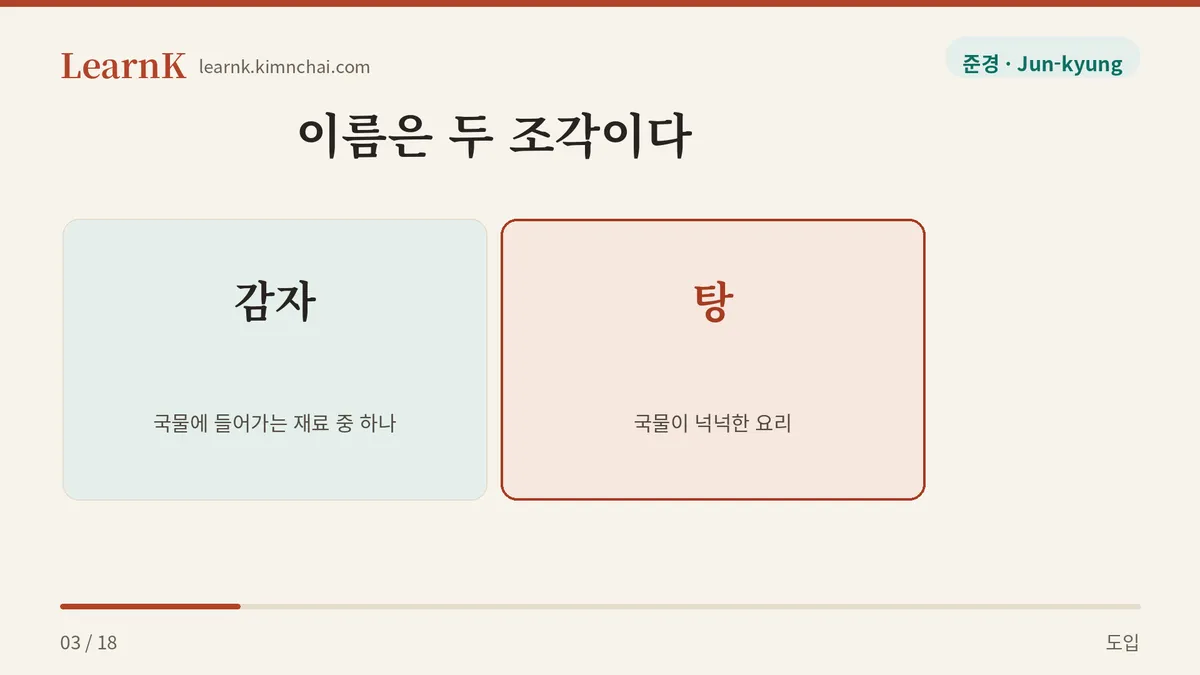
감자탕 (gamjatang) means a jjigae — a Korean stew — made by simmering pork spine with potatoes, perilla seeds, and assorted vegetables until it’s hot and spicy. Picture a winter night: you push open a fogged-up glass door in a back alley, and there it is — pork spine piled up like a mountain in the middle of the pot, buried under perilla powder like snow. In Korea, 감자탕 (gamjatang) isn’t really something you eat quietly on your own. It’s closer to what a group orders after a long night at the office, or the next afternoon after a night of drinking: one pot in the middle of the table, everyone picking meat off the bones.
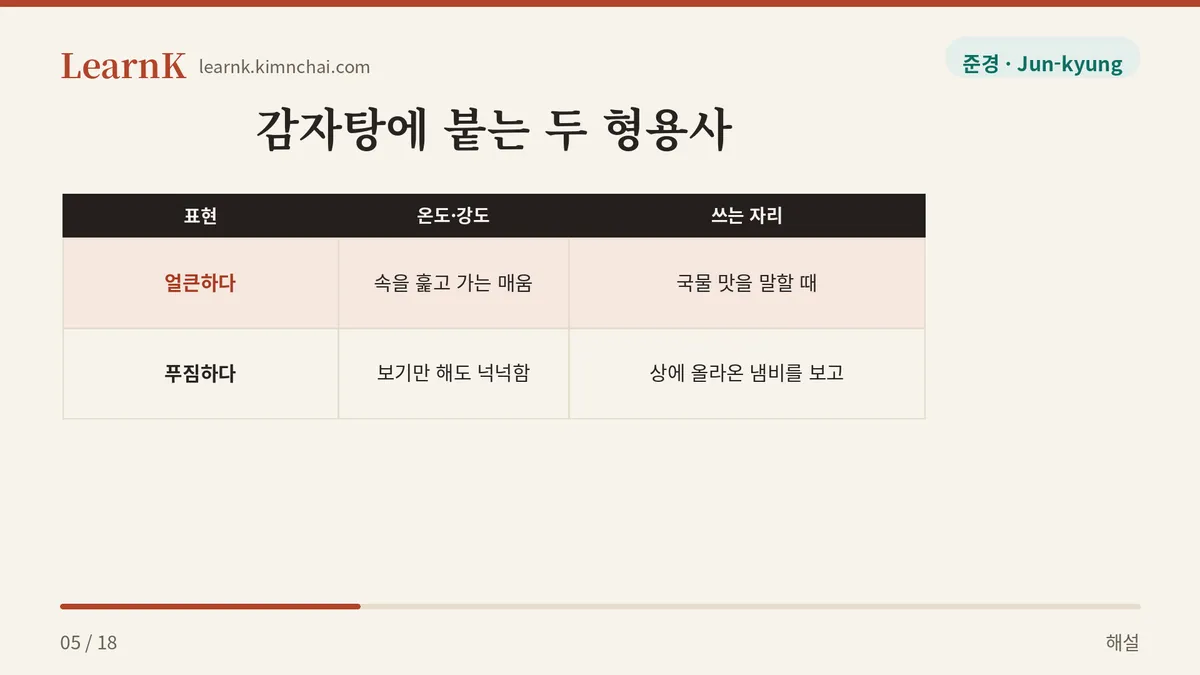
The name makes potatoes sound like the star, but what actually builds the broth is pork spine. The bones are simmered for a long time, and the resulting stock is seasoned with gochugaru (red pepper flakes), doenjang (soybean paste), and garlic. Big chunks of potato, 우거지 (ugeoji, outer cabbage leaves), perilla leaves, and green onion go on top, and finally a generous shower of perilla seed powder. That’s why the two adjectives Koreans attach to this dish most often are 얼큰하다 (eolkeunhada) and 푸짐하다 (pujimhada). 얼큰하다 (eolkeunhada) isn’t a heat that slaps your tongue — it’s the heat of a hot broth sweeping down through your insides. 푸짐하다 (pujimhada) means the portion is so generous that just looking at it fills you up. Memorize these two words together and you’ve already learned half of what you’ll say in a gamjatang restaurant.
Checking the National Institute of Korean Language Dictionary
감자탕 (gamjatang) 「noun」 A jjigae (stew) made by simmering pork spine with potatoes, perilla seeds, and assorted vegetables until spicy. — National Institute of Korean Language, Basic Korean Dictionary (krdict.korean.go.kr)
The dictionary also glosses the word in several other languages.
[en] gamjatang — Jjigae, stew, cooked in stock derived from the spine of a pig with potatoes, wild sesame, and other vegetables. [ja] カムジャタン — 豚の背骨にジャガイモ、エゴマなどの野菜を入れて辛く煮込んだチゲ料理。 [es] gamjatang, caldo picante de costillas de cerdo — Caldo picante con costillas de cerdo, patatas, sésamo silvestre, y variedad de verduras. [zh] 脊骨土豆汤 — 由猪脊骨、土豆、紫苏籽以及各种蔬菜所炖制而成的辣汤。 — National Institute of Korean Language, Basic Korean Dictionary (krdict.korean.go.kr)
Portuguese isn’t included in the dictionary, so we translated it ourselves (our own translation): gamjatang — ensopado coreano picante feito com espinhaço de porco, batatas, gergelim-selvagem (deulkkae) e diversos legumes.
Here are the real usage examples the dictionary lists alongside the entry.
감자탕을 먹다. (gamjatang-eul meokda) 감자탕을 끓이다. (gamjatang-eul kkeurida) 감자탕이 익다. (gamjatang-i ikda) 얼큰한 감자탕. (eolkeunhan gamjatang) 푸짐하고 맛있는 감자탕 어때요? (pujimhago masinneun gamjatang eottaeyo?) — National Institute of Korean Language, Basic Korean Dictionary (krdict.korean.go.kr)
- 감자탕을 먹다 (gamjatang-eul meokda) — “to eat gamjatang.” This is the most basic pairing. Remember that gamjatang is something you eat, not something you drink. Even if you’re only spooning up the broth, Korean treats the whole dish with 먹다 (meokda, to eat).
- 감자탕을 끓이다 (gamjatang-eul kkeurida) — “to cook (boil) gamjatang.” This is used not just for restaurants but for making it yourself at home. Since you have to soak the blood out of the bones and simmer them for hours, saying you’re cooking gamjatang at home means you’ve taken on a half-day project.
- 감자탕이 익다 (gamjatang-i ikda) — “the gamjatang is cooked through.” This one comes up while the pot is still bubbling on the burner at your table. It’s done when the meat slips easily off the bone, so you’ll naturally hear exchanges between customers and the owner like 「아직 안 익었어요, 조금만 더 끓이세요」 (“It’s not ready yet — let it boil a little longer”).
- 얼큰한 감자탕 (eolkeunhan gamjatang) — “spicy, warming gamjatang.” This is the most typical way to describe the dish. As in the dictionary’s example 「김 대리는 날씨도 춥고 해서 동료들과 함께 얼큰한 감자탕을 먹고 싶었다」 (“Since the weather was cold, Assistant Manager Kim wanted to eat some hot, spicy gamjatang with his coworkers”), cold weather and coworkers almost always come along for the ride.
- 푸짐하고 맛있는 감자탕 어때요? (pujimhago masinneun gamjatang eottaeyo?) — “How about some hearty, delicious gamjatang?” This is how you suggest a menu to someone. The polite ending -요 (-yo) plus 어때요? (eottaeyo?) turns it into a soft invitation that asks what the other person thinks.
Seeing It in a Real Conversation
Setting: 11 p.m. on a Friday. Overtime is over, and the only sign still lit in the alley behind the office is a 24-hour gamjatang place.
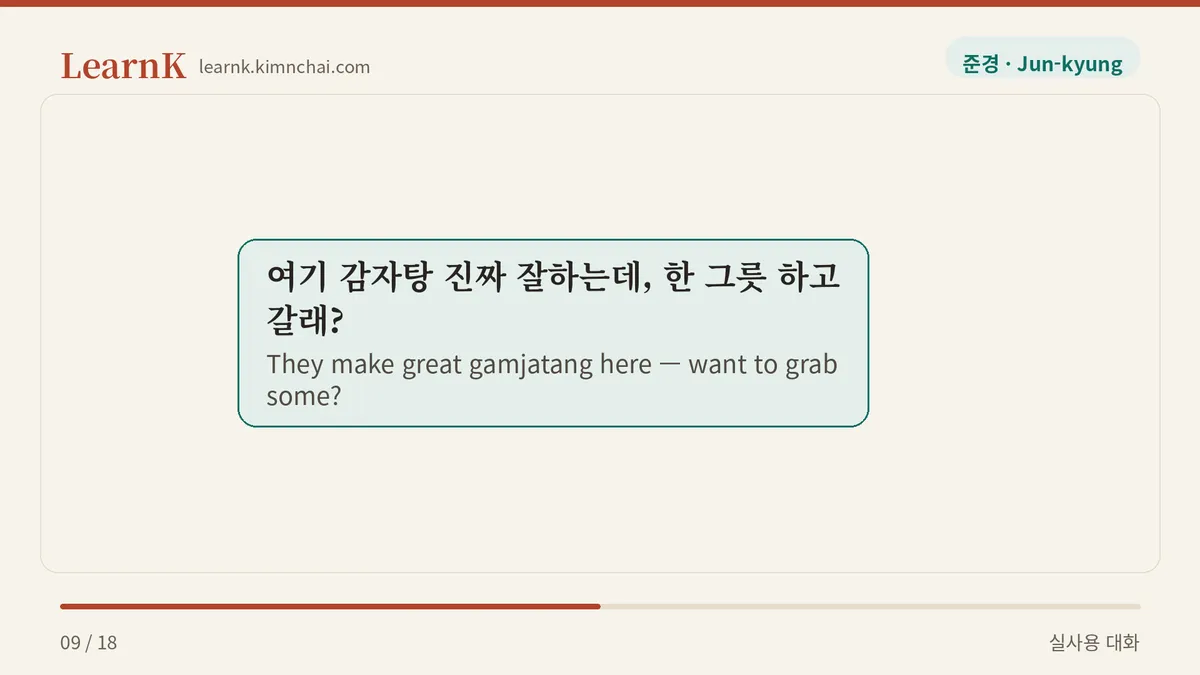
Jun-kyung: 아, 배고파 죽겠다. 여기 감자탕 진짜 잘하는데, 한 그릇 하고 갈래? Ah, I’m starving. They make really great gamjatang here — want to grab some before we head home?
Emily: 좋지. 근데 우리 둘인데 소자 시키면 양 괜찮아? Sure. But it’s just the two of us — will the small be enough?
Jun-kyung: 소자면 딱 맞아. 배고프면 이따 라면 사리 넣자. The small is just right. If we’re still hungry we’ll add ramyeon noodles later.
Emily: 난 뼈에 붙은 살 발라 먹는 게 제일 좋아. 솔직히 그것 때문에 감자탕 먹는 거야. My favorite part is picking the meat off the bones. Honestly, that’s the whole reason I eat gamjatang.
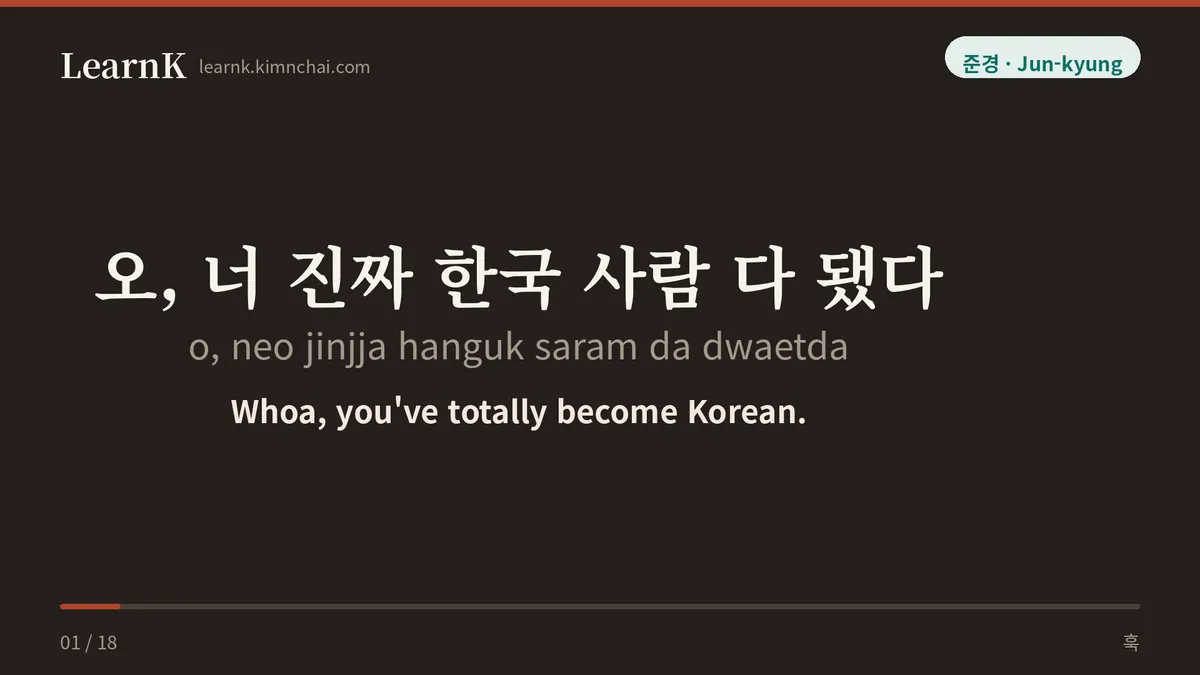
Jun-kyung: 오, 너 진짜 한국 사람 다 됐다. 들깨가루 더 넣어줄까? Whoa, you’ve turned into a real Korean. Want me to add more perilla powder?
Emily: 응, 듬뿍. 국물은 그래야 고소하지. Yeah, lots. That’s what makes the broth nutty.
This Sounds Off
Gamjatang is the name of a thing, so there’s no real risk of being rude with it — but there are two spots where the name itself misleads learners.
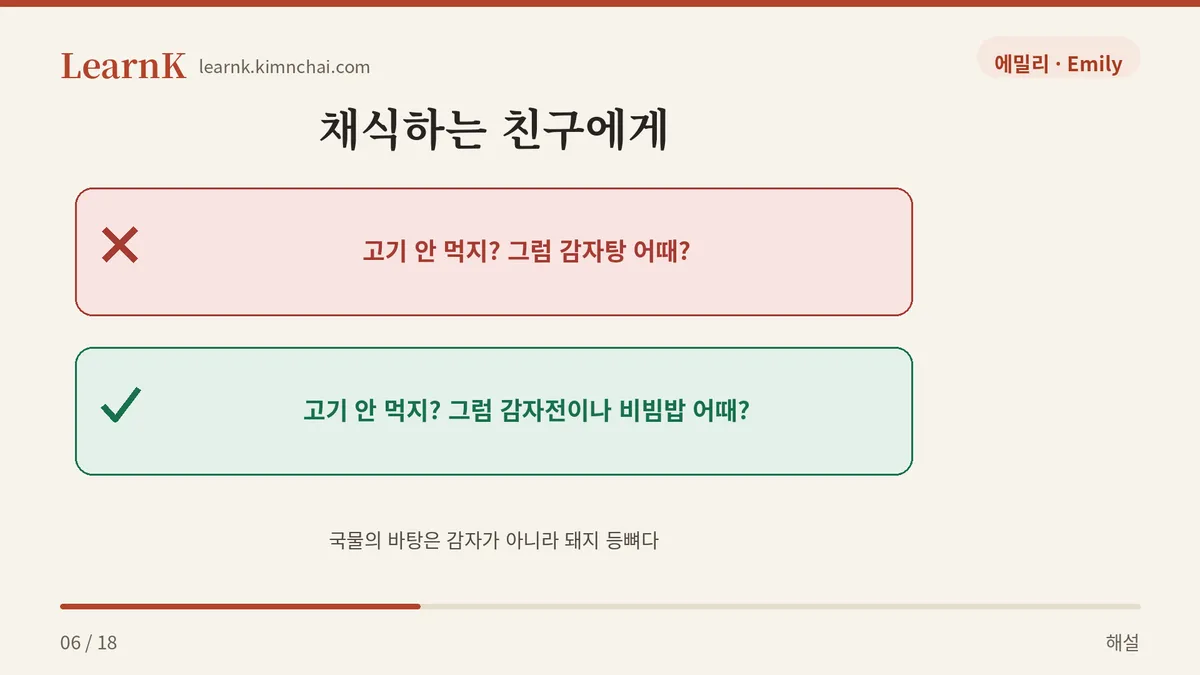
✗ (to a vegetarian friend) 너 고기 안 먹지? 그럼 감자탕 어때? 감자 요리잖아. (neo gogi an meokji? geureom gamjatang eottae? gamja yorijana.) — “You don’t eat meat, right? How about gamjatang, then? It’s a potato dish.” ✓ (to a vegetarian friend) 너 고기 안 먹지? 그럼 감자전이나 비빔밥 어때? (neo gogi an meokji? geureom gamjajeon-ina bibimbap eottae?) — “You don’t eat meat, right? How about gamjajeon (potato pancake) or bibimbap?” → Even though 감자 (gamja, potato) is right there in the name, the base of the broth is pork spine. The dictionary definition spells out the order clearly: “pork spine with potatoes added.” Gamjatang is a meat dish.
✗ (walking in alone) 사장님, 감자탕 1인분 주세요. (sajangnim, gamjatang irinbun juseyo.) — “Excuse me, one serving of gamjatang, please.” ✓ (walking in alone) 사장님, 뼈해장국 하나 주세요. (sajangnim, ppyeohaejangguk hana juseyo.) — “Excuse me, one ppyeohaejangguk, please.” → The grammar is fine, but it doesn’t fit the situation. Gamjatang comes to the table in the pot to be shared, so at many restaurants even the “small” starts at two servings. When you’re alone, the same flavors come in a single-serving earthenware pot under the name 뼈해장국 (ppyeohaejangguk).
Example Sentences by Situation
1. Suggesting dinner to a coworker on a cold day
오늘 같은 날엔 감자탕이죠. 퇴근하고 한 냄비 어때요? (oneul gateun naren gamjatangijyo. toegeunhago han naembi eottaeyo?) “A day like today calls for gamjatang, right? How about a pot after work?”
On the day of the first snow, or when the wind is biting, this is the most common suggestion you’ll hear in an office. The unit 한 냄비 (han naembi, one pot) tells you everything about the nature of this dish. It’s not “a bowl” — it’s “let’s empty a whole pot together.”
2. The day after drinking, to a friend (casual speech)
속 좀 풀게 감자탕 한 그릇 하러 갈까? 국물이 답이야. (sok jom pulge gamjatang han geureut hareo galkka? gungmuri dabiya.) “Want to go get some gamjatang to settle our stomachs? Broth is the answer.”
속을 풀다 (sogeul pulda) is an idiom for soothing a stomach upset by alcohol with hot broth. Gamjatang and this sentence travel together almost as a set.
3. At home, waiting in front of the pot
엄마, 감자탕 다 익었어요? 뼈에서 살이 아직 안 떨어져요. (eomma, gamjatang da igeosseoyo? ppyeoeseo sari ajik an tteoreojyeoyo.) “Mom, is the gamjatang done? The meat still isn’t coming off the bone.”
This takes the dictionary example 감자탕이 익다 (gamjatang-i ikda) and puts it into a real kitchen. It’s worth learning the test for doneness along with the phrase: whether the meat falls off the bone.
Polite vs. Casual Speech, and Related Expressions
The name of the food itself has no honorific form, but the verb you use with it changes. To a friend it’s 감자탕 먹으러 갈래? (gamjatang meogeureo gallae?), and to someone older or senior it’s 감자탕 드시러 가실래요? (gamjatang deusireo gasillaeyo?). Don’t miss that 먹다 (meokda) rises to 드시다 (deusida) and -ㄹ래 (-llae) rises to -실래요 (-sillaeyo) together.
| Expression | Temperature / Intensity | Where it’s used |
|---|---|---|
| 감자탕 (gamjatang) | Spicy-warming and heavy, hearty | Shared straight from the pot by a group. Work dinners, late-night meals, weekend family meals |
| 뼈해장국 (ppyeohaejangguk) | Same ingredients, on the milder side | When eating alone. A single-serving earthenware pot, served with rice |
| 감잣국 (gamjatguk) | Clear and mild | A home-style soup where potato really is the main ingredient. Similar name, completely different dish |
Cultural Background — Time Spent Picking the Bones
The word itself is a simple compound: 감자 (gamja, potato) plus 탕 (tang, 湯, a soupy dish). What’s interesting is that the name says 탕 (tang) while the dictionary definition calls it a 찌개 (jjigae). There’s plenty of broth, so it gets called a tang — but the way you set the pot on a burner at the table and keep it bubbling as you eat is closer to a jjigae.
Gamjatang restaurants are the shops that hold up the night in Korean cities. Many keep their lights on 24 hours, so people finishing overtime and people starting a dawn shift end up sitting across from each other at the same hour. The way you eat it makes the dish special, too. Chopsticks won’t do it — eventually you have to pick up the bone with your hands and strip the meat off, and that posture, apron on, broth on your fingers, breaks down formality between people fast. That’s why gamjatang restaurants show up so often in Korean dramas as the place where characters finally open up. Not at a nicely set table, but in front of a gamjatang pot with soju glasses beside it — that’s where the real conversation comes out.
Even the order of eating is practically fixed. First you fish out the spine and the potatoes; around the time the potatoes have soaked up the broth and start falling apart, you add ramyeon noodles or 수제비 (sujebi, hand-torn dough flakes). At the end, you turn the leftover broth into fried rice with rice, seaweed flakes, and sesame oil. One pot, three different meals. So when someone says “let’s go eat gamjatang,” there’s a quiet second meaning in it: let’s spend two or three hours together.
Today’s Quiz
It’s lunchtime, and you’ve walked into a gamjatang restaurant alone. At most places, which order sounds the most natural?
① 감자탕 1인분 주세요 (gamjatang irinbun juseyo) ② 뼈해장국 하나 주세요 (ppyeohaejangguk hana juseyo) ③ 감자탕 대(大)자 주세요 (gamjatang daeja juseyo)
Answer: ② Gamjatang is meant to be shared from the pot, so even the small usually starts at two servings. When you’re alone, you order 뼈해장국 (ppyeohaejangguk) — the same broth in a single-serving earthenware pot, served with rice. ③ is what you’d say with a group, and ① is grammatically correct but often won’t be accepted at the restaurant.
Definitions and example sentences are from the National Institute of Korean Language’s Basic Korean Dictionary (krdict.korean.go.kr); that portion of this post, including our translations, is licensed under CC BY-SA 2.0 KR.