강약약강 (gangyagyakgang) — Bowing to Those Above, Barking at Those Below
강약약강 (gangyagyakgang)
강약약강 (gangyagyakgang) describes the attitude of shrinking to nothing in front of powerful people and suddenly getting loud in front of weaker ones — or the kind of person who behaves that way. Pull the four syllables apart one at a time and the meaning is right there: 강 (gang, “strong”) → 약 (yak, “weak”), 약 (yak, “weak”) → 강 (gang, “strong”). Weak toward the strong, strong toward the weak.
Live in Korea for a while and the moment you need this word will definitely come. The customer at a restaurant who was jabbing a finger at the part-timer and talking down to her, then suddenly smiles and says “아이고, 제가 뭘요 (aigo, jega mwollyo)” — “Oh please, it was nothing” — the instant the manager walks over. The coworker who did nothing but nod at the boss for an entire meeting, then walks out the door and dumps all that swallowed anger on a junior. Ask a Korean person today to compress those two scenes into a single word and they will not hesitate. 강약약강 (gangyagyakgang).
The nuance is unmistakable. This is not an observation, it is an accusation. “저 사람 성격이 좀 급해 (jeo saram seonggyeogi jom geuphae)” — “he’s a bit impatient” — is an assessment of a trait. “저 사람 강약약강이야 (jeo saram gangyagyakgangiya)” is closer to a verdict on a person’s character, because it takes precise aim at one of the most looked-down-upon types of person in Korean society. Which is why the word is almost always passed around when the person in question isn’t there — between friends, between colleagues, or in the comments of an anonymous online community.
It looks like a 사자성어 (sajaseongeo), one of those four-character Sino-Korean idioms, but it isn’t one — it’s a coinage that was born on the internet and spread from there. It hasn’t been added to the Korean dictionary as a headword yet, so you don’t use it in formal writing like reports or official documents. Its matching opposite, 강강약약 (ganggangyagyak), describes someone who pushes back hard against the powerful and is gentle with the powerless — in other words, the highest compliment available. It’s best to memorize these two as a set.
It’s flexible grammatically. It works as a noun and as a predicate: “강약약강이다 (gangyagyakgangida)” (“he’s a gangyagyakgang”), “강약약강 스타일 (gangyagyakgang seutail)” (“the gangyagyakgang type”), “강약약강 오진다 (gangyagyakgang ojinda)” (“unbelievably gangyagyakgang” — 오진다 means it’s off the charts), “강약약강 그 자체 (gangyagyakgang geu jache)” (“gangyagyakgang personified”).
Seeing It in Real Conversation
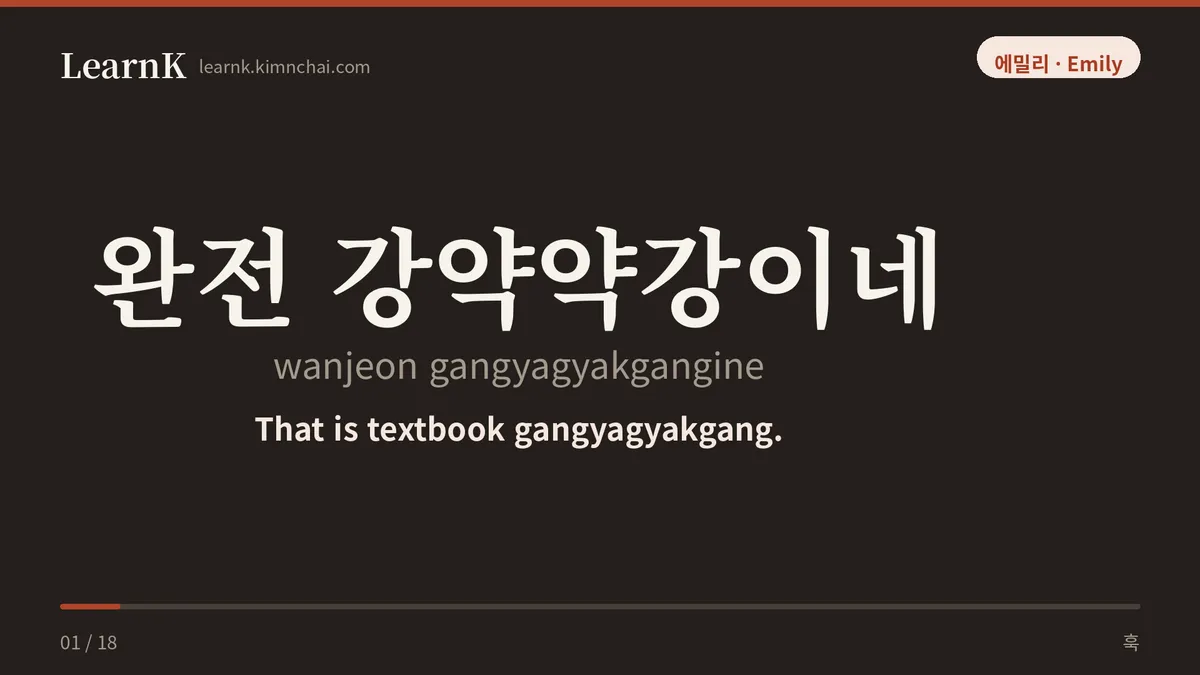
The scene: a Korean BBQ place on a Friday night. A customer at the next table has been yelling at a part-timer, and then the manager comes over and his voice suddenly goes soft and sweet.
Jun-kyung: 야, 봤지? 방금 목소리 확 바뀌는 거. Hey, did you see that? The way his voice just changed.
Emily: 아까 알바생한테는 야야 하더니. 완전 강약약강이네. A second ago he was barking “hey, you” at the part-timer. That is textbook gangyagyakgang.
Jun-kyung: 저런 사람이 제일 별로야. 회사에도 꼭 한 명씩 있어. That type is the worst. There is always one at every company.
Emily: 우리 팀장님은 반대야. 위에다 할 말 다 하고 우리한텐 진짜 잘해 주고. My team lead is the opposite. Says what needs saying to the higher-ups, and treats us really well.
Jun-kyung: 그게 강강약약이지. 야, 근데 너 아까 사장님 지나갈 때 자세 고쳐 앉지 않았어? That is gang-gang-yak-yak. Hey, but didn’t you straighten up when the owner walked past?
Emily: 야! 그건 예의지, 강약약강 아니야. Hey! That is just manners, not gangyagyakgang.
These Uses Sound Off
✗ (Said straight to your team lead) 팀장님, 팀장님은 좀 강약약강이세요. (Timjangnim, timjangnimeun jom gangyagyakgangiseyo. — “Team lead, you’re a bit gangyagyakgang.”)
✓ (Said to a coworker, just the two of you) 야, 우리 팀장님 좀 강약약강 아니냐? (Ya, uri timjangnim jom gangyagyakgang aninya? — “Hey, isn’t our team lead kind of gangyagyakgang?”)
→ The grammar is perfectly fine; the setting is wrong. This word is a verdict that cuts down who a person fundamentally is, so using it to someone’s face isn’t criticism — it’s a declaration of war. If you do need to raise the problem with the person directly, it’s safer to point only at the behavior: “저희한테도 그렇게 말씀해 주시면 좋겠습니다 (jeohuihantedo geureoke malsseumhae jusimyeon joketseumnida)” — “I’d appreciate it if you spoke to us that way too.”
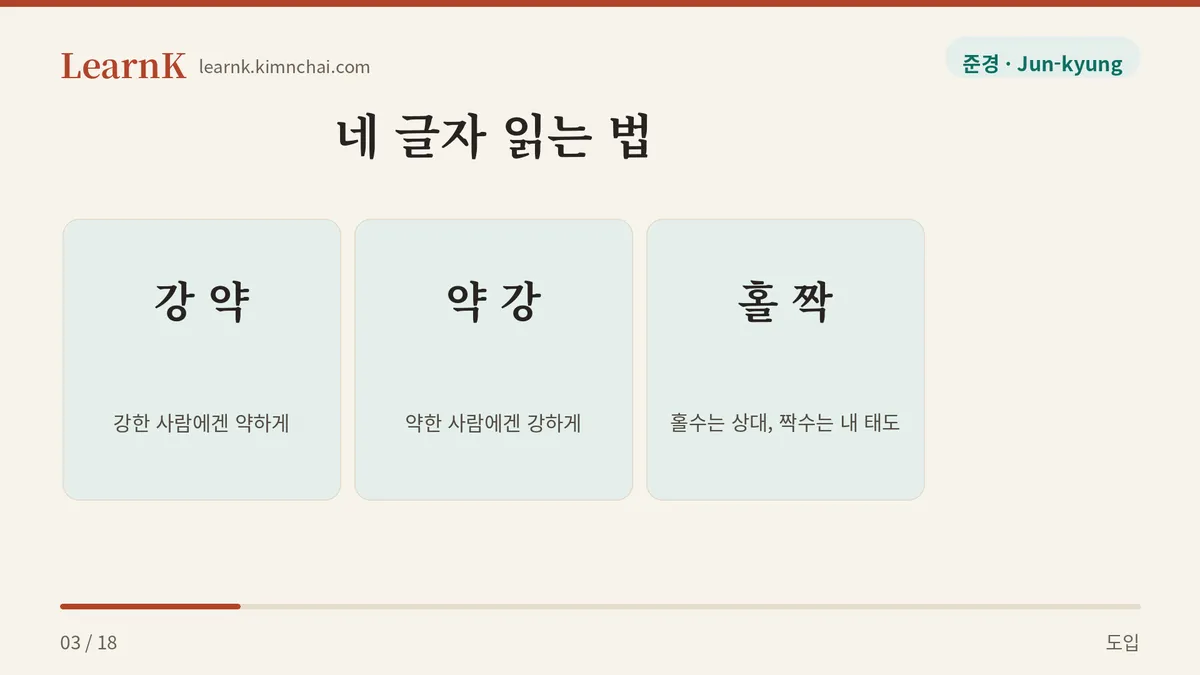
✗ 저 사람 할머니한테는 존댓말 쓰고 친구한텐 반말 쓰네. 완전 강약약강이다. (Jeo saram halmeonihanteneun jondaenmal sseugo chinguhanten banmal sseune. Wanjeon gangyagyakgangida. — “He uses polite speech with his grandmother and casual speech with his friends. Total gangyagyakgang.”)
✓ 저 사람 할머니한테는 존댓말 쓰고 친구한텐 반말 쓰네. 그냥 한국어 쓰는 거지. (Jeo saram halmeonihanteneun jondaenmal sseugo chinguhanten banmal sseune. Geunyang hangugeo sseuneun geoji. — “He uses polite speech with his grandmother and casual speech with his friends. That’s just… speaking Korean.”)
→ Changing your speech level depending on who you’re talking to is basic Korean grammar, not 강약약강 (gangyagyakgang). For this word to apply, what changes has to be not the speech style but the amount of respect. It’s only 강약약강 when someone pours all their courtesy onto the people with power and takes it back from the people without.
Example Sentences by Situation
1. After a meeting, between coworkers in the office kitchen
부장님 앞에서는 아무 말도 못 하더니 왜 우리한테만 저래? 진짜 강약약강이야. (bujangnim apeseoneun amu maldo mot hadeoni wae urihanteman jeorae? jinjja gangyagyakgangiya.) “He couldn’t say a word in front of the department head, so why is he like that only with us? He’s such a gangyagyakgang.”
This is where the word is born most often. What got swallowed in the meeting room comes bursting out in the kitchen. It’s casual speech, the voice is low, and there’s exactly one person listening.
2. A comment on a news article about how a company treats its customers
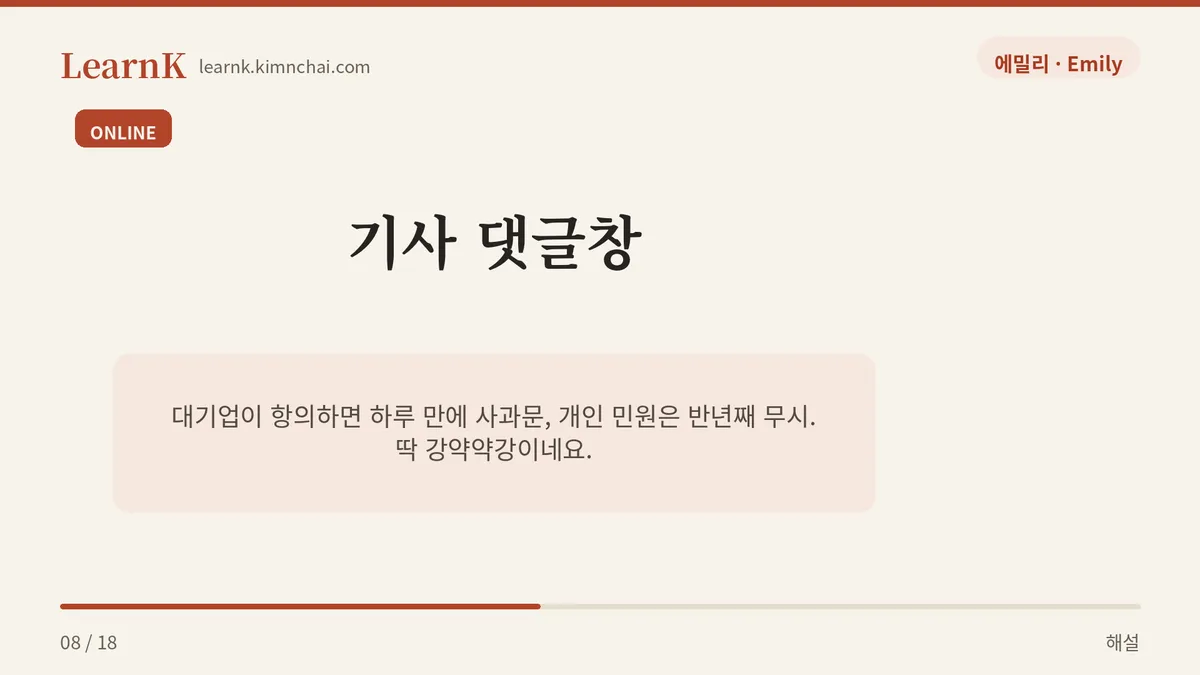
대기업이 항의하니까 하루 만에 사과문 올리고, 개인 소비자 민원은 반년째 무시하고. 딱 강약약강이네요. (daegieobi hangui hanikka haru mane sagwamun ollrigo, gaein sobija minwoneun banyeonjjae musihago. ttak gangyagyakgangineyo.) “A big corporation complains and they post an apology within a day, but individual consumer complaints get ignored for six months. That’s gangyagyakgang, exactly.”
It’s used for companies, institutions and governments too, not just people. In fact, these days it shows up even more often as criticism of organizations. Attaching a polite ending (-네요 / -neyo) doesn’t cool the accusation down at all.
3. Teasing a friend
넌 형 앞에서는 찍소리도 못 하면서 동생한테만 큰소리야. 강약약강 좀 그만해. (neon hyeong apeseoneun jjiksorido mot hamyeonseo dongsaenghanteman keunsoriya. gangyagyakgang jom geumanhae.) “You can’t make a peep in front of your older brother but you’re all loud with your younger one. Quit being such a gangyagyakgang.”
Among close friends it can be a joke like this. But that’s only true when the relationship can already absorb it with a laugh. Throw this joke at someone you’re only half-close with and nobody will be laughing.
Polite Speech, Casual Speech, and Related Expressions
You can technically build polite forms of it — “강약약강이시네요 (gangyagyakgangisineyo)”, “강약약강이신 것 같아요 (gangyagyakgangisin geot gatayo)”. But almost nobody actually says these. Wrapping it in polite endings doesn’t cushion anything, because the content is still an insult. If you really must express this idea in a formal setting, you unpack it into something like “상대에 따라 태도가 달라지시는 것 같습니다 (sangdaee ttara taedoga dallajisineun geot gatseumnida)” — “It seems your attitude changes depending on who you’re dealing with.”
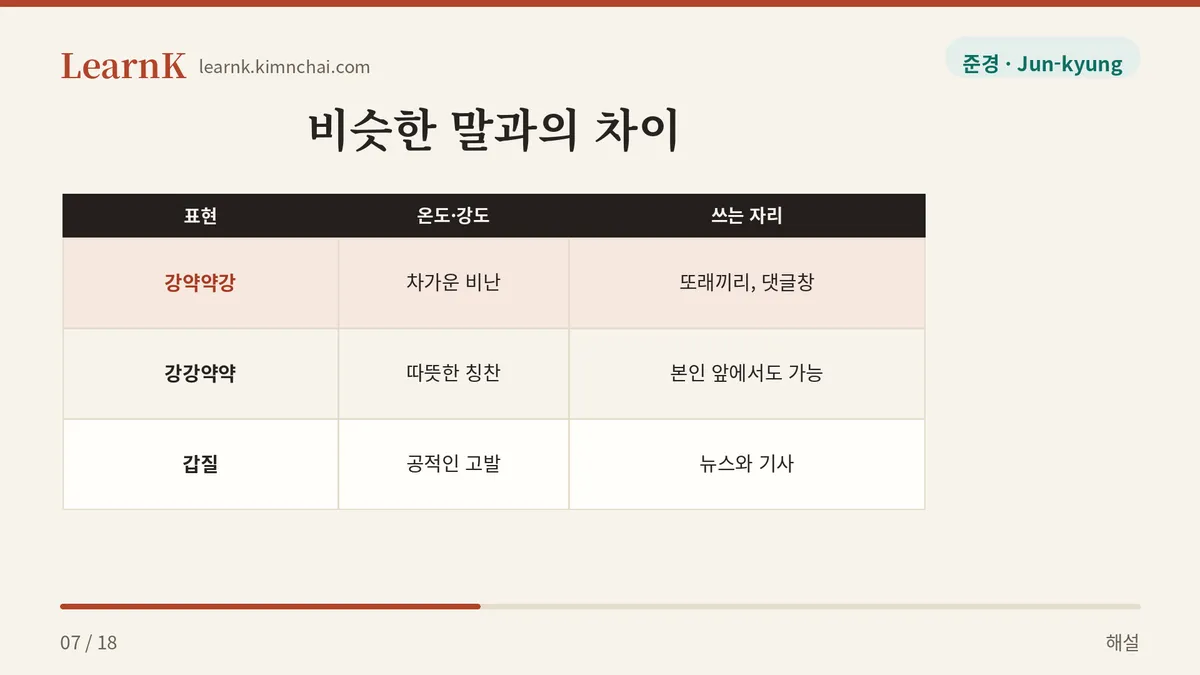
| Expression | Temperature / Intensity | Where it’s used |
|---|---|---|
| 강약약강 (gangyagyakgang) | Cold, unmistakable criticism | Among peers, in online comments. Never to the person’s face |
| 강강약약 (ganggangyagyak) | Warm praise | When you’re building someone up. Fine to say to their face |
| 갑질 (gapjil) | Heavy, public accusation | Abuse of power by the stronger side. Used in news and journalism too |
| 간에 붙었다 쓸개에 붙었다 (gane butteotda sseulgaee butteotda) | Critical, but old-fashioned | Someone who switches sides for their own gain. Favored by older generations |
It’s easy to mix up with 갑질 (gapjil), but the focus is different. 갑질 looks at one thing only: power swung downward. 강약약강 looks at the downward swing and the upward bow — at the drop between them. That’s why eyewitness accounts of it always come with a before-and-after contrast: “아까는 그러더니 (akkaneun geureodeoni)” — “and just a minute ago he was…”
Cultural Background — The Drop Packed Into Four Syllables
The way the word is built is transparent. Take the two Chinese characters 강 (强, strong) and 약 (弱, weak), alternate them, and borrow nothing but the shape of a four-character idiom. Once you’ve got the reading order, you can’t get confused. The odd-numbered syllables are the other person; the even-numbered syllables are your attitude. 강-약 means “to the strong, weak,” and the following 약-강 means “to the weak, strong.” Know that rule and 강강약약 (ganggangyagyak) decodes itself: to the strong, strong; to the weak, gentle.
Behind this word’s unusual staying power is Korean workplace culture. In organizations where age and rank divide everyone into a fine-grained hierarchy, a person who wears one face upward and another downward stands out unusually sharply — and is unusually hated. The middle-manager villain who appears in virtually every Korean office drama is exactly this type: bending 90 degrees at the waist in front of the CEO, then turning around and throwing documents at the new hire. Making the audience hate him doesn’t require a single line of dialogue; the camera only has to catch the one second in which his expression changes. 강약약강 is that one second transcribed into four syllables.
Flip it over and the word also tells you what kind of person Korean society wants. The fact that 강강약약 (ganggangyagyak) counts as the highest praise means people still hold precious the attitude of speaking up in the face of power and extending a hand to the weaker side. The moment someone calls another person 강약약강, the speaker is also telling you which of the two they want to be.
Today’s Quiz
Which of these three people counts as 강약약강 (gangyagyakgang)?
① The senior colleague who can’t get out a single word in front of the CEO but shouts only at the new hire ② The senior colleague who says what needs to be said even to the CEO and quietly buys the new hire a coffee ③ The senior colleague who is equally blunt and gruff with the CEO and the new hire alike
See the answer
The answer is ①. The whole point is the drop — shrinking toward those above, swelling toward those below. ② is the exact opposite, 강강약약 (ganggangyagyak), which is the praised side. ③ may be gruff, but their attitude doesn’t change based on who they’re facing, so it isn’t 강약약강. Remember that what this word targets isn’t whether an attitude is good or bad, but changing your attitude according to the other person’s power — that act itself.
Definitions and example sentences are from the National Institute of Korean Language’s Basic Korean Dictionary (krdict.korean.go.kr); that portion of this post, including our translations, is licensed under CC BY-SA 2.0 KR.