간이 크다 (gani keuda) — Why Does Korean Talk About Your Liver When It Means "Fearless"?
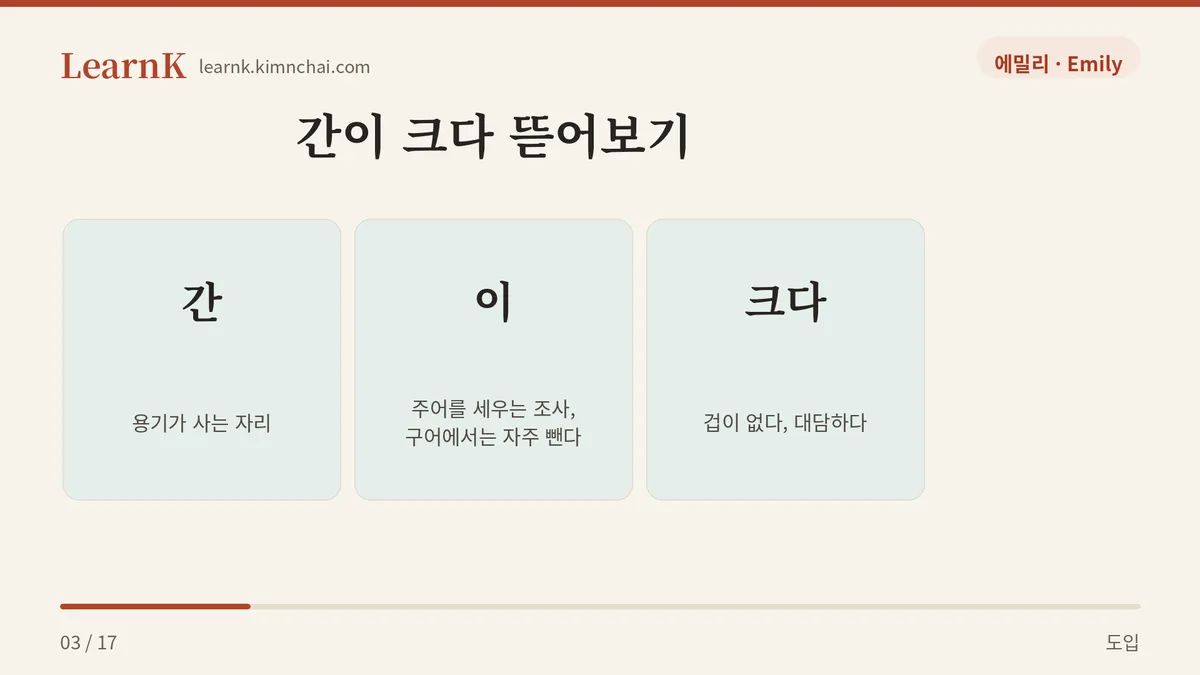
간이 크다
간이 크다 (gani keuda) means to be fearless and daring — to calmly go ahead and do the kind of thing an ordinary person would be too scared to attempt. A friend packing a suitcase when finals are three days away. Someone sending a large amount of money, first, to a person they’ve never laid eyes on. A new hire who point-by-point disagrees with the CEO’s proposal in a meeting during their first week on the job. Faced with scenes like these, the line Koreans blurt out — half impressed, half exasperated — is ‘야, 너 간 크다 (ya, neo gan keuda)’.
Translated word for word it comes out as “the liver is big,” so learners hearing it for the first time assume it’s a story about a health checkup. In Korean, the liver is where courage lives. So if you have no fear, your liver is big, and if you’re frightened, 간이 콩알만 해진다 (gani kongalman haejinda) — your liver shrinks to the size of a bean. We’ll come back to this way of picturing nerve as the size of an internal organ later on.
If you split the temperature of the phrase into numbers, it’s about 3 parts admiration, 4 parts worry, and 3 parts disbelief. In other words, it isn’t pure praise. Where ‘용감하다 (yonggamhada)’ — brave — describes someone who knows the danger and leaps toward the right thing anyway, ‘간이 크다’ comes out when someone looks like they never really did the math on the risk. That’s why the person who hears it feels a little proud and a little called out at the same time.
The form is flexible, too. Dropping the particle to get 간 크다 (gan keuda) is actually more common in speech, and speakers freely use the past tense 간이 컸다 (gani keotda), the exclamatory 간도 크다 (gando keuda), and even the noun-like 간 큰 사람 (gan keun saram) — “a big-liver person.”
See It in a Real Conversation
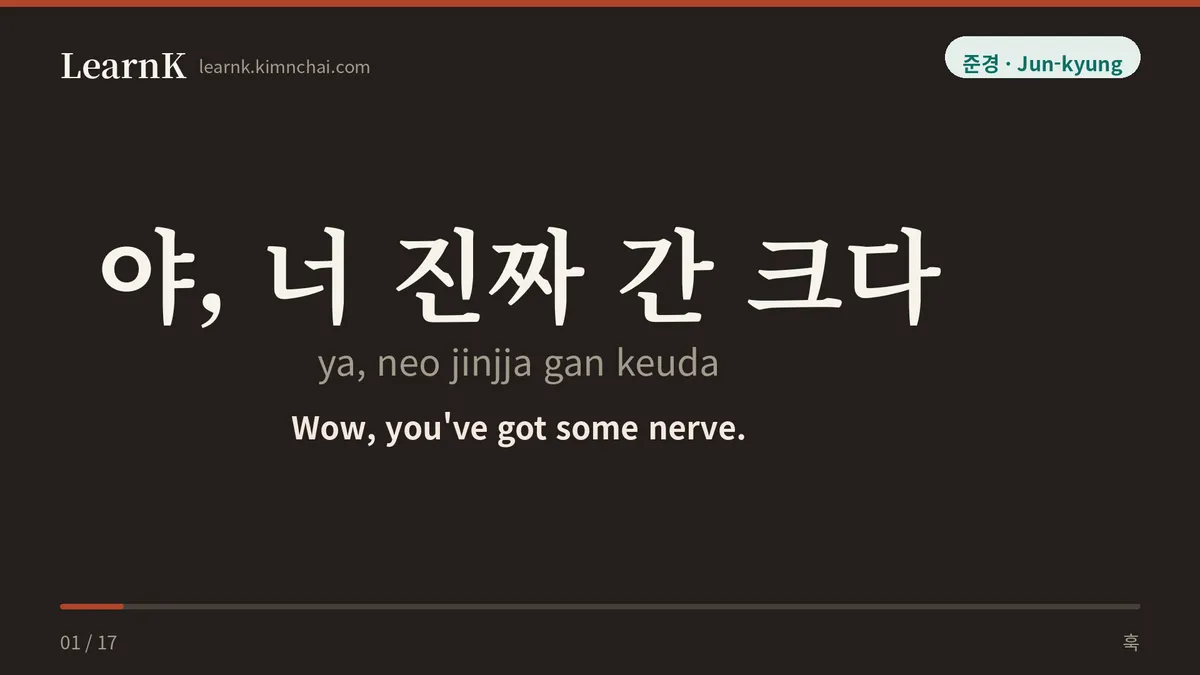
Situation: Saturday afternoon, in front of Exit 3 of the subway station. Emily has come out to pick up a laptop she bought secondhand — and she already sent the money yesterday.
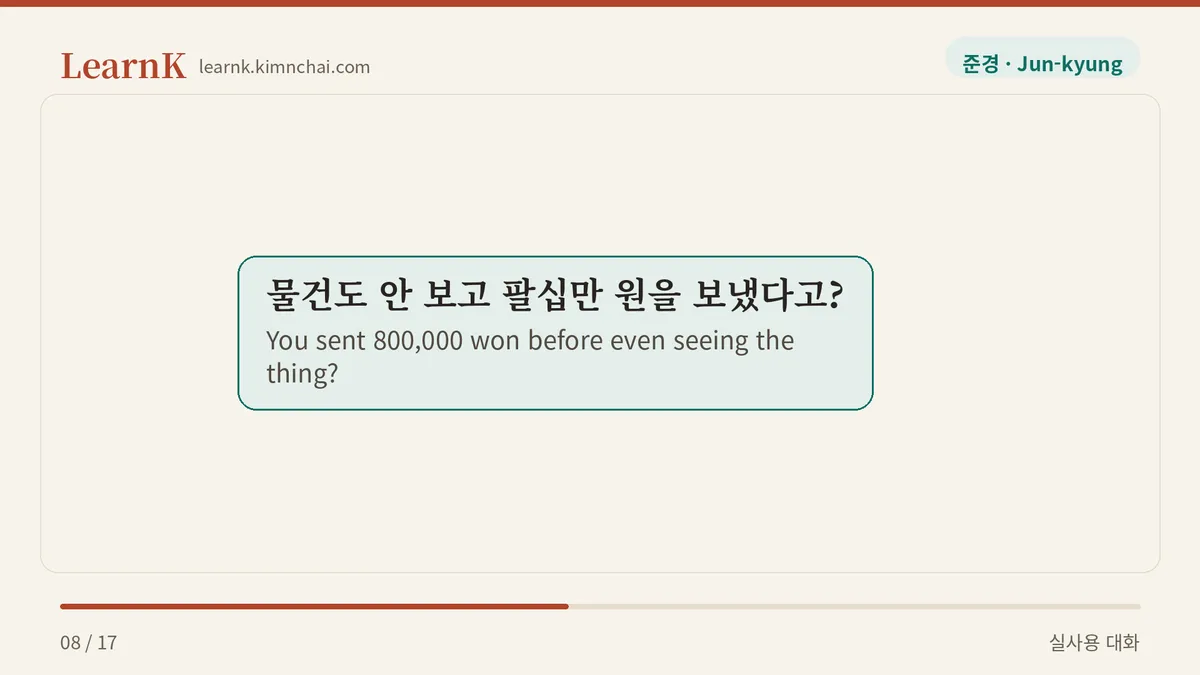
Jun-kyung: 뭐? 물건도 안 보고 팔십만 원을 먼저 보냈다고? What? You sent 800,000 won before even seeing the thing?
Emily: 응. 후기가 백 개 넘는 분이었어. 다른 사람한테 팔까 봐 급했지. Yeah. He had over a hundred reviews. I panicked he’d sell it to someone else.
Jun-kyung: 야, 너 진짜 간 크다. 나는 만 원짜리도 직거래만 해. Wow, you’ve got some nerve. I only do in-person deals, even for a 10,000-won item.
Emily: 어… 근데 약속 시간 십 분 지났다. Uh… it’s ten minutes past the meeting time, though.
Jun-kyung: 봐, 그러니까. 그렇게 간이 크면 언젠간 한 번 데여. See, that’s what I mean. Be that fearless and you’ll get burned eventually.
Emily: 방금까지 간이 컸는데 갑자기 콩알만 해지네… 어, 저기 뛰어오신다! My nerve was huge until a second ago and now it’s the size of a bean… oh, there he is, running!
These Uses Sound Off
✗ (to your department head) 부장님, 이번 결정 정말 간이 크셨어요. ✓ (to your department head) 부장님, 이번 결정 정말 과감하셨어요 (gwagamhasyeosseoyo). → The grammar is perfectly fine, but you’d be summing up a superior’s judgment as “something they recklessly went and did.” With people above you, 과감하다 (gwagamhada, bold/decisive) or 결단력 있다 (gyeoldallyeok itda, having resolve) is the safe choice.
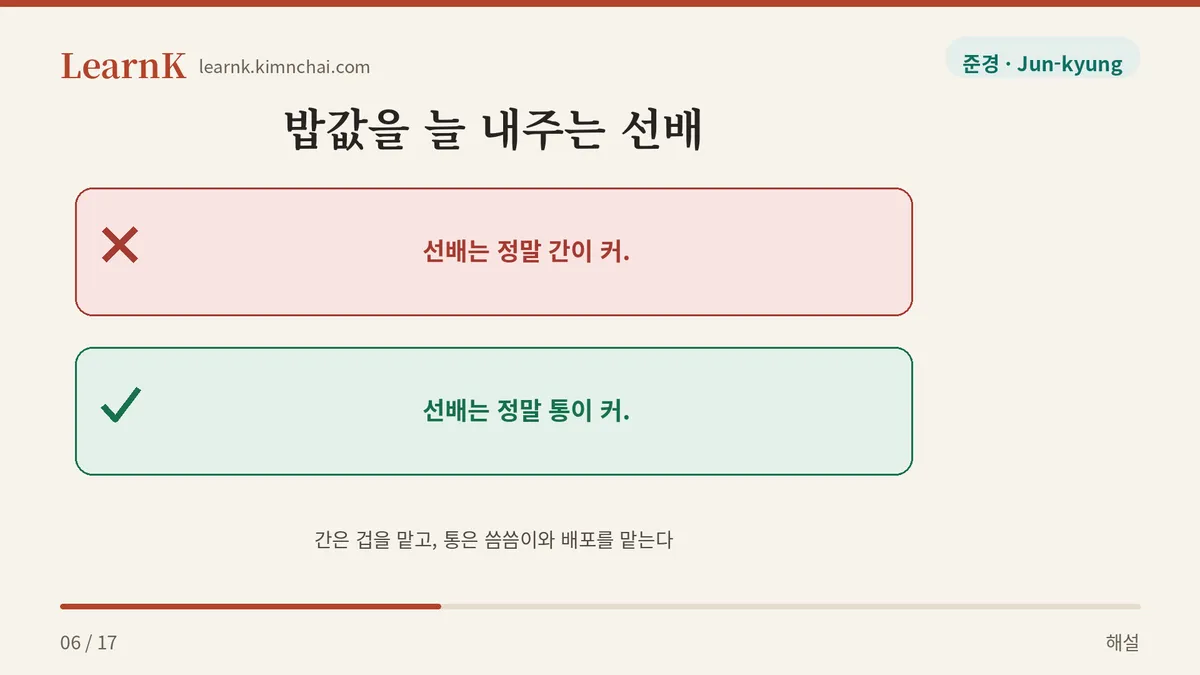
✗ 선배는 후배들 밥값을 늘 내주셔. 정말 간이 커. ✓ 선배는 후배들 밥값을 늘 내주셔. 정말 통이 커 (tongi keo). → This is the trip-up learners hit most often. 간이 크다 means “has no fear,” not “is generous with money.” Bigness of wallet or of heart is handled by 통이 크다 (tongi keuda).
Example Sentences by Situation
1) First week on the job, in the hallway after the all-hands meeting The new hire laid out point-by-point objections to the CEO’s proposal. As they leave the meeting room, a senior colleague grins and claps them on the shoulder.
“너 첫 주부터 간이 크네. 나는 3년 차에도 그 말 못 해.” (neo cheot jubuteo gani keune. naneun samnyeon chaedo geu mal mot hae.) You’ve got guts, in your very first week. I couldn’t say that even in my third year.
Here the admiration side is stronger. It isn’t a scolding — it’s an acknowledgment: “you did the thing I can’t do.” Said this way, the sentence rises at the end and comes with a laugh.
2) The day before finals, a beach photo shows up on a friend’s social media
“내일이 기말인데 지금 강릉? 간도 크다, 진짜.” (naeiri gimarinde jigeum Gangneung? gando keuda, jinjja.) Finals are tomorrow and you’re in Gangneung right now? You are unbelievably bold.
Here disbelief comes before admiration. Slipping in the particle ‘도 (do)’ as in ‘간도 크다’ adds a sarcastic flavor — “so that’s big too, huh.” Use it only with close friends.
3) At the dinner table, Mom has just checked the card payment text
“엄마 카드로 게임 아이템을 샀다고? 네가 간이 커도 너무 컸다.” (eomma kadeuro geim aitemeul satdago? nega gani keodo neomu keotda.) You bought game items with my card? You’ve gone way too far.
Same expression, but drop the voice a register and it becomes a telling-off. ‘간이 커도 너무 컸다’ sits at exactly the temperature just before the next stage up: 간덩이가 붓다 (gandeongiga butda), “your liver has swollen.”
Politeness Levels and Similar Expressions
This expression fundamentally lives in casual speech (반말, banmal). Add honorifics to make ‘간이 크시네요 (gani keusineyo)’ and the grammar checks out, but it will usually land as sarcasm. With people above you, it’s better to switch over to 대담하시다 (daedamhasida) or 과감하시다 (gwagamhasida); used toward someone younger or junior, on the other hand, it naturally reads as either admiration or a scolding.
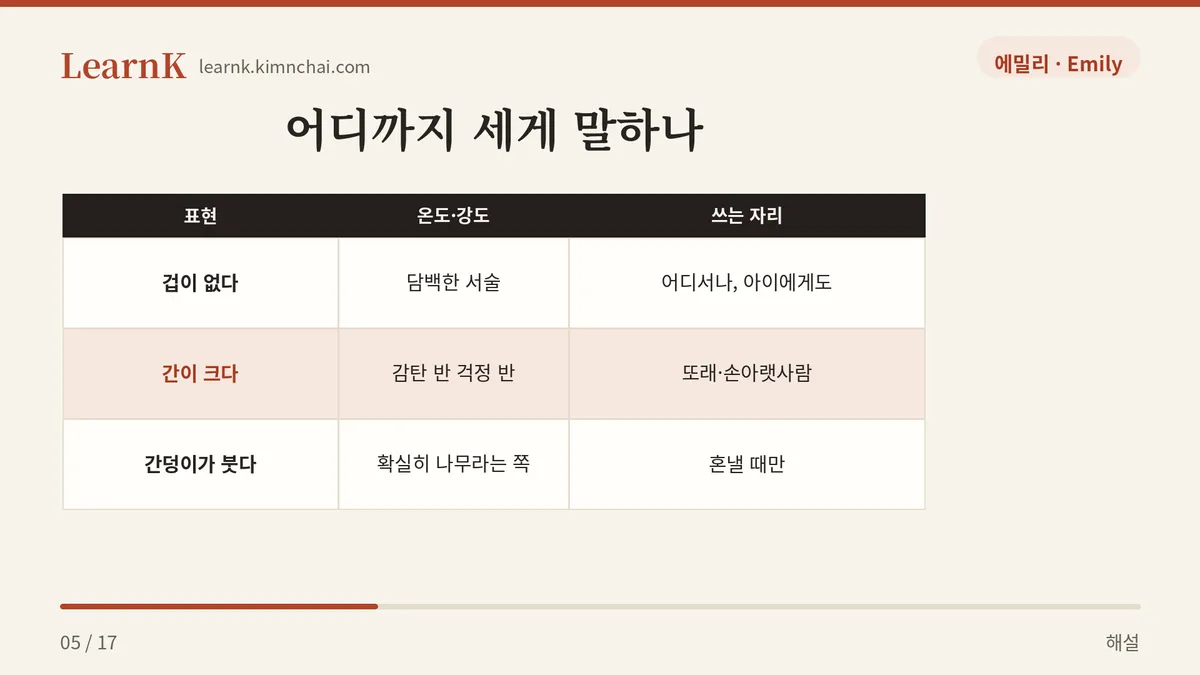
| Expression | Temperature / Intensity | Where it’s used |
|---|---|---|
| 간이 크다 (gani keuda) | Half admiration, half worry. Spoken | Peers and juniors. Not used for a superior’s judgment |
| 간덩이가 붓다 (gandeongiga butda) | Much stronger, firmly on the scolding side | Only when telling someone off. Never as praise |
| 겁이 없다 (geobi eopda) | Plain description | Anywhere. Even to children |
| 대담하다 (daedamhada) | Neutral, written register | Articles, evaluations, reports; fine for superiors |
| 통이 크다 (tongi keuda) | Different meaning (generosity, largeness of spirit) | Watch out for the mix-up |
Cultural Background — Where Fear Lives
Korean locates nerve not in the head but in the belly. If you have no fear, your liver is big; if you’re frightened, your liver shrinks to a bean; and if you’re startled enough to feel a chill down your spine, you say 간담이 서늘하다 (gandami seoneulhada). The 간담 (肝膽) there is the liver and the gallbladder. The 담 (膽) in the Sino-Korean word 대담(大膽)하다 (daedamhada) is also the gallbladder — so ‘담이 크다’ and ‘간이 크다’ turn out to be the same picture drawn twice, once in Chinese characters and once in native Korean. The old view in traditional Korean medicine, that the liver and gallbladder govern decisiveness and courage, is fossilized right there in the language.
Watch enough historical dramas and you’ll often see a scene where a subject risks his life to speak the truth before the king, and the enraged king thunders something like ‘네 간덩이가 부었구나 (ne gandeongiga bueotguna)’ — “your liver has swollen!” The funny part is that the thundering is, in fact, also an acknowledgment of the man’s guts. Today’s ‘간 크다’ inherited that doubleness intact. It’s a scolding that sounds like admiration, and admiration that sounds like worry.
So the right reaction when you hear it isn’t a straight face — it’s a laugh. When a Korean friend says “너 간 크다,” it generally means “you’re something else, but be careful,” so answering with something like “그러게, 나도 아까 좀 무서웠어 (geureoge, nado akka jom museowosseo)” — “right? I was a little scared back there too” — keeps the conversation rolling smoothly.
Today’s Quiz
Which of the following sentences uses ‘간이 크다’ naturally?
- 선배는 후배들 밥값을 늘 내주셔서 정말 간이 커.
- 태풍 오는 날 낚시를 갔다고? 너 간 진짜 크다.
- 부장님, 이번 결정 정말 간이 크셨어요.
Show the answer
Answer: number 2. It’s something done without fear of the danger, so it fits perfectly. Number 1 is about generosity with money, so it should be ‘통이 커’, and number 3 sums up a superior’s judgment as “a fearless stunt,” so ‘과감하셨습니다 (gwagamhasyeotseumnida)’ is the right call.
All of the definitions, example sentences, and dialogue in this post are our own original writing. (A search of the National Institute of Korean Language’s Basic Korean Dictionary returns no headword for ‘간이 크다’, so no dictionary quotation section and no dictionary source credit are included.)