갑툭튀 (gaptuktwi) — When Something Pops Up Out of Nowhere
You’re walking down a quiet alley at night when a cat suddenly darts out from behind a wall. You’re creeping through an empty hallway in a game when a zombie bursts straight through the wall at you. An old classmate you haven’t heard from in years abruptly shows up in the group chat. These moments — when something appears right in front of you, suddenly, with no warning at all — get handled by Koreans these days with one short word. Today’s expression: 갑툭튀 (gaptuktwi).
This is a living piece of slang you’ll see dozens of times a day in drama-review comments, gaming streams, and variety-show captions. Once you know what it means, watching Korean content brings a lot more of those little “ah, that’s what they call this scene” moments.
갑툭튀
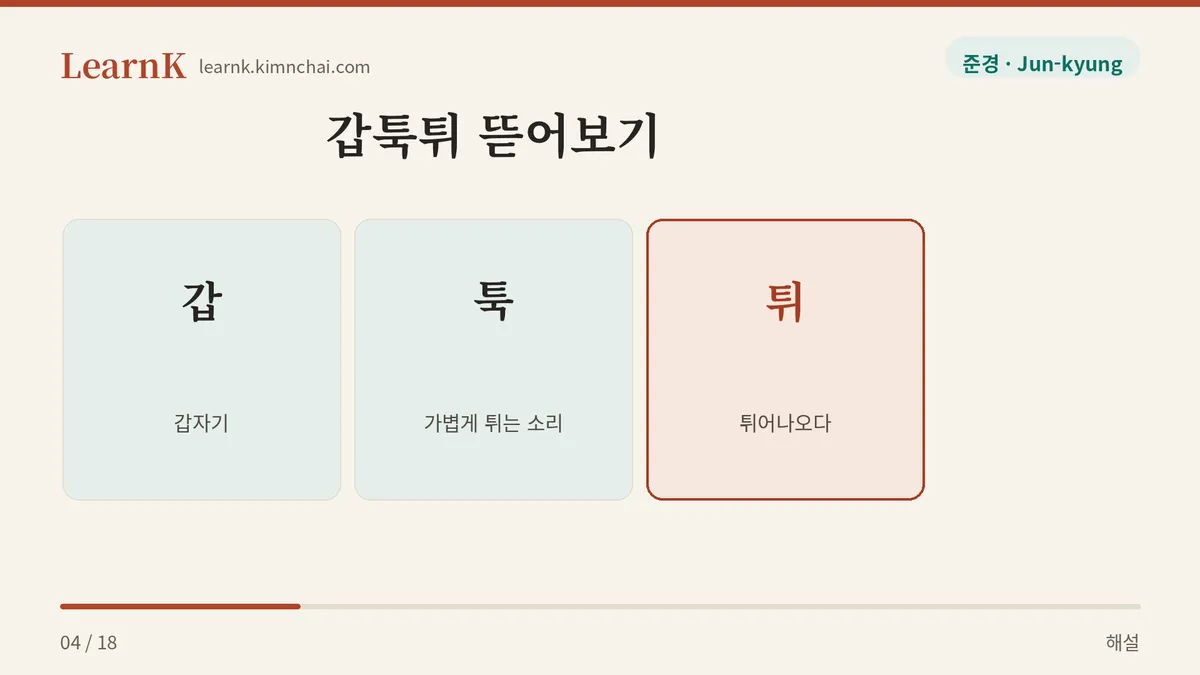
갑툭튀 (gaptuktwi) looks like a four-syllable word, but it’s actually a whole sentence compressed into one. Break down each syllable and here’s what you get:
- 갑(자기) → 갑자기 (gapjagi, suddenly)
- 툭 → 툭 (tuk, a word for the sound or look of something lightly popping out or bumping)
- 튀(어나오다) → 튀어나오다 (twieonaoda, to pop/jump out)
In other words, it’s an abbreviation made by taking the first syllable of each part of “갑자기 툭 튀어나오다” (gapjagi tuk twieonaoda, to suddenly pop out). It isn’t a standard word listed in the dictionary — it’s slang that took root naturally in internet and everyday conversation.
The heart of the nuance is “an unexpected appearance.” You use it when a person, thing, or situation you never saw coming suddenly shows up and startles or flusters you. Whether it feels good or bad depends on the moment. It can be scary, like a zombie in a horror game; it can be happy, like a welcome face appearing; or it can be baffling, because the appearance came out of nowhere. The one thing they all share is this — it’s an appearance you didn’t expect.
Seeing It in a Real Conversation

Scene: Friday night, in Jun-kyung’s living room. Emily is playing a horror game while Jun-kyung watches from beside her.
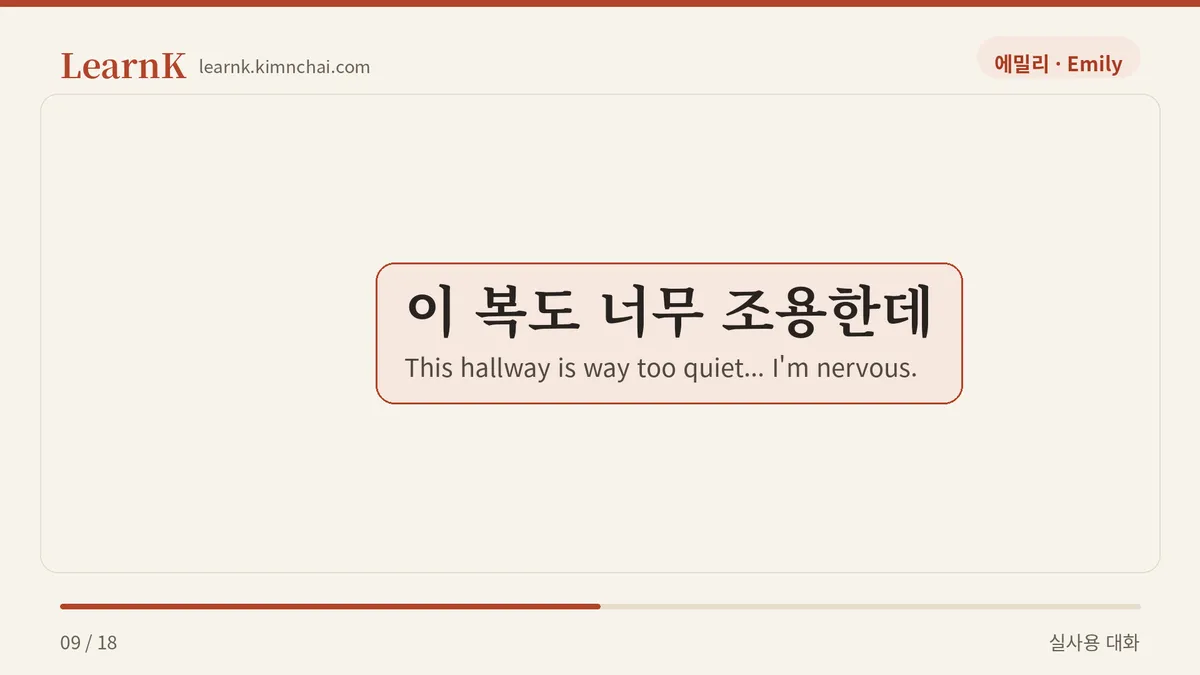
에밀리: 이 복도 너무 조용한데… 뭔가 나올 것 같아, 불안해. This hallway is way too quiet… something’s about to come out, I’m nervous.
준경: 야, 천천히 가. 그런 데서 꼭 갑툭튀 하거든. Hey, go slow. That’s exactly the kind of spot where stuff pops out of nowhere.
에밀리: 으악! 뭐야 방금! 아 진짜 심장 떨어질 뻔했어! Aaah! What was that just now! Ugh, I seriously almost had a heart attack!
준경: 거봐, 내가 갑툭튀 한다 그랬지. 좀비가 벽에서 튀어나왔잖아. See, I told you it’d pop out. The zombie jumped out of the wall.
에밀리: 이런 갑툭튀 는 심장에 너무 안 좋아. 나 이제 이 게임 못 하겠어. These jump-scare moments are so bad for the heart. I can’t play this game anymore.
준경: ㅋㅋ 겁 많은 거 다 티 나. 딱 한 판만 더 하자, 응? Haha, your scaredy side is totally showing. Just one more round, okay?
How to Use It in Different Situations
갑툭튀 attaches to people, things, and situations alike. Let’s look at it situation by situation.
① When a person shows up without warning
길 가다가 헤어진 옛 친구가 갑툭튀 해서 완전 어색했어. (gil gada-ga heeojin yet chinguga gaptuktwi hae-seo wanjeon eosaekhae-sseo.) — I ran into an old friend I’d drifted apart from popping up out of nowhere on the street, and it was totally awkward.
This is the flustered situation where someone you never imagined bumping into appears right in front of you. It’s often used as a verb by adding -하다 (-hada) to the end, as in ‘갑툭튀하다’.
② A plot twist in a story or piece of content
드라마 마지막 회에서 죽은 줄 알았던 인물이 갑툭튀 했다. (deurama majimak hoe-eseo jugeun jul aratdeon inmuri gaptuktwi haetda.) — In the drama’s final episode, a character everyone thought was dead popped up out of nowhere.
This points to an unexpected twist appearance. In webtoon and movie reviews, saying “this character 갑툭튀’d” is really common.
③ When a task or agenda item suddenly cuts in
회의 다 끝난 줄 알았는데 안건이 하나 갑툭튀 했다. (hoeui da kkeutnan jul aratneunde angeoni hana gaptuktwi haetda.) — I thought the meeting was completely over, but one more agenda item popped up out of nowhere.
This is the slightly annoyed situation where a new item abruptly jumps out of something you thought was finished.
Note That It’s Casual Slang — Plus Some Similar Expressions
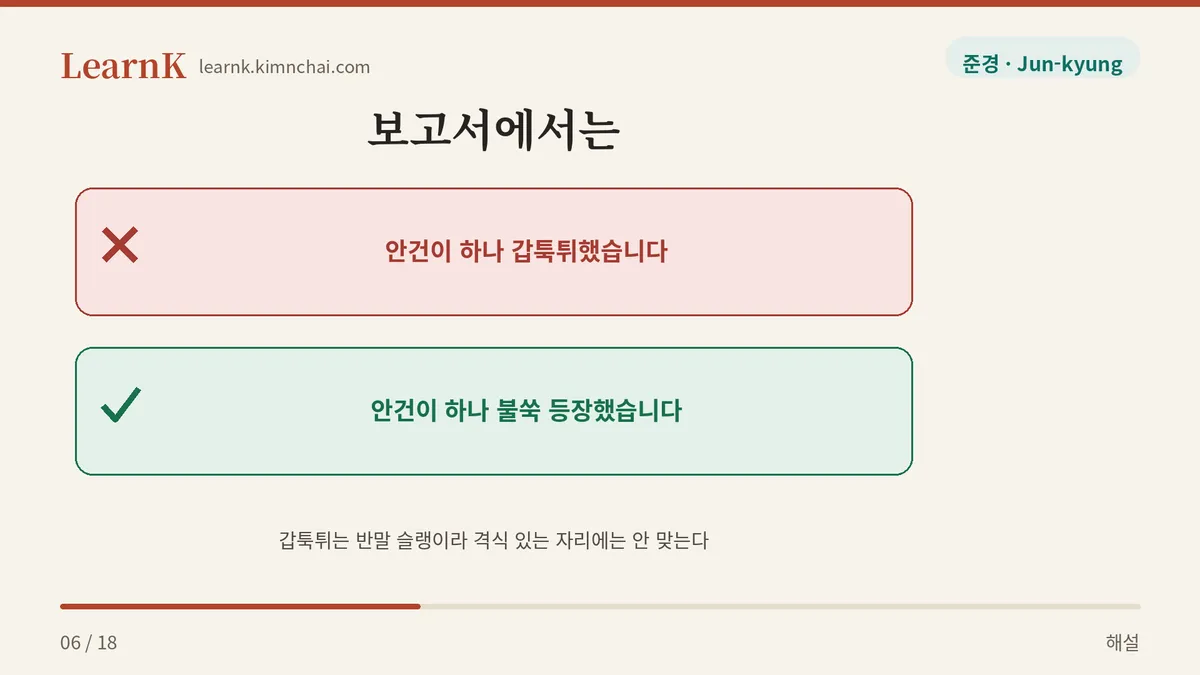
갑툭튀 is informal casual speech and slang (반말·슬랭). It’s a perfect fit among friends or in lighthearted online comments, but it doesn’t belong in a company report or in polite speech to your elders. In formal settings, you spell it out like this:
- Casual/spoken: 갑툭튀했어 (gaptuktwi-hae-sseo)
- Formal/written: 갑자기 나타났습니다 (gapjagi natanatseumnida) / 불쑥 등장했습니다 (bulssuk deungjanghaetseumnida)
It’s also worth learning some similar expressions:
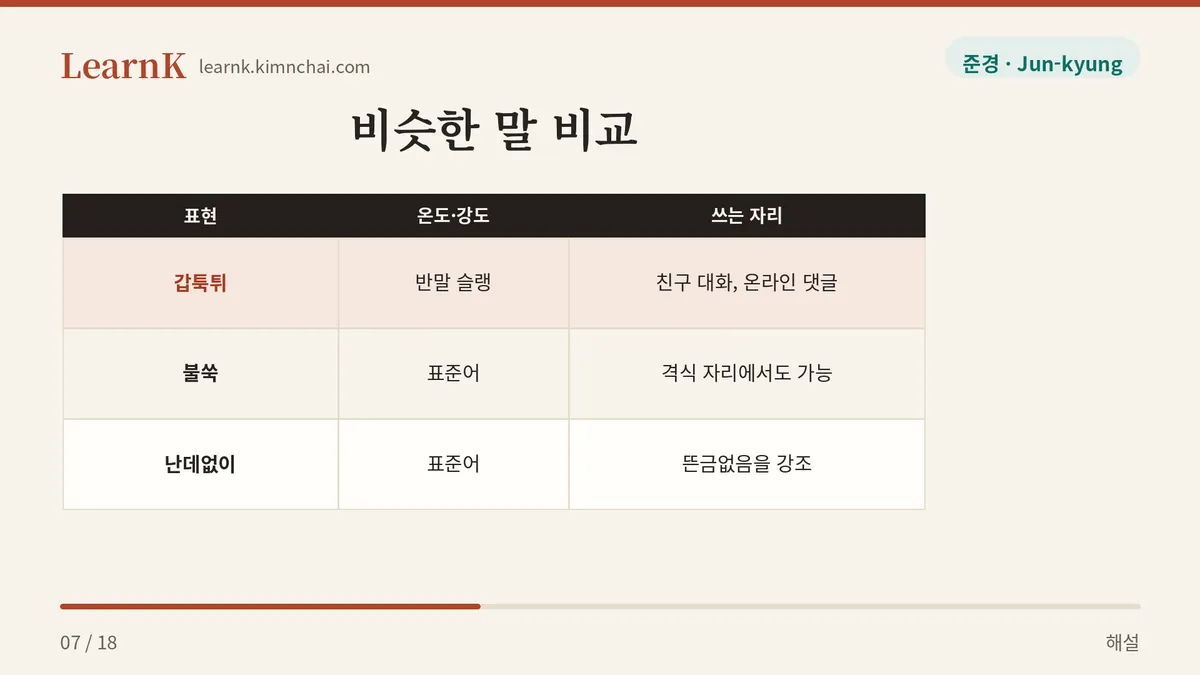
- 불쑥 (bulssuk): the look of popping up abruptly without warning. It’s the closest to 갑툭튀, but since it’s a standard word, you can use it in formal settings too.
- 난데없이 (nandeeopsi): “out of nowhere, with no telling where it came from.” It emphasizes how out-of-the-blue the appearance is.
- 뜬금없이 (tteungeumeopsi): popping up totally out of context. It’s used not just for appearances but for out-of-place remarks and behavior too.
Compared to these three, 갑툭튀 is younger, more casual, and carries a stronger sense of surprise.
Where This Word Lives — In Games and On Screen
By far the liveliest stage for 갑툭튀 is games and video. In Korea, a “jump scare” scene in a horror game or thriller movie — where something suddenly leaps out and startles the audience — is simply called a ‘갑툭튀 장면 (gaptuktwi jangmyeon, a 갑툭튀 scene)’. And when an unexpected guest shows up on a variety show, a big ‘갑툭튀!’ will sometimes flash across the caption at the bottom of the screen.
So the benefit of knowing this word is clear — when you watch a Korean drama’s twist, hear the screams in a gaming stream, or catch a surprise entrance on a variety show, you’ll feel that moment with the exact same word Koreans do. One expression can change the way your eyes take in the screen.
Closing Quiz
A friend says, “어제 편의점 갔는데 몇 년 만에 첫사랑이 ______ 해서 심장 멎는 줄 알았어” (“I went to the convenience store yesterday and my first love, whom I hadn’t seen in years, ______, and I thought my heart was going to stop”). What’s today’s slang word — the one meaning ‘suddenly appeared with no warning at all’ — that fills in the blank?
(Answer: 갑툭튀 — short for ‘갑자기 툭 튀어나오다 (gapjagi tuk twieonaoda, to suddenly pop out)’!)