갓벽 (gatbyeok) — What Koreans Say When '완벽 (wanbyeok)' Just Isn't Enough
갓벽 (gatbyeok)
갓벽 (gatbyeok) is an internet coinage that takes 완벽 (wanbyeok) — “perfect” — and pushes it one notch higher. 갓벽 means “so perfect it doesn’t look like human handiwork, as if a god had a hand in it.” The 갓 (gat) stuck on the front is the English word God transcribed straight into Hangul, so the word isn’t simply saying “flawless” — it comes with a gasp layered on top: hold on, this isn’t from the human realm, is it?
That’s why the places this word turns up are fairly predictable. Right after a favorite singer’s stage ends. The moment you check a photo you happened to nail. When an unplanned schedule falls into place unbelievably well. In other words, it’s a word that bursts out when your feelings are already running high, not one you use while sitting calmly and appraising something. If you’re flipping through paperwork in a meeting room and say 이 문서 갓벽하네요 (i munseo gatbyeokhaneyo), “this document is godlike,” the person listening will pause for a beat. The word simply runs too hot for that room.
Grammatically, it’s quite flexible. You can toss it out on its own like a noun (갓벽 (gatbyeok)), or attach -하다 to use it as a predicate (갓벽하다 (gatbyeokhada), 갓벽해 (gatbyeokhae), 갓벽했어 (gatbyeokhaesseo)). To modify a noun it becomes 갓벽한 (gatbyeokhan) — as in 갓벽한 하루 (gatbyeokhan haru), “a perfect day,” or 갓벽한 조합 (gatbyeokhan johap), “a perfect combination.” That said, an honorific form like 갓벽하십니다 (gatbyeokhasimnida) is something you can build grammatically but almost never hear in practice. We’ll come back to this later, but this word does not sit well with honorifics.
One more thing. A bit of exaggeration is baked into this word from the very start. So while it’s used for genuine admiration, it also gets twisted slightly when a situation lines up ironically. If you left your umbrella at home on a rainy day and then missed your bus on top of that, you might say 타이밍 갓벽하네 (taiming gatbyeokhane), “perfect timing.” Here it isn’t praise at all but something closer to self-mockery. Tone of voice and facial expression are what decide which one it is.
Seeing It in Real Conversation
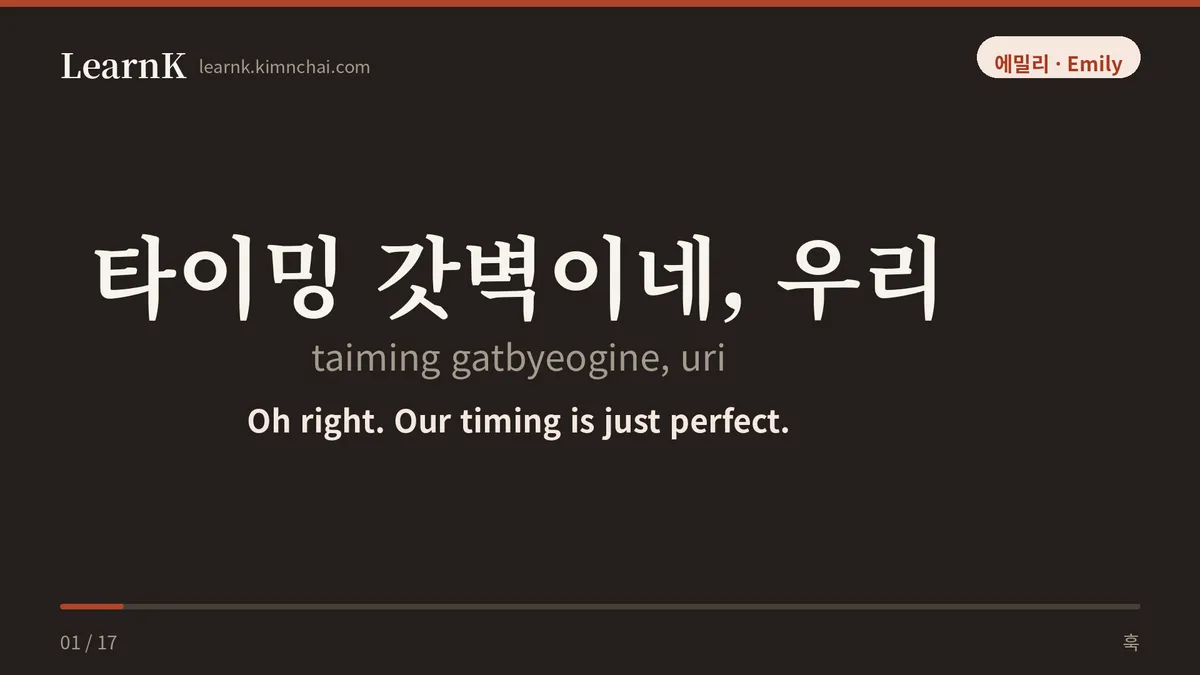
Scene: 10 p.m. on a Saturday, in front of a gymnasium where a concert has just let out. At an exit with people pouring through it, Jun-kyung is waiting for Emily.
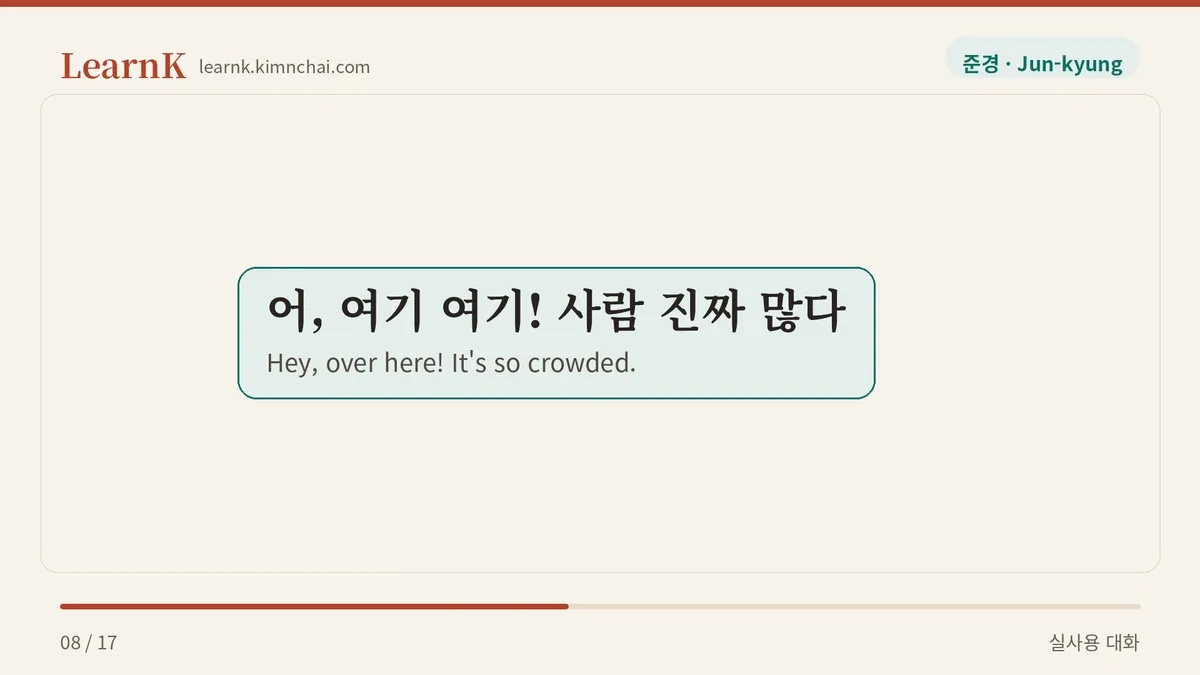
Jun-kyung: 어, 여기 여기! 사람 진짜 많다. 어땠어? Hey, over here! It’s so crowded. How was it?
Emily: 야, 말도 마. 마지막 곡 무대가 갓벽이었어. Oh man, don’t even ask. The last song’s stage was absolutely godlike.
Jun-kyung: 그렇게 좋았어? 너 목소리 벌써 다 쉬었는데. Was it that good? Your voice is already completely gone.
Emily: 조명이 딱 그 박자에 떨어지는데 소름 돋았다니까. 진짜 갓벽했어. The lights dropped right on the beat — I got chills. It was seriously perfect.
Jun-kyung: 알겠어 알겠어. 근데 우리 막차 십 분 남았다. Okay, okay. But we’ve got ten minutes till the last train.
Emily: 아 맞다. 타이밍 갓벽이네, 우리. Oh right. Our timing is just perfect.
Take a close look at that last line. It’s the same word, but the temperature is different from the two before it. The first two are sincere admiration; the last one is the self-mocking “of all the moments for this.” Korean speakers slide between these two readings of a single word without giving it a second thought.
When It Sounds Off
✗ (to your department head) 부장님, 이번 기획안 갓벽하십니다. (bujangnim, ibeon gihoegan gatbyeokhasimnida.) ✓ (to a colleague) 야, 이번 기획안 갓벽하던데? (ya, ibeon gihoegan gatbyeokhadeonde?) → It’s an exaggerated slang term born online, so aiming it at someone senior lands less like praise and more like clowning around. With people above you, 흠잡을 데가 없습니다 (heumjabeul dega eopseumnida), “there’s nothing to fault,” or 정말 완성도가 높습니다 (jeongmal wanseongdoga nopseumnida), “it’s really well put together,” is the safer choice.
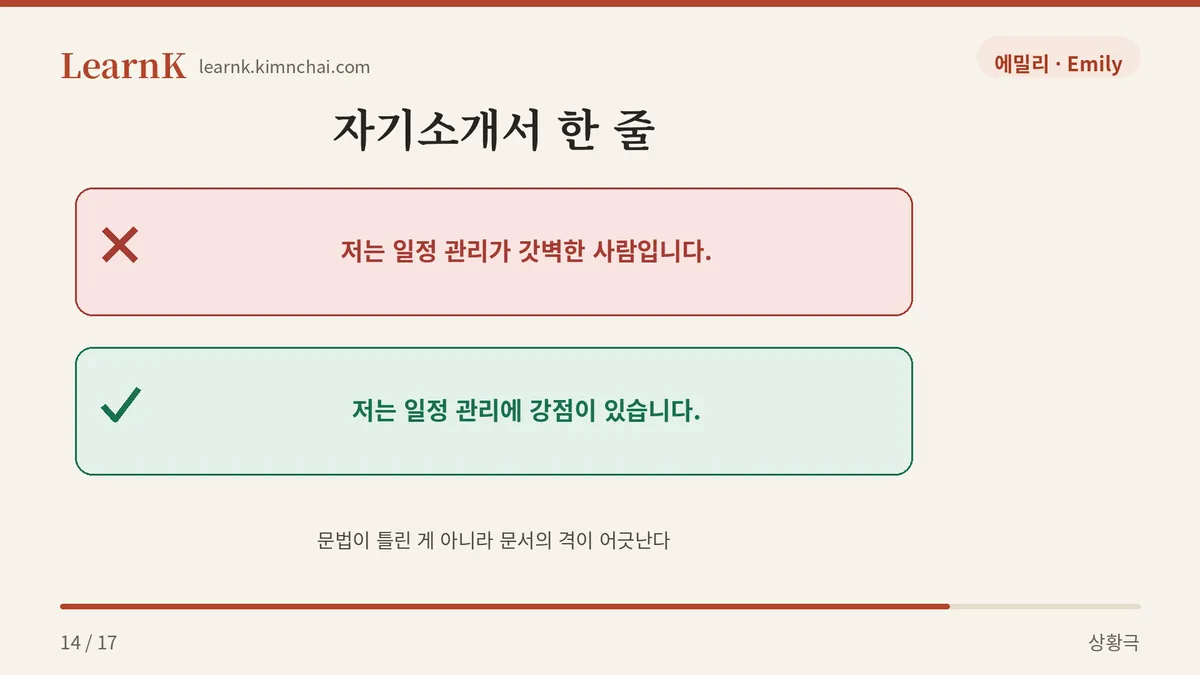
✗ (in a cover letter) 저는 일정 관리가 갓벽한 사람입니다. (jeoneun iljeong gwalliga gatbyeokhan saramimnida.) ✓ (in a cover letter) 저는 일정 관리에 강점이 있습니다. (jeoneun iljeong gwallie gangjeomi itseumnida.) → Nothing here is grammatically wrong; what’s off is the register of the document. Used in an official document, it makes the whole piece read as lightweight. Slang is best left where it belongs — speech and chat.
Example Sentences by Situation
① Talking about the weather — the first weekend of autumn, the instant you open the window
오늘 날씨 진짜 갓벽하다. 이런 날 집에 있으면 손해야. (oneul nalssi jinjja gatbyeokhada. ireon nal jibe isseumyeon sonhaeya.) “The weather today is seriously godlike. Staying home on a day like this is a waste.” In plain Korean: 오늘 날씨 정말 완벽하다. 이런 날 집에 있으면 손해다.
There are honestly only a handful of days a year in Korea when you’d say this about the weather. Summers are humid and winters are biting, so the just-right days arrive in short bursts in spring and autumn. Which means this sentence isn’t really delivering the information “the weather is nice” — it’s closer to a proposal: “let’s get outside, now.”
② The moment you check a photo — after firing off about a hundred shots on a trip
어? 이거 봐 봐. 각도 갓벽. 이건 프로필 사진 각이다. (eo? igeo bwa bwa. gakdo gatbyeok. igeon peuropil sajin gagida.) “Huh? Look at this. The angle is godlike. This is profile-picture material.” In plain Korean: 어? 이것 좀 봐. 각도가 완벽해. 이건 프로필 사진감이다.
Here 갓벽 ends as a bare noun, with no predicate attached at all. When admiration is urgent, Korean tends to lop the ending right off. Short tosses in the shape of [noun + 갓벽] — 각도 갓벽 (gakdo gatbyeok), 조합 갓벽 (johap gatbyeok), 타이밍 갓벽 (taiming gatbyeok) — are the closest thing to how people actually talk.
③ When you discover an unexpected combination — at the parasol table outside a convenience store
이 라면에 저 삼각김밥 넣어 먹어 봐. 조합 갓벽해서 놀랄걸. (i ramyeone jeo samgakgimbap neoeo meogeo bwa. johap gatbyeokhaeseo nollalgeol.) “Try dropping that samgak-gimbap into this ramyeon. The combination is so godlike it’ll surprise you.” In plain Korean: 이 라면에 저 삼각김밥을 넣어서 먹어 봐. 조합이 완벽해서 놀랄 거야.
In food talk, the slot this word fills is usually not a single ingredient but a combination. It isn’t saying one thing is excellent; it’s saying two things met and turned out unexpectedly good — so the admiration is really pointed at the discovery itself.
Honorific Speech, Casual Speech, and Similar Expressions
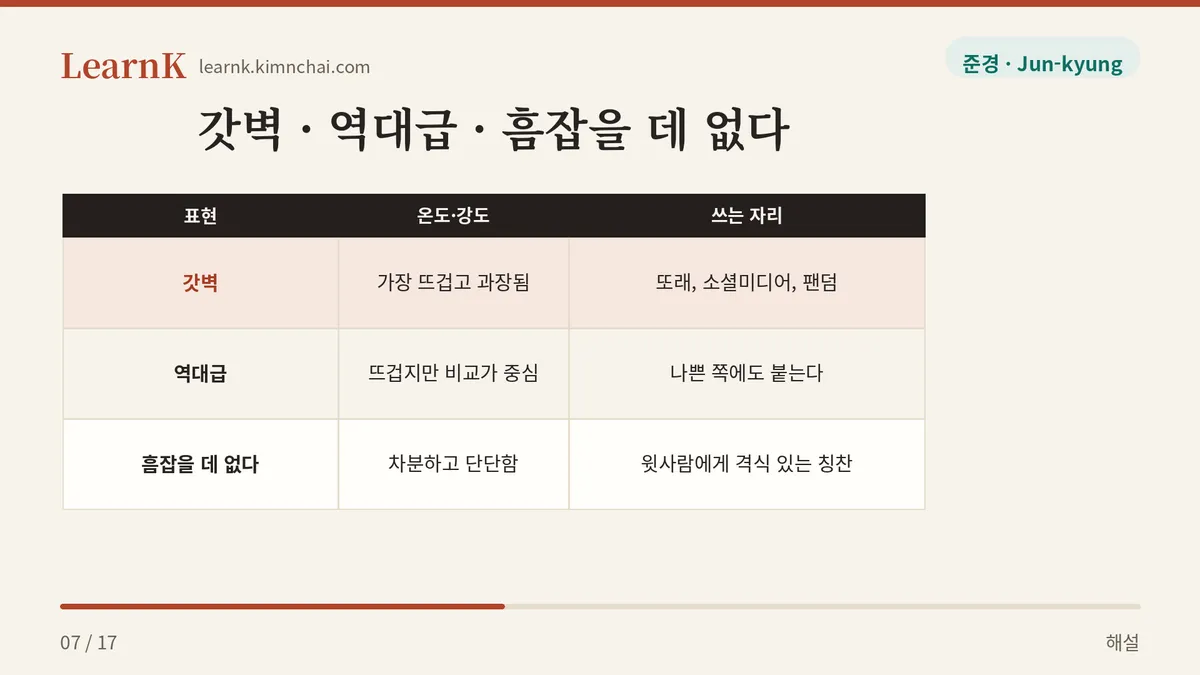
Let’s start with honorifics. 갓벽 has, for all practical purposes, no honorific form. You can construct 갓벽합니다 (gatbyeokhamnida), but say it out loud and it sounds like you’re joking. To carry the same meaning to someone senior or in a public setting, you have to change the word itself. In the table below, formality rises as you move down.
| Expression | Temperature / intensity | Where it’s used |
|---|---|---|
| 갓벽 (gatbyeok) | Hottest and most exaggerated | Peers, social media, fandom. Not with seniors or in official documents |
| 역대급 (yeokdaegeup) | Hot, but built around comparison | Peers, even news headlines. Also used for bad things |
| 완벽하다 (wanbyeokhada) | Neutral | Anywhere. No problem in reports or interviews |
| 흠잡을 데 없다 (heumjabeul de eopda) | Calm and solid | With seniors, as formal praise |
역대급 (yeokdaegeup) means “the highest grade in history,” so it always presupposes something to be compared against. That’s why it attaches to bad things too, as in 역대급 실수 (yeokdaegeup silsu), “a blunder for the ages” — whereas 갓벽 attaches only to good things. 흠잡을 데 없다 (heumjabeul de eopda) has a completely different grain: it says you went looking for flaws and found none, an evaluation reached after calmly weighing things up. It’s closer to a judgment than to an exclamation.
Cultural Background — Where 갓 (gat) Started Getting Attached
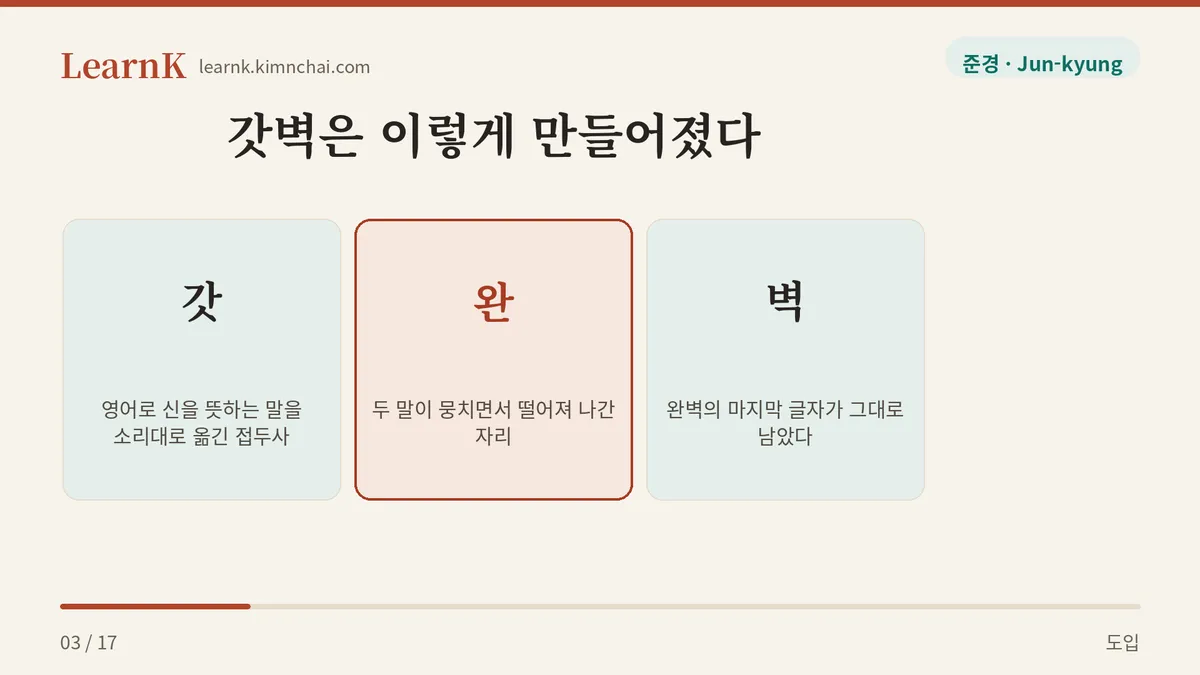
갓 (gat) is the English word God transcribed by sound. In the early 2010s it settled into online communities as something like a prefix pinned to the front of nouns, and by now it goes in front of just about anything. 갓벽 (gatbyeok) is a slightly unusual case among these: in [갓 + 완벽], the middle syllable 완 falls out and the two words fuse into a single lump. So on the surface it looks like a brand-new two-syllable word, while 완벽 is still sitting right inside it.
One easy point of confusion. Korean already had several words pronounced 갓. The black hat men wore in the Joseon era is also 갓 (gat), and the 갓 in 갓 구운 빵 (gat guun ppang), “freshly baked bread,” is an adverb meaning “just now.” The slang prefix 갓 has nothing to do with either of them. They merely sound alike; their origins are entirely separate — so don’t let a 갓-wearing character in a historical drama bring this word to mind.
The place this word lives most actively is, unsurprisingly, fandom. The comment section under a stage video, the group chat right after a concert ends, an SNS post where photos have just gone up. It’s the card you play when emotion peaks and 완벽하다 (wanbyeokhada) doesn’t feel like enough. That said, as is the fate of all slang, trends run in cycles, and it no longer sounds as fresh as it did when it first appeared. It’s also worth keeping in mind that when this word shows up in a Korean drama or variety show, it’s generally read as a signal that the character belongs to a generation at home in online culture.
The real lesson this word holds for Korean learners isn’t its meaning. It’s the fact that Korean has a great many clusters of words that divide one meaning up by temperature. 흠잡을 데 없다 → 완벽하다 → 갓벽. All three point at the same thing, but which one you reach for lays bare exactly who you’re with and what you are to each other. Knowing where a word belongs is always harder — and always more important — than knowing what it means.
Today’s Quiz
Which of the following is the most awkward situation in which to use 갓벽 (gatbyeok)?
- Walking out after a movie with a friend, saying the final scene was incredible
- Explaining your strengths in a job interview
- On the morning of a picnic, marveling at the clear sky
- Recommending a ramyeon add-in to a friend because the ingredients went together better than expected
Show the answer
Answer: 2
갓벽 (gatbyeok) is internet slang traded between peers with the emotional dial turned all the way up. In a setting that calls for formality, like an interview, it leaves the impression that the speaker is taking the situation lightly. Here it’s better to pick a neutral expression such as 흠잡을 데 없이 준비했습니다 (heumjabeul de eopsi junbihaetseumnida), “I’ve prepared it so there’s nothing to fault,” or 완성도를 중요하게 생각합니다 (wanseongdoreul jungyohage saenggakhamnida), “I take polish seriously.” Options 1, 3, and 4 are all private settings where the exclamation comes out first, so they’re perfectly natural.