겉바속촉 (geotba-sokchok) — The Food Expression Koreans Love Most
겉바속촉
While watching a Korean drama or a YouTube mukbang (먹방), you’ll see someone take a bite of freshly fried chicken, open their eyes wide, and shout: 겉바속촉 (geotba-sokchok)! What kind of magic spell are these four little syllables, that everyone reacts with such awe? Today, let’s take a deep dive into this expression that cuts right to the heart of Korean food culture.
Meaning and Nuance
겉바속촉 (geotba-sokchok) is a newly coined word that compresses four separate words. Spelled out, it breaks down like this:
- 겉 (geot) = the outside, the surface → 바 (ba) = 바삭 (basak), a crispy texture
- 속 (sok) = the inside, the flesh → 촉 (chok) = 촉촉 (chokchok), a moist, tender texture
In other words, it’s a four-syllable shortening of “겉은 바삭하고 속은 촉촉하다 (geoteun basakhago sogeun chokchokhada)” — “crispy on the outside, moist on the inside.” Taking just the first syllable of each word to shorten a phrase like this is a very common bit of wordplay in Korean these days.
The nuance of this expression goes far beyond a simple “delicious.” It captures a satisfaction that borders on being moved — the feeling you get when two completely opposite textures (crispiness and moistness) coexist perfectly in a single bite. That’s why 겉바속촉 counts as the highest form of praise.
Example Sentences by Situation
1. At a chicken restaurant (with a friend)
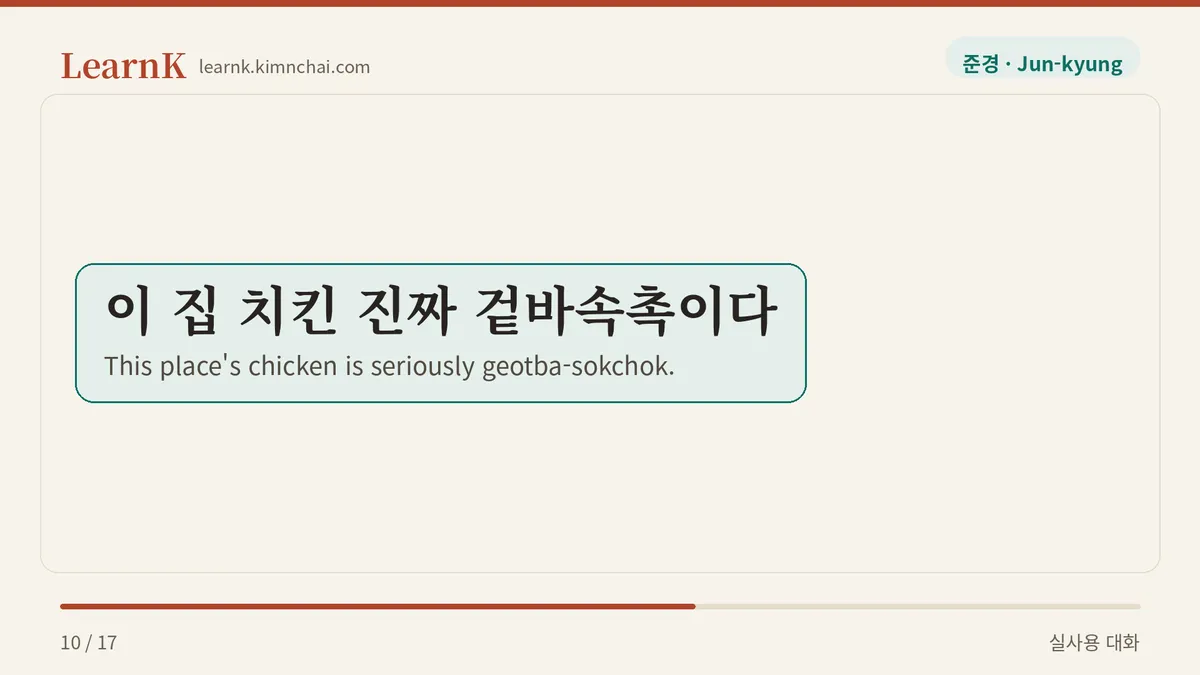
야, 이 집 치킨 진짜 겉바속촉이다. 튀김옷은 바삭한데 살은 안 퍽퍽해!
Ya, i jip chikin jinjja geotba-sokchogida. Twigimoseun basakhande sareun an peokpeokhae!
(Hey, this place’s chicken is seriously 겉바속촉. The batter is crispy but the meat isn’t dry at all!)
This is the most classic situation — used when the coating on freshly fried chicken is crispy while the meat inside is still juicy.
2. Eating a croissant at a café (politely)
여기 크루아상 정말 겉바속촉하네요. 결이 살아 있어요.
Yeogi keuruasang jeongmal geotba-sokchokhaneyo. Gyeori sara isseoyo.
(The croissants here are really 겉바속촉. You can taste every flaky layer.)
It’s used not only for chicken but widely for bread too — especially foods with a crispy exterior, like croissants or 붕어빵 (bungeoppang, fish-shaped pastries).
3. Showing off your cooking (a social media post)
오늘 처음 만든 감자전, 겉바속촉 성공! 이제 나도 요리 좀 하나?
Oneul cheoeum mandeun gamjajeon, geotba-sokchok seonggong! Ije nado yori jom hana?
(My first-ever 감자전 (gamjajeon, potato pancake) — 겉바속촉 achieved! Maybe I can cook after all?)
When expressing pride at a cooking success, the combination “겉바속촉 성공 (geotba-sokchok seonggong)” — “겉바속촉 success” — shows up all the time.
Formal vs. Casual Speech, and Similar Expressions
Since 겉바속촉 works like a noun, you only need to change the word that follows it.
- Casual (반말): 겉바속촉이야 (geotba-sokchogiya)
- Polite (존댓말): 겉바속촉이에요 (geotba-sokchogieyo) / 겉바속촉하네요 (geotba-sokchokhaneyo)
It’s also worth knowing some related texture words. 바삭바삭 (basak-basak) emphasizes only the surface, while 촉촉 (chokchok) points only to the tenderness of the inside. On the flip side, a failed dish isn’t called “겉촉속바” — instead, people usually say 눅눅하다 (nungnukhada, gone soggy so the crispiness is lost) or 퍽퍽하다 (peokpeokhada, dry and dense on the inside). 겉바속촉 is really the ideal state that avoids both of these failures at once.
Cultural Background
There’s a reason 겉바속촉 is so beloved. As Korea’s food-delivery culture — and especially “치맥 (chimaek, chicken + beer)” — became a national go-to snack, people wanted a short, punchy word to rate how well something was fried. As TV shows and YouTube mukbangs repeated the expression, it spread across the whole country in no time.
Scenes where someone offers heartfelt admiration to the person who cooked for them are also a staple of Korean dramas. The moment a character tastes a lovingly prepared meal and says, moved, “이거 진짜 맛있다 (igeo jinjja masitda)” — “this is really delicious” — viewers feel the warmth between the two people. 겉바속촉 is, in a sense, the modern version of that kind of warm praise.
Closing Quiz
Which of the following situations is the best fit for using 겉바속촉?
- Eating ice cream as cold as ice
- When freshly fried 탕수육 (tangsuyuk, sweet-and-sour pork) is crispy on the outside and the meat inside is tender
- Gulping down cool 냉면 (naengmyeon) broth
The answer is number 2! The 겉바속촉 moment is exactly when two different textures coexist in a single bite. If you happen to have chicken or a croissant today, try shouting it out with confidence: 겉바속촉 (geotba-sokchok)!