게스트하우스 (geseuteuhauseu) — A Cheap Bed, With People Thrown In
게스트하우스
게스트하우스 means lodging where several travelers stay under one roof, share the living room, kitchen, and bathroom, and pay less precisely because of all that sharing. 게스트하우스 (geseuteuhauseu) entered Korean as a sound-for-sound borrowing of English guest house, but once it landed here it took on a much narrower and much clearer role than the English original. Someone heading down to Jeju with a single backpack, a foreign traveler looking for a few nights near Hongdae, a university student who bolted for Busan the day exams ended — the word all of them type into the search bar of a booking app is 게스트하우스.
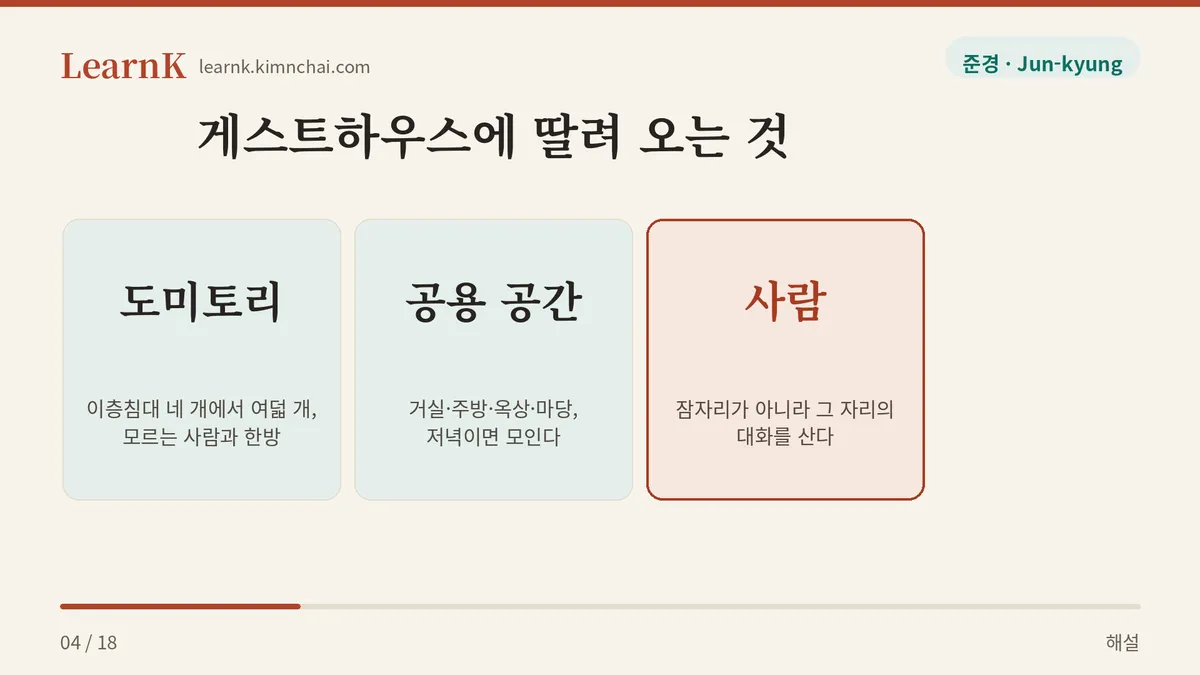
Being cheap doesn’t explain the whole word, though. In Korea, when you say 게스트하우스, three things usually come with it. First, the room — called a 도미토리 (domitori) or 다인실 (dainsil). Four to eight bunk beds, and you sleep in the same room as people you’ve never met. Second, the shared space. There’s a living room, a kitchen, a rooftop, or a yard, and in the evening the guests gather there. Third, people. Someone who picks a 게스트하우스 usually isn’t just buying a place to sleep — they’re buying the conversations that happen there too.
So the nuance splits like this. At a hotel, your day ends when you close your door; at a 게스트하우스, your day starts when you open it and walk out. For someone who wants to rest quietly that’s a drawback, and for someone traveling alone that’s the entire point. When a Korean says “게스트하우스 잡았어 (geseuteuhauseu jabasseo)” — “I booked a guesthouse” — the listener’s mind automatically fills in a picture: young, cheap, a little loud, toast and eggs in the morning.
There are set words for the people who run the place, too. The owner is 사장님 (sajangnim), and the staff or long-stay guests who help out in exchange for a bed are 스태프 (seutaepeu). Among guests, people often skip the whole question of age and just switch to casual speech (반말) with each other — which is a fairly rare exception in Korean speech habits.
Seeing It in a Real Conversation
Situation: The second morning of a trip to Jeju. In the guesthouse’s shared kitchen, the other guests are rustling around packing their bags.
Jun-kyung: 야, 너 어제 몇 시에 들어왔어? 나 먼저 잤잖아. Hey, what time did you come in last night? I fell asleep first.
Emily: 한 시쯤? 거실에서 사람들이랑 얘기하다가. 게스트하우스는 이 맛이지. Around one? I was talking with people in the living room. This is the whole point of a guesthouse.
Jun-kyung: 하여간 못 말려. 난 그냥 조용한 호텔이 낫던데. You’re hopeless. I’d honestly rather have a quiet hotel.
Emily: 그럴 거면 뭐 하러 게스트하우스 잡았어. 여긴 원래 시끌시끌한 데야. Then why did you book a guesthouse? This place is supposed to be noisy.
Jun-kyung: 싸잖아. 둘이 이 값에 제주 왔으면 잘 온 거지. It’s cheap. Getting the two of us to Jeju for this price — we did well.
Emily: 그럼 오늘 밤엔 너도 앉아 있어 봐. 사장님이 바비큐 한대. Then sit with us tonight. The owner said he’s doing a barbecue.
This Is Where It Sounds Off
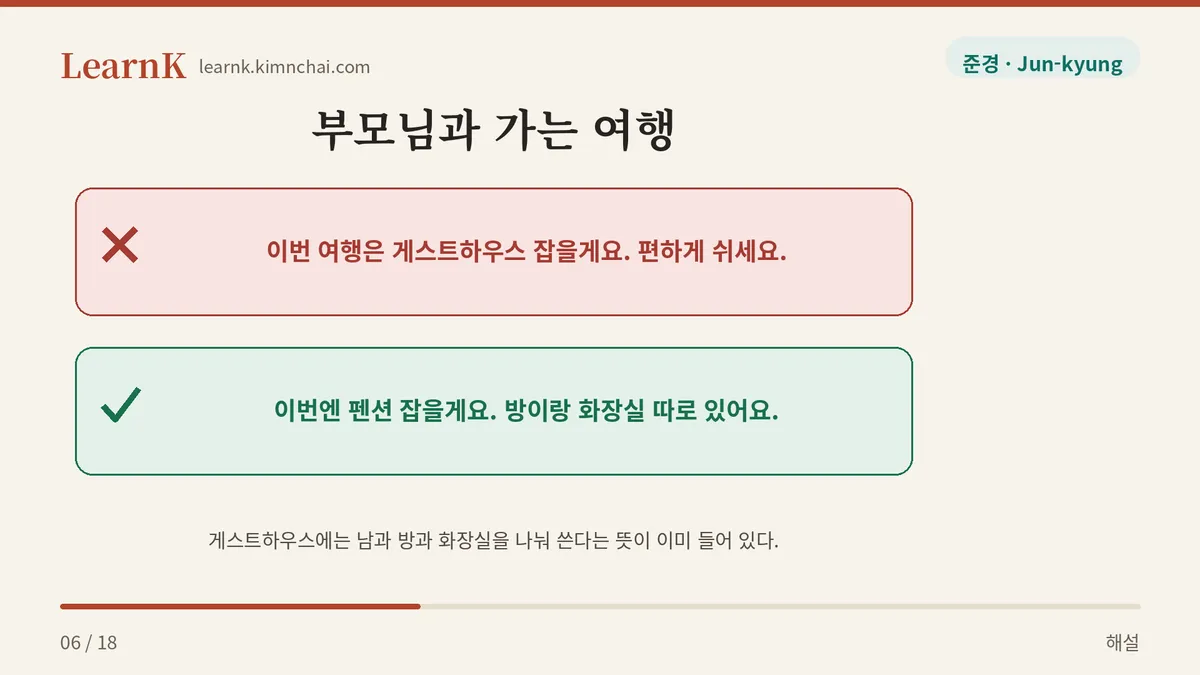
✗ (to your parents) 엄마, 이번 여행은 게스트하우스 잡을게요. 편하게 쉬세요. Mom, I’ll book a guesthouse for this trip. Just relax and rest.
✓ (to your parents) 이번엔 펜션 (pensyeon) 잡을게요. 방이랑 화장실 따로 있어요. This time I’ll book a pension. It has its own room and its own bathroom.
→ The grammar is fine, but the word is in the wrong seat. 게스트하우스 already carries the meaning “a place where you share the bathroom and the bedroom with strangers,” so using it for a trip where you’re taking your parents contradicts “just relax and rest” in the very next breath. For a family trip, 펜션 (pensyeon) or a hotel is the right call.
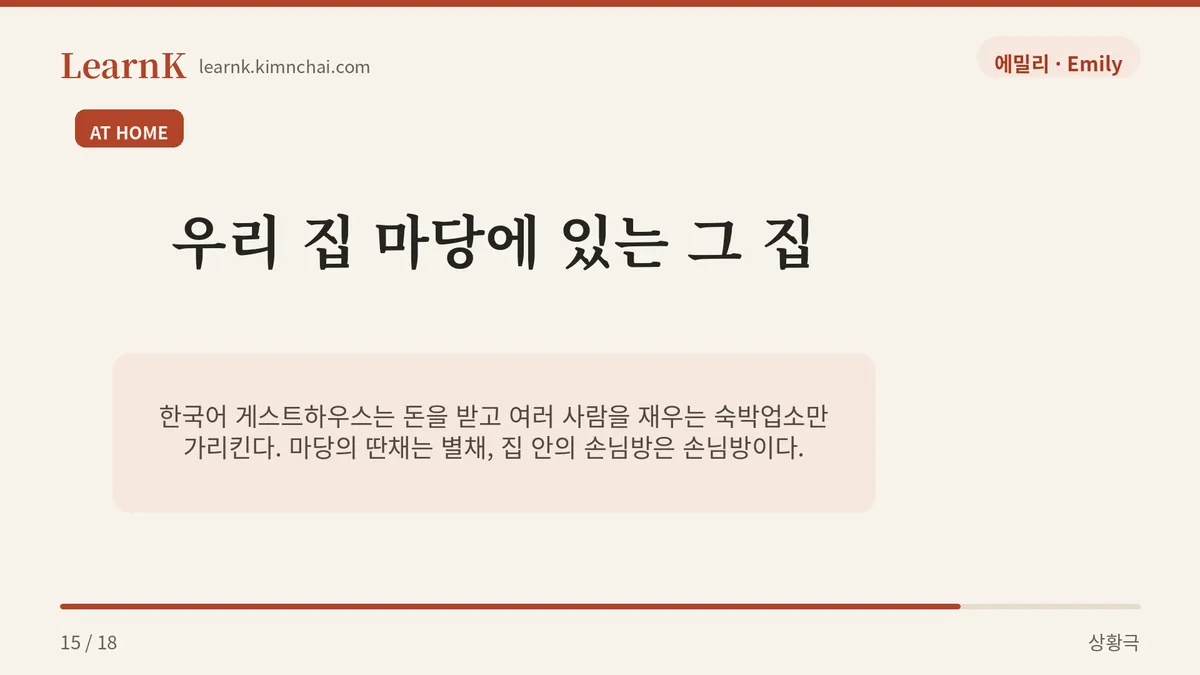
✗ 저희 집 마당에 게스트하우스가 하나 있어서 손님이 오면 거기서 주무세요. There’s a guesthouse in our yard, so when visitors come they sleep there.
✓ 저희 집 마당에 별채 (byeolchae) 가 하나 있어서 손님이 오면 거기서 주무세요. There’s an annex in our yard, so when visitors come they sleep there.
→ In English, guest house can mean “a small house for guests next to the main one,” but Korean 게스트하우스 has no such meaning. In Korea the word points only to a paid lodging business that puts multiple people up for the night. A guest room inside the house is a 손님방 (sonnimbang), and a separate building in the yard is a 별채 (byeolchae) — those are the words that will actually land.
Example Sentences by Situation
① Planning a trip with a friend (casual speech) This is what you say when you want to save money but find traveling alone too dull.
이번엔 호텔 말고 게스트하우스에서 묵자. 사람도 좀 만나고. ibeonen hotel malgo geseuteuhauseueseo mukja. saramdo jom mannago. (This time let’s stay at a guesthouse instead of a hotel. We can meet some people too.)
② Calling to ask about a booking (polite speech) A 게스트하우스 sells by the bed, not by the room, so people use the word “자리 (jari)” — a spot. Knowing this expression makes the phone call go much more smoothly.
혹시 이번 주 토요일에 여성 도미토리 자리 하나 남아 있을까요? hoksi ibeon ju toyoire yeoseong domitori jari hana nama isseulkkayo? (Do you happen to have one spot left in the female dormitory this Saturday?)
③ After the trip is over (casual speech) This is the sentence that shows best why 게스트하우스 is more than the name of a place to sleep.
작년에 게스트하우스에서 만난 사람들이랑 아직도 연락해. jangnyeone geseuteuhauseueseo mannan saramdeurirang ajikdo yeollakae. (I’m still in touch with the people I met at that guesthouse last year.)
Polite vs. Casual, and Similar Expressions
게스트하우스 is the name of a thing, so the word itself carries no honorific level. The politeness comes from the verb that follows it.
- Casual: 게스트하우스에서 잘 거야. (geseuteuhauseueseo jal geoya.)
- Polite: 게스트하우스에서 묵을 거예요. (geseuteuhauseueseo mugeul geoyeyo.)
- Formal: 게스트하우스에 묵을 예정입니다. (geseuteuhauseue mugeul yejeongimnida.)
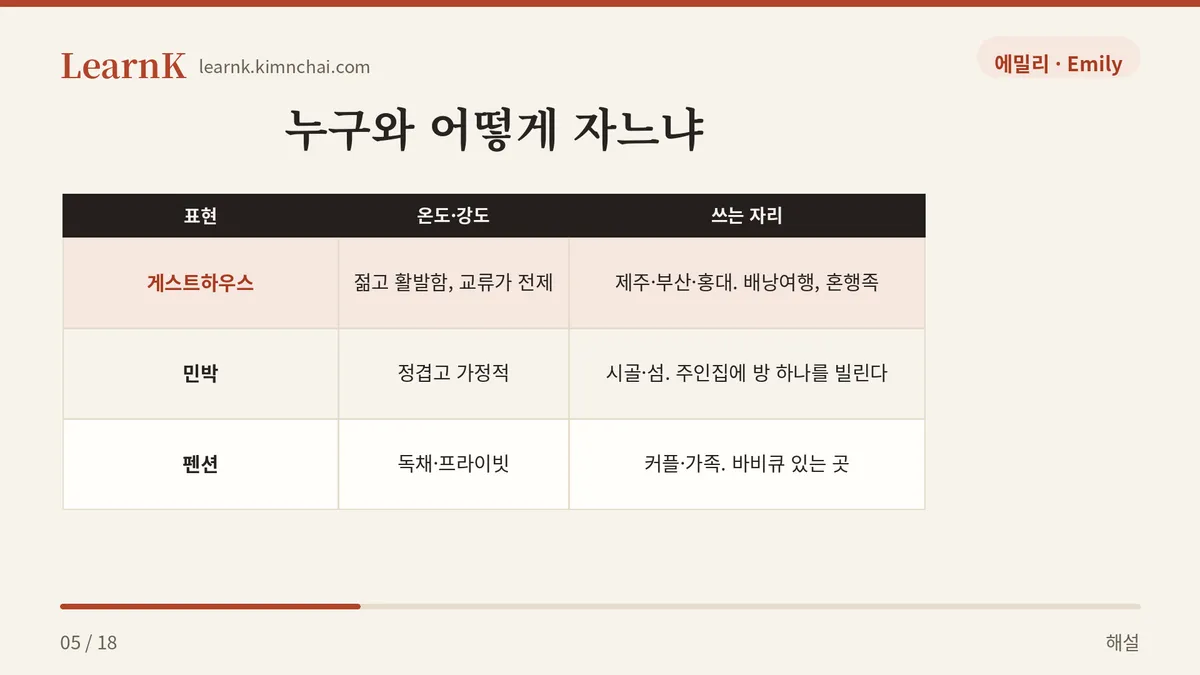
The lodging words that look similar are divided not by price but by “who you sleep with, and how.”
| Expression | Tone / intensity | Where it’s used |
|---|---|---|
| 게스트하우스 (geseuteuhauseu) | Young and lively; mingling is assumed | Jeju, Busan, Hongdae. Backpackers, solo travelers |
| 호스텔 (hoseutel) | Almost the same meaning, but slightly more international and businesslike | Booking sites aimed at foreigners, big cities |
| 민박 (minbak) | Warm and homey; the owner’s household is right there | Countryside and islands. Fine even with family or older relatives |
| 펜션 (penyeon/penseon) | A private, self-contained unit; mid-range price | Couples and families. The kind of place with a barbecue |
| 모텔 (motel) | Cheap and private, no mingling at all | A quick night downtown |
게스트하우스 and 민박 in particular get mixed up even among Koreans, but the test is simple: if you share a room with strangers, it’s a 게스트하우스; if you rent one whole room in the owner’s house and stay under their roof, it’s a 민박.
Cultural Background — A Word the Olle Trail Made
The word 게스트하우스 got its current temperature in Korea in the late 2000s, on Jeju Island. As the Olle Trail — a network of walking routes — became known, more and more people were walking 20 kilometers a day and needed nothing in the evening but a shower and a bed. For those guests, a hotel was overkill. Places that sold a single bed and gave over a big living room in exchange sprang up one after another, and those houses called themselves 게스트하우스. Even now, say the word to a Korean and a good number of them will picture the Jeju sea and a wooden platform in a yard first.
One offshoot of the word is 파티 게스트하우스 (party geseuteuhauseu) — a “party guesthouse.” It refers to a place where the owner grills meat every evening and sits all the guests down together. For someone traveling alone it’s the best possible choice; for someone who came to rest quietly it’s the worst. That’s why the search phrase “파티 없는 조용한 게스트하우스” (“a quiet guesthouse with no parties”) is forever attached to the reviews. Checking whether that label is there or not is a practical survival skill for picking lodging in Korea.
Korean television has spread this feeling widely at least once. The best-known case is 《효리네 민박 (Hyorine minbak)》 (Hyori’s Homestay, JTBC, 2017), a variety show in which the singer Lee Hyori and her husband open their Jeju home to guests. The title says 민박, but the picture of strangers gathering in one living room to eat and talk is exactly what a 게스트하우스 sells. It isn’t selling a room — it’s selling a slice of an evening. That’s where the word’s real meaning in Korea lives.
One more thing: because it’s a loanword, no short form ever really caught on. Even at five syllables, Koreans generally say the whole thing. Force an abbreviation and people often just won’t understand you, so learners are safest simply pronouncing all five syllables clearly.
Today’s Quiz
A friend who has come to Seoul alone says this: “사람들이랑 얘기도 좀 하고 싶은데, 숙소값은 아끼고 싶어.” (“I’d like to talk to some people, but I want to save on lodging.”) Which of the following is the best thing to recommend?
- 그럼 모텔 잡아. 싸고 조용해. (Then book a motel. It’s cheap and quiet.)
- 그럼 게스트하우스 잡아. 저녁에 거실에서 사람들 만날 수 있어. (Then book a guesthouse. You can meet people in the living room in the evening.)
- 그럼 펜션 잡아. 독채라 방해받을 일 없어. (Then book a pension. It’s a private unit, so nobody will bother you.)
Answer: 2. Options 1 and 3 get the price or the quiet right, but they run head-on into the condition “I want to talk to people.” A 모텔 and a 펜션 are places where you never run into anyone else, and the only option built around mixing with strangers in a shared living room is the 게스트하우스.
Definitions and example sentences are from the National Institute of Korean Language’s Basic Korean Dictionary (krdict.korean.go.kr); that portion of this post, including our translations, is licensed under CC BY-SA 2.0 KR.