금수저 (geumsujeo) — What Some People Are Already Holding at Birth
금수저
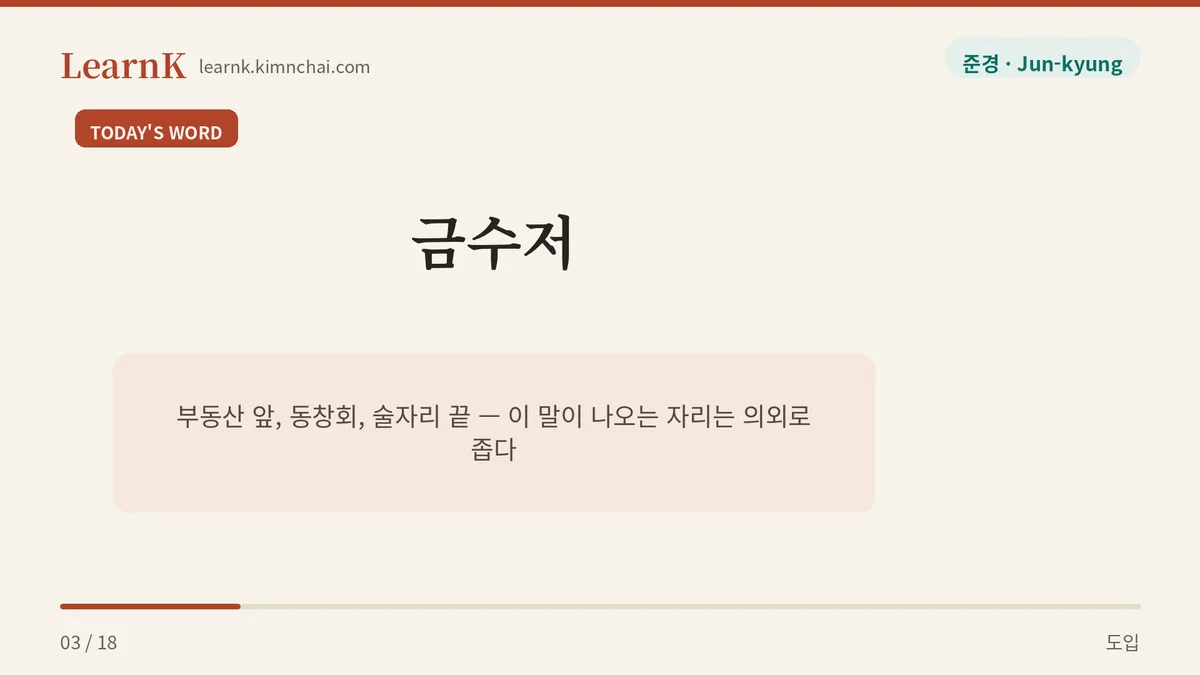
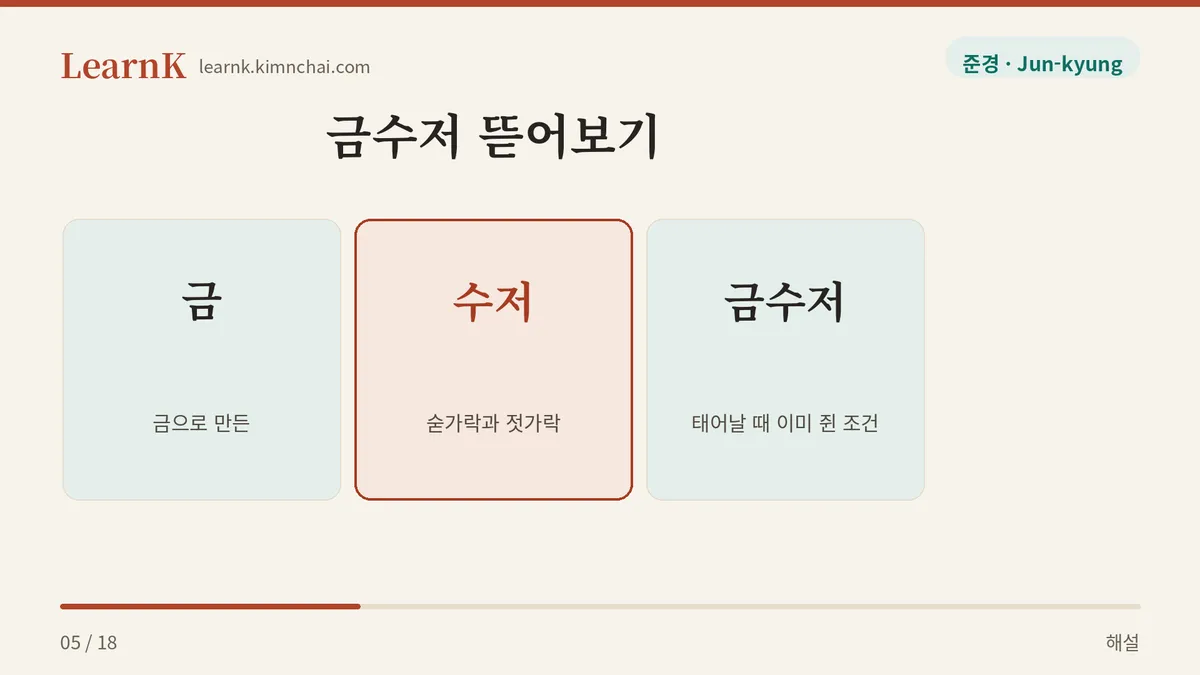
금수저 (geumsujeo) refers to someone born into a wealthy family who started out in an advantageous position from day one, thanks to their parents’ money and connections. Read literally, the word is just “a spoon made of gold,” but nobody who says it is talking about cutlery. 금수저 points at a person — more precisely, at the conditions that person was already holding in their hand the moment they were born. The situations where this word comes out are surprisingly narrow and specific. While you’re looking up deposit prices for a one-room apartment; when you hear secondhand that a classmate bought their own place at thirty-two; while you’re doing rough math on four years of tuition for a friend who studied abroad — in other words, it surfaces in the moment you think, I ran this far, so why can’t I get where they are?
To get the temperature of this word right, you only need to remember three things.
First, 금수저 is not a compliment. 쟤 능력 좋아 (jyae neungnyeok joa, “she’s really capable”) and 쟤 금수저야 (jyae geumsujeoya, “she’s a geumsujeo”) point in opposite directions. The first points at what the person did; the second points at what they never had to do. So along with the envy, there’s a very thin barb stuck in this word: but you didn’t earn it.
Second, it is almost always third person. It’s something said about a person who isn’t in the room. Throw it at the person themselves and — even wearing the face of a joke — they’ll go on the defensive.
Third, attach it to yourself and it turns into a brag. Almost no Korean says 나 금수저야 (na geumsujeoya, “I’m a geumsujeo”) about themselves. Instead they laugh and attach the opposite word, 흙수저 (heuksujeo) — “dirt spoon” — to themselves. 나는 흙수저라서 (naneun heuksujeoraseo, “since I’m a heuksujeo…”) is self-mockery and modesty at the same time, which is exactly why it’s so much more common.
It’s also worth knowing how strong the word is. 금수저 doesn’t really stick to a family that’s merely “doing all right.” It gets attached when the size of the effort and the size of the result look visibly out of line — when someone’s starting point looks like your finish line, say. Overuse it and the word goes bland, and the people listening start to feel, this person says that about everything.
A Real Conversation
Scene: evening in Seoul, after viewing three one-room apartments. In the alley outside the real estate office, the sound of delivery scooters.
Emily: 세 번째 집이 그나마 낫던데… 보증금이 왜 저래? The third place was the best of the three, but that deposit — seriously?
Jun-kyung: 그게 요즘 시세야. 나도 처음엔 잘못 봤나 했어. That’s just the going rate now. At first I thought I’d misread it.
Emily: 아까 중개사님이 옆 건물 얘기하셨잖아. 스물여덟 살이 샀다고? The agent mentioned the building next door, right? Bought by a twenty-eight-year-old?
Jun-kyung: 응, 부모님이 사주셨대. 완전 금수저지. Yeah, his parents bought it for him. Total geumsujeo.
Emily: 하… 나도 다음 생엔 금수저로 태어날래. Ugh… next life, I’m coming back as a geumsujeo.
Jun-kyung: 야, 그럼 나도 좀 끼워 줘. Hey, count me in then.
This Sounds Awkward
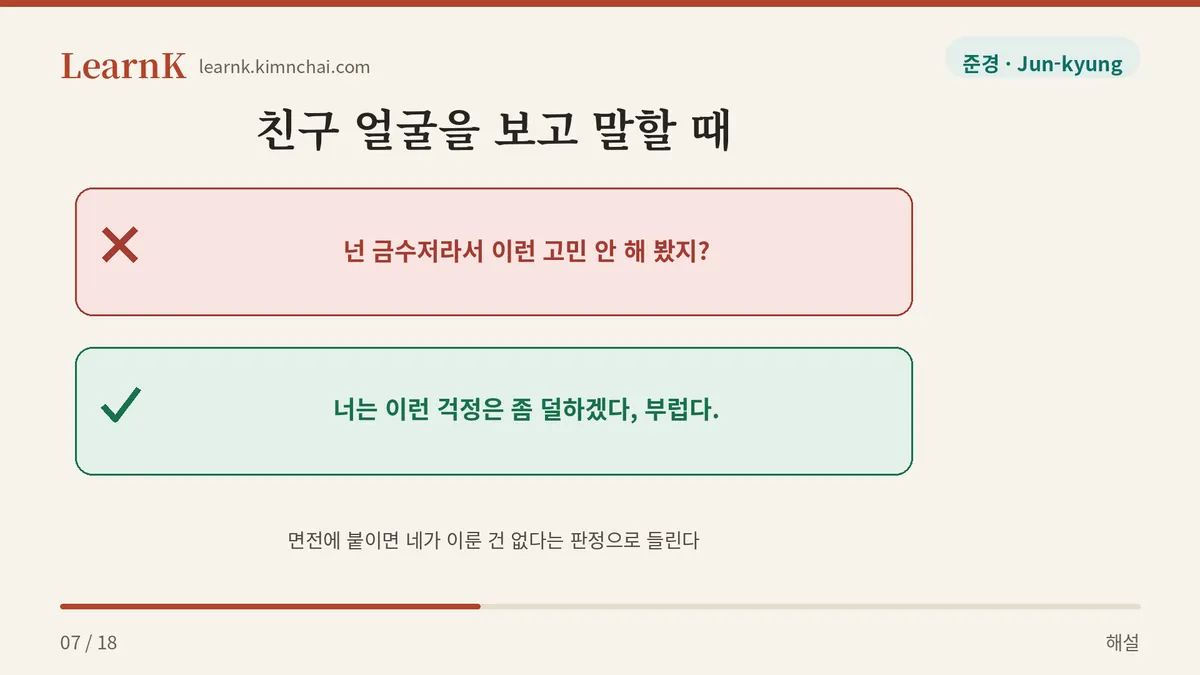
✗ (to a well-off friend, right to their face) 넌 금수저라서 이런 고민 안 해 봤지? (neon geumsujeoraseo ireon gomin an hae bwatji? — “You’re a geumsujeo, so you’ve never had to worry about this, have you?”) ✓ (to that same friend) 너는 이런 걱정은 좀 덜하겠다, 부럽다. (neoneun ireon geokjeongeun jom deolhagetda, bureopda. — “You probably worry about this less than the rest of us. Lucky you.”) → Muttered behind someone’s back it’s a joke, but attached to their face it lands as a verdict: nothing you have is something you worked for.
✗ (in a job interview or self-introduction) 저는 금수저로 자라 부족함 없이 컸습니다. (jeoneun geumsujeoro jara bujokham eopsi keotseumnida. — “I grew up a geumsujeo and never wanted for anything.”) ✓ (same setting) 저는 비교적 여유 있는 환경에서 자랐습니다. (jeoneun bigyojeok yeoyu inneun hwangyeongeseo jarasseumnida. — “I grew up in a relatively comfortable environment.”) → Put it on yourself and it reads as boasting, not humility — and in a formal setting, being internet slang, the word itself sounds lightweight.
Example Sentences by Situation
1) Hearing secondhand news about someone at a class reunion 걔는 금수저라서 취업 걱정이란 걸 해 본 적이 없대. (gyaeneun geumsujeoraseo chwieop geokjeongiran geol hae bon jeogi eopdae. — “He’s a geumsujeo, so apparently he’s never once worried about finding a job.”) → The 「-대」 at the end is a casual (반말) ending used when passing along something you heard from someone else. 금수저 travels with reported speech like this. The more the story is something you heard secondhand rather than saw yourself, the better the word fits.
2) Correcting a label someone else pinned on you 금수저까지는 아니야. 그냥 부모님이 보증금만 좀 보태 주셨어. (geumsujeokkajineun aniya. geunyang bumonimi bojeunggeumman jom botae jusyeosseo. — “I wouldn’t go as far as geumsujeo. My parents just helped a bit with the deposit.”) → This is the sentence you use to hand back a label that makes you uncomfortable. 「-까지는 아니다」 (“not to the point of…”) knocks the intensity down a notch and is an extremely common defensive expression — memorize it as is and you’ll find plenty of uses.
3) Closing a conversation with self-mockery 우린 금수저가 아니니까 그냥 각자 버티는 수밖에. (urin geumsujeoga aninikka geunyang gakja beotineun subakke. — “We’re not geumsujeo, so all we can do is each hang in there.”) → This is the tone that shows up as a night of drinking winds down. You spit out the envy once, pat yourself on the back, and fold up the topic.
Polite vs. Casual Speech, and Similar Expressions
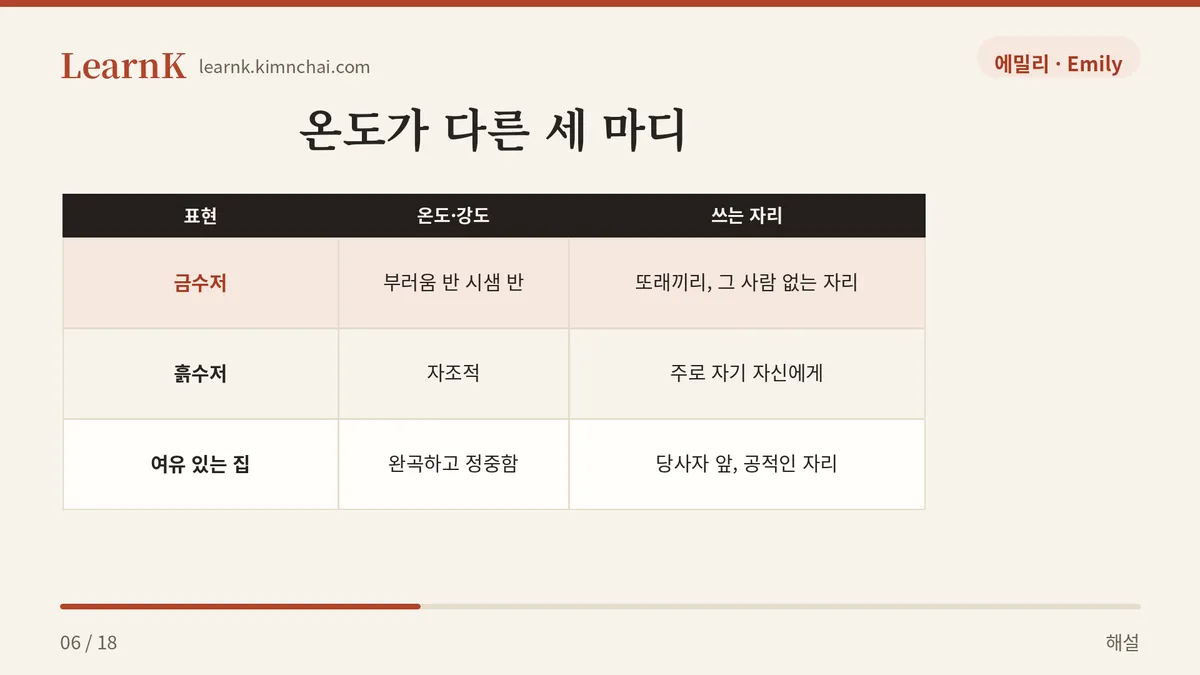
금수저 is a noun, so there’s no honorific level built into it. You don’t say 금수저이십니다. What matters instead is that the seat this word can sit in is casual by nature — friends, coworkers, social media, comment sections. In front of someone older than you or in an official setting, it’s safer to switch to 「여유 있는 집안」 (“a comfortable family”) or 「형편이 넉넉한」 (“well-off”).
| Expression | Temperature / Strength | Where it’s used |
|---|---|---|
| 금수저 (geumsujeo) | Half envy, half resentment; joking tone | Peers, social media. Careful in front of the person |
| 흙수저 (heuksujeo) | Self-deprecating, mostly about oneself | When talking your own situation down |
| 재벌 2세 (jaebeol ise) | Closer to a statement of fact; a different league | Only for actual conglomerate-owning families |
| 부잣집 아들·딸 (bujatjip adeul·ttal) | Neutral, slightly old-fashioned | Used freely across generations |
| 여유 있는 집 (yeoyu inneun jip) | Euphemistic and polite | In front of the person, formal settings |
Cultural Background — Class Divided by Spoons
The root of this word is an English idiom. When “born with a silver spoon in one’s mouth” (은수저를 물고 태어나다) made its way into Korea, Korean added one more rung to it: gold on top of silver. Around 2015, posts sorting people into 금수저 (gold spoon), 은수저 (silver spoon), 동수저 (bronze spoon) and 흙수저 (dirt spoon) spread across internet forums, and this scheme is called 수저계급론 (sujeo-gyegeumnon), the “spoon class theory.” The interesting part is the bottom rung. Gold, silver and bronze are the order of medals — but dirt isn’t even a metal. It’s not a lower rank; it’s a different material altogether. That arrangement was already a sentence in itself, which is why the word spread so fast.
Korean dramas and films have long used this gap as the engine of their stories. The Heirs (SBS, 2013), which sits heirs and an ordinary protagonist in the same classroom, is the classic example, and the film Parasite (2019) told the same story using nothing but the height of the stairs between two houses. You don’t need to quote a line of dialogue — just picture the scenes and you’ve got the temperature of this word. The distance between a window you look up through from a semi-basement and a garden on the hill — 금수저 is that distance compressed into three syllables.
One more thing: this word belongs to a generation. Our parents’ generation lived believing in 「개천에서 용 난다 (gaecheoneseo yong nanda)」 — “a dragon rises from a small stream,” meaning that if you work hard you can overturn where you came from. 금수저 and 흙수저 are closer to the younger generation’s reply to that sentence. That’s why the word carries less jealousy aimed at any particular individual than exhaustion aimed at a structure. If a learner uses it knowing that grain, their joke will be aimed far more accurately.
Today’s Quiz
A university classmate says with a smile: “이번에 부모님이 전셋집 얻어 주셨어.” (ibeone bumonimi jeonsetjip eodeo jusyeosseo. — “My parents got me a jeonse place this time.” Jeonse is the Korean lease system where you put down one large deposit instead of paying monthly rent.) What’s the most natural response here?
① 와, 너 완전 금수저구나! (wa, neo wanjeon geumsujeoguna! — “Wow, you’re a total geumsujeo!”) ② 부모님이 도와주셨구나. 좋겠다, 부럽다. (bumonimi dowajusyeotguna. jokketda, bureopda. — “So your parents helped you out. Nice — I’m jealous.”) ③ 금수저이십니다. (geumsujeoisimnida. — “You are a geumsujeo [honorific].”)
Answer: ② ① works if you’re very close and say it with a laugh, but if you’re not that close, the other person will easily hear it as so what does that make everything I did? ③ is a form that doesn’t exist in the first place. 금수저 isn’t a word for elevating the person you’re speaking to — it’s mostly said about someone who isn’t in the room.
The definitions, example sentences, and dialogue in this post were all written by our editorial team.