김칫국 마시다 (gimchitguk masida) — Nobody Has Even Thought About Giving You Rice Cake Yet
김칫국 마시다
김칫국 마시다 (gimchitguk masida) literally means “to drink the kimchi broth.” It describes deciding all on your own that a good outcome is already yours — getting excited, or even starting to prepare for it — when absolutely nothing has been settled yet.
The person who has had exactly one interview and is already choosing the shirt for their first day at work. The person who has received two texts and is already picturing the other person’s parents. The person who buys a lottery ticket and drafts a resignation email on the walk home. The line a friend grins and tosses out at moments like these is “야, 김칫국 마시지 마 (ya, gimchitguk masiji ma)” — “Hey, don’t drink the kimchi broth yet.” Live in Korea long enough and you’ll hear this at least once, and say it to someone else at least once.
The heart of this expression isn’t expectation — it’s order. It isn’t scolding you for wanting something. It points at the getting-ahead: the other side hasn’t promised you a thing, but you’ve already decided how the story ends and reached for the step after that. That’s why hearing it doesn’t really sting. It’s usually said with a laugh, and the person on the receiving end usually just scratches their head and says 아, 그런가? (a, geureonga?) — “Huh, you think so?”
If we sort out the temperature, it goes like this: less criticism than teasing, and less teasing than a touch of concern. If the other person is so certain that they actually start spending money or setting things in motion, the same words get a little heavier and mean “slow down before you get hurt.” When it’s all still in the imagination stage, though, it’s close to a pure joke.
Four forms show up often.
- 김칫국 마시지 마 (gimchitguk masiji ma) — the most common form. Used to rein in someone who’s racing ahead.
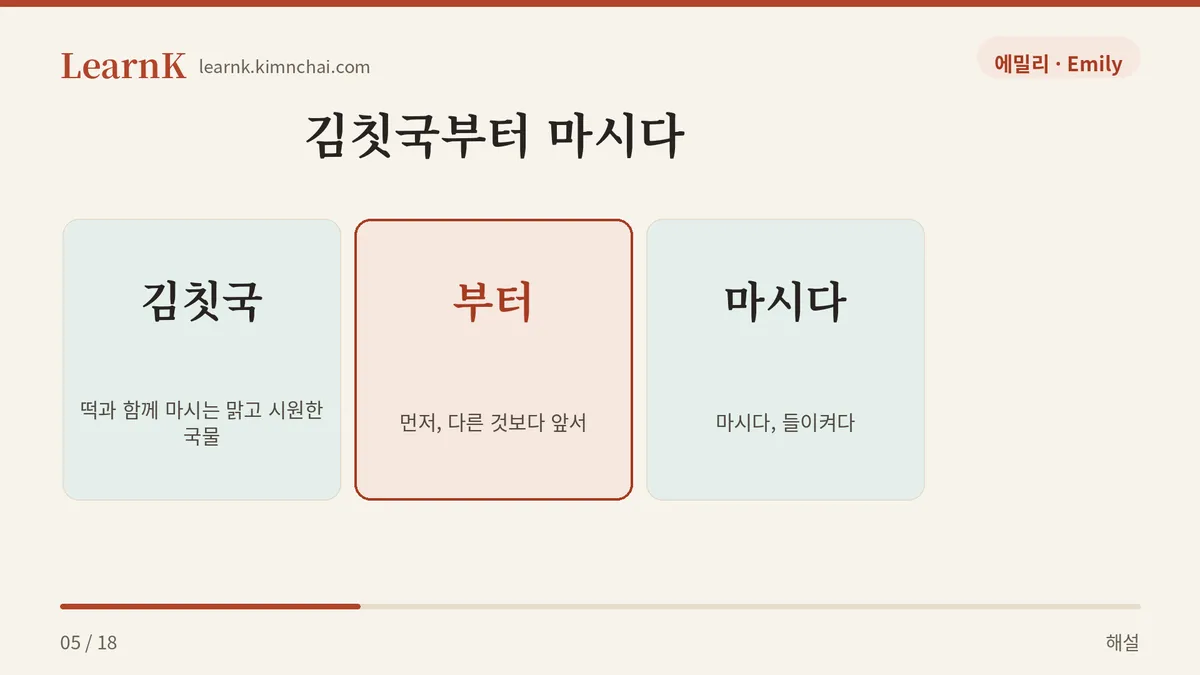
- 김칫국부터 마시다 (gimchitgukbuteo masida) — emphasizes that the order has been flipped. The particle 부터 (buteo), “starting with,” is the backbone of this expression.
- 김칫국 마시고 있네 (gimchitguk masigo inne) — the kind of remark you mutter half to yourself while watching from the side.
- 제가 김칫국을 마셨네요 (jega gimchitgugeul masyeonneyo) — said about yourself after your expectations miss the mark. This form alone sounds natural in polite speech.
Seeing It in Real Conversation
Setting: Friday evening, under a parasol in front of the neighborhood convenience store. Jun-kyung has just come out with five lines of lottery numbers.
Jun-kyung: 야, 이번엔 진짜 느낌이 달라. 1등 되면 월요일에 바로 사표 낼 거야. Hey, this time it really feels different. If I hit the jackpot I’m handing in my resignation on Monday.
Emily: 추첨도 아직 안 했잖아. 벌써 김칫국 마시고 있네. The drawing hasn’t even happened yet. You’re already counting your chickens.
Jun-kyung: 그래도 준비는 해 놔야지. 퇴사 메일 초안은 어제 다 써 놨어. Still, I should be ready. I finished the draft of my resignation email yesterday.
Emily: 초안까지 썼다고? 그 정도면 김칫국을 사발째 들이켠 거지. You wrote a draft? At that point you didn’t just sip the kimchi broth, you chugged a whole bowl.
Jun-kyung: 너도 한 줄 사. 되면 반 나눠 줄게, 진짜로. Buy a line too. If it hits I’ll split it with you, I mean it.
Emily: 됐고, 오늘 저녁이나 사. 그건 확실하잖아. Never mind that — just buy me dinner tonight. At least that one’s guaranteed.
Used This Way, It Sounds Off
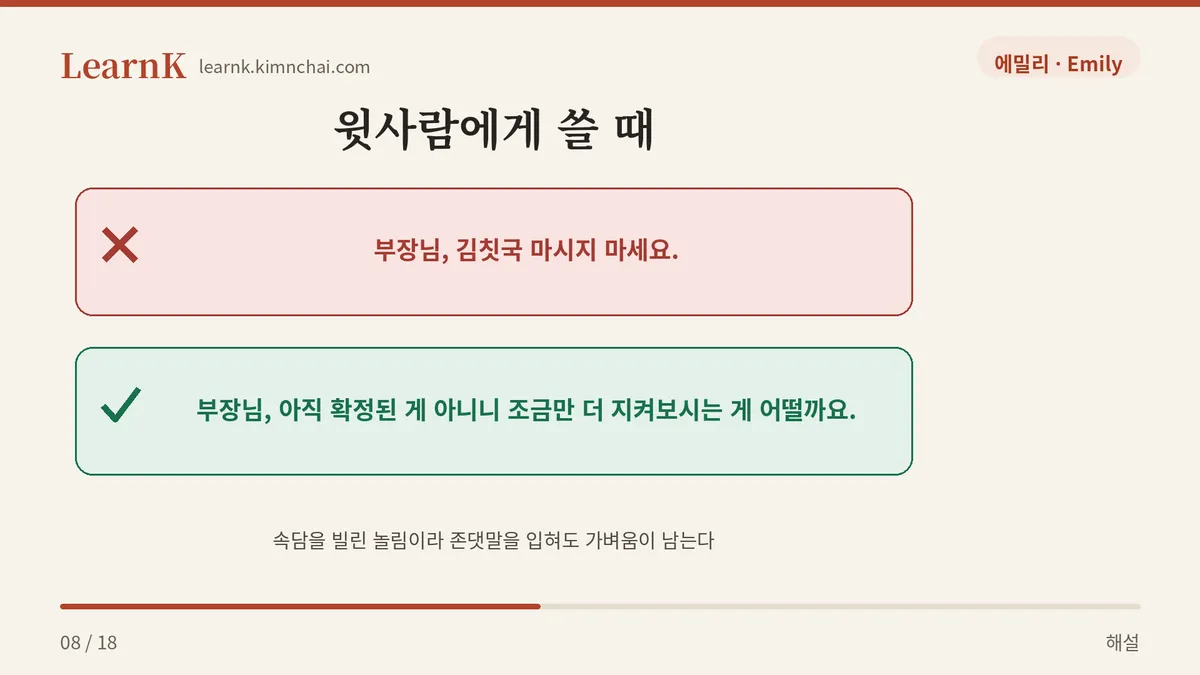
✗ (to your department head) 부장님, 그 계약 아직 모르는 일이잖아요. 김칫국 마시지 마세요 (gimchitguk masiji maseyo). “Sir, that contract is still up in the air. Don’t count your chickens.” ✓ (to your department head) 부장님, 아직 확정된 게 아니니 조금만 더 지켜보시는 게 어떨까요. “Sir, nothing is confirmed yet — what if we watch it a little longer?” → The grammar is fine, but it amounts to openly throwing cold water on a senior’s hopes. It’s a proverb-based tease, so dressing it in polite endings leaves the lightness fully intact.
✗ (to a friend waiting on surgery results) 너무 좋게만 생각하지 마. 김칫국 마시는 (gimchitguk masineun) 걸 수도 있잖아. “Don’t assume the best. You might just be drinking the kimchi broth.” ✓ (in the same moment) 결과 나올 때까지 같이 기다리자. “Let’s wait for the results together.” → This phrase is a joke laid on top of light expectations. Aim it at hope someone is clinging to in desperation and it stops being a joke and turns cruel. When the weight of the moment is heavier than the temperature of the expression, don’t use it.
Example Sentences by Situation
1. When a friend fresh out of an interview is already booking a celebration
아직 최종 발표도 안 났는데 축하 파티라니, 김칫국 마시지 마. (ajik choejong balpyodo an nanneunde chukha patirani, gimchitguk masiji ma.) The final results aren’t even out and you’re planning a party — don’t count your chickens.
Hiring at Korean companies runs through a long series of stages: documents, first round, second round, final. Clearing one stage is a completely different thing from getting the job, which is why this expression shows up here more than anywhere else.
2. When two people have exchanged a few messages and one is already imagining a wedding
연락 두 번 왔다고 벌써 상견례를 알아봐? 김칫국 마시고 있네. (yeollak du beon watdago beolsseo sanggyeollyereul arabwa? gimchitguk masigo inne.) They texted you twice and you’re already looking into meeting the parents? You’re getting way ahead of yourself.
This is what friends throw at each other most often during the early 썸 (sseom) stage — that “something’s happening” phase before anyone is officially dating. Here it’s said with a smile close to 100% of the time.
3. When the deal isn’t closed and someone is already spending on the next step
계약서에 도장도 안 찍었는데 소파부터 고른다고? 김칫국부터 마시는 거 아니야? (gyeyakseoe dojangdo an jjigeonneunde sopabuteo goreundago? gimchitgukbuteo masineun geo aniya?) You haven’t even signed the contract and you’re picking out a sofa? Aren’t you jumping the gun?
Where real money changes hands — a housing contract, a job change, an investment — the same words tilt away from joking and toward advice. Think of the tone of voice dropping one notch.
Polite vs. Casual Speech, and Similar Expressions
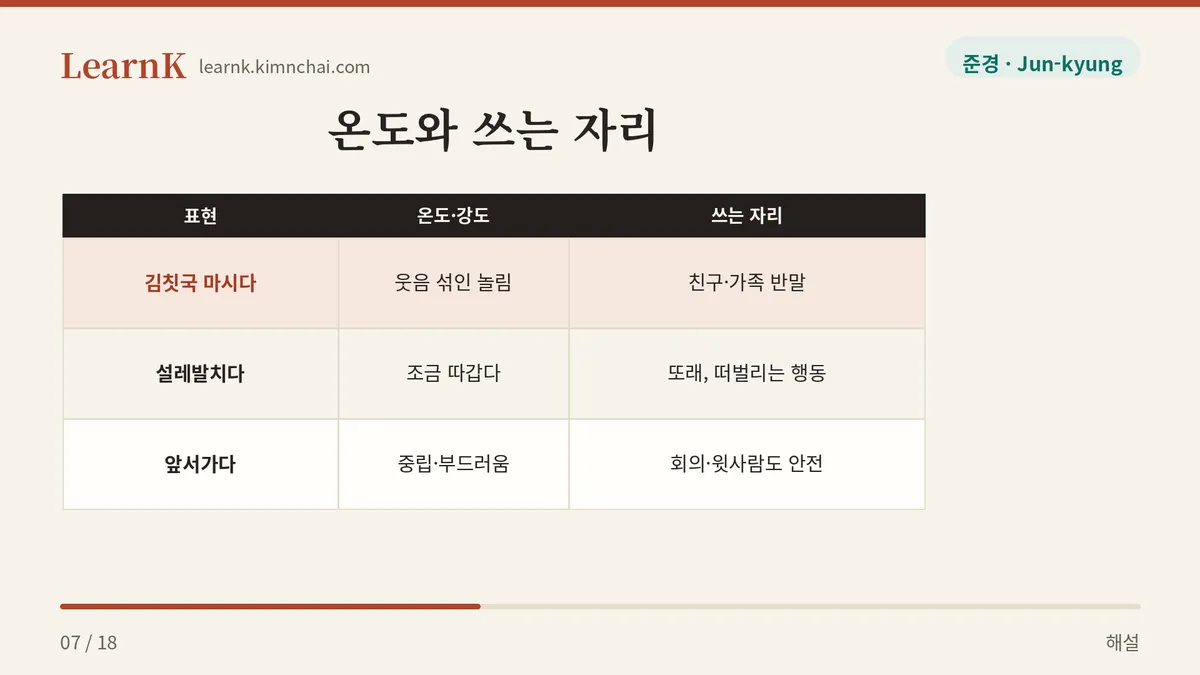
Structurally, this expression lives in casual speech. Converting it to polite form as 김칫국 마시지 마세요 (gimchitguk masiji maseyo) is grammatically possible, but people almost never actually say it to someone senior. Turning the arrow on yourself, however, sounds perfectly natural even in polite speech. After your expectations miss, saying 제가 너무 김칫국을 마셨네요 (jega neomu gimchitgugeul masyeonneyo) — “I got way ahead of myself, didn’t I” — is a humble, mood-lightening way to close things out.
Putting it next to similar phrases makes its place clearer.
| Expression | Temperature / Strength | Where it’s used |
|---|---|---|
| 김칫국 마시다 (gimchitguk masida) | Light and teasing, mixed with laughter | Casual speech among friends and family. With seniors, only about yourself |
| 설레발치다 (seollebalchida) | A bit more stinging. Calls out the worked-up behavior | Peers. When the loud talk runs ahead of the expectation |
| 앞서가다 (apseogada) | Neutral, gentle | Anywhere. Safe in meetings and with seniors |
| 오버하다 (obeohada) | Light and blunt | Peers, messaging apps. Not just expectations but overreactions in general |
If you need to get the same idea across to someone senior, go with 앞서가다 (apseogada). 조금 앞서가신 것 같습니다 (jogeum apseogasin geot gatseumnida) — “I think you may be getting slightly ahead of things” — isn’t rude at all.
Cultural Background — Between the Rice Cake and the Kimchi Broth
The expression comes from the proverb 「떡 줄 사람은 꿈도 안 꾸는데 김칫국부터 마신다」 (tteok jul sarameun kkumdo an kkuneunde gimchitgukbuteo masinda) — “The person who’d give you the rice cake isn’t even dreaming of it, yet you’re already drinking the kimchi broth.” The front half fell away and the back half survived as a set phrase. That’s why the particle 부터 (buteo) still tags along so often: the flipped order is the whole point of the expression.
Picture it and the meaning sinks in physically. Rice cake is dense and sticks in your throat, so you eat it alongside something cool to drink. Back in the day, when the smell of rice cake being steamed drifted over the wall from next door, it was natural to expect a plateful to come your way — sharing rice cake with the neighbors was simply what you did. So you ladle out the kimchi broth in your kitchen and sit down to wait before the rice cake has arrived — except the neighbors never had any intention of sharing. That mismatch is the entire expression.
There’s one point learners often get wrong here. The 김칫국 (gimchitguk) in question isn’t red kimchi stew. It’s a clear, cool broth like the liquid from 동치미 (dongchimi), water radish kimchi. You’re drinking it to wash the rice cake down, so it couldn’t possibly be a spicy stew.
The phrase is a regular in dramas and variety shows too. When a character with a one-sided crush reads meaning into one small kindness and imagines the next scene all by themselves, the friend character delivers exactly this line. It’s a moment where viewers feel exasperated and charmed at once, which makes it excellent dialogue. It also gets slapped on as a subtitle in audition programs, when a contestant is sure they’ve advanced and starts picking a song for the next round.
One more thing. In Korea this phrase isn’t a cynical “don’t get your hopes up.” It’s closer to sitting down beside the hopeful person and laughing along with them. That’s why, when the lottery ticket busts or the interview doesn’t pan out, the friend who said it is the one who buys dinner.
Today’s Quiz
Jun-kyung is convinced about a promotion that hasn’t been announced yet and says he’s going to go buy a new suit. What’s the most natural thing for Emily to say here?
- 김칫국 마시지 마. (gimchitguk masiji ma.)
- 김칫국 잘 마셨어. (gimchitguk jal masyeosseo.)
- 김칫국 좀 마셔 봐. (gimchitguk jom masyeo bwa.)
Answer: 1. This expression is almost always used to hold someone back, and the negative command 김칫국 마시지 마 (gimchitguk masiji ma) is overwhelmingly the most common form. It isn’t used as past-tense praise like option 2, or as an invitation like option 3. Do keep in mind, though, that turning it on yourself in the past tense — 내가 김칫국을 마셨네 (naega gimchitgugeul masyeonne), “I got ahead of myself there” — is perfectly natural.
Definitions and example sentences are from the National Institute of Korean Language’s Basic Korean Dictionary (krdict.korean.go.kr); that portion of this post, including our translations, is licensed under CC BY-SA 2.0 KR.