Today's Korean Word: '고백' (gobaek) — The Bravest Little Word for Laying Your Heart Bare
고백 (gobaek)
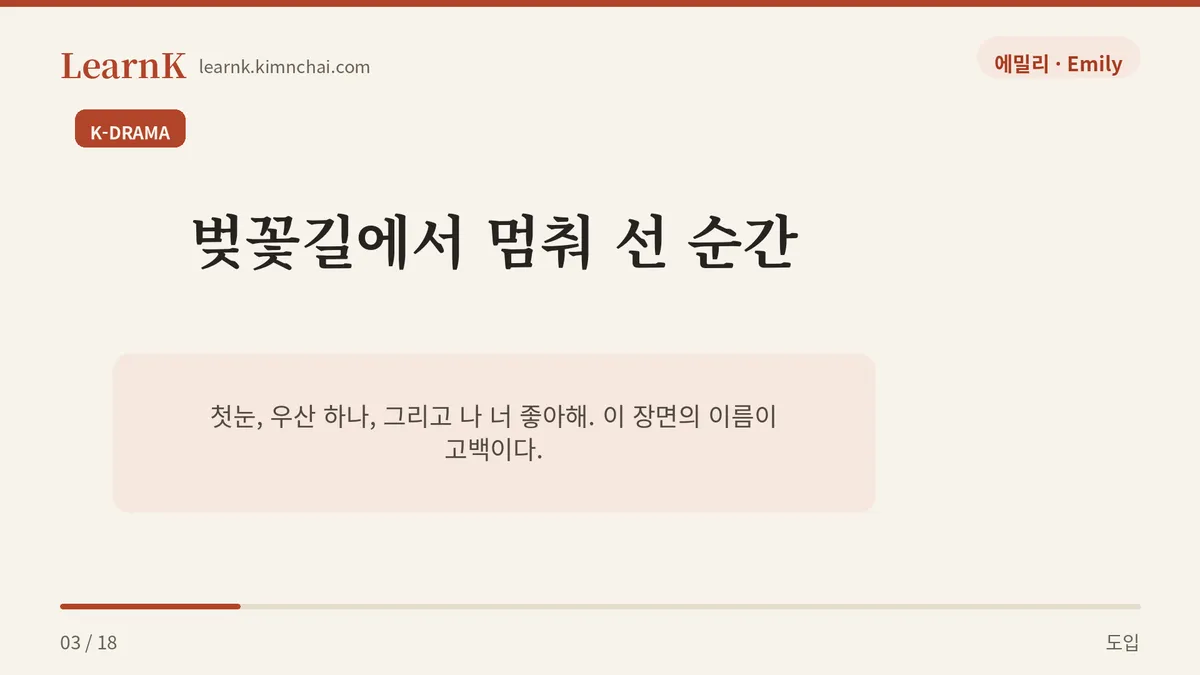
A cherry-blossom path at night, two people walking side by side—when suddenly one of them stops. “Um… I, actually, I like you.” The screen slows down, the music swells. If you watch Korean dramas long enough, you’re bound to run into this scene eventually, and its name is 고백 (gobaek). It’s that very moment when someone takes the true feelings they’d kept locked away deep inside and, in a trembling voice, lays them out in front of another person.
But 고백 isn’t a word used only for love. Owning up to a long-hidden wrongdoing, finally spilling a secret you couldn’t tell anyone—“I have to say it now”—that’s all 고백 too. Today, let’s take a look together at the ‘temperature of courage’ packed into this one short word.
Meaning and Nuance
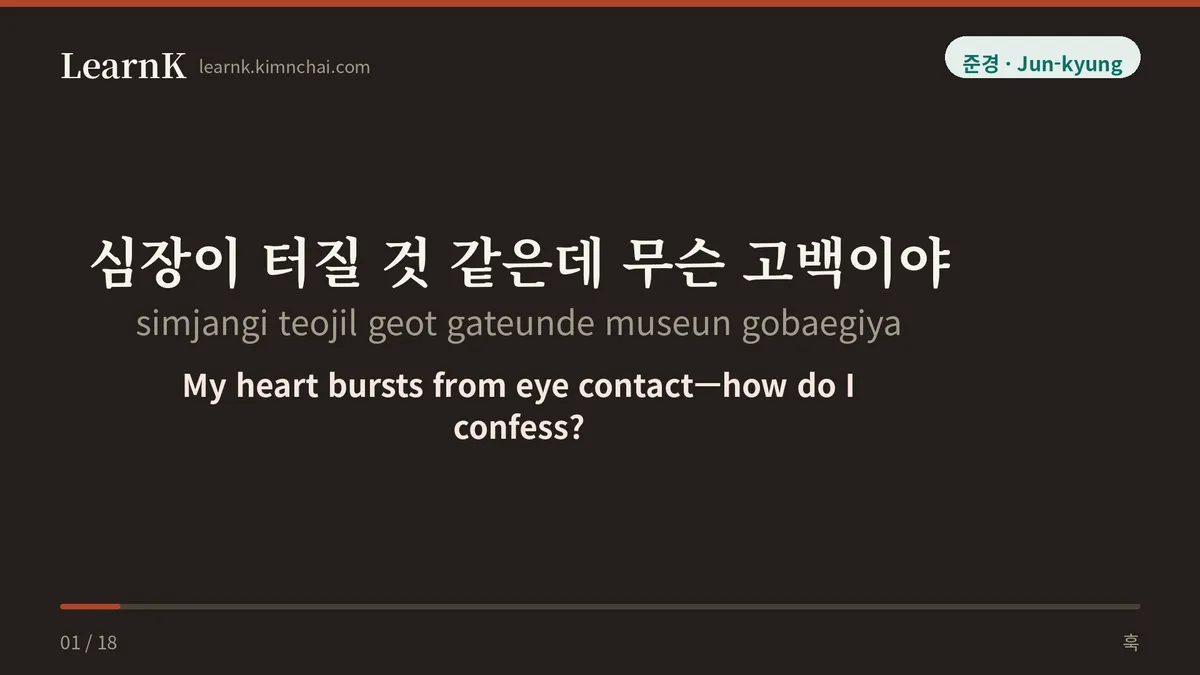
There are two things at the heart of 고백. First, the content has to be something you’d been hiding. Stating a fact everyone already knows isn’t a 고백. Second, you reveal it honestly, and completely. Saying only half of it, or beating around the bush, can hardly be called a 고백.
That’s why the word 고백 always carries a little fear and courage along with it. Opening your mouth even though you know that the moment the words come out, the relationship could change—because of that weight, when Koreans hear the single phrase “고백했다 (I confessed),” they already read a considerable amount of emotion into it. The verb form is 고백하다 (gobaekhada), and in a romantic situation it’s commonly used as 사랑을 고백하다 (sarangeul gobaekhada), to confess one’s love.
Checking the National Institute of Korean Language Dictionary
고백 (noun) 마음속의 생각이나 숨기고 있는 사실을 솔직하게 모두 다 말함. [en] confession; confiding; making a clean breast of something — The act of telling one’s innermost thoughts or secrets truthfully. [ja] こくはく【告白】 — 心の中で思っていることや隠していることを正直にすべて打ち明かすこと。 [es] confesión — Acción de declarar francamente todos los sentimientos o hechos que se ocultaba. [zh] 告白,坦白,表白 — 把心里的想法或隐瞒的事实坦率地全部说出来。 — National Institute of Korean Language, Basic Korean Dictionary (krdict.korean.go.kr)
Shall we also look at some real usage examples the dictionary provides? Try to feel just how varied the situations can be, even for the same word 고백.
그렇게 가슴앓이만 하지 말고 고백을 해 봐. — National Institute of Korean Language, Basic Korean Dictionary (krdict.korean.go.kr)
This is a situation where you’re giving a nudge to a friend who’s just pining away alone: “At least try saying something.” It shows nicely just how close 고백 is to ‘an act of working up courage.’
지수한테 네 잘못을 솔직하게 고백해 보는 건 어때? — National Institute of Korean Language, Basic Korean Dictionary (krdict.korean.go.kr)
Here it’s not love but a wrongdoing that’s being confessed. It’s warm advice to admit it and apologize. This is decisive proof that 고백 isn’t a word reserved solely for romance.
평소 수줍음이 많던 승규는 술 마신 객기로 사랑을 고백했다가 보기 좋게 차였다. — National Institute of Korean Language, Basic Korean Dictionary (krdict.korean.go.kr)
The results of courage aren’t always a happy ending—with ‘차였다 (chayeotda, got rejected)’ tacked on, this example keeps its bitterness fully alive.
비리 혐의로 구속되었다가 풀려난 공직자는 이제 청렴한 정치인으로 거듭나겠다고 고백했다. — National Institute of Korean Language, Basic Korean Dictionary (krdict.korean.go.kr)
This time it’s a 고백 that’s closer to a public pledge. From personal love to a social declaration, the range is that wide.
겁쟁이처럼 굴지 말고 용기 내서 고백해 봐. — National Institute of Korean Language, Basic Korean Dictionary (krdict.korean.go.kr)
Encouragement that gives a push to someone who’s hesitating. Once again we can see just how much ‘용기 (courage)’ and ‘고백’ are words that go hand in hand.
Seeing It in a Real Conversation
Scene: Late at night, on plastic chairs in front of the neighborhood convenience store. They’re sitting there, each holding a can of beer.
Jun-kyung: 야, 나 오늘 진짜 말하려고 했는데 또 입이 안 떨어지더라. Hey, I really meant to say it today, but the words just wouldn’t come out again.
Emily: 뭘? 설마 또 그 얘기? 좋아한다고 말도 못 하고 그냥 왔어? What? Don’t tell me it’s that again. You came back without even saying you like her?
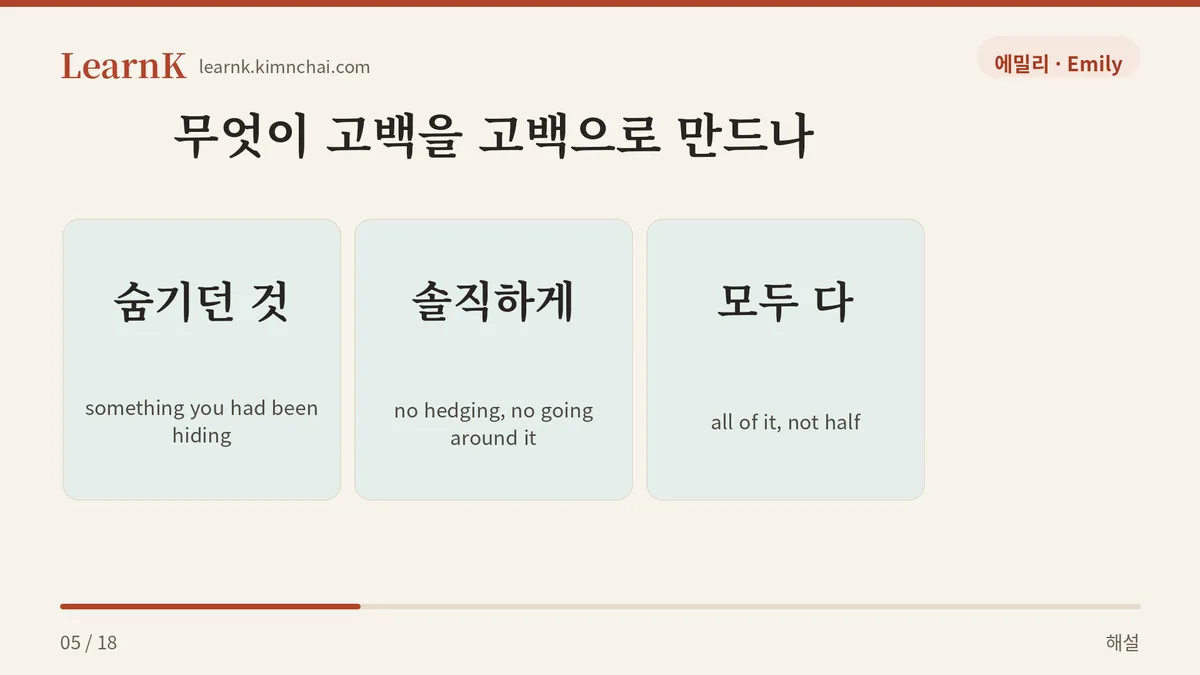
Jun-kyung: …어. 눈만 마주쳐도 심장이 터질 것 같은데 무슨 고백이야. …Yeah. My heart feels like it’ll burst just from eye contact—how am I supposed to confess?
Emily: 야, 그렇게 가슴앓이만 하다가 평생 후회한다. 지레 겁먹지 말고 고백해. Come on, keep bottling it up like that and you’ll regret it forever. Don’t psych yourself out—just confess.
Jun-kyung: 차이면 어떡해. 지금 이 어정쩡한 사이도 그냥 끝나 버리잖아. What if I get rejected? Even this in-between thing we’ve got would just be over.
Emily: 안 하면 그게 진짜 후회야. 내일 딱, 문자로라도 고백해 봐. 응? Not doing it—that’s the real regret. Tomorrow, even by text, just try to confess, okay?
Example Sentences by Situation
-
Confessing love — when you bring out your feelings for the first time 오늘은 꼭 고백할 거예요. (oneureun kkok gobaekhal geoyeyo.) — A sentence carrying the resolve that today, of all days, you’ll definitely say how you feel.
-
Confessing a wrongdoing — when you come clean with the truth after the fact 사실은 제가 깼어요. 늦었지만 고백할게요. (sasireun jega kkaesseoyo. neujeotjiman gobaekhalgeyo.) — A situation where you own up to a wrongdoing you’d been hiding.
-
Confessing your true heart — when you open up an inner thought you couldn’t share with anyone 이건 아무한테도 안 한 고백인데요… (igeon amuhantedo an han gobaeginedyo…) — A good expression to use right before bringing out a heavy secret for the first time.
Polite/Casual Forms and Similar Expressions
- Casual: 고백해. (gobaekhae.) / Polite: 고백하세요. (gobaekhaseyo.) / More formal: 고백드릴게요. (gobaekdeurilgeyo.)
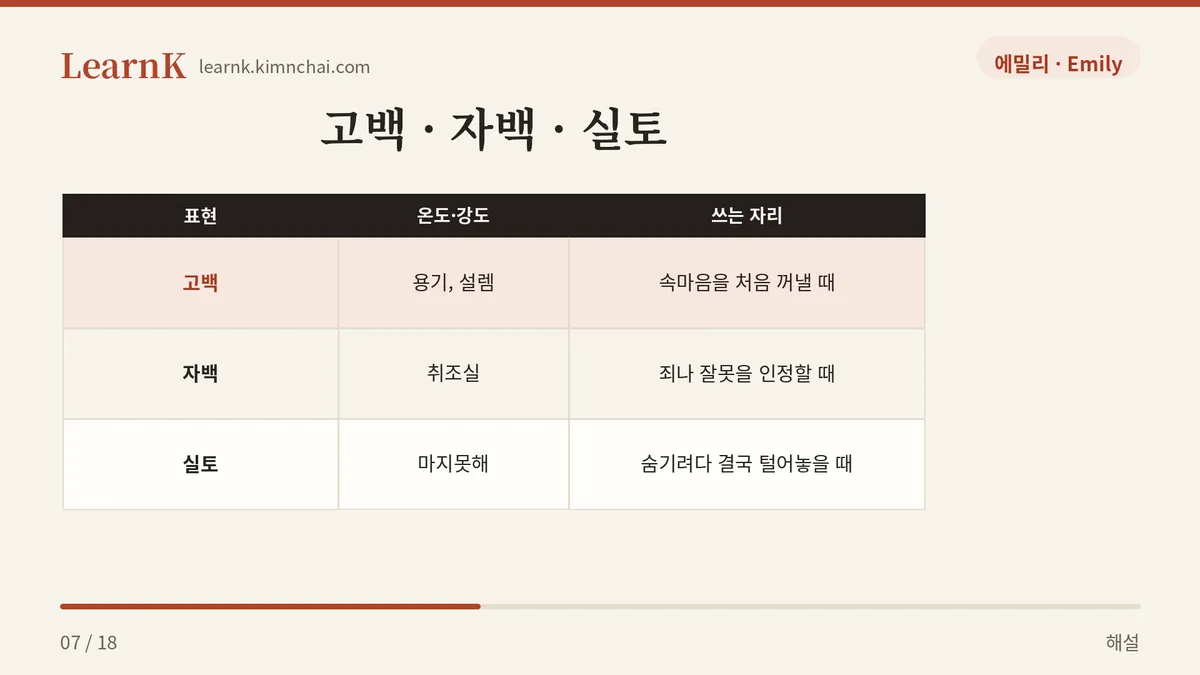
- Words that are similar but different in temperature:
- 털어놓다 (teoreonota): The feeling of comfortably letting out something you’d been holding onto heavily. Softer than 고백.
- 자백하다 (jabaekhada): Mainly for admitting to a crime or wrongdoing. It has a strong police-station/interrogation-room nuance.
- 실토하다 (siltohada): A word with a slightly cornered feeling—you tried to hide it but ended up spilling it in the end.
- In a romantic situation, 좋아한다고 말하다 (joahandago malhada) can also be a more low-key alternative.
Cultural Background
In Korean dramas, the confession scene is staged with care, almost like a ritual. In the moment when the first snow falls, or cherry blossoms scatter, or two people share a single umbrella, words like “나랑 사귈래? (Will you go out with me?)” or “나 너 좋아해 (I like you)” come bursting out. These days, the subtle stage right before dating is called ‘썸 (some),’ and 고백 is exactly the decisive blow that ends the 썸 and makes the relationship official.
What’s interesting is that in Korea, ‘who confesses first’ is quietly an important topic of conversation. That’s why scenes like the dialogue above—friends nudging each other with “You confess first!”—actually happen quite often in real life. Whether it’s love or a wrongdoing, this word is deeply steeped in the sentiment that 고백 is ultimately ‘the act of working up courage and opening yourself up first.‘
Closing Quiz
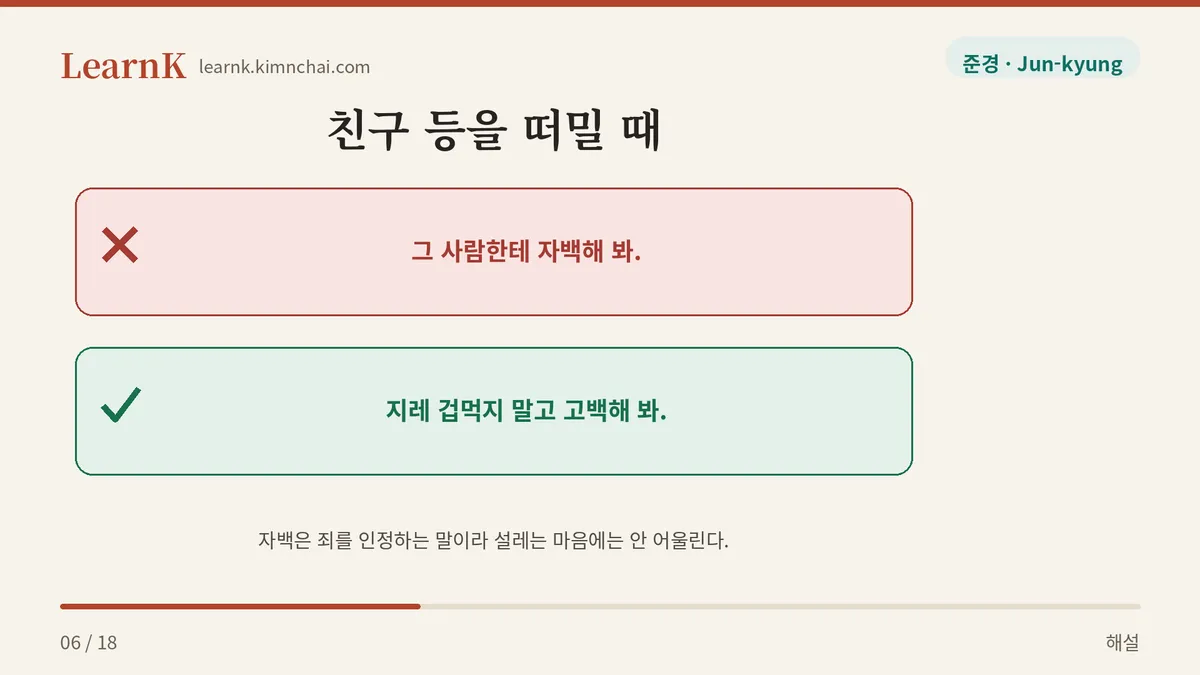
Your friend can’t get a word out in front of the person they like, and has been pining away alone for days. What’s the most natural line you could offer while giving them a nudge?
A. “지레 겁먹지 말고 고백해 봐.” (Don’t psych yourself out—just try to confess.) B. “그 사람한테 자백해 봐.” (Try to fess up to that person.) C. “얼른 실토해.” (Hurry up and spill it.)
(Answer: A. B’s ‘자백’ and C’s ‘실토’ are words for pressing someone to admit a crime or wrongdoing, so they don’t suit a situation of conveying fluttering feelings. For love, it really has to be ‘고백.’)
Definitions and example sentences are from the National Institute of Korean Language’s Basic Korean Dictionary (krdict.korean.go.kr); that portion of this post, including our translations, is licensed under CC BY-SA 2.0 KR.