Living Your Best Life, gatsaeng-style: The Korean Buzzword That Turns Every Day Into a Win
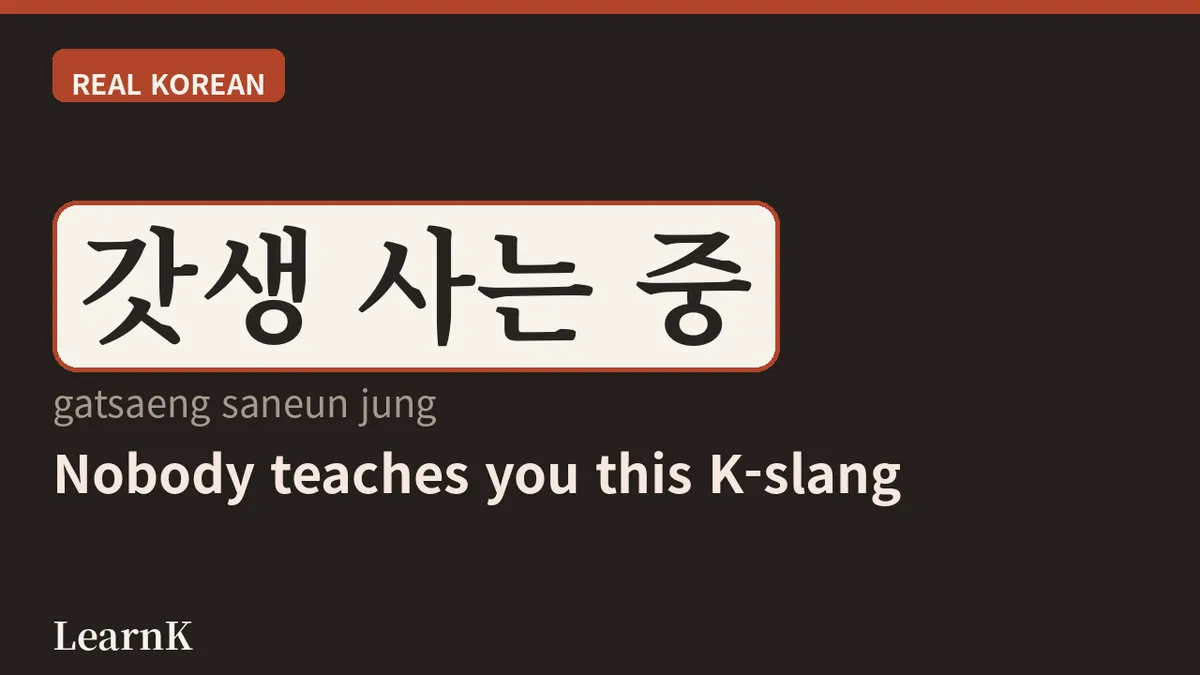
Someone who wakes up at 6 a.m., drinks a glass of water, works out, studies, and makes the most of their whole day. When people on Korean social media spot someone like this, one word always shows up in the comments: 갓생 (gatsaeng). Appearing hundreds of times a day on Instagram, YouTube, and TikTok, this expression is a keyword that neatly captures how Korea’s younger generation feels about life. Today, let’s dig deep into this red-hot piece of new slang.
갓생
갓생 (gatsaeng) is a compound word made of two parts. The first part, 갓 (gat), is the English word God written out phonetically in Hangul, and the second part, 생 (saeng), comes from the Chinese character for “birth/life” (生), meaning life or living. So a literal translation of 갓생 is “the life of a god,” and a more natural rendering would be “living as perfectly and diligently as a god.”
Here, “갓” doesn’t actually carry a religious meaning — on the Korean internet, it’s a prefix you can stick in front of almost any word to mean “the best” or “amazing.” For example, an actor who acts incredibly well is called a 갓배우 (gatbaeu). So in the end, 갓생 is a term of praise for “a diligent, exemplary, well-spent day-to-day life.” As for its opposite, the new slang ‘나락 인생’ (narak insaeng) — a life spent letting time slip by listlessly — or ‘무기력’ (mugiryeok), meaning lethargy, come to mind.
There’s one important nuance. 갓생 praises not grand success but “small yet steady conscientiousness.” It’s not about landing a job at a big company — it’s the warm language of self-encouragement, where you feel proud of yourself for the little wins: getting up early today, making your bed, finally doing the dishes you’d been putting off.
Example Sentences by Situation
1. When talking about your New Year’s resolutions
올해는 진짜 갓생 살기 (gatsaeng salgi) 가 목표야. 매일 아침 6시에 일어날 거야. (This year my real goal is 갓생 살기 — living my best life. I’m going to get up at 6 a.m. every morning.)
This is a scene where you’re telling a friend your New Year’s resolution. ‘갓생 살기’ is the noun form meaning “living the gatsaeng life,” and it’s the form most often used for diary goals and social media hashtags.
2. When bragging about a productive day
오늘 운동도 하고 공부도 했어. 나 오늘 완전 갓생 살았지 (gatsaeng saratji)? (Today I worked out AND studied. I totally lived my best life today, right?)
This is a situation where you praise yourself after a well-spent day. Adding ‘~았지?’ at the end turns it into a cute way of fishing for the listener’s agreement and praise.
3. When reflecting on your own laziness
주말 내내 누워만 있었네… 내일부터는 갓생 (gatsaeng) 살아야겠다. (I spent the whole weekend just lying around… Starting tomorrow, I’ve got to live my best life.)
Here it’s the opposite — a scene of making a resolution after wasting a day. In this way, 갓생 often shows up as an “ideal you haven’t lived up to.”
Polite and Casual Speech, and Similar Expressions
Because 갓생 is new slang, it mainly fits casual speech (반말) situations used between friends. But if you change the form, it works perfectly well in polite speech too.
- Casual: 갓생 살자! (gatsaeng salja!) — Let’s live our best lives together!
- Polite: 갓생 사세요! (gatsaeng saseyo!) — Have a productive, fulfilling time!
A similar expression is the standard phrase ‘열심히 살다 (yeolsimhi salda)’, meaning “to live hard/diligently.” If 갓생 has a young, trendy feel, then ‘열심히 살다’ is a safe expression that lands with any generation. In formal settings or with older people, it’s more natural to use ‘성실하게 지내다 (seongsilhage jinaeda)’ — “to spend one’s time conscientiously” — instead of 갓생.
Cultural Background
Behind the 갓생 craze lies the pressure young people feel in Korea’s fiercely competitive society. In an era where big success has grown harder and harder to reach, people have started to find comfort in the small sense of accomplishment that comes from “I lived today well.” A culture of waking up at dawn to work on self-improvement — like the so-called “Miracle Morning” — posting proof of the process on social media, and cheering each other on is exactly what grew the word 갓생.
These diligent characters are beloved in K-dramas, too. When a protagonist keeps steadfastly living out their days despite a harsh reality, viewers leave supportive comments like, “Now THAT’S real 갓생.” In the end, 갓생 is more than just a buzzword — it’s a word that holds the heart of Koreans today, trying to overcome a tough reality with positivity.
Closing Quiz
Which of the following sentences uses 갓생 (gatsaeng) the most naturally?
- 어제 늦잠 자고 아무것도 안 했더니 완전 갓생이었어. (I slept in yesterday and did nothing, so it was total 갓생.)
- 오늘 새벽에 일어나 운동하고 책도 읽었어. 이게 바로 갓생이지! (Today I got up at dawn, worked out, and read a book too. THIS is 갓생!)
- 갓생이 너무 비싸서 못 샀어. (갓생 was too expensive, so I couldn’t buy it.)
The answer is number 2. Since 갓생 means “a diligent, fulfilling life,” you can’t use it for a lazy day (number 1) or for an object (number 3). Why not start your own little 갓생 today? Beginning with just making your bed!