Gomtang — the Word Held in a Bowl of Broth Simmered All Night
곰탕 (gomtang)
곰탕 (gomtang) means a soup made by simmering beef and beef bones long and slow. The occasions when a Korean reaches for this word are more predictable than you might think. The morning after a night of too much drinking. When someone has been laid up sick for days. The evening after the whole family has finished hauling boxes on moving day and everyone is running on empty. In other words, it’s the word that comes out when a signal goes on that says, “somebody needs to put something back into their body right now.” So 곰탕 (gomtang) is a menu item and an expression of worry at the same time.
The broth is generally bland. Korean learners are often thrown off by that first spoonful — it’s barely seasoned at all. Salt, pepper, and finely chopped green onion are added by each diner. Stir in some rice, top it with 깍두기 (kkakdugi), and that’s a whole meal. What leads in 곰탕 (gomtang) isn’t flavor — it’s time. This is a broth that takes hours, sometimes an entire night, to draw out, so the word comes attached to the feeling that “someone spent that much time on me.” That’s exactly why Korean dramas keep coming back to the scene of a mother boiling 곰탕 (gomtang) and sending it off to her child.
Checking the National Institute of Korean Language dictionary
First, let’s see how the national institution’s dictionary defines the word.
곰탕 (gomtang) 「명사」 (noun) 소고기와 소뼈를 오랫동안 푹 끓인 국. (A soup made by boiling beef and beef bones long and slow.) [en] gomtang; beef bone soup — Soup, made by boiling beef and beef bones for a long time. [ja] コムタン — 牛の肉や骨を長時間じっくり煮込んだスープ料理。 [es] gomtang, caldo de carne — Caldo espeso de carne y hueso de res, que se cuece durante mucho tiempo. [zh] 精熬牛骨汤 — 将牛肉和牛骨放在一起经过长时间熬制而成的浓汤。 — National Institute of Korean Language, Basic Korean Dictionary (krdict.korean.go.kr)
The Portuguese definition isn’t listed in the dictionary, so we translated it ourselves: sopa coreana de carne e ossos de boi, cozidos longamente (our own translation).
Notice that all four language definitions hold onto the same idea — “a long time” (long time / 長時間 / mucho tiempo / 长时间). Time, not ingredients, is the core of this word.
Let’s also look at the real usage examples listed in the dictionary.
- 곰탕을 끓이다.
- 곰탕 한 그릇.
- 사골 곰탕.
- 아버지는 뜨끈한 곰탕에 밥을 말아 드시고는 출근하셨다.
- 엄마, 곰탕은 곰으로 만든 국이에요? — National Institute of Korean Language, Basic Korean Dictionary (krdict.korean.go.kr)
Let’s take them one at a time.
- 곰탕을 끓이다 (gomtang-eul kkeurida, “to boil gomtang”) — this is the verb that attaches to 곰탕 (gomtang) most often. 끓이다 (kkeurida) is overwhelmingly more natural than 만들다 (mandeulda, “to make”). The act of leaving it over the fire for a long time is the identity of this dish.
- 곰탕 한 그릇 (gomtang han geureut, “one bowl of gomtang”) — 곰탕 (gomtang) is counted in 그릇 (geureut, bowls), not plates. It’s the exact phrase you use to order in a restaurant, so it’s worth memorizing as one chunk.
- 사골 곰탕 (sagol gomtang) — a version that specifically foregrounds 사골 (sagol), the leg bones of the cow. You’ll also find it commonly sold pre-packaged in the refrigerated aisle of Korean supermarkets.
- 아버지는 뜨끈한 곰탕에 밥을 말아 드시고는 출근하셨다 (“Father stirred rice into a piping-hot bowl of gomtang, ate it, and left for work.”) — one sentence containing the whole typical time and manner in which 곰탕 (gomtang) appears. Morning, 밥을 말다 (bab-eul malda, “to stir rice into soup”), and a person heading out to get through the day. This is the Korean breakfast scene that treats 곰탕 (gomtang) as fuel.
- 엄마, 곰탕은 곰으로 만든 국이에요? (“Mom, is gomtang a soup made from bears?”) — it’s listed as a question a child would ask, but honestly, this is also the single most common misunderstanding among foreign learners. We’ll cover it in the very next section.
A real conversation
Scene: A snowy Saturday morning. Two people who were out drinking until late the night before push open the door of a neighborhood gomtang shop that’s been in business for 40 years.
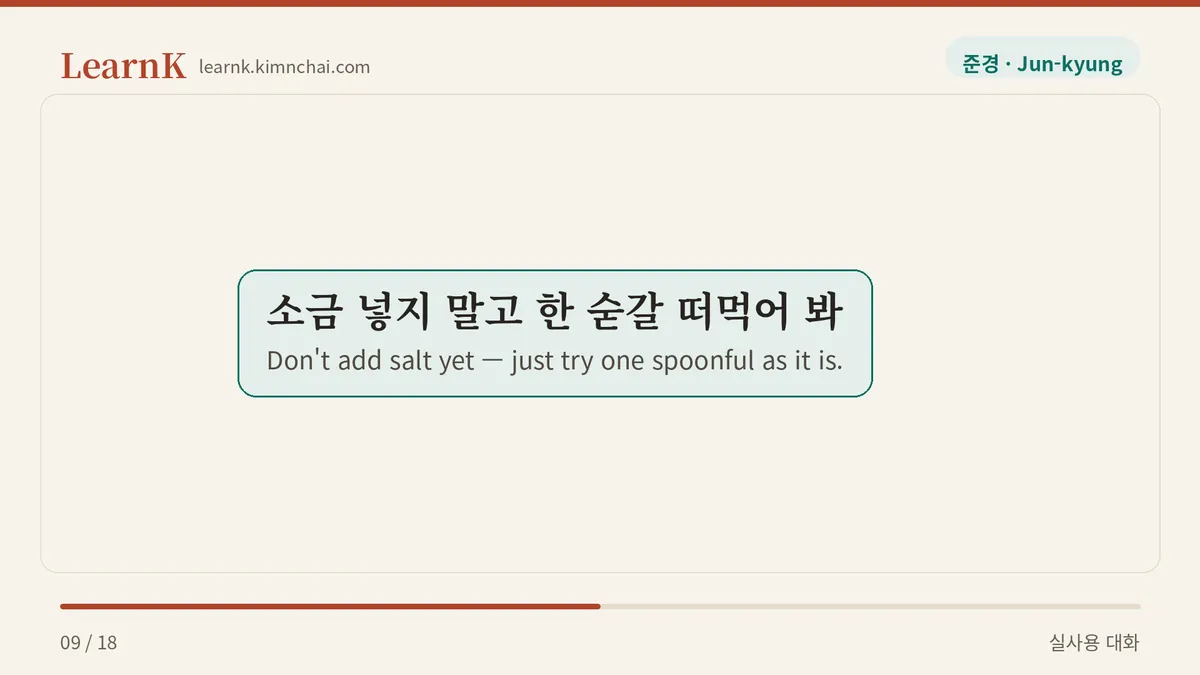
Jun-kyung: 여기 곰탕 두 그릇이요! 야, 너 소금 넣지 말고 일단 한 숟갈 그냥 떠먹어 봐. Two gomtang here, please! Hey, don’t add salt yet — just try one spoonful as it is.
Emily: 어? 무슨 맛인지 모르겠는데. 이거 원래 이래? Huh? I can’t tell what it tastes like. Is it supposed to be like this?
Jun-kyung: 응, 그게 맞는 거야. 간은 네가 하는 거고. 소금 조금, 파 많이, 그다음에 밥 말아. Yeah, that’s how it is. You do the seasoning. A little salt, lots of green onion, then put your rice in.
Emily: 아… 이제 알겠다. 속이 확 풀리네. 어제 그렇게 마셨는데도. Ah… now I get it. It really settles my stomach, even after all that drinking yesterday.
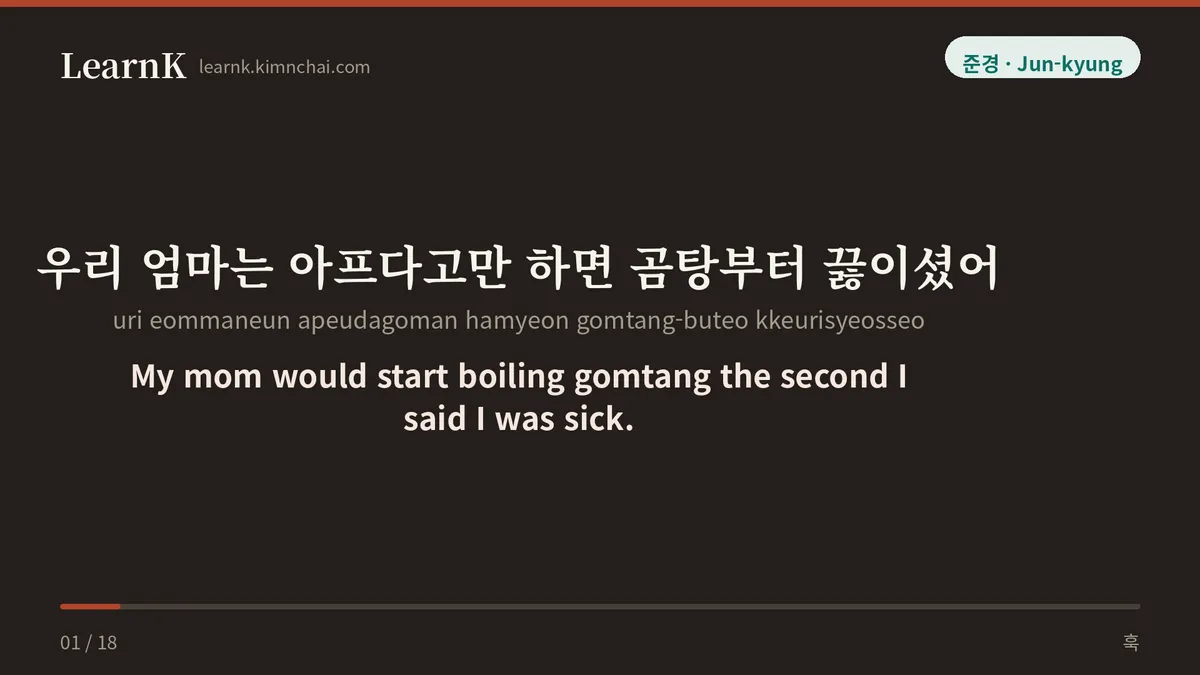
Jun-kyung: 그래서 우리 엄마는 내가 아프다는 말만 하면 무조건 곰탕부터 끓이셨어. That’s why my mom would start boiling gomtang the second I said I wasn’t feeling well.
Emily: 어쩐지. 이거 음식이 아니라 거의 약이다, 진짜. No wonder. This isn’t food, it’s basically medicine.
This sounds off in Korean
곰탕 (gomtang) is the name of a thing, so it isn’t a word you have to adjust depending on who you’re talking to. Instead, let’s look at two misunderstandings learners genuinely run into all the time.
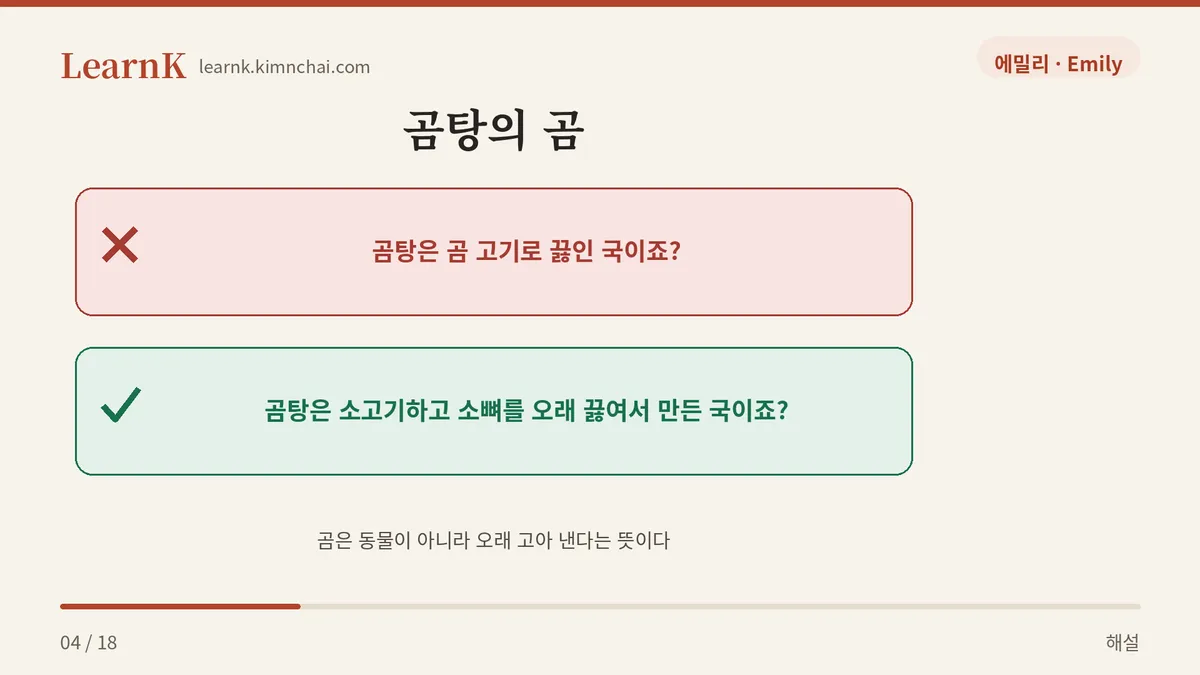
✗ 곰탕은 곰 고기로 끓인 국이죠? 한국 사람들 곰도 먹는구나. (Gomtang is a soup boiled from bear meat, right? So Koreans eat bear too.) ✓ 곰탕은 소고기하고 소뼈를 오래 끓여서 만든 국이죠? (Gomtang is a soup made by boiling beef and beef bones for a long time, right?) → The 곰 (gom) in 곰탕 (gomtang) is not the animal 곰 (gom, “bear”). It comes from the verb 고다 (goda), meaning to simmer something down long and slow, so the name means roughly “the simmered-down thing.” The ingredient is beef from start to finish.
✗ (deciding on lunch) 곰탕은 국이니까, 밥이랑 다른 메뉴도 같이 시키자. (Gomtang is a soup, so let’s order rice and another dish with it.) ✓ (deciding on lunch) 곰탕 두 그릇이요. 밥은 말아서 주세요. (Two gomtang, please. With the rice already stirred in.) → 곰탕 (gomtang) isn’t a soup served alongside other dishes like a side; it belongs to the 국밥 (gukbap, “soup-and-rice”) family that constitutes a meal all by itself. Treating it like an “appetizer” with the English sense of soup in mind makes it sound strange. If you ordered 곰탕 (gomtang), that is your main.
Example sentences by situation
1. Visiting a sick friend
You stop by a friend’s place where they’ve been flat on their back with the flu for days. 죽 (juk, rice porridge) is fine too, but when you want to put some strength back into them, this is the line that comes out.
곰탕 좀 사 왔어. 밥 조금만 말아서 먹어 봐. (gomtang jom sa wasseo. bap jogeumman marasseo meogeo bwa.) “I picked up some gomtang for you. Stir in just a little rice and try to eat.”
2. Ordering at a restaurant
A gomtang shop has a short menu. Ordering usually ends with this one sentence.
곰탕 두 그릇 주세요. 하나는 밥 따로 주시고요. (gomtang du geureut juseyo. hananeun bap ttaro jusigoyo.) “Two bowls of gomtang, please. And one of them with the rice on the side.” If you don’t want the rice served already stirred into the soup, just say 밥 따로 (bap ttaro, “rice separate”). If you do want it stirred in, say 말아 주세요 (mara juseyo).
3. When guests come to your home
When offering it to an elder, switch to honorific speech.
어머니, 곰탕 한 그릇 드시겠어요? 어제부터 고아 놓은 거예요. (eomeoni, gomtang han geureut deusigesseoyo? eojebuteo goa noeun geoyeyo.) “Would you like a bowl of gomtang? I’ve had it simmering since yesterday.” The phrase “I’ve had it simmering since yesterday” already contains the measure of care involved. Offering someone 곰탕 (gomtang) usually comes with a mention of time.
Formal vs. casual speech, and similar expressions
곰탕 (gomtang) is a noun, so there’s no honorific level built into the word itself. The politeness is decided by the verb you use with it.
- Casual: 곰탕 먹으러 갈래? (gomtang meogeureo gallae?)
- Polite: 곰탕 한 그릇 드시겠어요? (gomtang han geureut deusigesseoyo?)
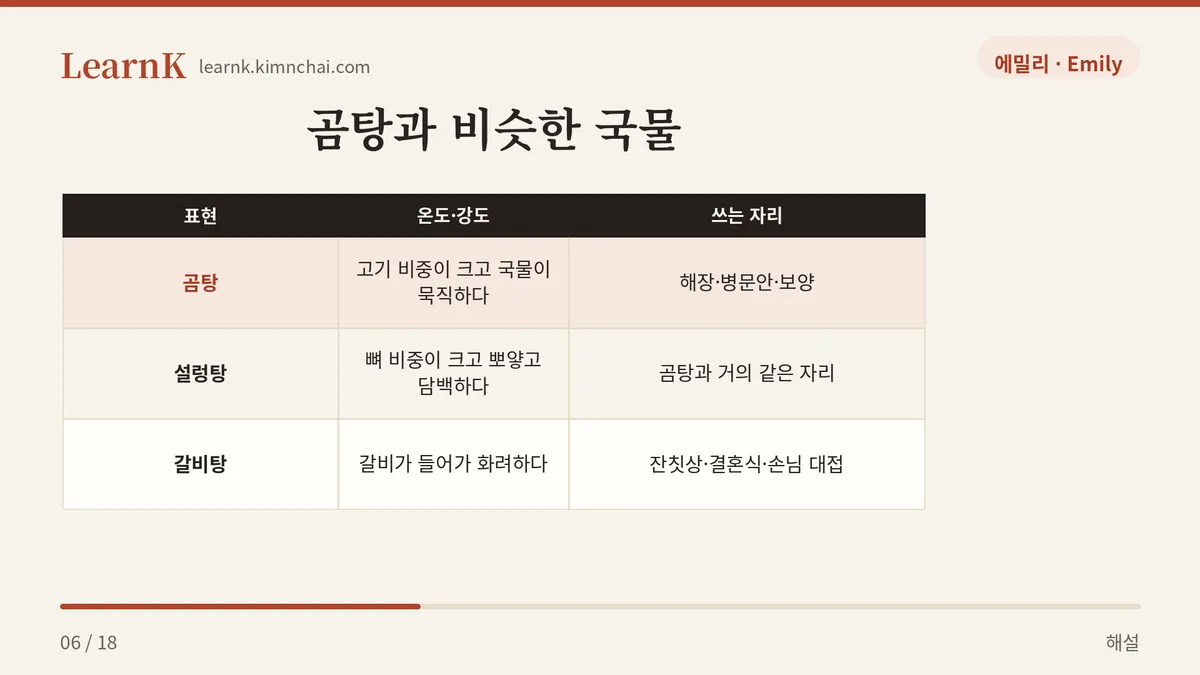
With elders, use 드시다 (deusida) or 잡수시다 (japsusida) instead of 먹다 (meokda, “to eat”). The differences between the similar soup dishes are laid out in the table below.
| Expression | Character & body | Where it’s used |
|---|---|---|
| 곰탕 (gomtang) | Heavy on meat; the broth has real weight to it | Hangover cures, sickbed visits, restorative eating. Stir in rice and it’s a meal |
| 설렁탕 (seolleongtang) | Heavy on bone; milky-white and mild | Almost exactly the same occasions as gomtang. The difference shows up on the shop’s sign |
| 사골국 / 곰국 (sagolguk / gomguk) | Broth simmered at home from bones alone | Home rather than restaurant. Frozen and pulled out as needed |
| 갈비탕 (galbitang) | Made with short ribs — showy, with real meat on the bone | Banquet tables, wedding receptions, entertaining guests |
The line between 곰탕 (gomtang) and 설렁탕 (seolleongtang) shifts by region and by shop, and even Koreans explain it differently from one another. For learners, one practical rule is plenty — both are broths made by boiling beef for a long time, and the diner does the seasoning.
Cultural background — the taste of a night spent simmering
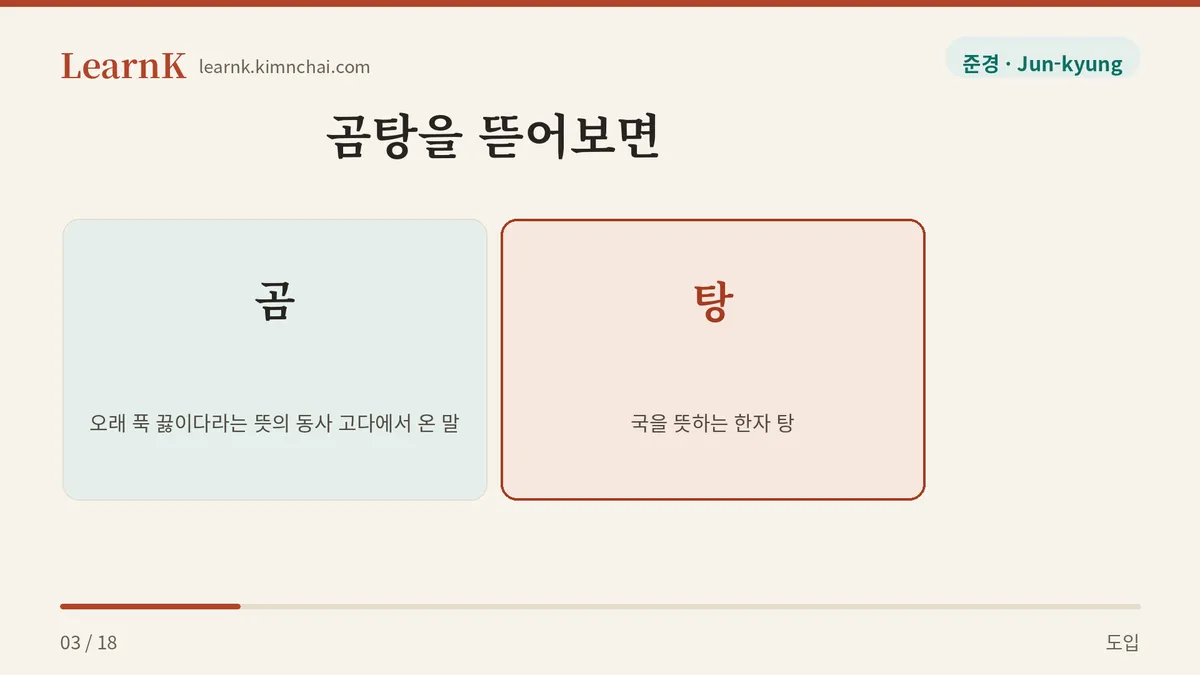
As mentioned above, the 곰 (gom) here isn’t an animal; it comes from the verb 고다 (goda). The 탕 (tang) that follows is the Chinese character 湯, meaning soup. So the name 곰탕 (gomtang) is itself a record of a cooking method: “soup simmered down over a long time.” Dishes with time rather than ingredients embedded in their name are rarer than you’d think.
곰탕 (gomtang) is also a signature menu item of 노포 (nopo, long-established old shops). In Seoul and out in the provinces there are gomtang restaurants that have served the same broth in the same spot for decades, and some have hardened into regional names — like 나주곰탕 (Naju gomtang) from Naju in South Jeolla Province. The interiors of these places are usually plain. The side dishes amount to 깍두기 (kkakdugi) and 김치 (kimchi), and customers empty their bowls in fifteen minutes without a word and head out.
At home, too, 곰탕 (gomtang) occupies a special place. Ahead of a holiday or an ancestral rite, or when a child is facing an exam or leaving for military service, out comes the big pot and the bones simmer all night long. When that smell soaks into the house, the family knows: something important is happening. Once it’s done, the broth gets divided into containers and stashed in the freezer, and sometimes shipped off to a child living far away. Korean dramas often show a mother opening the fridge in her son’s tiny rented room to check on the frozen containers of broth — and what the camera lands on is usually this, 곰탕 (gomtang). What’s inside that container is how a generation that doesn’t say “I love you” out loud says it.
So if someone tells you, “곰탕 끓여 놨으니까 와서 먹어” (“I’ve made gomtang, so come over and eat”), that’s more than a dinner invitation. It means they spent a whole night on you.
Today’s quiz
Your friend has been down with a cold for days. You show up at their place with gomtang in hand. What’s the most natural thing to say?
① 곰탕 사 왔어. 밥 조금 말아서 좀 먹어 봐. (I bought some gomtang. Stir in a little rice and try to eat.) ② 곰탕 사 왔어. 반찬으로 조금씩 먹어. (I bought some gomtang. Have a bit of it as a side dish.) ③ 곰탕 사 왔어. 곰 고기라 금방 힘날 거야. (I bought some gomtang. It’s bear meat, so you’ll get your strength back fast.)
Answer: ①
② mistakes 곰탕 (gomtang) for a soup served on the side. 곰탕 (gomtang) becomes a full meal the moment you stir rice into it, so it doesn’t sit well with the word 반찬 (banchan, “side dish”). ③ is the classic misunderstanding covered in this post — the 곰 (gom) in 곰탕 (gomtang) isn’t the animal, but comes from 고다 (goda), “to simmer long and slow.” Pairing it with 밥을 말다 (bab-eul malda) as in ① is the most Korean-sounding option of all.
Definitions and example sentences are from the National Institute of Korean Language’s Basic Korean Dictionary (krdict.korean.go.kr); that portion of this post, including our translations, is licensed under CC BY-SA 2.0 KR.