굳이 (guji): The Quiet Feelings Koreans Tuck Into One Little Word
굳이
When you watch Korean dramas or variety shows, there’s a word you hear remarkably often yet find surprisingly hard to pin down. Today’s expression, 굳이 (guji), is exactly that kind of word. Someone who receives a gift says “굳이 뭘 이런 걸 사 왔어” (you really didn’t have to buy something like this), and someone who wants to skip a gathering says “내가 굳이 거기까지 가야 해?” (do I really have to go all the way there?). On the surface these sound like polite refusals or reluctance, but underneath them are mixed feelings of apology and gratitude toward the other person — and sometimes a quiet streak of stubbornness. That’s why 굳이 is a word you can only half-use if you just memorize its meaning; you have to feel its temperature to truly master it.
Meaning and Nuance
굳이 (guji) is used with two main shades. The first is “with effort, on purpose” (애써서, 일부러). This is when you pour your heart and effort into something you didn’t have to do. It’s this shade both when you express gratitude — “굳이 시간을 내서 와 줬다” (you took the trouble to make time and came) — and when you point out that something is unnecessary — “굳이 그렇게까지 할 필요 있어?” (do you really need to go that far?). The second is “stubbornly, digging in” (고집을 부려서). You use it when someone pushes ahead with their own way even after being told not to: “굳이 그 길로 가겠다고 우겼다” (he insisted on going that way no matter what).
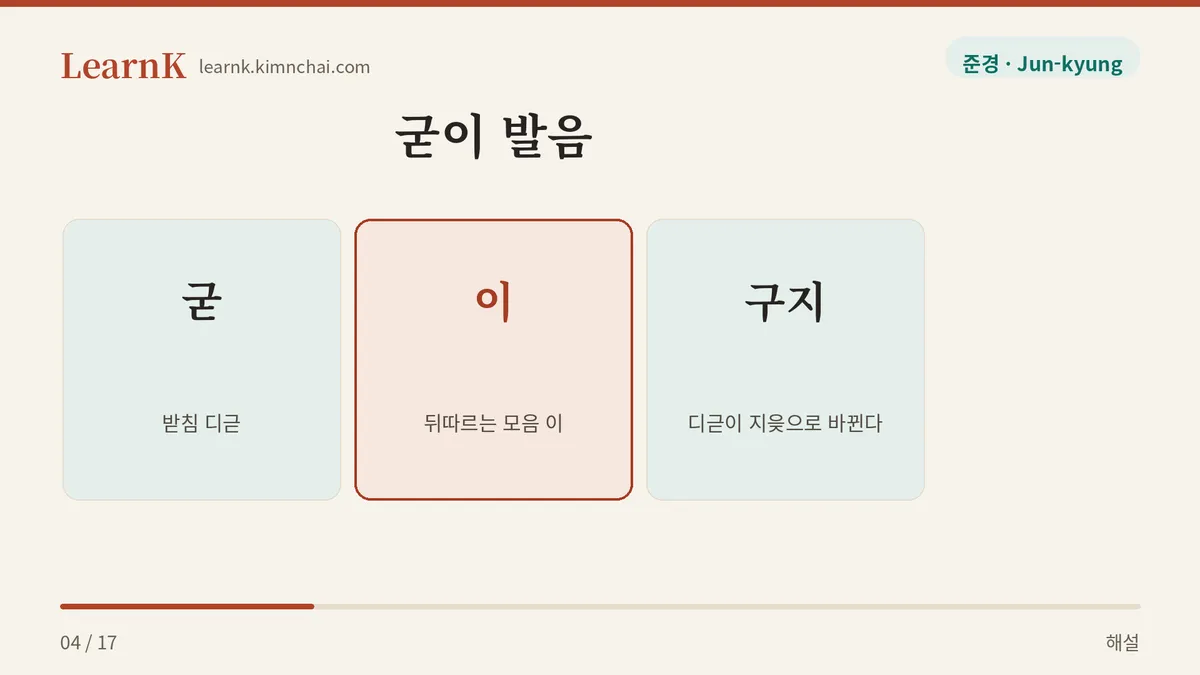
One note on pronunciation. ‘굳이’ is not read letter-by-letter as [구디]; it sounds like [구지] (guji). This is because of palatalization (구개음화): the final consonant ㄷ meets the following ‘이’ and shifts into ㅈ.
Checking the National Institute of Korean Language Dictionary
굳이 「부사」 (adverb)
- 마음을 써서 일부러. (in the manner of taking trouble / あえて / a propósito / 有意地)
- 고집을 부려서. (obstinately, persistently / どうしても / obstinadamente / 执意) — National Institute of Korean Language, Basic Korean Dictionary (krdict.korean.go.kr)
The dictionary doesn’t list a Portuguese definition, so we’re adding our own — 굳이 ≈ de propósito (sense 1), teimosamente (sense 2). Now let’s look at a few of the real usage examples the dictionary provides.
유민이는 굳이 시간을 내서 자신의 졸업식에 참석해 준 삼촌이 고마웠다. (Yumin was grateful to her uncle, who went out of his way to make the time to attend her graduation.) — National Institute of Korean Language, Basic Korean Dictionary (krdict.korean.go.kr)
This means the busy uncle deliberately carved out time to be somewhere he didn’t have to be. It’s a textbook use of the first shade — the “with effort” that carries gratitude.
그는 이곳에 더 머물렀다 가라는 나의 권유를 굳이 마다하고 길을 떠났다. (He flatly declined my suggestion to stay a while longer and set off on his way.) — National Institute of Korean Language, Basic Korean Dictionary (krdict.korean.go.kr)
Here’s a scene where, even as I hold him back and urge him to stay longer, he insists on declining and leaves. This is the second shade — the stubbornness you feel in “굳이 마다하다 (to flatly refuse).”
나는 집에 무슨 일이 있는지 친구들에게 굳이 알리고 싶지 않았다. (I didn’t particularly want to go out of my way to let my friends know what was going on at home.) — National Institute of Korean Language, Basic Korean Dictionary (krdict.korean.go.kr)
“굳이 ~하고 싶지 않다 (I don’t particularly want to ~)” creates the nuance of passively keeping your distance — “I don’t really care to go that far.”
‘굳이’가 [구지]로, ‘해돋이’가 [해도지]로 소리 나는 것입니다. (This is why ‘굳이’ sounds like [구지] and ‘해돋이’ sounds like [해도지].) — National Institute of Korean Language, Basic Korean Dictionary (krdict.korean.go.kr)
The dictionary backs up the pronunciation rule we mentioned earlier with its own example.
Seeing It in a Real Conversation
Situation: Jun-kyung’s housewarming at his new place. Emily has just arrived and holds out a bundle of toilet paper rolls.
Jun-kyung: 어서 와! 근데 이게 다 뭐야, 굳이 뭘 이런 걸 사 와. Welcome! But what’s all this — you really didn’t have to buy stuff like this.
Emily: 집들이엔 휴지지. 이거 사러 굳이 두 정거장 더 걸었잖아, 칭찬해 줘. A housewarming calls for toilet paper. I even walked two extra stops just to get it — give me some credit.
Jun-kyung: 아이고, 그걸 뭐 하러. 그냥 몸만 와도 되는데. Oh come on, why go to the trouble. You could’ve just shown up empty-handed.
Emily: 됐고, 집 구경이나 시켜 줘. 우와, 저 창문 봐. Never mind that, just give me the tour. Whoa, look at that window.
Jun-kyung: 굳이 이 동네까지 온 이유가 저 창문 하나야. The one reason I bothered moving all the way to this neighborhood is that window.
Emily: 인정. 이건 굳이 여기 살 만하네. Fair enough. This is worth going out of your way to live here for.
Example Sentences by Situation
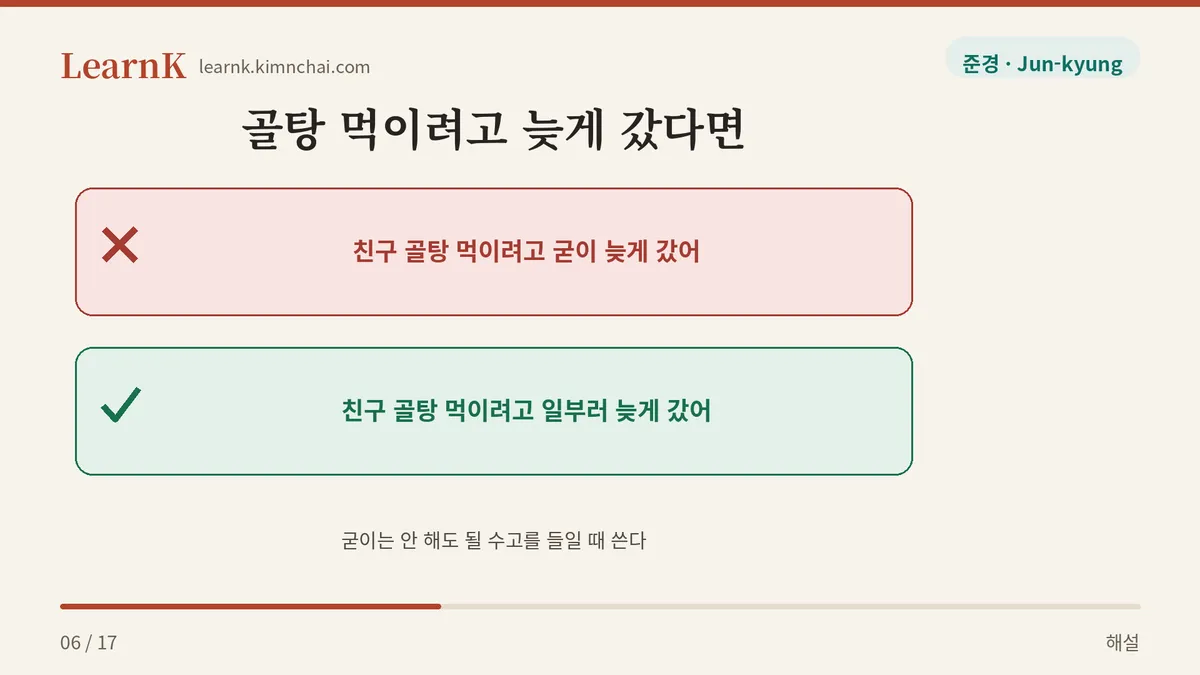
- Wrapping up a meeting — “이 부분은 다들 아시는 내용이라 굳이 (guji) 설명 안 드릴게요.” → A polite way of skipping an unnecessary repeat: “Since everyone already knows this part, I won’t bother explaining it.”
- To a thoughtful friend — “비 오는데 굳이 (guji) 데리러 나와 줘서 고마워.” → Thanks offered to someone who took on trouble they didn’t have to: “Thanks for coming out to pick me up in the rain when you didn’t have to.”
- Mulling over a purchase — “멀쩡한데 굳이 (guji) 새로 살 필요 있을까?” → Talking to yourself, asking whether the spending is really necessary: “It still works fine — do I really need to buy a new one?”
Formal vs. Casual Speech, and Similar Words
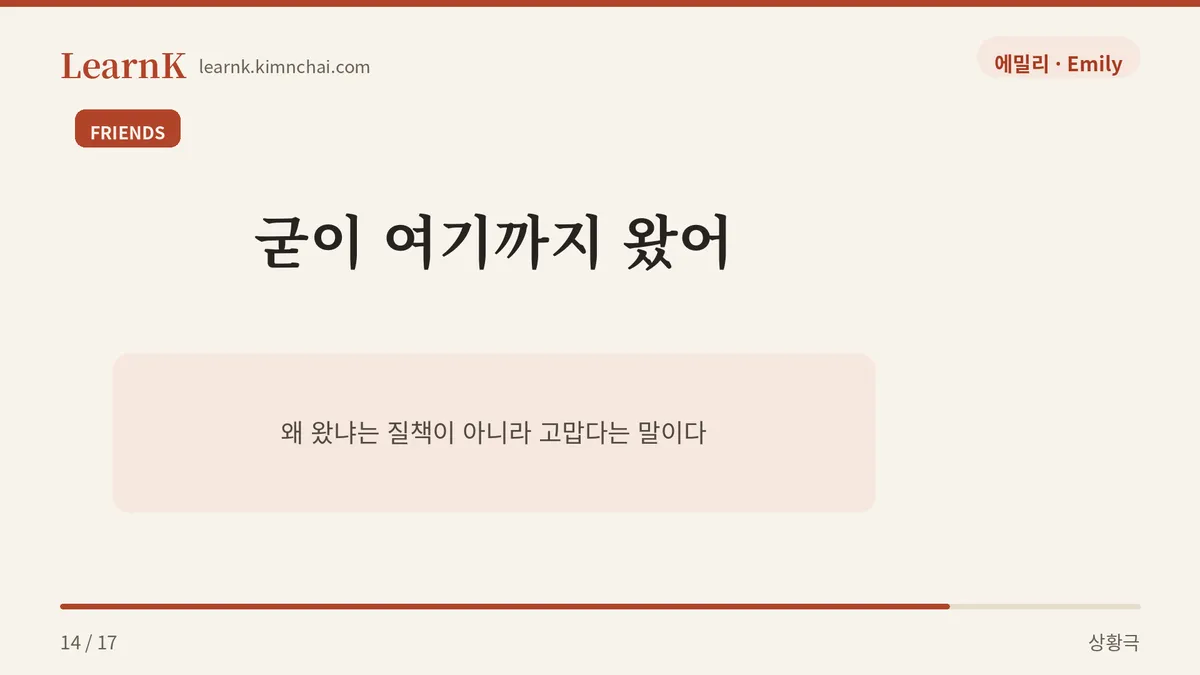
Since 굳이 is an adverb, its form doesn’t change. In formal speech you say “굳이 안 하셔도 돼요 (you really don’t have to),” and in casual speech “굳이 그럴 것까진 없어 (there’s no need to go that far)” — you only swap out the predicate that follows.
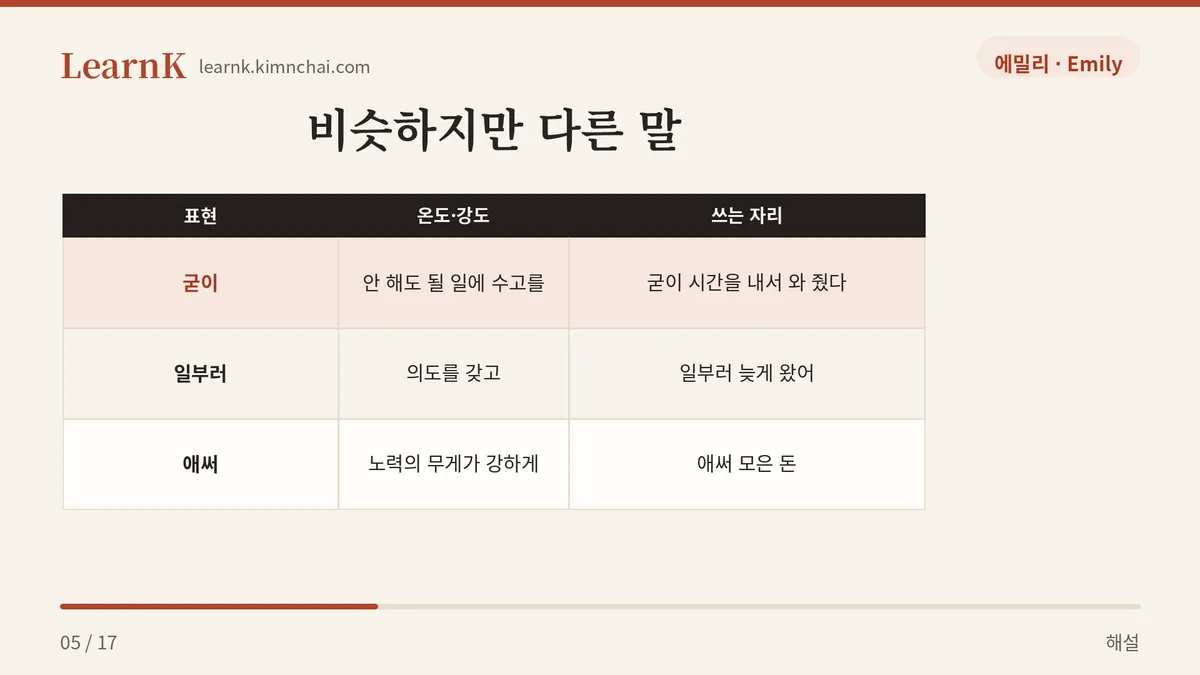
Similar words each carry a slightly different shade. 일부러 (ilbureo) is closer to “with intent” (e.g., 일부러 늦게 왔어 — I came late on purpose), and 구태여 (gutaeyeo) means almost the same as 굳이 but is a touch more literary. 애써 (aesseo) carries a stronger weight of effort — “taking pains to.” Of these, 굳이 is the most everyday, and its distinguishing feature is the built-in questioning nuance of “do you really need to go that far?”
Cultural Background — “왜 굳이? (why bother?)”
In Korean online conversation these days, “왜 굳이? (wae guji?)” is used almost like a meme. Tossed out when you can’t quite understand someone’s choice, this short phrase carries both a genuine question — “is there really a reason to go that far?” — and a bit of gentle teasing. Characters in dramas often use it too, holding back a warm-hearted person who’s overextending for their sake: “굳이 그러지 마 (don’t go to the trouble).” On the surface it’s a refusal, but inside it hides gratitude — a word that beautifully captures the temperature of Korean expression.
Today’s Quiz
A friend has come to visit you while you’re sick, bringing along some medicine. You’re grateful, but you also feel they really didn’t have to go that far. Fill in the blank with that feeling in mind.
“바쁠 텐데 ____ 여기까지 와 줘서 정말 고마워.” (Answer: 굳이 (guji))
Definitions and example sentences are from the National Institute of Korean Language’s Basic Korean Dictionary (krdict.korean.go.kr); that portion of this post, including our translations, is licensed under CC BY-SA 2.0 KR.