Gukmul (국물) — Why Koreans Say "Refreshing" While Drinking Something Scalding Hot
If you ever eat a meal with Koreans in winter, there’s a phrase you’ll almost certainly hear: “국물부터 한 숟갈 떠 봐 (gungmulbuteo han sutgal tteo bwa)” — “Try a spoonful of the broth first.” Not the meat, not the noodles — why the liquid first? Because on a Korean table, that liquid isn’t a side note; it’s the thing that makes or breaks the dish. Look at restaurant reviews and the first thing people praise is “국물이 진하다 (gungmuri jinhada)” — “the broth is rich” — or “국물이 깔끔하다 (gungmuri kkalkkeumhada)” — “the broth is clean-tasting.” Today we’re following this one word all the way down.
국물 (gukmul)
Meaning and Nuance

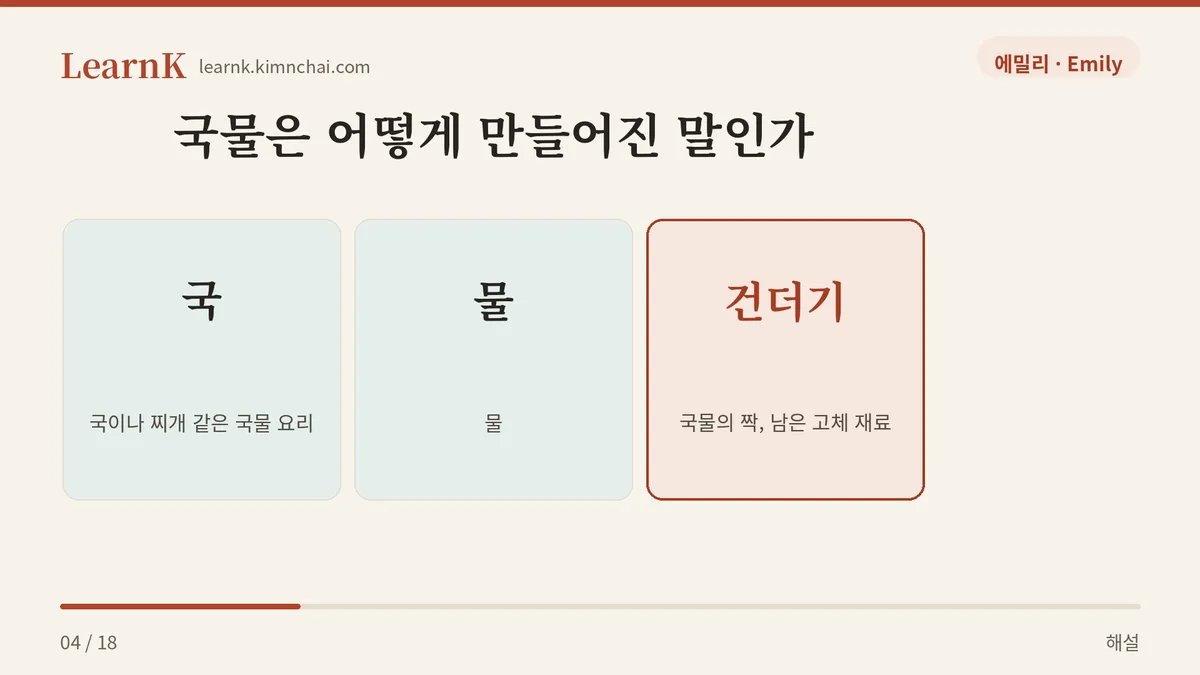
국물 (gukmul) combines 국 (guk, soup/stew) and 물 (mul, water). It refers to the liquid left behind — with the solid ingredients removed — from dishes simmered in water, like guk, jjigae, tang, or jeongol. It overlaps with the English words “broth” or “stock,” but its range is wider: ramen broth, kimchi-jjigae broth, fish-cake broth — any liquid from an already-finished dish gets called gukmul.
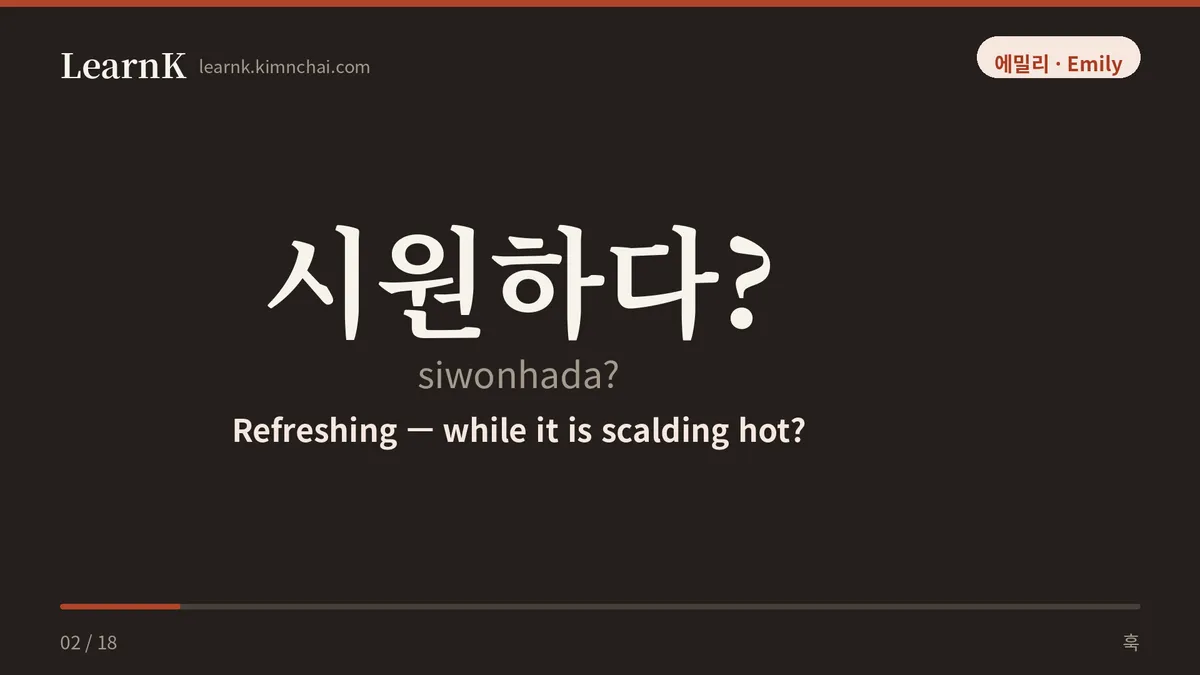
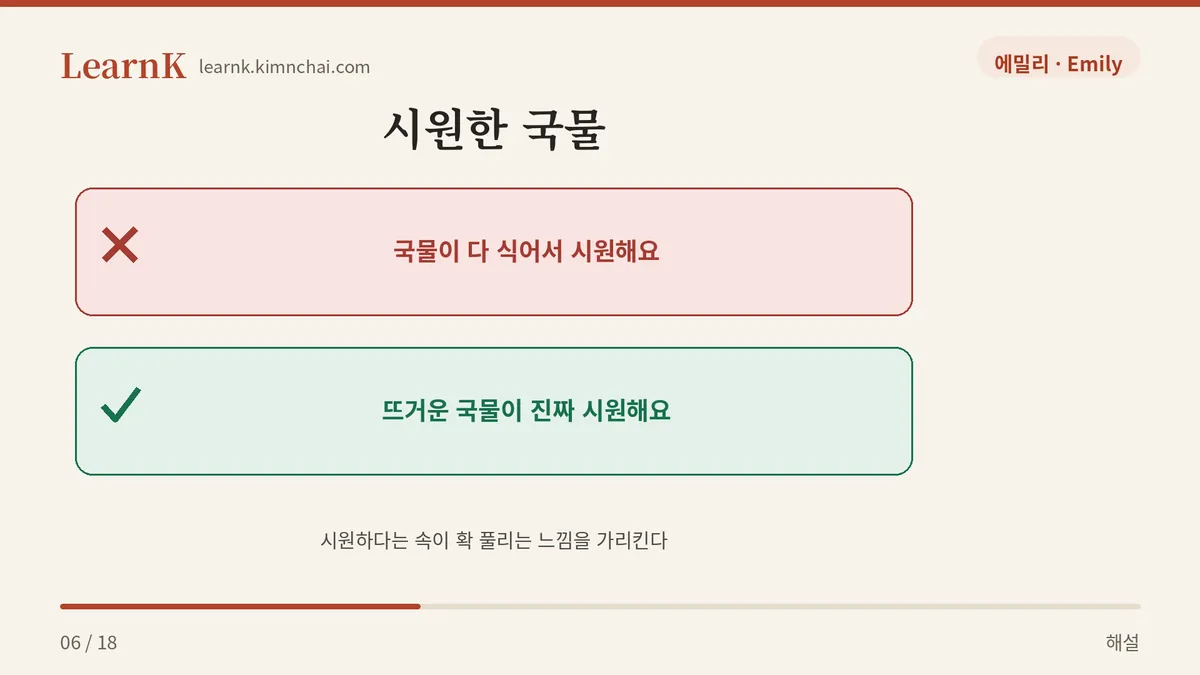
The core sense is “the part where all the dish’s flavor has dissolved.” That’s why adjectives like 진하다 (jinhada, rich/strong), 깔끔하다 (kkalkkeumhada, clean-tasting), and 시원하다 (siwonhada, refreshing — literally, “it clears you out”) attach to it. When someone drinks piping-hot hangover soup and says “어우, 시원하다 (eou, siwonhada)” — “ahh, that’s refreshing” — they’re not talking about temperature at all; they mean the feeling of your insides clearing up. Understand this one sentence and you’re already halfway to shedding the “language learner” look.
Checking the National Institute of Korean Language Dictionary
국물 「명사」
- 국이나 찌개 등의 음식에서 건더기를 빼고 남은 물. [en] broth, stock, or soup — Broth or stock, which is the liquid part of a soup or jjigae, stew left after all ingredients have been taken out. [ja] しる・つゆ【汁】。だし【出し】 — 汁物や鍋物などの料理で具を除いて残るスープ。 [es] sopa, caldo — Líquido que queda después de retirar los ingredientes sólidos de un hervido. [zh] 汤水,汤汁 — 在清汤或浓汤等食物里,除去汤料以外剩下的水。 — National Institute of Korean Language, Basic Korean Dictionary (krdict.korean.go.kr)
(The dictionary has no Portuguese definition listed, so the following is our editorial team’s own translation: caldo — o líquido que resta de uma sopa ou ensopado depois de retirados os ingredientes sólidos.)
국물 「명사」 2. (속된 말로) 어떤 일의 대가로 다소나마 생기는 이득이나 부수입. [en] crumb — (slang) A small profit or supplementary income earned for a certain service [ja] よとく【余得】。よろく【余禄】 — ある事への見返りとして多少でも得られる利得や副収入を俗にいう語。 [zh] 油水,甜头 — (粗俗)作为某事的代价,多少产生的利益或其他收入。 — National Institute of Korean Language, Basic Korean Dictionary (krdict.korean.go.kr)
So a word that started with food stretched into a meaning close to “extra perks” or “a cut of the profit.” Let’s look at how the dictionary shows the word actually being used.
이 진한 국물에 쫄깃한 면발, 정말 맛있다! — National Institute of Korean Language, Basic Korean Dictionary (krdict.korean.go.kr)
Picture someone mid-bite of kalguksu or ramen, chopsticks still in hand, gushing with delight. It’s a classic flavor compliment that praises the broth’s richness and the noodles’ chewy texture in the same breath.
추운 날씨에는 입에 감치는 따끈한 국물이 당긴다. — National Institute of Korean Language, Basic Korean Dictionary (krdict.korean.go.kr)
Here 당기다 (danggida, to crave) shows up. It’s a sentence that links season to appetite — when the weather turns cold, the body reaches for hot broth before the mind even decides to.
나도 속이 안 좋아서 깔끔한 국물을 마시고 싶다. — National Institute of Korean Language, Basic Korean Dictionary (krdict.korean.go.kr)
Here “깔끔한 (kkalkkeumhan)” means not greasy — light and clean. It reveals something telling: when their stomach feels off, Koreans reach for clear broth before they reach for rice porridge.
나는 배가 불러 국물만 먹고 건더기는 남겼다. — National Institute of Korean Language, Basic Korean Dictionary (krdict.korean.go.kr)
This sentence pairs gukmul precisely against 건더기 (geondeogi, the solid ingredients). Memorize this pair together and both the menu and the dinner-table conversation open right up.
Seeing It in Real Dialogue
Scene: A snowy December evening, in front of a fish-cake street stall at the market. Both are standing with gloved hands wrapped around paper cups.
Jun-kyung: 야, 국물 먼저 한 모금 마셔. 손 시린 거 싹 풀려. Hey, take a sip of the broth first. It’ll melt the cold right out of your hands.
Emily: 어우 뜨거— 근데 진짜 시원하다. Ooh, hot— but wow, that’s so refreshing.
Jun-kyung: 그치? 뜨거운데 시원하다는 말, 이제 몸으로 알겠지. Right? Now you get “hot but refreshing” in your bones.
Emily: 사장님, 국물 한 컵만 더 주세요! Excuse me, could I get one more cup of broth?
Jun-kyung: 야, 어묵도 좀 사. 국물만 축내면 어떡해. Hey, buy some fish cake too. You can’t just drain the broth.
Emily: 아 맞다, 두 개요! 나 아무것도 안 시켰으면 진짜 국물도 없었겠네. Oh right, two please! If I hadn’t ordered anything, I’d have gotten nothing at all.
Example Sentences by Situation
① Asking for a refill at a restaurant 국물 좀 더 주실 수 있을까요? (gukmul jom deo jusil su isseulkkayo?) — “Could I get a bit more broth?” This is the sentence you’ll hear most at budae-jjigae or fish-cake places. Adding “좀 (jom)” softens the request from a demand into a favor.
② When the taste needs help 국물이 좀 싱거운데, 소금 있어요? (gukmuri jom singgeounde, sogeum isseoyo?) — “The broth’s a bit bland — do you have salt?” This extends the dictionary’s example sentence “국물이 좀 싱거운데” into an actual restaurant situation. Ending with -는데 (-neunde) makes it sound like a muttered aside rather than a complaint — much safer.
③ When you came away with nothing (meaning 2) 그 프로젝트는 국물도 없었어. (geu peurojekteuneun gukmuldo eopseosseo.) — “That project got us nothing.” It means all the effort went in and nothing came back out. A line coworkers trade all the time.
Formal vs. Casual Speech, and a Similar Word
The same request changes clothes depending on who you’re talking to. To a friend: 국물 좀 더 줘 (gukmul jom deo jwo). To a shop owner or an elder: 국물 좀 더 주세요 (gukmul jom deo juseyo).
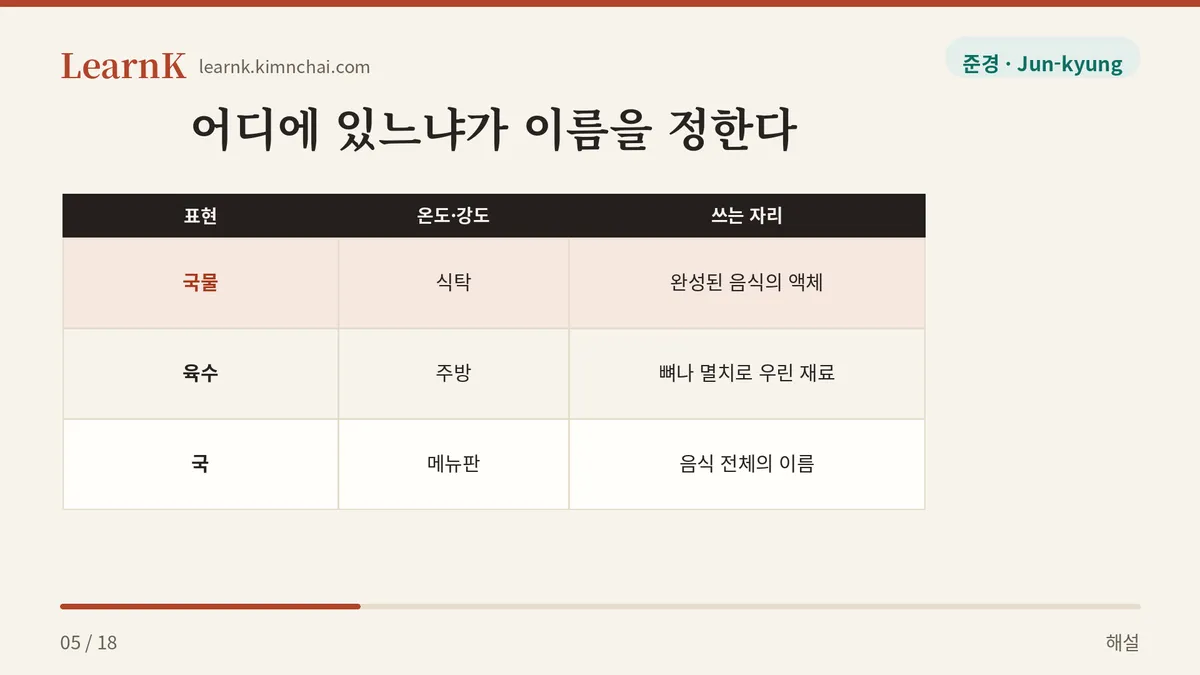
An easy word to confuse it with is 육수 (yuksu, stock/broth base). Yuksu is the broth at the ingredient stage — simmered from bones or dried anchovies — while gukmul refers to the liquid once it’s in the bowl, part of a finished dish. In the kitchen, you make yuksu; at the table, you drink gukmul. And 국 (guk) is the name for the whole dish, while gukmul refers only to its liquid part.
Cultural Background
One of the things foreign visitors are most often surprised by on Korean winter streets is fish-cake broth being handed out free in paper cups. Gukmul is less a product for sale than warmth passed to whoever happens to be standing there with you. The same emotional thread runs through reaching for 해장국 (haejangguk, hangover soup) the morning after drinking, and through simmering clear broth — rather than rice porridge — for someone who’s sick. Korean dramas often show a character sitting silently in front of a bowl of gukbap, saying nothing at all — and without a single line of dialogue, it reads as “this person needs comfort right now.” Gukmul works that way: an emotional language that needs no subtitles.
Quick Quiz
A friend tells you they worked a ton of overtime and didn’t get paid a single won extra for it. Which response fits?
- 국물이 진했겠다.
- 국물도 없었네.
- 국물이 싱거웠구나.
The answer is #2. “국물도 없다” means there was no profit left over at all as compensation. #1 is a compliment about flavor, and #3 means the seasoning was weak — neither fits the situation.
Definitions and example sentences are from the National Institute of Korean Language’s Basic Korean Dictionary (krdict.korean.go.kr); that portion of this post, including our translations, is licensed under CC BY-SA 2.0 KR.